
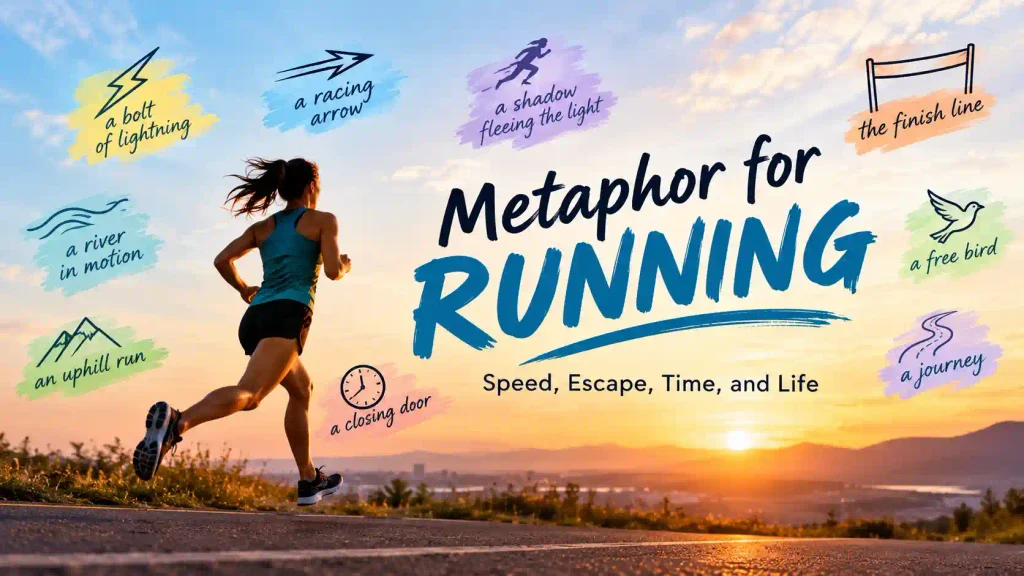
Metaphor for Running: 25 Powerful Metaphors for Speed, Escape, Time, and Life
A metaphor for running turns movement into a vivid idea. Instead of simply saying someone runs fast, you might describe them as a bolt of lightning, a racing arrow, or a runaway train. Running can also symbolize escape, freedom, ambition, pressure, progress, or the passage of time.
The best metaphor depends on what you want running to mean. A marathon suggests endurance, a finish line represents a goal, and running out of time turns movement into urgency. For creative writing, these distinctions matter because the image should match the emotion behind the action.
Quick Answer
A strong metaphor for running is “running is a river in motion.” It suggests continuous, flowing movement. For speed, “he was a bolt of lightning” creates a sharper image. And for escape, “she was a shadow fleeing the light” suggests urgency and fear. For life, “life is a marathon” represents patience and endurance. The best metaphor depends on whether you want to emphasize speed, freedom, escape, struggle, progress, or time.
Best Metaphors for Running
Rather than giving you dozens of nearly identical images, these metaphors cover different meanings and writing situations.
1. A River in Motion
This metaphor presents running as smooth, continuous movement.
Example: His stride was a river in motion, steady and impossible to interrupt.
Best for: Poetry, descriptive writing, endurance, and graceful movement.
2. A Bolt of Lightning
Lightning represents sudden, explosive speed.
Example: She became a bolt of lightning as soon as the starting signal sounded.
Best for: Sprinting, sports writing, and dramatic action.
3. A Racing Arrow
An arrow suggests speed combined with direction.
Example: He was a racing arrow aimed at the finish line.
Best for: Focus, determination, and purposeful movement.
4. A Runaway Train
A runaway train suggests enormous momentum and difficulty stopping.
Example: Once he found his rhythm, he was a runaway train.
Best for: Relentless movement and unstoppable momentum.
5. A Burning Engine
An engine represents power, while “burning” adds intensity.
Example: Her legs were a burning engine carrying her through the final mile.
Best for: Effort, energy, endurance, and determination.
6. A Drumbeat
A runner’s repeated footsteps can become a metaphorical drumbeat.
Example: His footsteps became a drumbeat on the empty road.
Best for: Rhythm, repetition, and atmospheric writing.
7. A Free Bird
A bird can represent movement without restraint.
Example: On the open trail, she was a free bird.
Best for: Freedom, joy, escape, and outdoor running.
8. A Storm
A storm suggests force, intensity, and movement.
Example: The runners swept through the street like a storm of energy.
Best for: Crowds, races, dramatic scenes, and powerful movement.
9. A Marathon
A marathon works as a metaphor for something requiring patience and sustained effort.
Example: Building a career is a marathon, not a sprint.
Best for: Life, education, work, recovery, and long-term goals.
10. A Sprint
A sprint represents a short period of intense effort.
Example: Finishing the project became a sprint toward the deadline.
Best for: Work, deadlines, short-term challenges, and urgency.
11. The Starting Line
The starting line can represent a new beginning.
Example: Graduation placed her at the starting line of a completely different life.
Best for: New chapters, opportunities, transitions, and fresh starts.
12. The Finish Line
The finish line represents a destination or goal.
Example: He kept the finish line in his mind whenever the training became difficult.
Best for: Achievement, ambition, perseverance, and goals.
13. An Uphill Run
An uphill run represents difficulty and increased effort.
Example: Rebuilding the company after the loss was an uphill run.
Best for: Setbacks, challenges, difficult periods, and adversity.
14. A Road Unfolding Beneath Your Feet
This metaphor connects running with progress and discovery.
Example: Each mile was another piece of the road unfolding beneath her feet.
Best for: Personal growth, travel, reflective writing, and life transitions.
15. A Conversation With the Body
Running can become a metaphor for listening to physical and emotional signals.
Example: Every run was a conversation with his body.
Best for: Reflective writing and personal essays.
Metaphors for Running Fast
If your main goal is speed, choose an image that already suggests acceleration, force, or rapid movement. Current search results repeatedly use rockets, lightning, bullets, arrows, animals, wind, trains, and machines for this purpose.
16. A Rocket on the Track
A rocket suggests rapid acceleration and enormous speed.
Example: He was a rocket on the track, leaving the field behind him.
17. A Flash of Lightning
This image emphasizes suddenness as well as speed.
Example: She crossed the final stretch as a flash of lightning.
18. A Racing Bullet
A bullet creates an image of fast, direct movement.
Example: The runner was a racing bullet heading toward the finish.
19. A Cheetah
A cheetah can represent exceptional speed and athletic ability.
Example: On the final lap, he became a cheetah.
20. The Wind With a Pulse
This original metaphor combines speed with flowing movement.
Example: She moved across the trail like the wind with a pulse.
It works particularly well when you want something less predictable than the usual rocket or lightning comparison.
What Is a Metaphor for Running Fast?
A metaphor for running fast directly identifies the runner or the running action with something associated with extraordinary speed.
For example:
He was a rocket on the track.
The runner is not literally a rocket. The metaphor communicates rapid acceleration and speed.
Other strong choices include:
- A bolt of lightning — explosive speed
- A racing arrow — speed with direction
- A rocket — acceleration and power
- A bullet — extremely rapid movement
- A cheetah — athletic speed
- A runaway train — speed combined with unstoppable momentum
- A storm — speed combined with force
One important distinction: “He ran like a rocket” is a simile, not a direct metaphor, because it uses “like.” A metaphor would be “He was a rocket on the track.” Current metaphor-focused search results make this distinction central to their explanations as well.
Metaphor for Running Away
Running away carries a different meaning from simply running fast. It can suggest fear, escape, avoidance, freedom, survival, or leaving something behind.
Here are stronger metaphors for that meaning.
A Shadow Fleeing the Light
This metaphor suggests someone escaping something they do not want to face.
Example: He was a shadow fleeing the light, disappearing before anyone could reach him.
A Door Bursting Open
This image focuses on escape rather than physical speed.
Example: Her decision was a door bursting open after years of confinement.
A Prisoner Breaking the Chain
This metaphor makes running away represent freedom.
Example: He ran from the town like a prisoner breaking his chain.
A Deer Before the Storm
This metaphor suggests instinctive escape from danger.
Example: She fled like a deer before the storm.
A Boat Cutting Its Anchor
This original metaphor focuses on leaving something behind.
Example: Running away felt like a boat cutting its anchor and entering open water.
What Does Running Away Symbolize?
In literature and creative writing, running away can symbolize escape, freedom, avoidance, fear, survival, or the search for a new life. The meaning depends on the surrounding story. Running toward something usually creates a different interpretation from running away from something.
For example:
- Running away from danger can symbolize survival.
- Running away from home can symbolize independence.
- Running away from a relationship can symbolize avoidance.
- Running toward a destination can symbolize ambition.
- Running toward freedom can symbolize transformation.
So when you choose a metaphor for running away, first determine whether the character is escaping something or pursuing something.
Metaphor for Running Out of Time
“Running out of time” is already an established metaphorical expression. Time does not literally run, but English commonly describes limited time as something that can be spent, lost, saved, borrowed, or run out.
You can build on that idea with metaphors such as:
The Clock Is a Closing Door
Example: The deadline was a closing door, and every second brought it nearer.
Time Is a Vanishing Road
Example: Time was a vanishing road disappearing behind her with every step.
The Hourglass Is Emptying
Example: The hourglass was emptying, and the final decision could not wait.
The Finish Line Is Moving Closer
Example: With every passing minute, the finish line moved closer.
For everyday writing, however, “running out of time” is usually clearer than replacing it with an elaborate metaphor.
What Is the Symbolism of Running?
Running can symbolize different things depending on context.
Freedom
Running into an open landscape can represent independence or release.
Escape
Running away from danger can represent survival or the desire to leave a difficult situation.
Progress
Moving forward can symbolize personal development.
Ambition
Running toward a finish line can represent pursuit of a goal.
Struggle
An uphill run can represent obstacles and difficult circumstances.
Time
A race or finish line can represent deadlines, aging, or the limited nature of time.
Transformation
Leaving one place and moving toward another can represent a major change in identity or circumstances.
This is why running works so well as a literary symbol: the same physical action can communicate completely different ideas depending on direction, destination, speed, environment, and emotional context.
What Can I Say Instead of Running?
If you simply need another word for running, choose according to the type of movement you mean.
| Instead of “running” | Meaning or Tone |
| Jogging | Slow, steady running |
| Sprinting | Very fast running |
| Dashing | Fast, energetic movement |
| Racing | Competitive or very fast movement |
| Bolting | Sudden, rapid escape |
| Fleeing | Running away from danger |
| Charging | Forceful forward movement |
| Rushing | Moving quickly because of urgency |
| Hurrying | Moving faster because time is limited |
| Bounding | Large, energetic steps |
| Striding | Long, confident steps |
| Scurrying | Quick, small movements |
| Stampeding | A large group moving suddenly and forcefully |
For fiction, don’t replace “running” automatically. A precise verb often creates a stronger image than a complicated metaphor.
Compare:
She was running down the street.
with:
She bolted down the street.
The second sentence immediately suggests urgency.
What Is Slang for Running?
Running slang depends on whether you mean casual language or technical running terminology.
Common running-related terms include:
- PR — personal record
- PB — personal best
- DNF — did not finish
- DNS — did not start
- Easy run — a deliberately comfortable run
- Long run — a longer training session
- Tempo run — sustained running at a controlled, challenging pace
- Shakeout run — a short, easy run, often used before or after a harder effort
- Strides — short, controlled faster runs often used during training
- Bonk — a sudden drop in energy during endurance exercise
- Hit the wall — reaching a point of severe fatigue during a long effort
Running terminology can vary between casual runners, coaches, racing communities, and regions. Running glossaries commonly distinguish training terms such as tempo runs, strides, and race terminology such as chip time and cutoffs.
For casual slang, “dash,” “bolt,” “take off,” “book it,” and “tear off” can describe moving away quickly, although they do not all specifically mean sustained running.
What Is a Good Motto for Running?
A good running motto should be short enough to remember and specific enough to motivate.
Here are original motto-style lines suitable for captions, posters, journals, or personal motivation:
- One mile, one step, one more reason to keep going.
- Find your pace. Keep your direction.
- Run the mile you’re in.
- Progress has a pace of its own.
- Keep moving when motivation gets quiet.
- The finish line starts with one step.
- Run your own race.
- Strong legs, steady mind.
- Forward is still progress.
- Every mile teaches something.
“Run your own race” is particularly useful because it works both literally and figuratively. It can describe running while also expressing the idea of focusing on your own progress rather than constantly comparing yourself with others.
What Are Good Running Quotes?
If you need a short line for a caption or article, original wording can often fit better than borrowing a famous quotation.
Try:
“The road doesn’t ask how fast you started; it asks whether you kept moving.”
“Every mile leaves a lesson behind.”
“Run until the distance becomes a memory.”
“Your pace is part of your story.”
“Some finish lines are places. Others are versions of yourself.”
These are original lines for this article, not quotations attributed to famous runners or writers.
For schoolwork or publication, avoid presenting an unattributed sentence as a famous running quote. If you need a quotation from a specific athlete or author, verify the wording and attribution before publishing it.
Why Is Gen Z Obsessed With Running?
The phrase “Gen Z obsessed with running” describes a noticeable cultural trend, but “obsessed” is a broad characterization rather than a precise scientific finding.
Recent data does show a strong rise in running and run-club culture among younger people. Strava’s 2025 Year in Sport report said running remained its most-recorded sport, while Gen Z was 75% more likely than Gen X to say a race or event was their main exercise motivation. The same report said new clubs on Strava nearly quadrupled in 2025, with running clubs increasing 3.5 times.
The social side appears particularly important. Strava’s 2024 report found that 55% of Gen Z respondents said social connection was their top reason for joining a fitness group, compared with 48% overall. It also reported a 59% increase in running clubs on Strava in 2024.
Recent reporting also describes run clubs as social spaces where younger adults combine exercise with friendship, coffee, music, and other activities rather than treating running purely as competitive sport.
So, rather than reducing the trend to a single reason, the available evidence points to several overlapping factors:
- Community: Run clubs provide an easy way to meet people.
- Offline connection: Group running creates an in-person activity in a highly digital culture.
- Fitness: Running is accessible and requires relatively little equipment.
- Personal goals: Races and personal bests provide measurable milestones.
- Identity: Running can become part of someone’s lifestyle and social identity.
- Content culture: Running translates naturally into social-media content, from race preparation to outfits and route sharing.
The important point is that the current running boom is not only about athletic performance. Social connection and community are part of the appeal.
Short Metaphors for Running
If you need a short metaphor for running, these work well:
- A river
- A rocket
- Lightning
- An arrow
- A storm
- A machine
- A drumbeat
- A marathon
- A journey
- Freedom in motion
- For an essay, “running is a journey” is simple and flexible.
- For poetry, “running is a drumbeat” creates stronger sensory imagery.
- For sports writing, “he was lightning” communicates speed immediately.
- For life writing, “life is a marathon” communicates endurance.
Best Metaphor for Running
There is no single best metaphor for every situation.
If you need one general-purpose metaphor, “running is a river in motion” works well because it communicates movement without limiting the idea to speed.
- For running fast, choose “a bolt of lightning.”
- For running away, choose “a shadow fleeing the light.”
- For running out of time, choose “the clock is a closing door.”
- For life and endurance, choose “life is a marathon.”
- For personal progress, choose “running your own race.”
The best metaphor is therefore the one that matches the meaning, not simply the one that sounds the most dramatic.
Metaphor vs. Simile for Running
This distinction is especially important for students.
A metaphor makes a direct comparison:
He was a rocket on the track.
A simile uses “like” or “as”:
He ran like a rocket on the track.
Both create imagery, but they use different grammatical structures.
Another example:
Metaphor:
Her footsteps were a drumbeat.
Simile:
Her footsteps sounded like a drumbeat.
If an assignment specifically asks for a metaphor for running fast, use the direct form rather than automatically adding “like” or “as.”
How to Choose the Right Running Metaphor
Before choosing an image, ask one simple question:
What do I want running to represent?
| If you mean… | Try… |
| Speed | A bolt of lightning |
| Acceleration | A rocket |
| Direction | A racing arrow |
| Momentum | A runaway train |
| Smooth movement | A river in motion |
| Freedom | A free bird |
| Escape | A shadow fleeing the light |
| Fear | A deer before the storm |
| Long-term effort | A marathon |
| Short-term effort | A sprint |
| Difficulty | An uphill run |
| A goal | The finish line |
| A beginning | The starting line |
| Exhaustion | Running on empty |
| Personal growth | Running your own race |
| Urgency | A race against time |
| Limited time | A closing door |
This approach produces stronger writing than simply selecting the most impressive-sounding metaphor.
Frequently Asked Questions
What is a metaphor for running?
A metaphor for running compares running directly with another image or concept. “Running is a river in motion” suggests continuous movement, while “he was a bolt of lightning” emphasizes speed.
What is a metaphor for running fast?
“He was a bolt of lightning” is a strong metaphor for running fast because lightning suggests sudden, powerful speed. Other options include a rocket, racing arrow, bullet, cheetah, and runaway train.
What are the best metaphors for running fast?
Useful choices include a bolt of lightning for explosive speed, a rocket for acceleration, a racing arrow for focused movement, and a runaway train for unstoppable momentum.
What is a metaphor for running away?
“She was a shadow fleeing the light” is an original metaphor for escape. Other possibilities include a boat cutting its anchor for leaving something behind or a prisoner breaking a chain for escaping restriction.
What is a metaphor for running out of time?
“The clock is a closing door” is a strong original metaphor for limited time. The established expression “running out of time” itself is also metaphorical because time does not literally run.
What is the symbolism of running?
Running can symbolize freedom, escape, ambition, progress, struggle, survival, transformation, or the passage of time. The meaning depends on whether the person is running toward something, away from something, or simply moving forward.
What can I say instead of running?
Depending on the context, you can use jogging, sprinting, dashing, racing, bolting, fleeing, charging, rushing, hurrying, bounding, or striding. Each word carries a slightly different meaning.
What is slang for running?
Running-related slang and jargon includes terms such as PR, PB, DNF, DNS, tempo run, easy run, long run, shakeout, strides, bonk, and hit the wall. Casual alternatives for moving quickly include dash, bolt, take off, and book it.
What is a good motto for running?
A strong running motto is “Find your pace. Keep your direction.” Other short original options include “Forward is still progress” and “Run your own race.”
What are good running quotes?
For an original running line, try: “Every mile leaves a lesson behind.” Other original options include “Your pace is part of your story” and “Some finish lines are places. Others are versions of yourself.”
Why is Gen Z so interested in running?
Recent Strava data shows strong Gen Z participation in running, racing, and run clubs. In its 2025 report, Strava said Gen Z was 75% more likely than Gen X to identify a race or event as its main exercise motivation, while running clubs on the platform grew 3.5 times during 2025. Social connection is another important factor: Strava reported that 55% of Gen Z respondents in its 2024 research named social connection as their top reason for joining a fitness group.
Conclusion
A metaphor for running can describe much more than physical movement. Running can become lightning when you want speed, a river when you want flow, a marathon when you want endurance, a closing door when you want urgency, or a shadow fleeing the light when you want escape.
The most effective metaphor depends on the meaning behind the movement.
If you’re describing a runner, choose an image that matches the action. If you’re writing about life, look at what the running represents: a beginning, a struggle, a goal, a deadline, an escape, or a journey.
And if you simply need a better way to say “running,” choose the verb that carries the exact feeling you need. Sprinting, bolting, fleeing, racing, dashing, and striding do more than replace a word—they tell the reader how the movement feels.

Qaiser Abbas is an award-winning author, leadership coach, and motivational speaker known for his work on personal growth, leadership, and human potential. Through his writing and speaking, Qaiser focuses on turning challenges into opportunities and helping people build the mindset to achieve meaningful growth.