
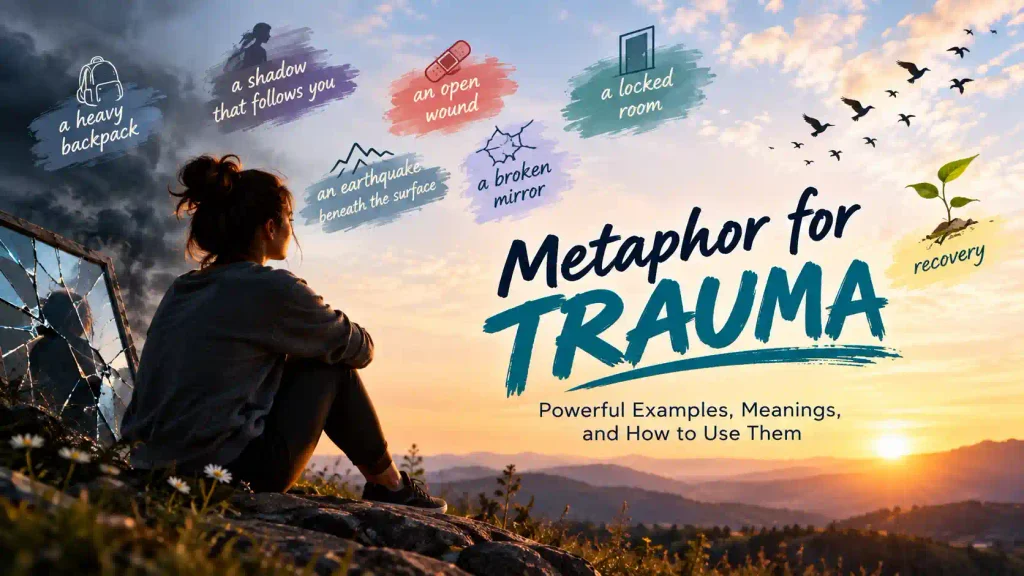
A metaphor for trauma turns an invisible or difficult experience into an image readers can understand. Trauma can be described as an open wound, a shadow, a locked room, a cracked mirror, a heavy backpack, or an earthquake beneath the surface. Each metaphor highlights something different: pain, lingering memories, emotional isolation, burden, fractured identity, or sudden disruption.
The strongest metaphor depends on what you want to communicate. A wound emphasizes pain, an iceberg emphasizes what remains unseen, and a shadow emphasizes how the past can continue to affect the present. No single image captures every person’s experience of trauma.
Quick Answer
A powerful metaphor for trauma is “an old wound that still aches when touched.” It captures the idea that trauma can leave a lasting psychological impact and that reminders can reactivate distress. Other useful metaphors include a shadow that follows you, a locked room, an earthquake beneath the surface, and a heavy backpack you never chose to carry. These are figurative descriptions, not clinical definitions.
The Best Metaphors for Trauma
Here are some of the most useful metaphors for different aspects of traumatic experience. The examples marked Original metaphor were created for this article; the others draw on familiar or commonly used figurative images.
1. An Open Wound
Meaning: Trauma as pain that has not fully healed.
Best for: Essays, emotional writing, poetry, and reflective descriptions.
Example:
The memory was an old wound that still hurt whenever someone touched the subject.
The wound metaphor works because physical wounds give readers an immediate picture of pain, vulnerability, and healing. It can also suggest that a reminder does not create the original injury; it touches something that was already sensitive.
2. A Shadow That Follows You
Meaning: The past continues to affect the present.
Best for: Poetry, personal writing, fiction, and emotional descriptions.
Example:
The experience became a shadow that followed her into places that once felt safe.
This is one of the clearest metaphors for the lingering quality of trauma. However, it should not imply that every trauma survivor feels haunted all the time.
3. A Heavy Backpack
Meaning: An emotional burden someone carries through everyday life.
Best for: Simple explanations, essays, conversations, and educational writing.
Example:
He carried the memory like a heavy backpack that no one else could see.
This metaphor makes an invisible burden concrete. It also allows you to describe differences in intensity: the backpack may feel heavier on some days and lighter on others.
4. A Locked Room
Meaning: Painful memories or emotions that feel difficult to access or discuss.
Best for: Poetry, fiction, therapy-related writing, and introspective essays.
Example:
Her childhood felt like a locked room she was afraid to enter.
The image suggests separation, protection, fear, and emotional distance without claiming that every person processes trauma in the same way.
5. An Earthquake Beneath the Surface
Meaning: An experience that can disrupt a person’s sense of stability even when everything looks normal from the outside.
Best for: Literary writing and deeper explanations.
Example:
He smiled through dinner, but an earthquake was moving beneath the surface.
This metaphor captures the difference between outward appearance and internal distress. It can be especially effective when writing about experiences that other people cannot easily see.
6. A Cracked Mirror
Meaning: Trauma can be represented as a disruption in how someone sees themselves or the world.
Best for: Poetry, fiction, and reflective essays.
Example:
After years of criticism, her image of herself felt like a cracked mirror.
The metaphor works particularly well when the focus is identity, self-perception, or a changed worldview.
7. A Broken Record
Meaning: A memory, thought, or emotional reaction that repeatedly returns.
Best for: Writing about recurring memories or repetitive thoughts.
Example:
The memory played in his mind like a broken record.
This is a familiar metaphor, so it works best when you want clarity rather than originality.
8. A Storm Inside
Meaning: Intense internal emotional turmoil.
Best for: Poetry, fiction, speeches, and emotional writing.
Example:
She looked calm, but a storm was gathering inside her.
Storm imagery communicates emotional intensity quickly. Its weakness is that it is common, so it may sound less original than a more specific image.
9. A House With a Damaged Foundation
Meaning: Trauma as something that can affect a person’s sense of safety or stability.
Best for: Longer essays and explanatory writing.
Example:
The experience felt like damage to the foundation of a house that still had to stand.
This metaphor can communicate why visible problems may not tell the whole story. It should remain figurative rather than implying that every person with trauma has a permanently damaged psychological foundation.
10. A Scar Beneath the Skin
Meaning: Something from the past remains part of a person’s history even after the most visible injury has changed.
Best for: Poetry, essays, and recovery-focused writing.
Example:
The past was a scar beneath the skin—quiet, but still part of her story.
Unlike an open wound, a scar suggests a different stage of the experience. That makes it useful when you want to write about lasting impact without describing the pain as continuously raw.
11. A Minefield
Meaning: Ordinary situations can feel unpredictable or emotionally dangerous because certain reminders may trigger strong reactions.
Best for: Fiction and intense emotional writing.
Example:
Every conversation about the past felt like walking through a minefield.
Use this metaphor carefully. It creates a strong sense of danger and should fit the tone of the writing rather than exaggerate someone’s experience.
12. A Chain
Meaning: Trauma as something that seems to restrict movement, choices, or freedom.
Best for: Poetry and symbolic writing.
Example:
The memory became a chain that seemed to pull him backward.
The image emphasizes restriction rather than pain itself.
13. A Fog
Meaning: Confusion, emotional distance, or difficulty making sense of an experience.
Best for: Reflective writing and fiction.
Example:
For years, the memory sat behind a fog she could not explain.
Fog works particularly well when the writer wants uncertainty rather than dramatic pain.
14. A Weight on the Chest
Meaning: Emotional heaviness and distress.
Best for: Personal essays, poetry, and descriptive writing.
Example:
The memory returned as a weight pressing against his chest.
This is vivid but should remain clearly figurative. Physical symptoms can have many causes and should not automatically be interpreted as evidence of trauma.
15. A House After a Storm
Meaning: Trauma as disruption followed by a period of rebuilding.
Best for: Recovery-focused writing.
Example:
Healing felt like rebuilding a house after a storm—one small repair at a time.
This metaphor shifts attention from the traumatic experience toward recovery without suggesting that healing follows one predictable path.
16. An Echo
Meaning: The past continues to reverberate in the present.
Best for: Poetry, essays, and literary writing.
Example:
The argument was over, but its words remained as an echo in her mind.
An echo is especially useful when the focus is on the lasting effect of something that has already happened.
17. A Fracture
Meaning: A disruption in something that once felt whole.
Best for: Serious essays, literary writing, and discussions of relationships or identity.
Example:
The betrayal left a fracture in the trust between them.
A fracture can describe a relationship or sense of security without suggesting that a person is permanently broken.
18. A Door That Won’t Stay Closed
Meaning: A past experience can return unexpectedly through memories or reminders.
Best for: Poetry and fiction.
Example:
She tried to close the door on the past, but certain memories kept opening it.
This metaphor focuses on recurrence rather than constant suffering.
19. A Bruise You Cannot See
Meaning: Emotional pain can exist without an obvious external mark.
Best for: Simple explanations and educational writing.
Example:
The experience left a bruise no one could see.
The image is accessible and immediately understandable, although it is a common metaphor.
20. A Landscape Changed by Fire
Original metaphor
Meaning: Trauma can be represented as an experience that changes the landscape of someone’s life without defining everything that comes afterward.
Best for: Literary essays, fiction, and recovery writing.
Example:
The past was a fire that changed the landscape, but it did not erase the possibility of new growth.
This metaphor is useful when you want to acknowledge damage while leaving room for change and recovery.
Metaphors for Trauma by Meaning
Different metaphors communicate different aspects of trauma. Choosing the image based on your intended meaning usually produces stronger writing than simply choosing the most dramatic phrase.
| Metaphor | What it emphasizes | Tone | Best use |
| Open wound | Pain and vulnerability | Emotional | Essays, poetry |
| Shadow | Lingering influence | Poetic | Fiction, poetry |
| Heavy backpack | Emotional burden | Accessible | Explanations |
| Locked room | Avoidance or isolation | Introspective | Fiction, essays |
| Earthquake beneath the surface | Hidden disruption | Powerful | Literary writing |
| Cracked mirror | Changed self-perception | Reflective | Poetry, essays |
| Broken record | Recurring memories | Familiar | Everyday writing |
| Fog | Confusion | Quiet | Reflective writing |
| Scar | Lasting impact | Reflective | Recovery writing |
| Echo | Past effects returning | Poetic | Literature |
| Fracture | Loss of wholeness or trust | Serious | Essays |
| House after a storm | Rebuilding | Hopeful | Recovery writing |
What Is the Best Metaphor for Trauma?
There is no single best metaphor for trauma because each image highlights a different part of the experience.
- If you want to emphasize pain, use an open wound.
- If you want to emphasize something lingering from the past, use a shadow or echo.
- If you want to describe an invisible burden, use a heavy backpack.
- If you want to describe hidden distress, an earthquake beneath the surface can work well.
- If you want to describe recovery and rebuilding, use a house after a storm.
The most accurate choice depends on the point you are trying to make.
What Does Trauma Symbolize?
In creative writing, trauma can symbolize a wound, disruption, loss of safety, fractured trust, emotional burden, isolation, repetition, or a changed sense of self.
But trauma itself is not simply a literary symbol. Psychological trauma has clinical meanings that depend on the person’s experience and its effects. The American Psychological Association describes trauma as a disturbing experience intense enough to have a lasting negative effect on functioning, while SAMHSA describes individual trauma in terms of an event, series of events, or circumstances experienced as physically or emotionally harmful or threatening with lasting adverse effects.
That distinction matters when writing about trauma: a metaphor can illuminate an experience, but it should not replace a clinical definition.
What Is Emotional Trauma?
Emotional trauma generally refers to lasting psychological effects associated with experiences that overwhelm a person’s ability to cope or seriously disrupt their sense of safety and functioning.
The terminology varies across clinical sources. The APA’s professional guidelines define psychological trauma as an event that exceeds an individual’s capacity to cope or creates a significant rupture to attachment and can be severe enough to disrupt daily functioning.
SAMHSA similarly emphasizes the lasting effects trauma can have on mental, physical, social, emotional, or spiritual well-being. It also notes that not everyone who experiences a traumatic event develops lasting traumatic stress reactions.
That is why metaphors such as “an open wound” can help communicate the idea of lasting impact, while still remaining figurative.
What Is Vicarious Trauma?
Vicarious trauma refers to the effects of indirect exposure to other people’s traumatic experiences. It can be relevant to people who regularly work with or listen to trauma survivors, including professionals in helping fields.
SAMHSA provides resources specifically addressing vicarious trauma in victim-service and emergency-response organizations. The APA also describes vicarious trauma as secondary exposure to traumatic experiences shared by others.
A useful metaphor for vicarious trauma is “carrying someone else’s storm.”
Example:
After years of hearing traumatic stories, the counselor felt as though she had been carrying other people’s storms.
This is a metaphor, not a diagnostic description.
What Does “In Vivo Mastery of Trauma Reminders” Refer To?
In vivo mastery of trauma reminders is not a metaphor. It is a clinical term used within trauma-focused cognitive behavioral therapy, particularly in work with children and adolescents.
It refers to gradually approaching safe, non-dangerous situations or cues associated with trauma rather than continuing to avoid them. The APA lists in vivo mastery of trauma reminders as one component of trauma-focused CBT, and clinical literature describes it as graduated exposure to safe trauma reminders.
The important distinction is safe reminder versus ongoing danger. Clinical materials emphasize that in vivo work applies to innocuous reminders and is carried out within an appropriate treatment framework.
So, if you encountered the phrase while researching a metaphor for trauma, treat it as a therapy concept rather than figurative language.
What Are the “7 Major Traumas”?
There is no single universally accepted clinical classification containing exactly seven major types of trauma. Different educational and professional frameworks group traumatic experiences in different ways.
For example, one commonly encountered seven-category framework discusses forms such as Big T trauma, Little T trauma, acute trauma, chronic trauma, and complex trauma, while other frameworks use different categories. Sources discussing the topic explicitly caution that these seven-type lists are not official universal classifications.
In nursing research, for example, Foli’s theory identifies seven nurse-specific forms of psychological trauma, including vicarious/secondary trauma, historical/intergenerational trauma, workplace violence, system-induced trauma, insufficient-resource trauma, second-victim trauma, and disaster-related trauma. That framework is specific to nursing practice rather than a universal taxonomy of all human trauma.
So the safest answer to “What are the 7 major traumas?” is: it depends on the framework being used. There is not one official list of seven that applies to everyone.
What’s a Fancy Word for Trauma?
There is no single fancy synonym that always means exactly the same thing as trauma.
Depending on context, useful formal terms include:
- Psychological trauma — emphasizes the psychological impact.
- Traumatic stress — emphasizes stress reactions associated with trauma.
- Traumatization — emphasizes the process or experience of becoming traumatized.
- Psychological injury — emphasizes lasting psychological harm.
- Adverse experience — broader and less specific than trauma.
- Distress — describes suffering but does not necessarily mean trauma.
- Adversity — refers to difficult circumstances more broadly and should not be treated as an exact synonym.
For academic writing, psychological trauma or traumatic stress will usually communicate more precisely than simply replacing “trauma” with a more complicated word.
What Are 5 Metaphor Examples?
Here are five simple metaphor examples for trauma:
- Trauma is an open wound. — emphasizes pain.
- Trauma is a shadow. — emphasizes lingering effects.
- Trauma is a locked room. — emphasizes isolation or difficulty approaching painful material.
- Trauma is an earthquake beneath the surface. — emphasizes hidden disruption.
- Trauma is a heavy backpack. — emphasizes emotional burden.
These are figurative descriptions rather than clinical definitions.
A Metaphor for Trauma in Different Types of Writing
For an essay
Choose a metaphor that explains rather than overwhelms.
Example:
Trauma can resemble a heavy backpack: invisible to others but capable of making ordinary steps feel harder.
For poetry
You can use more compressed imagery.
Example:
The past became an echo in rooms she thought were silent.
For fiction
Use an image that fits the character’s situation.
Example:
Every knock at the door felt like thunder from a storm that had already passed.
For descriptive writing
Choose a concrete image.
Example:
The memory sat beneath the surface like a fault line.
For recovery-focused writing
Use imagery that leaves room for change.
Example:
Healing was not erasing the scar; it was learning how to move without fearing every touch.
How to Choose the Right Trauma Metaphor
Ask one question first:
What aspect of trauma am I trying to describe?
- If the answer is pain, choose a wound.
- If it is a lingering memory, choose an echo or shadow.
- If it is a hidden emotional burden, choose a backpack.
- If it is isolation, choose a locked room.
- If it is instability, choose an earthquake or damaged foundation.
- If it is changed identity, choose a cracked mirror.
- If it is recovery, choose rebuilding, regrowth, or a house after a storm.
The strongest metaphor usually does one job well. You don’t need to combine a wound, storm, earthquake, prison, battlefield, and broken mirror in the same paragraph.
Metaphor vs. Simile for Trauma
A metaphor makes a direct comparison:
Trauma is an open wound.
A simile makes the comparison using “like” or “as”:
Trauma is like an open wound.
Both can communicate the same idea, but the metaphor usually sounds more direct and literary.
If you’re writing an essay, poetry, or fiction, choose whichever structure fits the surrounding sentence naturally.
A Good Trauma Quote
If you’re looking for a concise quotation about trauma, one widely circulated formulation from physician and author Gabor Maté is:
“Trauma is not what happens to you. Trauma is what happens inside you.”
Maté uses this formulation to distinguish the external event from its internal psychological impact. It should be attributed to him rather than presented as an anonymous proverb.
For original writing, however, it is usually better to create your own metaphor than to rely on a famous quotation.
A PDF-Friendly List of Trauma Metaphors
If you’re searching for a metaphor for trauma PDF for school notes, an essay, creative writing, or classroom reference, this compact list is easy to copy or save as a PDF:
- An open wound — ongoing pain
- A shadow — lingering influence
- A heavy backpack — emotional burden
- A locked room — isolation or avoidance
- An earthquake beneath the surface — hidden disruption
- A cracked mirror — changed self-perception
- A broken record — recurring memories
- A storm inside — emotional turmoil
- A scar — lasting impact
- An echo — the past reverberating into the present
- A fog — confusion or uncertainty
- A fracture — disrupted trust or wholeness
- A house after a storm — rebuilding and recovery
For academic or clinical use, keep the metaphor separate from factual descriptions of trauma so readers don’t mistake figurative language for a psychological definition.
FAQs About Metaphors for Trauma
What is a powerful metaphor for trauma?
“Trauma is an old wound that still aches when touched” is a powerful metaphor because it communicates lasting pain and sensitivity to reminders without claiming that every person’s experience is identical.
What is the best metaphor for trauma?
There is no universally best metaphor. An open wound works well for pain, a shadow for lingering effects, a locked room for isolation, and a house after a storm for recovery.
What is a metaphor for emotional pain?
Common metaphors include an open wound, a storm, a weight, a bruise, a crack, and a broken record. The best choice depends on whether you want to emphasize pain, intensity, burden, damage, or repetition.
What is a fancy word for trauma?
Depending on context, psychological trauma, traumatic stress, traumatization, or psychological injury may sound more formal. They are not perfect synonyms, so choose the term that matches your intended meaning.
What is vicarious trauma?
Vicarious trauma describes the effects of indirect exposure to other people’s traumatic experiences. The term is especially relevant to people who regularly work with trauma survivors or encounter traumatic material.
What does “in vivo mastery of trauma reminders” mean?
It refers to a component of trauma-focused cognitive behavioral therapy in which a person gradually approaches safe situations or cues associated with trauma, with appropriate therapeutic support, to reduce avoidance.
Conclusion
The most effective metaphor for trauma depends on the part of the experience you want to express. A wound communicates pain, a shadow suggests lingering effects, a backpack represents burden, a locked room conveys isolation, and a house after a storm can represent rebuilding.
Good trauma metaphors make difficult ideas easier to picture without pretending that every person’s experience follows the same pattern. For creative writing, choose one image that matches your meaning and let it do the work rather than stacking several dramatic comparisons together.

Qaiser Abbas is an award-winning author, leadership coach, and motivational speaker known for his work on personal growth, leadership, and human potential. Through his writing and speaking, Qaiser focuses on turning challenges into opportunities and helping people build the mindset to achieve meaningful growth.