
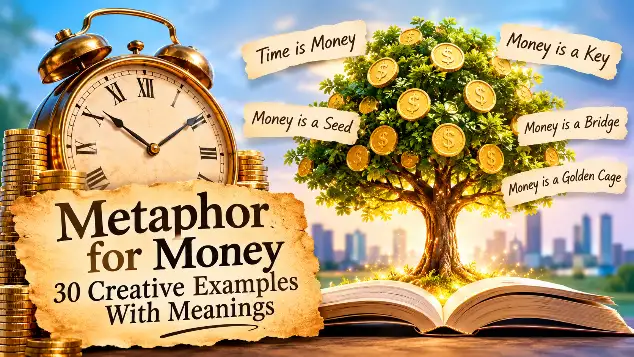
Metaphor for Money is more than coins, cash, or numbers in a bank account. It can represent freedom, security, power, opportunity, greed, happiness, and even the passage of time. That is why writers often use metaphors to describe money in ways that feel more vivid and meaningful.
A metaphor for money compares it to something else without using like or as. For example, “Money is a key” suggests that wealth can open doors to opportunities. Similarly, “Money is a seed” suggests that small amounts can grow when managed wisely.
Whether you are writing an essay, creating a speech, exploring literary symbolism, or looking for creative ways to describe wealth, these money metaphors can help you express your ideas clearly.
What Is a Metaphor for Money?
A metaphor for money describes money as something with a deeper meaning, such as a key, seed, river, tool, or double-edged sword. These comparisons help explain what money can represent in everyday life. For example, “Money is a tool” suggests that money can help people achieve their goals, while “Money is a golden cage” suggests that wealth can sometimes limit freedom.
30 Metaphors for Money With Meanings and Examples
Here are 30 creative metaphors for money, each with an explanation and an example sentence.
1. Money Is a Key
Money is a key that can open doors to education, travel, healthcare, and other opportunities. Like a key, it can provide access to places and experiences that might otherwise remain out of reach.
Example: A college scholarship gave Maya the key to a brighter future.
2. Money Is a Seed
Money is a seed because it can grow when saved, invested, and managed carefully. A small amount today may develop into greater financial security over time.
Example: He treated every dollar he saved as a seed for tomorrow.
3. Money Is a River
Money is like a river because it flows from one person, business, or community to another. It can create opportunities when it circulates, but it can also disappear quickly when poorly managed.
Example: Money flowed through the small town as new businesses opened.
4. Money Is Fuel
Money is fuel for plans, businesses, and ambitions. It provides the resources needed to keep projects moving.
Example: The investment became the fuel that pushed her business forward.
5. Money Is a Double-Edged Sword
Money can create comfort and opportunity, but it can also bring stress, conflict, and difficult responsibilities. This metaphor highlights both its benefits and risks.
Example: Wealth became a double-edged sword when success began to damage his relationships.
6. Money Is a Magnet
Money can attract attention, influence, opportunities, and sometimes people with selfish intentions.
Example: His sudden fortune became a magnet for people he had never met before.
7. Money Is a Bridge
Money can connect people to opportunities and help them move from financial difficulty toward greater stability.
Example: The emergency fund became a bridge between unemployment and a fresh start.
8. Money Is a Shield
Money can act as a shield by providing protection against unexpected expenses, emergencies, and financial uncertainty.
Example: Her savings were a shield when an unexpected medical bill arrived.
9. Money Is a Ticket
Money can be a ticket to experiences, opportunities, and new beginnings.
Example: The money she earned became her ticket to studying abroad.
10. Money Is a Garden
Money is a garden that requires patience, attention, and regular care. Saving and investing are like planting and tending something that may grow over time.
Example: He built his financial future like a garden, one careful decision at a time.
11. Money Is a Language
Money can communicate value, priorities, power, and social status. The way people spend or save it can reveal what matters to them.
Example: Her spending habits were a language that revealed her priorities.
12. Money Is a River That Never Stops Flowing
This metaphor presents money as something constantly moving through the economy. It emphasizes circulation, exchange, and the changing nature of financial circumstances.
Example: In a busy market, money was a river connecting buyers, sellers, and workers.
13. Money Is a Ladder
Money can help people climb toward goals such as education, homeownership, and financial independence.
Example: Each promotion became another rung on his ladder to financial stability.
14. Money Is a Mirror
Money can reflect a person’s habits, values, choices, and priorities. How someone handles money may reveal more than how much they earn.
Example: Her budget was a mirror of the life she wanted to build.
15. Money Is a Seedling of Opportunity
Money can represent the beginning of something larger. Even a small financial resource can support a new idea or opportunity.
Example: The first donation was a seedling of opportunity for the community project.
16. Money Is a Golden Cage
Wealth can provide comfort while creating pressure, dependence, or restrictions. This metaphor suggests that having money does not always mean having freedom.
Example: His luxurious lifestyle became a golden cage that he was afraid to leave.
17. Money Is a Compass
Money can help people make decisions about their priorities, but it should not become the only guide for their lives.
Example: She used her financial goals as a compass, not as a replacement for her values.
18. Money Is a Bridge Over Troubled Water
Money can help people get through difficult periods by providing practical support and stability.
Example: The community fund became a bridge over troubled water for families facing eviction.
19. Money Is a Rainmaker
Money can bring resources and activity into a business, organization, or community.
Example: The new investor was a rainmaker for the struggling company.
20. Money Is a Powerful Engine
Money can drive business activity, innovation, and development when used productively.
Example: Investment became the engine behind the city’s growing technology sector.
21. Money Is a Burden
Money can become a burden when it brings debt, pressure, or responsibilities that are difficult to manage.
Example: The inheritance felt less like a gift and more like a burden.
22. Money Is a Wild Horse
Money can be difficult to control when spending habits, financial risks, or sudden wealth go unchecked.
Example: Without a plan, his growing income became a wild horse he could not tame.
23. Money Is a Safety Net
Money can provide a financial cushion when life takes an unexpected turn.
Example: Her emergency savings were a safety net during the months she searched for work.
24. Money Is a Seed of Change
Money can help start social, personal, or economic improvements.
Example: Their small contribution became a seed of change in the neighborhood.
25. Money Is a Silent Partner
Money can support a business or project without being visible in its daily operations.
Example: Her savings became a silent partner in the family business.
26. Money Is a Crown
Money can symbolize status, influence, and authority, especially in societies where wealth is associated with prestige.
Example: To the ambitious businessman, wealth was a crown he had spent years chasing.
27. Money Is a Thirst That Never Ends
This metaphor describes greed and the desire for more wealth, even when a person already has enough.
Example: His thirst for money never ended, no matter how much he earned.
28. Money Is a Clock
Money can represent the time, effort, and work people exchange to earn it. It can also remind us that time is limited.
Example: Every hour at the office felt like another tick on the clock of his financial ambitions.
29. Money Is a Garden Fence
Money can provide boundaries and protection, helping people establish stability and maintain control over their resources.
Example: A carefully planned budget became a garden fence around the family’s financial future.
30. Money Is a Seed That Needs Sunlight
Money may have potential, but it needs wise decisions, patience, and the right conditions to grow.
Example: Her savings were seeds that needed the sunlight of careful planning.
Money Metaphors by Meaning and Symbolism
Money can symbolize different things depending on the writer’s message and the situation. The same image may suggest freedom in one context and greed in another.
| Meaning or symbolism | Money metaphor | What it suggests |
| Freedom | Money is a key | Access to choices and opportunities |
| Growth | Money is a seed | Saving and investing over time |
| Security | Money is a shield | Protection from financial uncertainty |
| Opportunity | Money is a ticket | Access to new experiences |
| Power | Money is a crown | Status and influence |
| Greed | Money is a bottomless well | A desire that never feels satisfied |
| Restriction | Money is a golden cage | Wealth without freedom |
| Progress | Money is a ladder | Moving toward financial goals |
| Support | Money is a bridge | Help during difficult times |
| Responsibility | Money is a burden | Financial pressure and obligations |
Positive Metaphors for Money
Positive money metaphors focus on the ways financial resources can support a better life.
- Money is a key to opportunity: It can open doors to education, travel, and personal growth.
- Money is a safety net: It can protect people during difficult times.
- Money is a seed of hope: It can help small ideas grow into meaningful projects.
- Money is fuel for dreams: It can provide resources to pursue ambitions.
- Money is a bridge to independence: It can help people gain more control over their lives.
Negative Metaphors for Money
Negative money metaphors explore the risks of greed, debt, and excessive attachment to wealth.
- Money is a golden cage: Wealth can bring restrictions instead of freedom.
- Money is a hungry monster: Greed can consume a person’s attention and values.
- Money is a heavy chain: Debt can limit choices and create pressure.
- Money is a bottomless pit: Some people never feel satisfied with what they have.
- Money is a poisonous apple: The pursuit of wealth can become harmful when it replaces integrity.
Money as a Symbol of Power
Money often represents influence because it can affect access to resources, opportunities, and decision-making.
Example: In the city, money was the throne on which influence sat.
Money as a Symbol of Freedom
Money can symbolize independence because financial resources may give people more choices about where to live, work, and study.
Example: For her, financial independence was a pair of wings.
Money as a Symbol of Greed
Money can represent greed when the desire to accumulate wealth becomes more important than relationships, fairness, or personal well-being.
Example: Gold became the fire that consumed his ambition.
Money Idioms and Figurative Expressions
Money-related idioms are established expressions whose meanings go beyond their literal words. They can make writing more natural and help communicate financial ideas quickly.
| Idiom or expression | Meaning | Example |
| Time is money | Time has economic value | Let’s begin; time is money |
| Money doesn’t grow on trees | Money is not easy to obtain | Spend carefully; money doesn’t grow on trees |
| Make ends meet | Manage basic expenses | They work two jobs to make ends meet |
| Bring home the bacon | Earn money for a household | She works hard to bring home the bacon |
| A cash cow | A reliable source of income | The subscription service became a cash cow |
| Break the bank | Spend more than one can afford | The vacation won’t break the bank |
| Pay through the nose | Pay an excessively high price | We paid through the nose for last-minute tickets |
| Money talks | Wealth can influence decisions | In that industry, money talks |
| Tighten your belt | Reduce spending | We had to tighten our belts this month |
| In the red | Owing money or operating at a loss | The business ended the quarter in the red |
Time Is Money Metaphor: Meaning, Examples, and Explanation
“Time is money” is a metaphor that compares time to a valuable financial resource. It suggests that time, like money, can be spent, saved, wasted, invested, or lost.
The expression is commonly used in business, productivity, education, and everyday conversation. It reminds us that time is limited and that the way we use it can have real consequences.
What Is the Meaning of the Time Is Money Metaphor?
The meaning of the time is money metaphor is that time has value. Just as people make decisions about how to use their money, they make decisions about how to use their time.
For example:
- “I can’t waste another minute.” Time is treated as something valuable that can be wasted.
- “She invested years in her education.” Time is treated as an investment that may produce future benefits.
- “We are running out of time.” Time is treated like a resource that can be depleted.
- “He saved time by taking the train.” Time is treated like money that can be saved.
The metaphor does not mean that time and money are literally the same. It uses the familiar idea of financial value to help people understand the importance of time.
Lakoff and Johnson’s Time Is Money Metaphor
In Metaphors We Live By (1980), linguists and philosophers George Lakoff and Mark Johnson explain how metaphors shape ordinary thought, not just creative language. Their discussion of TIME IS MONEY shows how people commonly understand time through the language of financial resources.
Expressions such as spend time, waste time, save time, and invest time reflect this conceptual metaphor. The related ideas TIME IS A LIMITED RESOURCE and TIME IS A VALUABLE COMMODITY help explain why the comparison is so common.
This is an example of a conceptual metaphor: a pattern of thinking that influences how people talk about and understand an abstract idea. It is more than a single poetic sentence.
Time Is Money Metaphor Examples
Here are examples that show how the metaphor works in everyday language.
| Expression | Meaning |
| Time is money | Time has value |
| Don’t waste my time | Treat my time as valuable |
| I spent the whole afternoon studying | Time is a resource that can be spent |
| She invested years in her career | Time can produce future benefits |
| We need to save time | Time can be conserved |
| He borrowed time from his weekend | Time is treated like something that can be borrowed |
| The deadline is costing us time | Time has a cost |
| I can’t afford to wait | Waiting has a perceived cost |
| They are running out of time | Time is a limited resource |
| Give me a minute | Time is treated like something that can be given |
| The project took years to pay off | Time is connected to financial return |
| Every minute counts | Each unit of time has value |
| That shortcut bought us an hour | Time can be gained through an action |
| We lost an entire afternoon | Time can be lost |
| He budgeted his time carefully | Time can be planned like money |
Time Is Money Metaphor Visual: How to Represent It
A visual representation of TIME IS MONEY should make the connection between a clock and financial value immediately clear. These concepts can work in a classroom presentation, an essay illustration, an infographic, or a visual metaphor project.
A clock made of coins
Shows time as a valuable resource.
Business metaphor – time is money, hourglass with falling gold coins
An hourglass filled with coins
Shows time passing and value being used.
Vintage watch and stack of coins. The concept of saving money for manage time to success business.
A watch beside money
Connects everyday timekeeping with financial value.
A clock exchanged for cash
Represents the exchange of working hours for income.
Time Is Money Metaphor Illustration: A Creative Concept
For a simple illustration, imagine an hourglass filled with gold coins instead of sand. As the coins fall from the upper chamber to the lower one, they represent time passing and opportunities being used.
You could include:
- A clock face in the background to represent the passage of time.
- Coins falling through the hourglass to symbolize time being spent.
- A hand reaching toward the hourglass to represent the choice to use time wisely.
- A fading calendar to show that missed opportunities cannot always be recovered.
Suggested illustration caption: Time is money: every moment spent is a resource that cannot be reclaimed.
Money Metaphor Examples: More Creative Ways to Describe Money
If you need additional money metaphor examples for creative writing, speeches, essays, or classroom assignments, these original comparisons offer different ways to describe wealth and financial resources.
| Money metaphor | Meaning | Example sentence |
| Money is a passport | It can provide access to new experiences | Her savings became a passport to a new life |
| Money is a toolbox | It provides resources for solving problems | Money was one tool in his plan for rebuilding |
| Money is a riverbank | It can help direct the flow of resources | A clear budget became the riverbank guiding their spending |
| Money is a candle | It can provide temporary comfort or support | Their small grant was a candle in a difficult year |
| Money is a ladder with missing rungs | Financial progress can be uneven | For many families, the path to stability is a ladder with missing rungs |
| Money is a map | It can help people plan their future | Their savings plan became a map toward independence |
| Money is a foundation | It can support long-term plans | A stable income gave the family a foundation to build on |
| Money is a window | It can reveal possibilities | The scholarship opened a window to new opportunities |
| Money is a lock | It can protect resources | A savings account became a lock on their future plans |
| Money is a seedbed | It can support new ideas and growth | The grant was a seedbed for local creativity |
| Money is a current | It moves through communities and markets | A new business brought a current of money into the neighborhood |
| Money is a balancing scale | It involves choices and trade-offs | Every purchase placed another weight on the balancing scale |
| Money is a bridge under construction | Financial progress takes time | Their savings were a bridge under construction toward a home |
| Money is a fragile glass | It can be lost through careless decisions | Without planning, their financial security was fragile glass |
| Money is a garden hose | It can be directed toward different needs | She directed her income like a hose toward the priorities that mattered |
These are creative comparisons, not all established idioms. Their purpose is to give writers fresh ways to communicate the different roles money can play.
Money Metaphors for a Professional Women’s Fundraising Group
A professional women’s fundraising group may use metaphors to communicate shared purpose, leadership, generosity, and the impact of collective action. The strongest comparisons emphasize what contributions make possible rather than suggesting that money alone creates change.
Here are original metaphor ideas that can work in a fundraising speech, campaign, event theme, or group presentation.
| Fundraising metaphor | Meaning | Possible campaign line |
| Every contribution is a seed | Small gifts can help meaningful projects grow | Plant a seed. Grow a future |
| Together, we are a bridge | Collective support connects people to opportunities | Building bridges through generosity |
| Our giving is a ripple | One contribution can inspire further action | One gift. A thousand ripples |
| We are a circle of support | Members strengthen one another and their community | A circle of women. A world of possibility |
| Every dollar is a building block | Contributions help create lasting results | Building stronger futures together |
| Generosity is our shared language | Giving communicates care and commitment | Speaking through action |
| Our vision is a rising tide | Collective effort can lift a community | Rising together through giving |
| Every gift is a spark | Contributions can help begin change | Be the spark that starts something bigger |
| We are roots of change | Sustained support helps communities become stronger | Rooted in service. Growing through impact |
| Our resources are wings | Funding can help people reach new possibilities | Giving opportunity its wings |
| We are a network of light | Members can bring hope and support to others | Many lights. One brighter future |
| Giving is a bridge to possibility | Donations can connect people with practical help | Connecting generosity with opportunity |
Short Fundraising Metaphors and Slogans
These shorter lines may work well on banners, brochures, invitations, or social media graphics:
- Small gifts, mighty roots.
- A circle of giving, a future of possibility.
- Together, we are the spark of change.
- Our generosity builds bridges.
- Every dollar plants a seed of hope.
- Many hands, one brighter future.
- Women united, possibilities multiplied.
For a professional group, choose language that reflects its actual mission. If the organization supports education, for example, the seed, bridge, and wings metaphors may communicate its purpose more clearly than a general slogan about wealth.
Farm Money Metaphor: Money as a Seed That Grows
A farm is a useful metaphor for money because both farming and financial planning involve preparation, patience, effort, and long-term care.
Money is a seed is one of the clearest farm-related metaphors. A seed can become a crop when it is planted in suitable soil and cared for. Similarly, money may grow through saving, responsible investment, and thoughtful financial decisions.
Farm-Related Metaphors for Money
| Farm metaphor | Meaning | Example |
| Money is a seed | Small savings can grow over time | She planted the first seed of financial independence with her savings |
| Money is fertile soil | A strong financial foundation supports growth | Their careful planning created fertile soil for the business |
| Money is a harvest | Financial results can follow sustained effort | Years of disciplined saving brought a welcome harvest |
| Money is a growing crop | Wealth can develop gradually | His investments were a crop that needed time to mature |
| Money is a farm tool | Resources can help produce something useful | The grant became a tool for growing the local economy |
| Debt is a weed | Unmanaged debt can damage financial progress | High-interest debt became a weed in their financial garden |
| A budget is a fence | A budget can create boundaries around spending | The family budget was a fence protecting its savings |
Example Sentences Using the Farm Money Metaphor
- Every dollar she saved was a seed planted in the soil of her future.
- Their small business grew like a healthy crop after years of hard work.
- A careful budget helped keep financial weeds from taking over.
- The family’s savings finally produced a harvest of security.
- He learned that wealth, like a farm, needs patience and consistent care.
An Extended Farm Metaphor for Money
Think of your financial life as a farm. Your income is the water that keeps the land alive, your savings are the seeds you plant, and your budget is the fence that protects the field. Wise investments are the crops you tend with patience. Debt can become a weed if you allow it to spread. Over time, careful decisions may bring a harvest of greater financial stability.
This extended metaphor works well in essays and speeches because it develops one central comparison across several connected ideas.
“Her Voice Is Full of Money” — Is It a Metaphor?
The phrase “her voice is full of money” is not a widely established English idiom. However, it can work as an original metaphor when the writer wants to suggest that a woman’s voice sounds wealthy, commercially valuable, persuasive, or connected to success.
Its meaning depends on the context.
Possible Meanings of “Her Voice Is Full of Money”
- Her voice sounds luxurious: The phrase may suggest a rich, polished, or expensive-sounding voice.
- Her voice has commercial value: It may imply that her voice could earn money through singing, voice acting, advertising, or narration.
- Her voice is persuasive: It could suggest that her words have the power to attract customers, influence decisions, or generate sales.
- Her voice expresses confidence and success: In a creative passage, it may symbolize ambition, influence, or prosperity.
More Natural Money Metaphors for a Valuable Voice
If you want the meaning to be clearer, consider these original alternatives:
- Her voice was a golden investment. Her voice had great potential value.
- Her words were a cash register ringing. Her speech helped generate sales.
- Her voice was a fountain of opportunity. Her talent opened doors.
- Her words were currency. Her communication carried influence and value.
- Her voice was a golden ticket. Her talent gave her access to opportunities.
Writing tip: If you use “her voice is full of money,” provide enough surrounding context for readers to understand whether you mean vocal beauty, commercial value, or persuasive power.
Metaphor for Money and Happiness: Is Money the Key to Happiness?
Money and happiness are often connected in literature and everyday conversation. Money can provide comfort, security, and opportunities, but it does not automatically create lasting happiness.
A metaphor for money and happiness can explore this relationship by comparing money to a key, foundation, garden, or tool. The comparison should make clear whether money supports happiness, limits it, or is mistaken for it.
Metaphors Connecting Money and Happiness
| Metaphor | Meaning |
| Money is a key to comfort | Financial resources can make daily life easier |
| Money is the soil of security | Financial stability can support peace of mind |
| Money is a stepping stone to opportunity | It can help people pursue meaningful goals |
| Money is a candle, not the sun | It can offer comfort but cannot provide everything |
| Money is a guest at happiness’s table | It may contribute to a happy life without being the whole story |
| Money is a roof over worry | Financial security can reduce certain stresses |
| Money is a bridge, not the destination | It can help people reach goals but is not itself the goal |
| Money is a garden that needs balance | Wealth requires care and should not consume every part of life |
| Money is a window, not the view | It can create possibilities but cannot determine what makes life meaningful |
| Money is a comfortable chair, not a happy home | Comfort alone does not create fulfillment |
| Money is a tool in the hands of happiness | It can support meaningful choices when used wisely |
| Money is a shadow of success | Wealth may reflect achievement but does not define a person’s worth |
| Money is a door, not the journey | It may open opportunities, but people still have to decide where to go |
| Money is a cushion beneath life’s falls | It can soften some unexpected difficulties |
| Money is one color in life’s painting | It contributes to life without defining the entire picture |
Example Sentences About Money and Happiness
- Money can be a roof over worry, but it cannot build a loving home.
- Wealth is a bridge to opportunity, not the destination of a meaningful life.
- Money is one color in the painting of happiness, not the whole canvas.
- A full bank account cannot always fill an empty heart.
- Financial security can quiet some worries, leaving more room for joy.
Is Money the Key to Happiness?
Money can contribute to happiness by helping people meet basic needs, manage emergencies, access opportunities, and reduce some forms of financial stress. However, relationships, health, purpose, belonging, and personal fulfillment also matter.
A useful way to express this idea is:
Money can open the door to comfort, but it cannot guarantee happiness inside the room.
Metaphor vs. Simile: What Is the Difference?
A metaphor and a simile both compare two different things, but they do so in different ways.
- Metaphor: Says that one thing is another to create a symbolic comparison.
- Simile: Compares two things using words such as like or as.
| Metaphor | Simile |
| Money is a seed | Money is like a seed |
| Money is a golden key | Money is like a golden key |
| Wealth is a river | Wealth flows like a river |
| Money is a double-edged sword | Money is like a double-edged sword |
| Savings are a safety net | Savings are like a safety net |
Metaphor example: Money is a ladder to opportunity.
Simile example: Money is like a ladder that helps people climb toward opportunity.
The metaphor makes a direct comparison, while the simile makes the comparison explicit with like.
How to Choose the Right Metaphor for Money
The best money metaphor depends on the message you want to communicate. Before choosing one, consider the context, tone, and audience.
1. Decide What Money Represents
Think about the idea behind your comparison.
- For opportunity, use a key, door, or ticket.
- For growth, use a seed, garden, or crop.
- For security, use a shield, roof, or safety net.
- For power, use a crown, engine, or throne.
- For greed, use a bottomless pit, hungry monster, or endless thirst.
- For financial pressure, use a burden, chain, or heavy weight.
2. Match the Tone to Your Writing
A serious financial essay may benefit from metaphors such as money is a foundation or money is a safety net. A poem may use more imaginative comparisons, such as money is a river of possibility.
For a humorous piece, you might describe money as a slippery fish that disappears just when you think you have caught it.
3. Make the Meaning Clear
A metaphor should help readers understand your point. If the comparison is too complicated, readers may struggle to understand it.
For example:
- Clear: Money is a key to opportunity.
- Less clear: Money is a silver cloud inside a silent clock.
The second comparison could work in experimental poetry, but it needs context to communicate a specific idea.
4. Avoid Mixing Too Many Metaphors
Try to develop one central comparison at a time. If you describe money as a river, a ladder, a garden, and a machine in the same sentence, the imagery may become confusing.
5. Use Original Comparisons Carefully
You do not need to rely only on familiar expressions. You can create your own metaphor as long as the comparison makes sense.
For example, “Money is a lantern in an uncertain season” is an original metaphor that suggests financial resources can offer guidance and security during difficult times.
Frequently Asked Questions About Metaphors for Money
1. What is a good metaphor for money?
A good metaphor for money is “Money is a key to opportunity.” It suggests that financial resources can open doors to education, travel, business, and new experiences. Other useful comparisons include money as a seed, shield, bridge, or tool.
2. What are five examples of metaphors for money?
Here are five examples:
- Money is a key to freedom.
- Money is a seed that grows.
- Money is fuel for ambition.
- Wealth is a golden cage.
- Money is a bridge to opportunity.
Each comparison highlights a different role money can play in people’s lives.
3. Is “time is money” a metaphor?
Yes. “Time is money” is a conceptual metaphor that treats time as a valuable resource. Expressions such as spend time, save time, and waste time reflect the same way of thinking. The phrase is commonly used to emphasize that time should be used carefully.
4. What does money symbolize in literature?
Money can symbolize power, freedom, greed, social status, security, temptation, or inequality. Its meaning depends on the characters, setting, and themes of the work. A wealthy character’s money, for example, might represent independence in one story and moral corruption in another.
5. What is a positive metaphor for money?
“Money is a seed of opportunity” is a positive metaphor. It suggests that financial resources can help ideas grow and create a better future. Other positive comparisons include money as a bridge, safety net, foundation, and fuel for dreams.
6. What is a negative metaphor for money?
“Money is a golden cage” is a negative metaphor. It suggests that wealth can create restrictions, pressure, or dependence instead of freedom. Other negative comparisons include money as a burden, chain, hungry monster, or bottomless pit.
7. How did Lakoff and Johnson explain the time is money metaphor?
In Metaphors We Live By (1980), George Lakoff and Mark Johnson explain that people commonly understand time through the language of financial resources. Expressions such as spend time, save time, and waste time demonstrate the conceptual metaphor TIME IS MONEY.
8. Can money be a metaphor for happiness?
Yes. Money can be described as a key to comfort, a foundation for security, or a bridge to opportunity. These comparisons suggest that money may support happiness, but it does not guarantee love, purpose, meaningful relationships, or fulfillment.
Conclusion: Money Is More Than Wealth
Money can be a key to opportunity, a seed of growth, a shield against uncertainty, or a golden cage that limits freedom. These metaphors reveal that money has different meanings depending on how people earn, spend, save, and value it.
The strongest metaphor is the one that communicates your intended message. Whether you are writing an essay, creating a speech, exploring symbolism, or developing a fundraising message, use comparisons that make your meaning clear and memorable.

Qaiser Abbas is an award-winning author, leadership coach, and motivational speaker known for his work on personal growth, leadership, and human potential. Through his writing and speaking, Qaiser focuses on turning challenges into opportunities and helping people build the mindset to achieve meaningful growth.