
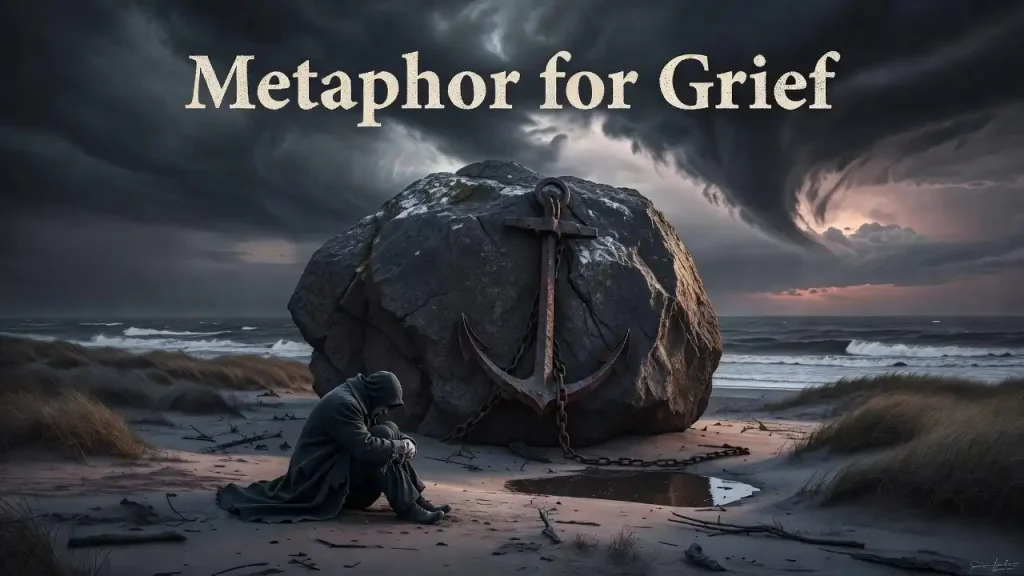
A Metaphor for Grief is the emotional pain we experience after losing someone or something meaningful. It can follow the death of a loved one, the end of a relationship, a lost opportunity, or a major life change. Although everyone experiences loss differently, grief often brings feelings that seem too complicated for ordinary language.
What Is a Metaphor for Grief?
A metaphor for grief describes this emotional experience by comparing it to something familiar. For example, “Grief is a storm that turns an ordinary day into darkness” compares emotional suffering to unpredictable weather.
Other metaphors describe grief as an ocean wave, a heavy stone, or an unfinished story. Each image captures a different part of the experience.
Why do these comparisons matter? Because grief does not always arrive as tears. Sometimes it feels like exhaustion, silence, confusion, or an unexpected memory.
Metaphors give these feelings a language. They help writers communicate emotional depth, allow readers to recognize their own experiences, and create meaningful connections between personal loss and universal human emotions.
25 Powerful Metaphors for Grief
Here are 25 original and familiar metaphorical expressions that describe different dimensions of grief.
| Metaphor | Meaning |
| 1. Grief is a storm | Emotional pain that arrives unexpectedly and overwhelms you. |
| 2. Grief is an ocean wave | Sadness that comes and goes in powerful waves. |
| 3. Grief is a heavy stone | The emotional burden that makes everyday life difficult. |
| 4. Grief is an unfinished story | A life or relationship interrupted before its natural ending. |
| 5. Grief is a broken mirror | A shattered sense of identity after losing someone. |
| 6. Grief is a dark winter | A period of emotional coldness, isolation, and uncertainty. |
| 7. Grief is an empty chair | The painful absence of someone who once belonged in your life. |
| 8. Grief is a fading photograph | Memories that remain meaningful even as details change. |
| 9. Grief is a silent companion | A feeling that quietly follows you through daily life. |
| 10. Grief is a wound beneath the skin | Invisible emotional pain that others may not recognize. |
| 11. Grief is a shadow | The lingering presence of loss in ordinary moments. |
| 12. Grief is a long road through darkness | An uncertain journey toward emotional adjustment. |
| 13. Grief is a locked room | Feelings that seem difficult to express or share. |
| 14. Grief is a falling star | The sudden loss of something beautiful and precious. |
| 15. Grief is a fading melody | The gradual transformation of memories over time. |
| 16. Grief is a garden after winter | The possibility of renewal after emotional hardship. |
| 17. Grief is a cracked foundation | The disruption of emotional security and stability. |
| 18. Grief is a missing puzzle piece | The absence of someone who made life feel complete. |
| 19. Grief is a candle burning in the dark | Love and remembrance that continue after loss. |
| 20. Grief is a tangled thread | Complicated emotions that are difficult to separate. |
| 21. Grief is a silent earthquake | An internal disruption that changes everything. |
| 22. Grief is a room without windows | The feeling of being trapped inside emotional pain. |
| 23. Grief is a river carrying memories | The movement of time while memories remain. |
| 24. Grief is a language without words | Feelings that ordinary speech cannot fully express. |
| 25. Grief is a bridge between yesterday and tomorrow | The process of carrying memories into a changed future. |
These examples work in poetry, personal essays, fiction, speeches, and reflective writing. Some draw on familiar figurative expressions, while others are original creative comparisons.
Grief Is a Storm
Metaphor: Grief is a storm that arrives without warning and changes the landscape of your life.
A storm represents the unpredictable nature of grief. One moment, life seems ordinary. The next, a familiar song, photograph, or memory brings an overwhelming rush of sadness.
This comparison captures the emotional intensity of losing someone important. Like severe weather, grief can disrupt routines, cloud judgment, and make even simple tasks feel difficult.
Historical Context
Writers have long used storms to represent emotional turmoil, conflict, and human suffering. In literature, dark skies and violent weather often reflect a character’s internal struggles.
The storm metaphor also appears naturally in everyday language. People describe difficult experiences as emotional storms because the image communicates intensity without requiring a lengthy explanation.
Psychological Impact
Grief rarely follows a predictable pattern. A person may experience sadness, anger, guilt, relief, or moments of peace, sometimes within the same day.
The storm metaphor helps explain why emotional setbacks do not necessarily mean someone has made no progress. A difficult day can occur even after a period of relative calm.
For writers using emotional storytelling, this image offers strong sensory detail. Dark clouds, heavy rain, distant thunder, and sudden lightning can express feelings that characters struggle to explain directly.
Practical Takeaway
Use the storm metaphor when you want to describe sudden emotional pain, overwhelming sadness, or the unpredictable nature of mourning.
Example: “After her father’s death, grief became a storm that swept through every quiet corner of her life.”
Grief Is an Ocean Wave
Metaphor: Grief is an ocean wave that rises, crashes, and slowly retreats.
The ocean wave is one of the most relatable metaphors for grief because it captures how emotions fluctuate.
Sometimes sadness remains quiet beneath the surface. At other times, it rises unexpectedly and becomes impossible to ignore.
A birthday, family gathering, favorite meal, or familiar voice can bring memories rushing back. Even years after a loss, a person may experience a powerful emotional wave.
Historical Context
Water has symbolized emotional depth, uncertainty, renewal, and transformation across many literary and cultural traditions.
Writers often compare human emotions to oceans because both can appear peaceful one moment and powerful the next.
The image of waves also offers a useful alternative to the idea that grief follows a straight path from sadness to recovery.
Psychological Impact
The wave metaphor encourages people to recognize that emotional experiences can change over time.
A person may laugh with friends in the morning and cry over a memory in the evening. These feelings do not cancel each other out.
Research into bereavement also recognizes the importance of continuing emotional connections with deceased loved ones. A systematic review by Hewson and colleagues examined how these continuing bonds can bring both comfort and distress.
Practical Takeaway
Choose this metaphor when describing recurring sadness, emotional triggers, memories, and the changing intensity of grief.
Example: “Her grief moved like ocean waves, sometimes gentle enough to ignore and sometimes powerful enough to bring her to her knees.”
Grief Is a Heavy Stone
Metaphor: Grief is a heavy stone carried inside the heart.
This metaphor represents the emotional weight of loss. It suggests that sadness can make ordinary responsibilities feel exhausting.
Imagine carrying a large stone everywhere you go. You can still walk, work, talk, and participate in daily activities, but every movement requires additional effort.
That is how grief can feel.
Historical Context
Writers have frequently associated emotional burdens with physical weight. Expressions such as carrying the weight of sorrow and having a heavy heart connect invisible suffering to familiar physical experiences.
This metaphor works because almost everyone understands the effort required to carry something heavy.
Psychological Impact
Bereavement can affect concentration, sleep, motivation, and everyday functioning. A grieving person may continue fulfilling responsibilities while privately struggling with emotional exhaustion.
The stone metaphor makes this invisible experience easier to understand. It reminds readers that someone can appear strong while carrying considerable emotional pain.
It also avoids suggesting that everyone must recover at the same speed.
Practical Takeaway
Use this image when writing about emotional exhaustion, prolonged sadness, responsibility, or the difficulty of continuing life after loss.
Example: “Every morning, she woke with the same heavy stone of grief resting against her heart.”
Grief Is an Unfinished Story
Metaphor: Grief is an unfinished story whose final chapter never arrived.
Losing someone can feel like reading a book that suddenly ends in the middle of a sentence.
There were conversations still waiting to happen, places you planned to visit, and memories you expected to create. Suddenly, the future you imagined no longer exists.
The unfinished story represents not only the person who died but also the shared experiences that will never take place.
Historical Context
Stories have always helped people understand human relationships, identity, memory, and mortality.
Literary works often use incomplete narratives to represent interrupted dreams, unresolved relationships, and unexpected endings.
The metaphor of an unfinished story connects these literary ideas with the emotional reality of bereavement.
Psychological Impact
After losing someone, people often revisit memories, conversations, and important moments. They may wonder what they could have said differently or imagine the experiences they will never share.
Research on continuing bonds explores how people maintain an inner relationship with someone who has died through memories, personal rituals, and symbolic connections.
These connections do not mean that someone refuses to accept reality. They can become part of how a person remembers and makes sense of the relationship.
Practical Takeaway
Use the unfinished-story metaphor when expressing regret, unanswered questions, interrupted relationships, or the lasting significance of shared memories.
Example: “His life was a beautiful story, but her grief came from knowing that their final chapter would remain unwritten.”
Psychological and Cultural Meaning of Grief
Grief is both a personal experience and a cultural one. People may share similar feelings of loss, but their beliefs, families, traditions, and communities influence how they express and understand those feelings.
The Psychological Dimension
Psychologically, grief involves emotional, cognitive, and sometimes physical responses to loss.
People may experience:
- Sadness and longing.
- Anger or frustration.
- Guilt and regret.
- Difficulty concentrating.
- Changes in sleep and appetite.
- A sense of disconnection from familiar surroundings.
- Unexpected comfort when remembering the person they lost.
No single metaphor captures every experience. A storm may describe emotional intensity, while an empty chair may communicate absence more effectively.
Metaphors also help people communicate feelings they struggle to explain directly. Research published in Health Psychology and Behavioral Medicine explores how bereaved people use symbolic language and metaphor to express experiences that ordinary words cannot fully capture.
The Cultural Dimension
Culture influences mourning rituals, remembrance, family responsibilities, and beliefs about death.
For example, a study by Suhail and colleagues examined continuing bonds among bereaved Pakistani Muslims. Participants described practices such as prayer, reciting religious verses, charity, visiting graves, and communal gatherings as ways of maintaining connections with deceased loved ones.
These findings show that grief does not exist outside culture. Communities shape the language, rituals, and meanings people associate with loss.
For some, grief resembles a journey toward acceptance. For others, it resembles a continuing relationship expressed through memories, faith, or family traditions.
Both perspectives deserve respect.
More Powerful Metaphors for Grief: Short, Poetic, and Creative Examples
Grief is difficult to explain because it can change from one moment to the next. Sometimes it feels heavy and overwhelming; at other times, it appears quietly in familiar places, memories, and ordinary routines. These additional metaphors offer different ways to describe that experience.
Short Metaphors for Grief
Short metaphors can express powerful emotions in just a few words. They work particularly well in poetry, personal essays, sympathy messages, and creative writing.
- Grief is an empty chair. It represents the absence of someone who once had a place in your everyday life.
- Grief is a shadow that follows you. It suggests that loss remains part of your experience, even during happy moments.
- Grief is a broken clock. It describes how life can seem to stop at the moment of loss.
- Grief is a silent companion. It expresses the way sorrow can remain beside you without always demanding attention.
- Grief is a winter without an ending. It represents the emotional coldness and loneliness that can follow a devastating loss.
- Grief is a missing page. It symbolizes a future or chapter of life that can no longer unfold as expected.
- Grief is an invisible wound. It describes emotional pain that others cannot always see.
- Grief is a fading photograph. It captures the fear of losing details while trying to preserve memories.
Poetic Metaphors for Grief and Death
Poetic metaphors can make the relationship between love, memory, grief, and mortality easier to express.
- Death is the closing of a familiar book. The story has reached its final page, but its words remain with those who read it.
- Grief is the echo of a beautiful song. The original voice is gone, yet its presence continues in memory.
- A loved one is a star beyond the horizon. Their physical presence is gone, but their influence remains part of the world you see.
- Grief is a garden growing around an empty space. Life continues, but the absence remains part of its landscape.
- Death is a door that opens only one way. It expresses the finality of losing someone.
- Memory is a lantern in the dark. It offers moments of connection when grief makes the future difficult to see.
These are original literary examples, not traditional quotations or established sayings.
Famous and Recognizable Metaphors for Grief
Some of the most recognizable grief metaphors appear in literature, mythology, film, and theater. They give audiences a shared image through which to understand loss.
- The sea of grief: A powerful image of sorrow that can surround a person and make it difficult to find solid ground.
- The storm of grief: A metaphor for intense emotions that arrive with overwhelming force.
- The unfinished story: A representation of a life or relationship interrupted by death.
- The monster in the house: An image of grief that remains present even when a person tries to ignore it, as explored in The Babadook.
- The journey into the underworld: The myth of Orpheus and Eurydice represents the desperate wish to recover someone who has died.
These images are recognizable literary patterns rather than quotations from a single author.
Funny Metaphors for Grief
Humor can sometimes help people describe the confusing, unpredictable parts of grief. It should be used thoughtfully, especially when speaking to someone who has recently experienced a loss.
- Grief is an unwanted houseguest who never checks the calendar. It appears when you least expect it.
- Grief is a phone with a broken notification system. Memories pop up at completely unexpected moments.
- Grief is an emotional roller coaster designed by someone who lost the instructions. It captures the unpredictable shifts in feeling.
- Grief is a browser with too many tabs open. Memories, regrets, questions, and unfinished thoughts compete for attention.
- Grief is a suitcase that keeps gaining weight. It represents the way memories and emotions can accumulate.
These humorous metaphors are best suited to personal reflection, gentle storytelling, or conversations where the grieving person welcomes humor. They should never be used to minimize someone’s loss.
Extended Metaphor for Grief: Grief Is an Ocean
An extended metaphor develops one central comparison across several sentences or paragraphs. Instead of describing grief as a single wave, imagine it as an ocean.
At first, the ocean may seem impossible to cross. Some days, its waves rise suddenly and pull you beneath the surface. On other days, the water becomes quiet, allowing you to breathe and remember the shore. You may discover islands of comfort in the people who support you, while familiar memories become lighthouses that help you navigate the darkness.
The ocean does not disappear, and neither does the importance of the person you lost. But over time, you may learn to recognize its currents, find moments of calm, and continue your journey.
This extended metaphor communicates several aspects of grief:
- The waves represent sudden emotional reactions and memories.
- The deep water represents feelings that are difficult to explain.
- The lighthouse represents support, love, and meaningful memories.
- The shore represents moments of stability and everyday life.
- Learning to navigate represents adapting to life after loss.
What Objects and Images Symbolize Grief?
Everyday objects can become powerful symbols of loss because they remind us of people, relationships, and experiences. Their meanings depend on the context in which they appear.
A Jar as a Metaphor for Grief
Grief is a jar filled with memories.
A jar can represent the emotions and memories a person carries after losing someone. Some memories are beautiful, some are painful, and others are too complicated to describe.
Imagine placing a small object inside the jar whenever a memory returns: a photograph, a handwritten note, a favorite recipe, or a tiny reminder of a shared experience. The jar becomes a symbol of the life and love that remain meaningful after death.
Another interpretation is that grief is a jar with no lid. Feelings cannot always be contained, and memories may emerge when something unexpected brings the person back to mind.
A Ball as a Metaphor for Grief
Grief is a ball that keeps changing shape in your hands.
This metaphor describes how grief can feel different depending on the day. Sometimes it is small enough to carry quietly; at other times, it seems too large and heavy to hold.
A ball can also symbolize the way grief moves through different parts of life. A familiar song, an anniversary, or a conversation can set it rolling again.
For creative writing, another version is grief is a ball of tangled thread. Each strand represents a memory, unanswered question, regret, or expression of love. Pulling one strand may reveal another, showing how closely emotions and memories are connected.
Glitter as a Metaphor for Grief
Grief is glitter: even after you think it has disappeared, a little remains.
Glitter is difficult to remove completely. A tiny piece may appear long after the original celebration has ended. In the same way, memories of someone who has died can return unexpectedly—in a familiar smell, a favorite song, a holiday tradition, or an ordinary conversation.
This metaphor is particularly useful for explaining how grief can remain part of everyday life without being equally intense all the time.
It does not mean a person is permanently trapped in sadness. Instead, it suggests that love and memory can leave traces that continue to matter.
The Grief Metaphor Box
A grief metaphor box can be used as a creative-writing or reflection exercise. Imagine a box containing objects that represent different parts of a person’s experience of loss.
For example:
- A photograph represents memories.
- A stone represents emotional heaviness.
- A candle represents hope and remembrance.
- A broken watch represents the feeling that time stopped.
- A letter represents words left unsaid.
- A small key represents the memories that unlock unexpected emotions.
In a poem, story, or personal essay, the box can become a symbol of the emotional world someone carries after a loss. Each object reveals a different part of the relationship.
This is a creative literary device, not a standardized psychological treatment.
The Babadook: Horror as a Metaphor for Grief
Is The Babadook a Metaphor for Grief?
Yes. The Babadook is widely interpreted as a metaphor for grief, unresolved trauma, and the emotional consequences of suppressing painful experiences.
In Jennifer Kent’s 2014 psychological horror film, Amelia is a widow raising her young son, Samuel. After a mysterious pop-up book introduces the frightening Babadook, the monster becomes an increasingly powerful presence in their home.
The creature can be understood as an embodiment of grief that Amelia cannot simply erase. Her husband’s death continues to affect her relationship with her son, her sense of identity, and her ability to manage everyday life.
The film’s central metaphor is especially powerful because the monster does not represent an ordinary fear that can be defeated once and forgotten. It represents an emotional reality that must be acknowledged and managed.
What Does the Babadook Symbolize?
The Babadook can symbolize several connected experiences:
- Unresolved grief: Pain that remains present when a person cannot fully confront a loss.
- Suppressed emotions: Feelings that become more frightening when they are denied or hidden.
- Anger after bereavement: The rage, frustration, and resentment that can accompany sadness.
- The burden of traumatic loss: The way a devastating event can affect relationships and daily life.
- The persistence of memory: The fact that losing someone does not mean the emotional connection simply disappears.
Why Is Horror a Metaphor for Grief?
Horror is an effective literary and cinematic language for grief because both experiences can involve fear, helplessness, isolation, and the feeling that something familiar has become unfamiliar.
A monster can represent an emotion that is difficult to name. A haunted house can symbolize a mind filled with painful memories. A dark hallway can represent uncertainty about life after loss.
In The Babadook, the horror imagery makes invisible emotional pain visible. The film suggests that healing does not necessarily mean pretending the loss never happened. Instead, it can mean learning how to live with the reality of grief without allowing it to control every part of life.
Is Pluribus a Metaphor for Grief?
Pluribus, the television series created by Vince Gilligan, can be interpreted through the lens of grief, although it is not exclusively a story about bereavement.
The series explores a transformed world and follows Carol as she struggles with the consequences of profound change and personal loss. Her emotional isolation contrasts with the apparent happiness and unity around her.
This creates a useful metaphor for grief: the world can move on while the grieving person feels left behind.
What Does Pluribus Represent About Grief?
Several elements of the story can be read as symbolic representations of loss:
- A changed world: The experience of grief can make familiar surroundings feel unfamiliar.
- Isolation: A grieving person may feel separated from people who do not share the same loss.
- Unwanted happiness: Other people’s apparent normality can make personal sadness feel even more isolating.
- The struggle to accept change: Losing someone can create a life that looks recognizable but feels fundamentally different.
- Individual identity: Grief can raise questions about who a person is after an important relationship ends through death.
The series also invites interpretations beyond grief, including identity, connection, conformity, and human nature. It is more accurate to describe grief as one meaningful lens through which viewers can interpret Pluribus, rather than claiming it has only one fixed meaning.
Is Hadestown a Metaphor for Grief?
Yes. Anaïs Mitchell’s musical Hadestown reimagines the ancient Greek myth of Orpheus and Eurydice through themes of love, separation, death, hope, and the human desire to recover what has been lost.
The story follows Orpheus as he travels into the underworld to bring Eurydice back. His journey can be understood as a metaphor for the struggle to accept the death of someone deeply loved.
Orpheus and Eurydice as a Metaphor for Grief
The myth of Orpheus and Eurydice is one of the most enduring literary representations of grief.
Orpheus’s journey into the underworld symbolizes the desperate wish to reverse death. He cannot accept that Eurydice is gone, so he attempts the impossible: bringing her back to the world of the living.
His journey represents several emotional dimensions of bereavement:
- The underworld: The darkness and emotional distance associated with losing someone.
- Orpheus’s song: Love, memory, and the desire to preserve a connection.
- The journey back: The difficult process of returning to life after loss.
- The forbidden glance: Doubt, fear, and the inability to trust that a loved one is still there.
- The final separation: The painful recognition that love cannot always undo death.
What Does Hadestown Teach About Grief and Loss?
One of the musical’s most meaningful ideas is that a story can be worth telling even when its ending is tragic. Orpheus does not permanently recover Eurydice, but his journey gives expression to love, hope, and the pain of separation.
The repeated retelling of the myth suggests that people continue to revisit stories of loss because remembering is part of how they make meaning from it.
The metaphor is not that grief can always bring someone back. Rather, it shows how love can remain meaningful even when a person cannot return.
Is a Storm of Grief a Metaphor?
Yes. A storm of grief is a metaphor that compares overwhelming sorrow to severe weather.
A storm can arrive suddenly, disrupt familiar surroundings, and make it difficult to see what lies ahead. Similarly, grief can bring unexpected waves of sadness, anger, confusion, and longing.
For example:
- “After her father’s death, she was caught in a storm of grief.”
- “The anniversary brought another storm of grief into his life.”
- “He waited for the storm of grief to pass, learning that some days would be calmer than others.”
The related expression a sea of grief emphasizes the feeling of being surrounded or overwhelmed by sorrow.
For example, “He drowned in a sea of grief after losing his wife” means that his sadness felt so powerful that he struggled to cope with everyday life.
Both metaphors are effective, but they emphasize different experiences: a storm suggests emotional intensity and disruption, while a sea suggests depth, vastness, and the feeling of being surrounded by loss.
Similes and Metaphors for Sadness and Grief
Metaphors and similes both help readers understand difficult emotions, but they use different forms of comparison.
A metaphor describes one thing as another, while a simile compares two things using words such as “like” or “as.”
| Type | Example | Meaning |
| Metaphor | Grief is a heavy stone. | Sorrow feels difficult to carry. |
| Metaphor | Sadness is a dark cloud. | Sadness makes life feel gloomy. |
| Metaphor | Grief is an empty house. | Loss creates a feeling of absence. |
| Simile | Grief is like a rising tide. | Emotions can become overwhelming. |
| Simile | Sadness feels like winter. | Life seems cold, quiet, and distant. |
| Simile | Her sorrow was as deep as the ocean. | Her emotional pain felt immense. |
| Simile | He felt like a ship without a compass. | He felt lost after the loss. |
What Is a Good Metaphor for Sadness?
A good metaphor for sadness is “sadness is a dark cloud over the heart.” It communicates emotional heaviness and the way sadness can affect a person’s outlook.
For deeper grief, “grief is an ocean with no visible shore” may be more suitable because it suggests the vastness and uncertainty of losing someone.
Metaphors for Losing Someone You Love
Losing someone you love can change your sense of home, identity, and the future. These metaphors express the emotional impact of that absence.
- Losing someone you love is losing a piece of your compass. It suggests that someone who helped guide your life is no longer physically present.
- It is watching a familiar light disappear from the window. It captures the loss of comfort and everyday companionship.
- It is living in a house where one room is forever quiet. It represents the permanent absence left by someone important.
- It is carrying a photograph of a place you can never visit again. It describes the distance between memory and reality.
- It is hearing an unfinished song. It expresses the feeling that a shared story ended before you were ready.
Metaphors for Grief After the Death of a Loved One
When grief follows the death of a loved one, metaphors often focus on absence, memory, and the continuing significance of the relationship.
- Death is a closed door between two worlds. It represents separation from someone who has died.
- Grief is a bridge between yesterday and today. It suggests that memories connect the life you shared with the life you now live.
- Love is a thread that death cannot erase. It expresses the continuing importance of a relationship.
- Grief is an empty place at the family table. It represents the visible absence of someone who once belonged to everyday family life.
These metaphors do not suggest that grief follows one universal path. Each person’s experience of loss is different.
Metaphors for Feeling Lost After a Loss
Grief can make people feel as though they have lost their direction. The future may seem uncertain, and familiar routines may no longer feel natural.
Here are some useful metaphors for feeling lost:
- Grief is walking through a city without street signs. You recognize the surroundings but do not know where to go.
- Grief is a ship without a compass. You are still moving, but your sense of direction has changed.
- Grief is a map with missing roads. The future no longer looks the way you imagined it.
- Grief is a room with all the lights turned off. Everything feels unfamiliar and difficult to understand.
- Grief is standing at a crossroads in the fog. You cannot clearly see what comes next.
What Are Some Idioms That Express Grief?
Idioms are familiar expressions that communicate emotions indirectly. Some describe sadness, while others express the physical and emotional weight of loss.
| Idiom or expression | Meaning |
| Heartbroken | Deeply hurt by loss or disappointment. |
| Heavy-hearted | Feeling deep sadness. |
| A broken heart | Intense emotional pain, often after losing someone. |
| Drowning in sorrow | Feeling overwhelmed by sadness. |
| A world turned upside down | Life changed dramatically after a loss. |
| Tears of sorrow | Crying because of deep sadness. |
| Carrying a heavy heart | Living with emotional pain. |
| Lost without someone | Feeling that life lacks direction after someone’s absence. |
| In mourning | Experiencing or expressing grief after a death. |
| A shadow over one’s life | A lasting sadness or painful influence. |
Some are established idioms, while others are common figurative expressions. They can help writers describe grief without repeating the word “sadness.”
Metaphor for Losing a Game: When Defeat Feels Like Grief
Losing a game is not the same as experiencing bereavement, but defeat can produce disappointment, frustration, and a temporary sense of loss.
A useful metaphor is “losing a game is watching your victory slip through your fingers.” It describes the feeling of coming close to success and then losing it.
Other examples include:
- Defeat is a door closing just before you reach it. It represents a missed opportunity.
- Losing is a mountain collapsing beneath your feet. It expresses sudden disappointment.
- A lost game is a dream with the final page torn out. It captures the frustration of an unfinished goal.
- Defeat is a missed train. It suggests that an opportunity has passed.
These expressions are best used for competition, sports, and personal setbacks. They should not be treated as equivalent to the death of a loved one.
Great Examples of Metaphors for Grief
The following examples bring together different styles of grief metaphors for poetry, essays, stories, and everyday expression.
| Metaphor | Meaning |
| Grief is an ocean. | Sorrow can feel vast and overwhelming. |
| Grief is an empty chair. | Someone important is missing. |
| Grief is a winter garden. | Life continues through a period of emotional coldness. |
| Grief is a broken clock. | Time can feel frozen after a loss. |
| Grief is a fading photograph. | Memories may feel distant while remaining precious. |
| Grief is a locked room. | Pain can be difficult to communicate. |
| Grief is a lighthouse in reverse. | Memories can draw attention back toward the person who is gone. |
| Grief is a tangled thread. | Emotions and memories are closely connected. |
| Grief is a silent storm. | Deep sorrow may be invisible to others. |
| Grief is an unfinished song. | A relationship or shared life ended too soon. |
How to Describe Grief in Creative Writing
When writing about grief, choose a metaphor that reflects the specific emotion or experience you want readers to understand.
- Use weather metaphors to describe emotional intensity, such as a storm, winter, or heavy rain.
- Use water metaphors to express depth, uncertainty, and overwhelming sadness.
- Use household objects to show absence through familiar details, such as an empty chair or an untouched cup.
- Use journey metaphors to describe uncertainty, adjustment, and the challenge of moving forward.
- Use light and darkness to represent hope, memory, loneliness, and moments of comfort.
A strong metaphor should make an emotion more understandable rather than simply make a sentence sound poetic. Specific details often make grief writing more convincing: an unused coffee mug, a familiar voice remembered in a quiet room, or a birthday that feels different after someone has died.
What Is a Good Quote or Metaphor for Grief?
A good grief quote should express loss honestly without suggesting that everyone experiences it in the same way. The following are original lines written for this article, not quotations attributed to famous writers.
Original Metaphor Quotes About Grief
- “Grief is the echo of a love that still has somewhere to go.”
- “A heart in mourning is a garden waiting for another season.”
- “Grief is an ocean; some days you float, and some days you search for shore.”
- “Memories are the small lights we carry through the darkness of loss.”
- “The empty chair speaks in a language only love understands.”
- “Grief is the shadow of someone who once stood beside you.”
- “Some goodbyes become chapters that the heart keeps rereading.”
Best Metaphor for Grief
One of the most versatile metaphors is “Grief is the shadow of love.”
It suggests that grief exists because someone or something mattered deeply. The sadness is connected to the love, memories, and relationship that remain important after a loss.
This metaphor works in personal essays, poetry, sympathy writing, and reflective conversations because it recognizes pain without reducing the person who died to their absence.
How to Comfort Someone Who Is Grieving
When someone is grieving, the most helpful response is often not a perfect metaphor or a clever phrase. It is patience, empathy, and a willingness to listen.
You can offer comfort by:
- Acknowledging the loss: Say that you are sorry and recognize that the person is going through something difficult.
- Listening without judgment: Allow them to talk, remain quiet, or share memories at their own pace.
- Offering specific help: Instead of saying “Let me know if you need anything,” offer to bring food, help with errands, or spend time with them.
- Remembering important dates: Birthdays, anniversaries, and holidays can bring back strong emotions.
- Avoiding forced positivity: Do not tell someone to move on, stop crying, or look for a silver lining.
- Respecting their individual experience: There is no single timetable or correct way to grieve.
A simple message can be more comforting than an elaborate expression:
“I’m so sorry for your loss. I know there are no words that can make this easier, but I’m here to listen and support you.”
The goal is not to remove someone’s grief. It is to help them feel less alone while they experience it.
How to Choose the Right Metaphor for Grief
The best metaphor depends on the feeling you want to communicate.
Consider these distinctions:
| What You Want to Express | Best Metaphor |
| Sudden emotional pain | Grief is a storm. |
| Recurring sadness | Grief is an ocean wave. |
| Emotional exhaustion | Grief is a heavy stone. |
| Unanswered questions | Grief is an unfinished story. |
| Missing someone | Grief is an empty chair. |
| Emotional isolation | Grief is a dark winter. |
| Memories and remembrance | Grief is a fading photograph. |
| Lasting love | Grief is a candle burning in the dark. |
| Personal transformation | Grief is a bridge between yesterday and tomorrow. |
When writing about grief, consider three questions:
- What emotion do you want to express? Identify whether the feeling involves sadness, longing, anger, regret, or hope.
- What image best represents that feeling? Choose something readers can visualize and emotionally understand.
- Does the metaphor feel authentic? Avoid making grief sound beautiful or inspirational when the subject requires honesty and sensitivity.
A strong metaphor does not need complicated language. Sometimes an empty chair communicates more than an entire paragraph.
Frequently Asked Questions
1. What is a good metaphor for grief?
A good metaphor for grief is “Grief is an ocean wave.” It represents how sadness can rise unexpectedly, overwhelm someone, and gradually retreat. Other meaningful examples include grief as a storm, a heavy stone, or an unfinished story.
2. What are 5 metaphors for grief?
Here are five powerful metaphors for grief:
- Grief is a storm that darkens the sky.
- Grief is an ocean wave that crashes without warning.
- Grief is a heavy stone carried in the heart.
- Grief is an unfinished story without its final chapter.
- Grief is an empty chair at a family table.
Each metaphor expresses a different aspect of emotional loss.
3. What is a metaphor for losing someone you love?
“Losing someone you love is like watching a familiar light disappear from your home.”
This metaphor expresses the emptiness that follows someone’s absence. It suggests that the person brought warmth, comfort, and meaning into everyday life.
4. What is a metaphor for a broken heart?
A broken heart can be described as a shattered mirror that reflects a changed version of yourself.
This metaphor represents the emotional disruption that follows heartbreak, separation, or the death of someone deeply loved.
5. Is grief like a journey?
Yes. Grief can be described as a long journey through unfamiliar territory.
The journey metaphor represents uncertainty, emotional changes, difficult experiences, and gradual adjustment. However, grief does not follow a fixed route or guarantee a particular destination.
6. Can grief be described as a shadow?
Yes. Grief is a shadow that follows you even on the brightest days.
This metaphor suggests that memories and feelings of loss can remain present during otherwise happy moments. It captures how someone can experience joy while still missing a loved one.
7. What is a metaphor for healing after grief?
“Healing after grief is a garden growing after winter.”
This metaphor represents the possibility of renewal after a difficult period. It does not suggest that someone forgets their loss. Instead, it shows how new experiences and meaningful connections can gradually grow alongside memories.
Conclusion: Finding Words for the Weight of Grief
Grief is difficult to explain because it reaches beyond ordinary language. It can feel like a storm, an ocean wave, a heavy stone, or a story that ended too soon. Each metaphor reveals a different part of the experience.
These images remind us that grief does not look the same for everyone. Some people carry their sadness quietly, while others express it through memories, stories, faith, and shared traditions.
Perhaps the most meaningful metaphor is that grief is love learning to live with absence. The relationship may change, but its memories can continue to hold meaning.
You do not have to find perfect words for every loss. Sometimes, finding one honest image is enough to begin expressing what your heart cannot easily say.
Which metaphor for grief resonates with you most? Share your thoughts in the comments, or share this article with someone who might find comfort in these words.
Key Takeaways
- Grief is a deeply personal emotional response to loss.
- Metaphors help express feelings that ordinary language cannot fully capture.
- An ocean wave represents the unpredictable nature of grief.
- A heavy stone symbolizes emotional exhaustion and sorrow.
- An unfinished story represents interrupted relationships and unanswered questions.
- Culture, family, faith, and personal memories influence how people experience mourning.
- Healing does not require forgetting someone or abandoning meaningful memories.

Qaiser Abbas is an award-winning author, leadership coach, and motivational speaker known for his work on personal growth, leadership, and human potential. Through his writing and speaking, Qaiser focuses on turning challenges into opportunities and helping people build the mindset to achieve meaningful growth.