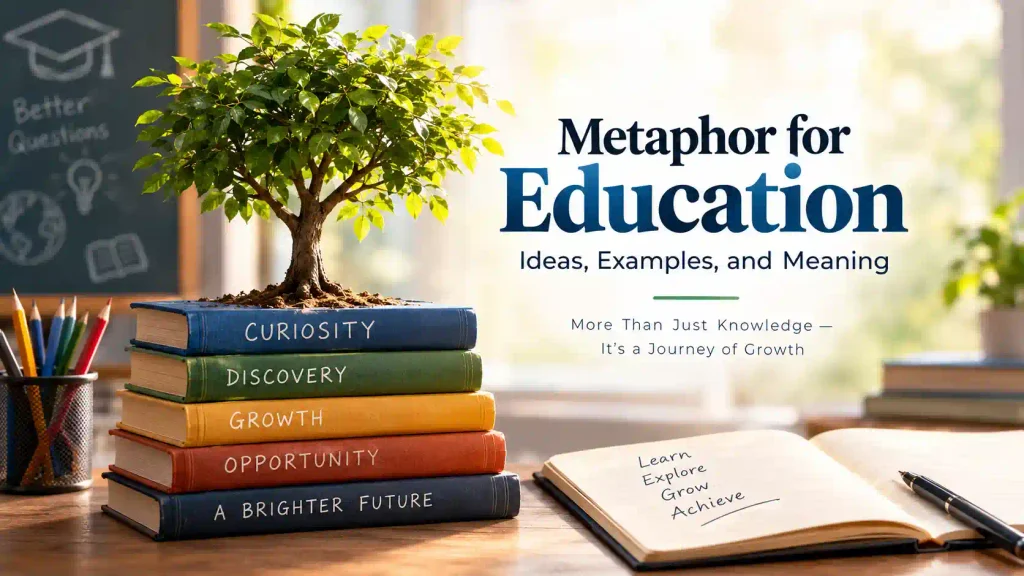
A metaphor for education compares education with something familiar—such as a journey, garden, bridge, foundation, or compass—to express what learning does and how people experience it. The best metaphor depends on the idea you want to communicate: a garden emphasizes growth, a bridge suggests progress, a toolbox highlights useful skills, and a compass represents direction.
Quick Answer
A strong metaphor for education is “Education is a garden.” It suggests that knowledge grows through time, care, practice, and guidance. Other useful metaphors include “Education is a journey,” “Education is a key,” “Education is a foundation,” “Education is a bridge,” and “Education is a compass.” For an essay, choose the metaphor that best matches your main idea rather than simply choosing the most familiar expression.
Best Metaphors for Education
Here are 25 useful metaphors for education, with each one emphasizing a different part of the learning experience.
1. Education is a Garden
Meaning: Education encourages knowledge and abilities to grow over time.
A garden provides a useful image because growth doesn’t happen instantly. Students need time, attention, practice, encouragement, and the right conditions.
Example: Education is a garden where every lesson plants a seed of knowledge.
Best for: Essays, speeches, school writing, and reflective pieces.
Type: Original metaphor based on a familiar educational image.
2. Education is a Journey
Meaning: Education is a continuing process with discoveries, challenges, setbacks, and new destinations.
The journey metaphor works especially well when you want to emphasize that learning doesn’t end with graduation.
Example: Education is a journey that takes us places we could never reach alone.
Best for: Essays, speeches, graduation writing, and inspirational content.
Type: Established conceptual metaphor.
3. Education is a Key
Meaning: Education can open doors to knowledge, opportunities, and new possibilities.
A key doesn’t represent every benefit of education, but it works well when your central idea is access or opportunity.
Example: Education is a key that opens doors to possibilities we cannot yet see.
Best for: Essays and motivational speeches.
Type: Familiar metaphor.
4. Education is a Foundation
Meaning: Education provides the basic knowledge and skills people use to build later achievements.
Like a physical foundation, early learning supports what comes afterward.
Example: A strong education is the foundation on which future opportunities can be built.
Best for: Academic essays and formal writing.
Type: Established metaphor.
5. Education is a Bridge
Meaning: Education connects where a person is now with where they want to go.
The bridge metaphor is particularly effective when discussing education as a path toward a career, greater independence, or new understanding.
Example: Education is a bridge between the person you are and the person you can become.
Best for: Speeches, essays, and inspirational writing.
Type: Familiar metaphor.
6. Education is a Compass
Meaning: Education provides knowledge and judgment that can help people navigate an uncertain world.
Unlike the key metaphor, which emphasizes access, the compass emphasizes direction.
Example: Education is a compass that helps us navigate a complicated world.
Best for: Essays, speeches, and discussions about critical thinking.
Type: Original metaphor using a familiar image.
7. Education is a Toolbox
Meaning: Education gives people skills, knowledge, and ways of solving problems.
This metaphor is especially useful when you want to emphasize practical learning rather than memorization.
Example: Education is a toolbox filled with skills we can use throughout life.
Best for: Career writing, practical education discussions, and classroom assignments.
Type: Familiar conceptual metaphor.
8. Education is a Lighthouse
Meaning: Education can provide clarity and guidance when people face uncertainty.
A lighthouse doesn’t remove the ocean or the storm. Instead, it helps people see their position and navigate more safely.
Example: Education is a lighthouse that helps us find our way through uncertainty.
Best for: Speeches and reflective essays.
Type: Original metaphor.
9. Education is a Window
Meaning: Education can give people new perspectives and expose them to ideas beyond their immediate experience.
Example: Education is a window through which we see worlds beyond our own.
Best for: Essays about culture, literature, history, and global understanding.
Type: Familiar metaphor.
10. Education is a Doorway
Meaning: Education can provide access to experiences, knowledge, and opportunities that may otherwise remain out of reach.
Example: Education is a doorway to ideas that can change the way we see the world.
Best for: Short essays, speeches, and inspirational writing.
Type: Familiar metaphor.
11. Education is a Map
Meaning: Education gives people information that helps them understand where they are and decide where they want to go.
A map, however, doesn’t make the journey for you. That makes this metaphor useful when discussing the relationship between knowledge and personal action.
Example: Education is a map, but each person must choose the road they take.
Best for: Essays requiring a more nuanced metaphor.
Type: Original metaphor.
12. Education is a Workshop
Meaning: Education is a place where people practice, experiment, make mistakes, and improve their abilities.
This image moves away from the idea that learning simply means receiving information.
Example: The classroom is a workshop where ideas become skills through practice.
Best for: Writing about hands-on learning and teaching.
Type: Original metaphor.
13. Education is a Seed
Meaning: Education can begin with a small idea that develops into deeper knowledge over time.
Example: A single lesson can be a seed that grows into a lifetime of curiosity.
Best for: Short writing, poetry, and inspirational pieces.
Type: Familiar metaphor.
14. Education is a Staircase
Meaning: Learning can happen through gradual progress, with each new skill supporting the next.
Example: Education is a staircase, and every lesson gives us another step to climb.
Best for: Essays about academic progress.
Type: Familiar metaphor.
15. Education is a Muscle
Meaning: Learning becomes stronger through regular use, practice, and challenge.
This metaphor works particularly well when discussing the importance of active learning.
Example: The mind is a muscle that education strengthens through practice.
Best for: Writing about study habits, practice, and intellectual development.
Type: Familiar metaphor.
16. Education is a Laboratory
Meaning: Education can be a place for asking questions, testing ideas, making mistakes, and discovering what works.
Example: A good classroom is a laboratory where curiosity turns questions into discoveries.
Best for: Science education and writing about experimentation.
Type: Original metaphor.
17. Education is a Spark
Meaning: Education can ignite curiosity or motivate someone to explore an idea further.
Example: A great teacher can provide the spark that turns curiosity into lifelong learning.
Best for: Teaching essays and inspirational writing.
Type: Familiar metaphor.
18. Education is a Seedbed for Ideas
Meaning: Education provides an environment where ideas can develop before they become mature beliefs, skills, or discoveries.
Example: A thoughtful classroom can become a seedbed for ideas that shape the future.
Best for: Formal essays and writing about creativity.
Type: Original metaphor.
19. Education is a Lens
Meaning: Education can change how people interpret information and understand the world.
A lens doesn’t simply add information; it changes what becomes visible and how something appears.
Example: Education is a lens that helps us examine familiar problems from new angles.
Best for: Essays about critical thinking and perspective.
Type: Original metaphor.
20. Education is a Puzzle
Meaning: Learning often involves connecting separate pieces of information until a larger idea becomes clear.
Example: Education is a puzzle whose pieces gradually form a clearer picture of the world.
Best for: Student essays and creative writing.
Type: Original metaphor.
21. Education is a River
Meaning: Learning can keep moving, changing direction, and carrying people toward new experiences.
Example: Education is a river that keeps moving long after one lesson ends.
Best for: Poetry and reflective writing.
Type: Original metaphor.
22. Education is a Fire
Meaning: Education can create intellectual energy, curiosity, and a desire to keep learning.
Example: Education should be a fire that fuels curiosity rather than a bucket that simply stores facts.
Best for: Essays about meaningful education and teaching.
Type: Original metaphor.
23. Education is a Launchpad
Meaning: Education can prepare people to move from learning toward action, careers, projects, and new experiences.
Example: Education is a launchpad that turns preparation into possibility.
Best for: Graduation speeches and career-focused writing.
Type: Original metaphor.
24. Education is a Mirror
Meaning: Education can help people examine their beliefs, assumptions, abilities, and identity.
Example: Education is a mirror that challenges us to examine what we believe.
Best for: Reflective essays and personal writing.
Type: Original metaphor.
25. Education is a Toolbox for Life
Meaning: Education provides different forms of knowledge and skills that people can apply to real situations.
Example: Education is a toolbox for life, giving us more than answers—it gives us ways to solve problems.
Best for: Speeches, essays, and practical discussions about education.
Type: Original extension of a familiar metaphor.
The Best Metaphors for Education by Meaning
The “best” metaphor depends on what you want education to represent.
| Metaphor | Meaning | Tone | Best Use |
|---|---|---|---|
| Education is a garden | Growth and development | Positive | Essays, speeches |
| Education is a journey | Continuous learning | Reflective | Essays, graduation |
| Education is a key | Opportunity and access | Inspirational | Speeches |
| Education is a foundation | Preparation and stability | Formal | Academic writing |
| Education is a bridge | Progress and transition | Inspirational | Essays, speeches |
| Education is a compass | Direction and judgment | Thoughtful | Critical-thinking essays |
| Education is a toolbox | Practical skills | Practical | Career writing |
| Education is a laboratory | Experimentation | Curious | Science/classroom writing |
| Education is a lens | Perspective | Intellectual | Analytical essays |
| Education is a launchpad | Preparation for action | Ambitious | Graduation writing |
The Tree Metaphor for Education
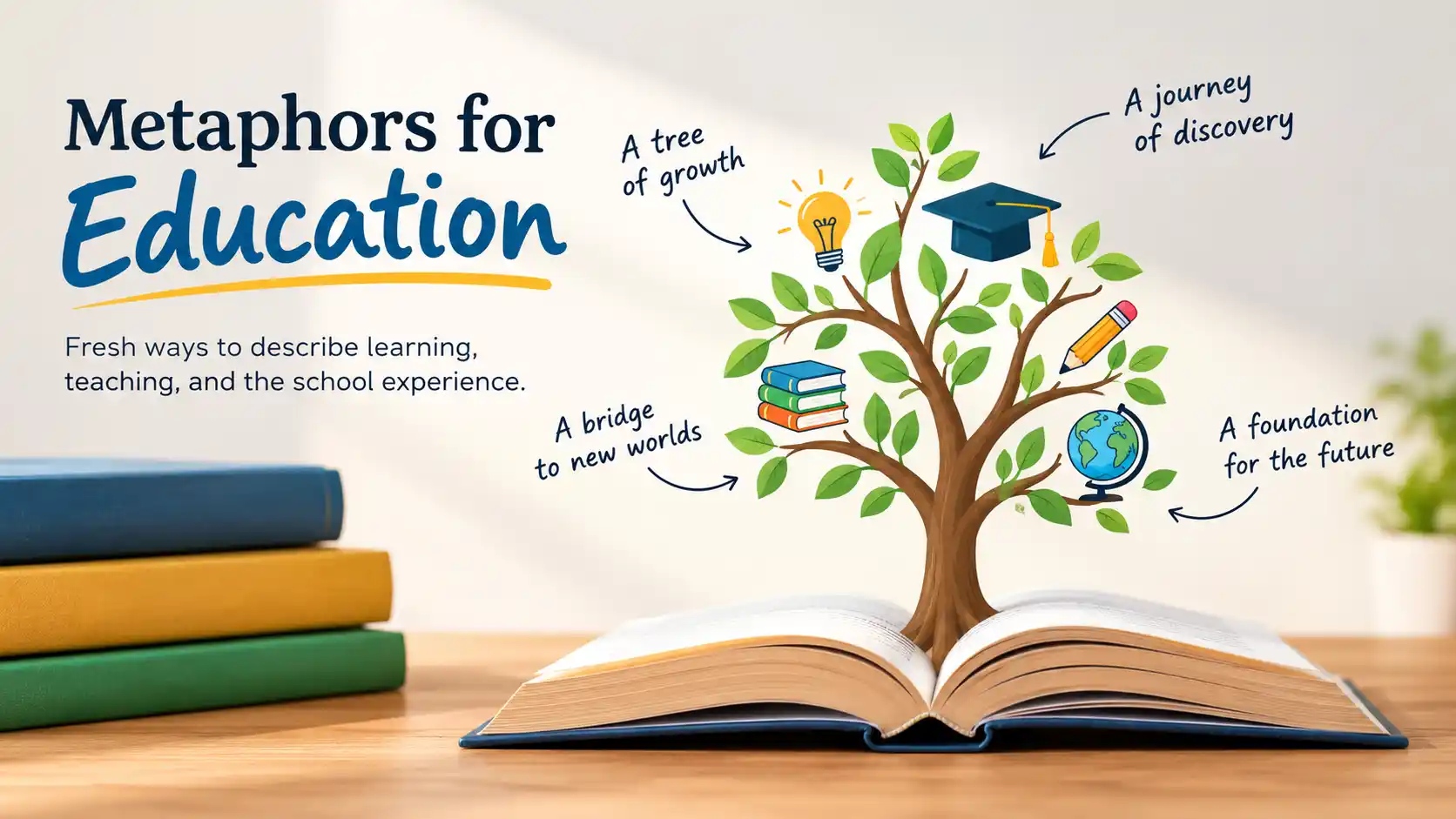
The tree metaphor for education is one of the most useful images for describing gradual intellectual and personal growth.
You can imagine the roots as foundational knowledge, the trunk as developing understanding, the branches as different subjects or interests, and the leaves and fruit as the skills, ideas, and contributions that emerge from learning.
Example: Education is a tree: its roots are knowledge, its branches are possibilities, and its fruit is what we contribute to the world.
The metaphor works because it captures growth, interconnectedness, development, and time in a single image. It also leaves room for individual differences: two trees can grow differently while both remain healthy.
For a more concise version:
Education is a tree whose roots are knowledge and whose branches reach toward possibility.
This is an especially strong choice for an education essay, presentation, poster, or speech.
Metaphors for Teaching
A metaphor for teaching focuses on the teacher’s role rather than education as a whole.
Some strong choices include:
- Teaching is gardening — the teacher creates conditions that support growth.
- Teaching is lighting a fire — the teacher stimulates curiosity.
- Teaching is building a bridge — the teacher helps connect unfamiliar ideas with what students already know.
- Teaching is coaching — the teacher guides practice and improvement.
- Teaching is opening a door — the teacher introduces students to new possibilities.
- Teaching is conducting an orchestra — the teacher coordinates different abilities toward a shared outcome.
Research on educational metaphor supports this distinction: metaphors have been used to examine how teachers understand teaching, curriculum, and their professional roles.
Metaphors for Learning
A metaphor for learning describes the learner’s process rather than the education system itself.
Useful examples include:
- Learning is a journey — knowledge develops through stages and experiences.
- Learning is building — new understanding rests on earlier knowledge.
- Learning is climbing a mountain — progress requires effort and persistence.
- Learning is solving a puzzle — separate pieces gradually form a complete understanding.
- Learning is planting seeds — small ideas can develop into deeper knowledge.
- Learning is opening doors — each discovery can lead to another opportunity.
- Learning is sharpening a tool — practice makes a skill more effective.
This distinction matters because metaphors can reveal different ways of conceptualizing learning. Research has found that learning-oriented metaphors can focus attention on learning processes and outcomes rather than merely on motivation.
Metaphors for the Education System
When you need a metaphor for the education system, choose an image that represents structure rather than an individual learning experience.
The education system is an ecosystem
This metaphor emphasizes the relationships among students, teachers, families, schools, communities, policies, and resources.
Example: The education system is an ecosystem in which every part affects the health of the whole.
The education system is an engine
This metaphor emphasizes how education can help move society forward.
Example: A strong education system is an engine that can drive social and economic progress.
The education system is a pipeline
This metaphor emphasizes movement through stages, such as early education, secondary school, higher education, and employment.
However, it can oversimplify education by making people sound like products moving through a fixed process. Use it carefully.
The education system is a network
This metaphor emphasizes connection and collaboration rather than a simple one-way path.
Example: The education system is a network connecting learners, teachers, families, institutions, and communities.
Short Metaphors for Education
If you need a short metaphor for education, these work well:
- Education is a key.
- Education is a journey.
- Education is a bridge.
- Education is a garden.
- Education is a compass.
- Education is a foundation.
- Education is a doorway.
- Education is a light.
- Education is a seed.
- Education is a launchpad.
For an essay, “Education is a foundation” is one of the safest choices because it naturally supports an argument about preparation, while “Education is a journey” works better when you want to emphasize continuous growth.
Metaphor for Education Examples in Sentences
Here are several ready-to-use examples:
- Education is a garden where knowledge grows with care and curiosity.
- Education is a bridge that connects today’s learner with tomorrow’s possibilities.
- Education is a compass that helps people navigate an uncertain world.
- Education is a foundation on which future skills and ambitions can stand.
- Education is a key that opens doors to new ideas.
- Education is a journey with discoveries around every turn.
- Education is a toolbox filled with skills for solving real problems.
- Education is a lens that changes how we see the world.
- Education is a laboratory where questions become experiments and discoveries.
- Education is a launchpad from which new possibilities take flight.
Metaphors for School
A metaphor for school describes the school experience or environment rather than education in the broadest sense.
Some useful school metaphor examples include:
- School is a garden — students grow through learning and guidance.
- School is a workshop — students practice and develop skills.
- School is a community — students and teachers learn with and from one another.
- School is a bridge — students prepare for the next stage of life.
- School is a laboratory — students investigate, experiment, and discover.
- School is a training ground — students prepare for future responsibilities.
- School is a doorway — students encounter new ideas and opportunities.
- School is a maze — students sometimes navigate difficult choices and challenges.
- School is a small world — students encounter different people, ideas, and social experiences.
The important point is that school doesn’t have one universally “correct” metaphor. The right image depends on what you want to say about school. Current search results similarly emphasize that different metaphors highlight different aspects of school life.
What Are 5 Metaphor Examples?
Five simple metaphor examples for education are:
- Education is a garden.
- Education is a journey.
- Education is a bridge.
- Education is a key.
- Education is a compass.
Each creates a different image. The garden emphasizes growth, the journey emphasizes progress, the bridge emphasizes transition, the key emphasizes opportunity, and the compass emphasizes direction.
What Are Some Metaphors for Learning?
Some effective metaphors for learning include:
- Learning is a journey.
- Learning is building a house.
- Learning is climbing a mountain.
- Learning is solving a puzzle.
- Learning is planting a seed.
- Learning is opening a door.
- Learning is sharpening a tool.
- Learning is exploring a new country.
Choose according to the idea you want to communicate. If you want to emphasize effort, climbing works. And if you want to emphasize development, planting works. If you want to emphasize connecting information, a puzzle works.
What Are Some Unique Metaphors for Teaching?
For a less predictable metaphor for teaching, try:
- Teaching is tuning an orchestra.
- Teaching is lighting a constellation.
- Teaching is building a bridge between questions and answers.
- Teaching is opening windows in a dark room.
- Teaching is cultivating a field of possibilities.
- Teaching is giving someone a set of lenses.
- Teaching is coaching a mind to recognize its own strength.
These work particularly well in reflective essays because they move beyond the most common “teacher as gardener” comparison.
What Is a Good Metaphor for School?
A strong all-purpose metaphor is:
School is a workshop for the future.
It suggests that students don’t simply receive information. They practice skills, make mistakes, experiment, solve problems, and prepare for situations beyond the classroom.
If your writing focuses on personal growth, however, “school is a garden” may work better. If it focuses on transition into adulthood, “school is a bridge” may be stronger.
Metaphor for Education Essay
For a metaphor for education essay, choose one central image and develop it instead of inserting many unrelated metaphors.
For example:
Education is a garden. Students enter with different experiences, abilities, and interests. Teachers help create conditions in which those qualities can develop. Some ideas take root quickly, while others require more time and attention. Education, therefore, is not simply about filling a mind with information; it is about creating the conditions for knowledge, curiosity, and ability to grow.
This approach gives the metaphor a clear argument rather than using it as decorative language.
Another strong essay metaphor is education as a foundation:
Education is the foundation of a person’s intellectual growth. Just as a building depends on a stable base, later knowledge depends on the skills and understanding developed earlier.
How to Choose the Right Education Metaphor
Start with the idea, not the metaphor.
If you want to communicate:
- Growth: choose a garden or tree.
- Progress: choose a journey or staircase.
- Opportunity: choose a key or doorway.
- Direction: choose a compass or map.
- Preparation: choose a foundation or training ground.
- Practical skills: choose a toolbox or workshop.
- Discovery: choose a laboratory or exploration.
- Perspective: choose a lens or window.
- Curiosity: choose a spark or fire.
- Transition: choose a bridge.
- Future possibilities: choose a launchpad.
The strongest metaphor makes your argument easier to understand. It shouldn’t merely sound poetic.
Metaphor vs. Simile in Education
A metaphor makes a direct comparison:
Education is a journey.
A simile usually uses “like” or “as”:
Education is like a journey.
Both can communicate a similar idea, but the metaphor creates a more direct and confident image.
For an essay, either can work. If you want a stronger figurative statement, use the metaphor.
FAQs
What is the best metaphor for education?
There is no single best metaphor for every situation. “Education is a garden” works well for growth, “education is a journey” for continuous learning, “education is a foundation” for preparation, and “education is a compass” for direction and critical thinking.
What is a metaphor for education and learning?
A useful metaphor for both education and learning is “Education is a journey.” It captures the idea that learning develops over time through experiences, challenges, discoveries, and progress.
What is the tree metaphor for education?
The tree metaphor presents education as a process of growth. Roots can represent foundational knowledge, the trunk can represent developing understanding, branches can represent different subjects or possibilities, and the fruit can represent the skills or contributions that emerge from learning.
What is a good metaphor for a teacher?
“A teacher is a gardener” is a familiar metaphor because it emphasizes nurturing and growth. For a more distinctive image, “a teacher is a compass” can emphasize guidance, while “a teacher is a coach” emphasizes practice and improvement.
What are 10 metaphors for school?
Ten useful school metaphors are a garden, workshop, bridge, laboratory, community, training ground, doorway, maze, launchpad, and small world. Each highlights a different aspect of school life.
How do you say “I love you” in a metaphor?
You can express love through an image rather than stating it directly. For example: “You are the light that makes my darkest days easier to navigate.” Another option is “You are the home my heart keeps returning to.” These are original metaphors rather than established sayings.
Conclusion
The best metaphor for education depends on the message you want to communicate. A garden represents growth, a journey represents continuous learning, a foundation represents preparation, a bridge represents transition, a key represents opportunity, and a compass represents direction.
Instead of choosing a metaphor simply because it sounds impressive, ask what you want readers to understand about education. When the image and the idea match, the metaphor becomes more than decoration—it becomes a clear way of thinking about learning.

Qaiser Abbas is an award-winning author, leadership coach, and motivational speaker known for his work on personal growth, leadership, and human potential. Through his writing and speaking, Qaiser focuses on turning challenges into opportunities and helping people build the mindset to achieve meaningful growth.