
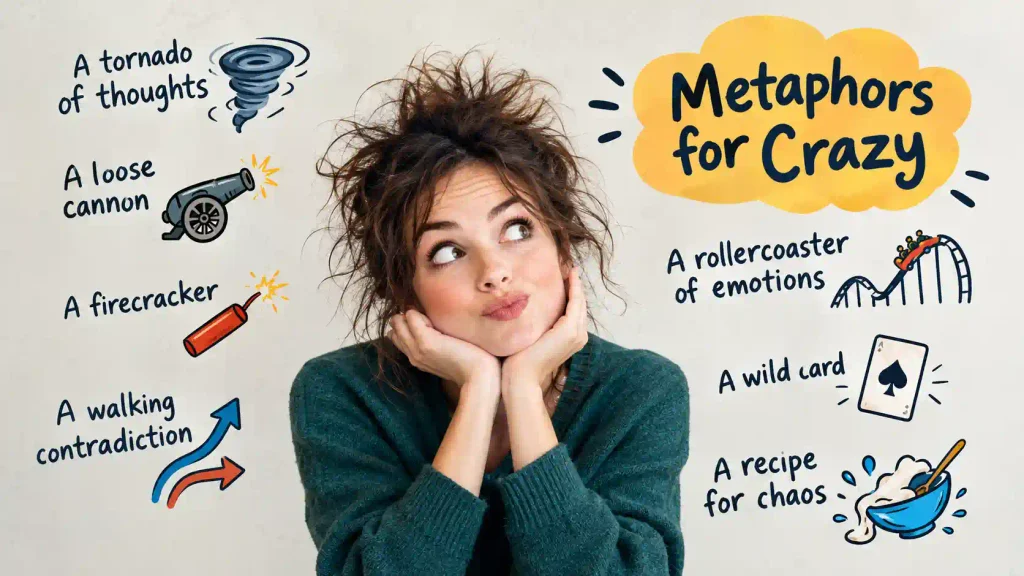
A metaphor for crazy turns an abstract idea such as chaos, irrationality, wild energy, or unpredictable behavior into a vivid image. Instead of simply saying someone is “crazy,” you might describe a mind as a storm with no eye, a situation as a runaway train, or a personality as a firecracker with a short fuse.
The best expression depends on what you actually mean. “Crazy” can describe something foolish or unreasonable, something unusually strange, intense behavior, or, in some contexts, mental illness. Because those meanings differ, a good metaphor should show the specific quality you want to describe.
Crazy Metaphor
A strong metaphor for crazy is “a storm with no eye.” It suggests constant chaos, emotional turbulence, and a lack of calm. Other useful metaphors include “a runaway train,” “a mind full of fireworks,” “a spinning compass,” and “a house with every light flashing.” For everyday speech, established idioms such as “off one’s rocker” or “lost one’s marbles” may sound more natural than a newly created metaphor.
20 Metaphors for Crazy
The following list focuses on distinct images rather than repeating the same idea with different objects. Some are original metaphors created for this article; established expressions are identified separately below.
| Metaphor | Meaning | Metaphor | Meaning |
| A storm with no eye | Constant emotional or mental chaos | A runaway train | Behavior or thoughts moving beyond control |
| A mind full of fireworks | Bursts of wild, energetic, or unpredictable thoughts | A spinning compass | Confusion and lack of direction |
| A firecracker with a short fuse | Someone quick to react or explode emotionally | A room of bouncing balls | Too many thoughts competing for attention |
| A carnival with no closing time | Continuous excitement, noise, and disorder | A broken traffic light | Conflicting signals and unpredictable behavior |
| A roller coaster without brakes | Extreme emotional ups and downs | A radio between stations | Disconnected or constantly shifting thoughts |
| A shaken soda bottle | Pressure building until an explosive reaction | A kite in a hurricane | Uncontrolled movement in overwhelming circumstances |
| A clock with every hand moving differently | Confusion about timing, priorities, or direction | A puzzle with moving pieces | A situation that refuses to settle into order |
| A circus inside a thunderstorm | Overwhelming, noisy, chaotic energy | A compass dancing on a magnet | Decisions constantly pulled in different directions |
| A squirrel-powered machine | Restless, frantic, almost comically energetic behavior | A door swinging in the wind | Unpredictable changes from one moment to another |
| A garden growing through the floorboards | Thoughts or impulses breaking through every attempt at control | A deck of cards caught in the wind | Plans, ideas, or reactions scattered unpredictably |
These metaphors work because they show a quality rather than simply labeling it. A runaway train emphasizes momentum, while a spinning compass emphasizes confusion. A firecracker emphasizes sudden reaction, while a radio between stations emphasizes disconnected thought.
Metaphors for Different Kinds of “Crazy”
“Crazy” does not always mean the same thing. Choosing an image based on the intended meaning makes the writing more precise.
When You Mean Chaotic
Use images involving storms, broken systems, or uncontrolled movement.
A storm with no eye works when everything feels chaotic and there is no obvious moment of calm.
Example:
Her thoughts were a storm with no eye, circling from one worry to another.
A circus inside a thunderstorm adds a more exaggerated and humorous sense of disorder.
Example:
The office became a circus inside a thunderstorm after the announcement.
When You Mean Unpredictable
Use images that suggest movement without a fixed direction.
A spinning compass suggests that a person’s thoughts or decisions keep changing.
Example:
His plans were a spinning compass, pointing somewhere new every five minutes.
A door swinging in the wind works particularly well for inconsistent behavior.
Example:
Her mood was a door swinging in the wind—impossible to predict.
When You Mean Extremely Energetic
Fire, electricity, and motion create a more energetic image.
A mind full of fireworks suggests rapid bursts of ideas, excitement, or creative energy.
Example:
Her mind was full of fireworks, producing one strange idea after another.
A squirrel-powered machine gives the description a deliberately funny tone.
Example:
After three cups of coffee, he became a squirrel-powered machine.
When You Mean Out of Control
Movement-based metaphors work especially well here.
A runaway train suggests that something has gained momentum and no longer responds easily to control.
Example:
The argument became a runaway train once everyone started shouting.
A roller coaster without brakes emphasizes extreme emotional movement.
Example:
The week felt like a roller coaster without brakes.
When You Mean Confused
Navigation and communication imagery can make confusion easier to visualize.
A radio between stations suggests thoughts that refuse to settle into a clear signal.
Example:
After staying awake all night, my brain was a radio between stations.
A broken traffic light can represent conflicting signals or decisions.
Example:
His thoughts were a broken traffic light—stop, go, stop, go.
Funny Metaphors for Crazy
If you want a funny metaphor for crazy, exaggeration usually works better than harsh labeling. The goal is to create a ridiculous mental picture.
Try:
- A squirrel-powered machine — comically restless energy.
- A circus inside a thunderstorm — exaggerated chaos.
- A carnival with no closing time — nonstop excitement or disorder.
- A room of bouncing balls — too many thoughts happening at once.
- A shaken soda bottle — someone who seems ready to burst.
Example:
My schedule is a carnival with no closing time.
That sounds playful because it describes the situation rather than making a serious claim about a person’s mental health.
What Is a Metaphor for a Crazy Person?
- There is no single metaphor that fits every person or situation. The better choice depends on the behavior you want to describe.
- If the person behaves unpredictably, “a spinning compass” emphasizes inconsistency.
- If the person reacts explosively, “a firecracker with a short fuse” emphasizes quick emotional reactions.
- If the person has enormous energy, “a squirrel-powered machine” creates a humorous image.
- If the person’s thoughts seem confused, “a radio between stations” focuses on mental noise and lack of clarity.
For a real person, however, describing specific behavior is usually clearer than labeling the person as “crazy.”
Established Idioms and Expressions for Crazy
Not every popular expression is technically a metaphor. English contains many idioms and figurative expressions that people use to communicate the idea of being crazy, foolish, eccentric, or irrational.
Off One’s Rocker
This established slang expression means crazy and can also suggest foolish, irrational, or eccentric behavior.
Example:
You’d have to be off your rocker to attempt that without a plan.
The expression is informal, so it fits casual conversation better than formal writing.
Lost One’s Marbles
“Lose one’s marbles” is an established expression meaning to lose one’s mind or become crazy.
Example:
I must have lost my marbles—I left my keys in the refrigerator.
It often works humorously when someone is describing their own forgetfulness rather than making a serious statement about another person.
Bats in the Belfry
“Bats in the belfry” is a slang expression associated with being crazy or eccentric.
Example:
He must have bats in the belfry if he thinks that plan will work.
Its unusual image makes it more playful and old-fashioned than a straightforward synonym.
Mad as a Hatter
This established expression describes someone as extremely eccentric or crazy.
Example:
The character was as mad as a hatter, constantly inventing bizarre machines.
It has a literary and old-fashioned flavor, so it can work particularly well in storytelling.
Mad as a March Hare
This expression describes someone as extremely wild or crazy and comes from the traditional image of hares behaving excitedly during their breeding season.
Example:
By midnight, the party guests were as mad as March hares.
Crazy Like a Fox
This expression is different from most expressions on this list. It suggests that someone appears foolish but is actually clever or calculating.
Example:
Everyone thought her decision was ridiculous, but she was crazy like a fox.
So this expression should not simply replace “crazy.” Its meaning includes hidden cleverness.
Barking Mad
“Barking mad” is an informal expression meaning thoroughly crazy and is especially associated with British and Australian English.
Example:
That sounds barking mad, but somehow the plan worked.
For a U.S. audience, it can sound deliberately British or playful rather than like ordinary American conversation.
Funny Ways to Say Someone Is Acting Crazy
If the goal is humor, focus on the behavior rather than making a serious claim about someone’s mental health.
Some playful options include:
- You’re running on pure chaos today.
- Your brain has left the group chat.
- You’re operating without a user manual.
- Your thoughts are doing laps.
- You’ve turned the volume on your imagination all the way up.
- Your plan has officially escaped the building.
- Your brain is juggling flaming marshmallows.
- You’re one plot twist away from a sitcom.
These are original humorous descriptions rather than established idioms. They work well for casual writing, captions, dialogue, and friendly teasing when the relationship supports that tone.
Crazy Metaphors for a Girl or Woman
The same principle applies when someone searches for a metaphor for crazy girl. Gender does not require a different metaphor. The useful distinction is the behavior being described.
For example:
- A firecracker with a short fuse — quick reactions.
- A carnival with no closing time — nonstop energy.
- A spinning compass — unpredictable decisions.
- A mind full of fireworks — intense creative or emotional energy.
- A door swinging in the wind — constantly changing behavior.
Example:
Her imagination was a mind full of fireworks, lighting up one unexpected idea after another.
This approach gives the description personality without relying on a gender stereotype.
Synonyms for Crazy in a Negative Sense
When crazy means “not sensible,” “unreasonable,” or “extremely unusual,” a more precise synonym can often improve the sentence.
Depending on context, useful alternatives include:
- Irrational — lacking a reasonable basis.
- Unreasonable — not sensible or justified.
- Reckless — showing little concern for danger or consequences.
- Chaotic — lacking order or control.
- Unpredictable — difficult to anticipate.
- Absurd — wildly unreasonable or ridiculous.
- Eccentric — noticeably unconventional.
- Wild — unusually uncontrolled or extreme.
- Frenzied — intensely excited or agitated.
- Bizarre — very strange or unusual.
The important distinction is that these words do not all mean the same thing. For example, eccentric can describe unusual behavior without necessarily implying something harmful, while reckless focuses on dangerous disregard for consequences.
What Is a Metaphor for Madness?
A metaphor for madness can represent disorder, loss of control, confusion, obsession, or overwhelming emotion without directly naming any of those states.
For example:
A maze with no exit can represent a mind trapped in confusion.
Example:
His thoughts became a maze with no exit.
A storm trapped inside a room can represent intense internal turmoil.
Example:
Her emotions were a storm trapped inside a room.
A machine with every gear turning at once can represent overwhelming mental activity.
Example:
His mind was a machine with every gear turning at once.
These images work especially well in poetry, fiction, and descriptive writing because they leave room for interpretation.
Slang for “Being Crazy”
Informal English has many slang terms associated with unusual or irrational behavior, including cuckoo, loony, bonkers, nuts, wacky, and off one’s rocker.
Their tone varies considerably. Some sound playful; others can sound insulting or dismissive.
For example:
- Cuckoo — playful and informal.
- Wacky — usually emphasizes strange or unconventional behavior.
- Bonkers — strongly informal and often humorous.
- Nuts — casual and potentially insulting depending on context.
- Loony — informal and often humorous, but it can also sound derogatory.
- Off one’s rocker — an established informal idiom.
For professional, academic, or sensitive contexts, specific descriptive words such as unpredictable, irrational, erratic, or eccentric are usually clearer.
Metaphor vs. Simile: What’s the Difference?
A metaphor directly identifies one thing with another:
His mind was a runaway train.
A simile makes the comparison explicit with words such as like or as:
His mind was like a runaway train.
Both create imagery, but they use different grammatical structures.
Choosing the Right Metaphor for Crazy Expression
| What you mean | Useful choice | Tone | Best use |
| Chaotic behavior | A storm with no eye | Dramatic | Creative writing |
| Unpredictable decisions | A spinning compass | Poetic | Essays and fiction |
| Explosive reactions | A firecracker with a short fuse | Playful | Casual writing |
| Too many thoughts | A room of bouncing balls | Light | Personal writing |
| Uncontrolled momentum | A runaway train | Strong | Everyday and creative writing |
| Confusion | A radio between stations | Poetic | Poetry and reflective writing |
| Extreme energy | A mind full of fireworks | Energetic | Creative writing |
| Comical restlessness | A squirrel-powered machine | Funny | Casual speech |
| Constant disorder | A carnival with no closing time | Humorous | Social media and fiction |
| Emotional pressure | A shaken soda bottle | Vivid | Descriptive writing |
The best metaphor is not necessarily the funniest or most dramatic one. Choose the image that matches the exact quality you want readers to notice.
When to Use a More Neutral Word
Sometimes the best alternative to a metaphor is simply a more precise word.
Instead of:
He is crazy.
You might write:
He is unpredictable.
Or:
Her reaction was irrational.
Or:
The situation became chaotic.
Or:
His behavior was unusually reckless.
These alternatives can communicate more information while avoiding the ambiguity of “crazy.”
FAQs About Metaphors for Crazy
What is a metaphor for crazy?
A metaphor for crazy describes unusual, chaotic, irrational, or unpredictable behavior through a vivid image. Examples include “a runaway train,” “a storm with no eye,” and “a mind full of fireworks.” The best metaphor depends on whether you want to emphasize confusion, energy, instability, humor, or loss of control.
What is an idiom for a crazy person?
Common figurative expressions include “off one’s rocker,” “lost one’s marbles,” “bats in the belfry,” “mad as a hatter,” and “mad as a March hare.” These are idioms or established expressions rather than all being strict metaphors.
What is a metaphor for madness?
Useful metaphors for madness include “a maze with no exit,” “a storm trapped inside a room,” and “a machine with every gear turning at once.” Each emphasizes a different aspect of inner turmoil, such as confusion, emotional pressure, or overwhelming thought.
What are some funny ways to say someone is crazy?
For playful situations, you can say someone is “running on pure chaos,” “operating without a user manual,” “one plot twist away from a sitcom,” or that “their brain has left the group chat.” These are humorous original expressions rather than established idioms.
What are 20 metaphors for crazy?
Twenty useful metaphors include a storm with no eye, a runaway train, a mind full of fireworks, a spinning compass, a firecracker with a short fuse, a room of bouncing balls, a carnival with no closing time, a broken traffic light, a roller coaster without brakes, a radio between stations, a shaken soda bottle, a kite in a hurricane, a clock with every hand moving differently, a puzzle with moving pieces, a circus inside a thunderstorm, a compass dancing on a magnet, a squirrel-powered machine, a door swinging in the wind, a garden growing through the floorboards, and a deck of cards caught in the wind.
Is “crazy” always a negative word?
No. “Crazy” can describe something foolish or unreasonable, something very strange, intense or unpredictable behavior, or mental illness depending on context. Because the word has several meanings, a more specific word such as chaotic, eccentric, reckless, irrational, or unpredictable can sometimes communicate the intended meaning more accurately.
Conclusion
A good metaphor for crazy does more than replace the word “crazy.” It tells readers what kind of craziness you mean. A runaway train suggests unstoppable momentum, a spinning compass suggests confusion, a firecracker with a short fuse suggests explosive reactions, and a mind full of fireworks suggests energetic or unpredictable thinking.
For humor, use exaggerated images, For fiction and poetry, choose vivid sensory comparisons. For everyday communication, established idioms may sound more natural. And when the subject is sensitive, describe the specific behavior rather than using “crazy” as a broad label.

Qaiser Abbas is an award-winning author, leadership coach, and motivational speaker known for his work on personal growth, leadership, and human potential. Through his writing and speaking, Qaiser focuses on turning challenges into opportunities and helping people build the mindset to achieve meaningful growth.