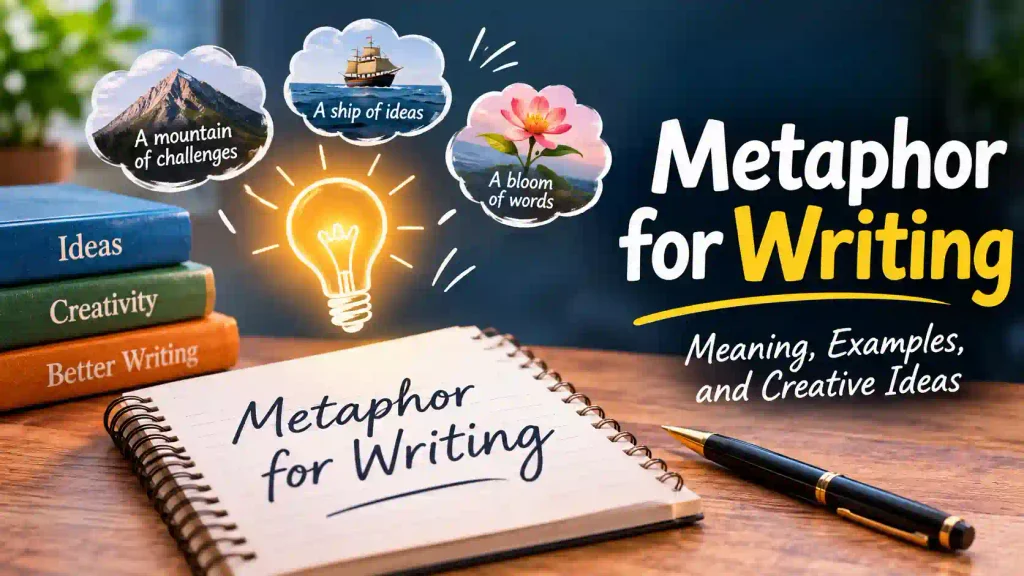
Writing is more than putting words on a page. It is an act of discovery, a bridge between minds, and sometimes a journey through thoughts that are difficult to express. A metaphor for writing compares the writing process to something familiar, helping readers understand its creativity, challenges, emotions, and power.
Whether you need a metaphor for a school essay, a creative writing assignment, a poem, or a personal reflection, the right comparison can make your message more memorable. Some metaphors describe writing as an artistic process, while others capture the struggle of finding words, shaping ideas, and sharing experiences.
Below are 25 creative metaphors for writing, including familiar expressions and original comparisons, with clear meanings and example sentences.
What Is a Metaphor for Writing?
A metaphor for writing describes writing by comparing it directly to another thing without using “like” or “as.” For example, writing is a journey suggests that creating a piece of work involves exploration, challenges, and discovery. Other examples include writing as painting with words, planting seeds, building bridges, and opening windows into the mind.
25 Best Metaphors for Writing
These metaphors explore different aspects of writing, from generating ideas to editing a finished piece. Each includes its meaning and an example sentence to show how it works in context.
1. Writing Is a Journey
Type: Established metaphor
Writing is a journey because it takes a writer through different stages, including inspiration, uncertainty, discovery, and completion. Like a traveler, a writer learns along the way and sometimes changes direction.
Example: Writing this novel has been a long journey filled with unexpected discoveries and difficult decisions.
Best use: Personal essays, reflections, speeches, and discussions about creative growth.
2. Writing Is Painting With Words
Type: Established metaphor
This metaphor presents words as colors and sentences as brushstrokes. Writers create mental pictures by choosing descriptive language, arranging details, and building an atmosphere.
Example: The poet painted a picture of the countryside with words that brought every flower and mountain to life.
Best use: Poetry, descriptive essays, storytelling, and creative writing.
3. Writing Is a Bridge Between Minds
Type: Established metaphor
Writing connects people who may never meet or share the same experiences. Through words, writers communicate ideas, emotions, knowledge, and perspectives across distances and generations.
Example: Her memoir became a bridge between her personal experiences and the lives of thousands of readers.
Best use: Speeches, persuasive essays, communication, and discussions about literature.
4. Writing Is Planting Seeds
Type: Original metaphor
An idea is a seed that grows through research, imagination, and careful development. A small thought can eventually become a complete story, essay, or book.
Example: Every paragraph she writes plants another seed in the reader’s imagination.
Best use: Educational writing, motivational speeches, and discussions about creativity.
5. Writing Is a Mirror of the Mind
Type: Established conceptual metaphor
Writing reflects a person’s thoughts, beliefs, feelings, and experiences. It allows writers to examine their own thinking while giving readers a glimpse into another person’s perspective.
Example: His journal became a mirror of his mind, revealing fears and hopes he rarely expressed aloud.
Best use: Personal narratives, memoirs, reflective essays, and journaling.
6. Writing Is a Lighthouse in the Darkness
Type: Original metaphor
Writing can provide direction when people feel confused, uncertain, or overwhelmed. Clear explanations and thoughtful words help readers find their way through complicated ideas.
Example: Her article was a lighthouse in the darkness for students struggling to understand the subject.
Best use: Inspirational writing, educational articles, and persuasive speeches.
7. Writing Is a Garden of Ideas
Type: Established-style metaphor
A piece of writing resembles a garden where ideas grow, develop, and interact. Some thoughts flourish, while others need more attention or must be removed to make room for stronger ones.
Example: His notebook was a garden of ideas, filled with unfinished stories and promising observations.
Best use: Creative writing, brainstorming, teaching, and discussions about the writing process.
8. Writing Is Building a House
Type: Established metaphor
Writing requires structure, planning, and attention to detail. Ideas form the foundation, paragraphs build the walls, and supporting evidence strengthens the entire structure.
Example: She built her research paper like a house, starting with a strong foundation before adding supporting arguments.
Best use: Academic essays, research papers, reports, and structured arguments.
9. Writing Is a Key That Unlocks the Imagination
Type: Original metaphor
Words open doors to possibilities that readers might never have considered. Through storytelling and description, writers invite people into new worlds and experiences.
Example: His first short story became a key that unlocked his imagination.
Best use: Children’s literature, fiction, poetry, and motivational writing.
10. Writing Is a River of Thoughts
Type: Established-style metaphor
Writing can resemble a flowing river because ideas move from one thought to another. Sometimes the flow is smooth; at other times, obstacles interrupt it.
Example: Her thoughts became a river of words as she poured her ideas onto the page.
Best use: Poetry, freewriting, personal essays, and creative expression.
11. Writing Is a Sculptor Shaping Stone
Type: Original metaphor
A first draft is like an unfinished block of stone. Through revision, writers remove unnecessary words, reshape sentences, and reveal the strongest ideas hidden inside their work.
Example: The editor was a sculptor shaping stone, carefully removing every sentence that weakened the story.
Best use: Editing, revision, literary criticism, and discussions about craftsmanship.
12. Writing Is a Window Into the Soul
Type: Established-style metaphor
Writing allows readers to see the emotions, values, and experiences behind a person’s words. It can reveal thoughts that remain hidden in ordinary conversation.
Example: Her poetry was a window into the soul, exposing the emotions she struggled to express.
Best use: Poetry, memoirs, personal essays, and emotional storytelling.
13. Writing Is Lighting a Fire
Type: Established metaphor
Powerful writing can awaken curiosity, inspire action, and encourage people to reconsider their beliefs. Like a fire, a strong idea can spread from one person to another.
Example: His speech lit a fire in the hearts of young writers.
Best use: Motivational speeches, persuasive essays, opinion articles, and activism.
14. Writing Is a Treasure Hunt
Type: Original metaphor
Writing often involves searching for the right words, uncovering useful information, and discovering unexpected connections. The finished piece represents the treasure found through exploration.
Example: Researching her historical novel was a treasure hunt that uncovered stories hidden for generations.
Best use: Research writing, investigative articles, academic assignments, and storytelling.
15. Writing Is a Compass for Thought
Type: Original metaphor
Writing helps organize scattered ideas and establish a direction. A clear thesis or central message acts as a compass that keeps an article or essay focused.
Example: His opening argument became a compass that guided every section of the essay.
Best use: Academic writing, persuasive essays, business communication, and reports.
16. Writing Is a Dance of Words
Type: Original metaphor
Writing involves rhythm, movement, balance, and coordination. Sentences work together to create a natural flow, while carefully chosen words give a passage its personality.
Example: The novelist created a dance of words that made even ordinary conversations feel beautiful.
Best use: Poetry, fiction, lyrical prose, and creative descriptions.
17. Writing Is a Time Machine
Type: Established-style metaphor
Written words preserve memories, historical events, and personal experiences. They allow future readers to explore moments from the past and understand lives beyond their own time.
Example: Her grandfather’s letters became a time machine that transported the family back to another generation.
Best use: Historical writing, biographies, memoirs, and personal narratives.
18. Writing Is a Puzzle
Type: Established metaphor
Writing involves bringing separate pieces of information together to create a complete picture. Writers must arrange ideas, evidence, examples, and transitions so that everything makes sense.
Example: Completing the research paper was like solving a puzzle, with every new source adding another missing piece.
Best use: Research papers, analytical essays, journalism, and problem-solving articles.
19. Writing Is a Voice Without a Body
Type: Original metaphor
Writing allows a person’s ideas and personality to communicate even when the writer is physically absent. A book, letter, or article can speak to readers long after its author has left the room.
Example: Through her published letters, her voice without a body continued to comfort people who had never met her.
Best use: Letters, memoirs, literature, and discussions about the lasting influence of writing.
20. Writing Is a Seed That Grows Into a Forest
Type: Original metaphor
A small idea can develop into something much larger when writers nurture it with imagination, research, and patience. A single sentence may inspire an entire book.
Example: His simple observation became a seed that grew into a forest of stories.
Best use: Creative writing, novels, personal development, and motivational content.
21. Writing Is a Ship Sailing Through the Unknown
Type: Original metaphor
Writing can involve navigating unfamiliar territory. Writers often begin without knowing exactly where an idea will lead, but curiosity and persistence help them move forward.
Example: Every new chapter was another voyage as she sailed through the unknown waters of her imagination.
Best use: Fiction, poetry, reflective essays, and discussions about uncertainty.
22. Writing Is a Conversation Across Time
Type: Established conceptual metaphor
Written communication allows people from different generations to exchange ideas. Readers can engage with the thoughts of authors who lived centuries before them.
Example: Reading the philosopher’s work felt like joining a conversation across time.
Best use: Literary essays, historical discussions, academic writing, and book reviews.
23. Writing Is a Sculpted Echo
Type: Original metaphor
Writing preserves an idea or emotion and sends it outward to be experienced by others. Like an echo, a message can continue to resonate long after the original words were written.
Example: Her final poem was a sculpted echo of the childhood memories that shaped her life.
Best use: Poetry, reflective writing, literary analysis, and emotional storytelling.
24. Writing Is a Lantern for Unspoken Thoughts
Type: Original metaphor
Writing brings hidden feelings and complicated ideas into the open. It helps writers understand experiences that they might otherwise struggle to explain.
Example: His diary became a lantern for unspoken thoughts, illuminating emotions he had kept hidden for years.
Best use: Journaling, personal essays, memoirs, and emotional narratives.
25. Writing Is an Orchestra of Ideas
Type: Original metaphor
A successful piece of writing brings different elements together in harmony. Vocabulary, sentence structure, tone, evidence, and rhythm work together to create a unified experience.
Example: The journalist conducted an orchestra of ideas, bringing facts, voices, and perspectives together in one compelling article.
Best use: Long-form articles, speeches, essays, storytelling, and collaborative writing.
Metaphors for Different Stages of the Writing Process
Writing is not a single action. It involves several stages, and each stage has its own challenges. Choosing a metaphor based on the specific stage makes the comparison more meaningful.
Metaphors for Writing Inspiration
These metaphors describe the excitement of discovering ideas and beginning a new project.
- A Spark in the Dark: A small idea that suddenly inspires a larger creative project.
- A Garden Waiting for Rain: An imagination full of potential that needs inspiration to grow.
- A Door to Another World: The beginning of a story that opens up new possibilities.
- A Match That Starts a Fire: A single thought that develops into a powerful creative idea.
Example: One conversation became a spark in the dark, inspiring an entire collection of short stories.
Metaphors for the Writing Process
These comparisons describe the experience of turning thoughts into sentences and complete pieces of writing.
- A River Finding Its Course: Ideas gradually develop a natural direction.
- A Road Through the Wilderness: Writing involves uncertainty, exploration, and discovery.
- A House Under Construction: A draft develops through planning and careful organization.
- A Thread Connecting Thoughts: Each sentence links one idea to the next.
Example: Writing her first novel was a road through the wilderness, full of unexpected turns and discoveries.
Metaphors for Editing and Revision
Editing is more than correcting spelling mistakes. It involves strengthening meaning, improving organization, and removing unnecessary material.
- Polishing a Diamond: Improving an already valuable piece of writing.
- Sculpting a Block of Marble: Removing unnecessary material to reveal the strongest ideas.
- Tuning a Musical Instrument: Adjusting sentences, rhythm, and word choices until everything works together.
- Weaving Loose Threads: Connecting disconnected paragraphs into a coherent whole.
Example: The editor polished the diamond by removing repetitive sentences and sharpening the central argument.
Metaphors for Writer’s Block
Writer’s block describes a period when a writer struggles to develop ideas or continue writing. These metaphors capture the frustration and uncertainty involved.
- A Dry Well: A temporary absence of ideas or inspiration.
- A Locked Door: A mental barrier preventing the writer from moving forward.
- A Foggy Road: Uncertainty about what to write next.
- A Frozen River: Creative energy that seems unable to move.
Example: After finishing the introduction, the writer faced a frozen river where every new sentence seemed impossible.
Simple Metaphors for Writing
If you need an easy metaphor for a school assignment, classroom activity, or short paragraph, these simple comparisons communicate the idea without complicated language.
| Simple metaphor | Meaning |
| Writing is a journey. | Writing involves progress and discovery. |
| Writing is an art. | Writing requires creativity and expression. |
| Writing is a mirror. | Writing reflects thoughts and feelings. |
| Writing is a bridge. | Writing connects people. |
| Writing is a garden. | Ideas grow through care and attention. |
| Writing is a key. | Words unlock new possibilities. |
| Writing is a river. | Thoughts flow onto the page. |
| Writing is a puzzle. | Different ideas form a complete message. |
| Writing is a window. | Writing reveals another perspective. |
| Writing is a light. | Words can guide and inspire readers. |
Short Metaphors for Writing
Short metaphors work particularly well in titles, introductions, captions, poetry, and creative assignments.
- Writing is a silent voice.
- Writing is bottled imagination.
- Writing is a bridge of words.
- Writing is a garden of thoughts.
- Writing is a mirror of the soul.
- Writing is a map of the mind.
- Writing is a river of ideas.
- Writing is a painted thought.
- Writing is a key to knowledge.
- Writing is a journey of discovery.
Powerful Metaphors for Writing
Some metaphors emphasize the influence of writing rather than the process itself. They are particularly effective when discussing literature, communication, education, and social change.
| Metaphor | Meaning | Best context |
| Writing is a weapon of truth. | Words can challenge misinformation and injustice. | Persuasive writing |
| Writing is a voice for the voiceless. | Writing gives overlooked experiences a platform. | Social commentary |
| Writing is a bridge across generations. | Words preserve knowledge and experiences. | Historical writing |
| Writing is a flame of knowledge. | Writing spreads understanding. | Education |
| Writing is an anchor in a storm. | Written words can offer stability during uncertainty. | Personal essays |
| Writing is a seed of change. | Ideas expressed through writing can inspire action. | Motivational speeches |
Funny Metaphors for Writing
Writing is not always an elegant or effortless experience. Sometimes it feels like wrestling with ideas, chasing missing words, or trying to organize a room full of scattered thoughts.
Here are some humorous metaphors for the writing process.
- Writing is wrestling with a dictionary. Finding the right words feels like a physical battle.
- Writing is herding cats. Organizing too many unrelated ideas can feel impossible.
- Writing is a traffic jam in the brain. Too many thoughts compete for attention.
- Writing is a roller coaster without seat belts. The creative process can be unpredictable.
- Writing is feeding a hungry monster. One completed paragraph demands another.
- Writing is chasing a runaway chicken. The perfect sentence always seems to escape just when you need it.
Example: Finishing my introduction was like herding cats because every sentence wanted to go in a different direction.
Poetic Metaphors for Writing
Poetic metaphors use imagery, emotion, and symbolism to express the deeper meaning of writing.
- Writing is stardust scattered across the pages. Words turn ordinary thoughts into something beautiful and memorable.
- Writing is a heartbeat captured in ink. A written piece preserves the emotions and rhythm of human experience.
- Writing is moonlight on a restless sea. Words bring calm and clarity to complicated feelings.
- Writing is a garden where forgotten memories bloom. Writing brings past experiences back to life.
- Writing is a whisper traveling through eternity. Written words can outlive the moment in which they were created.
Example: Her poetry was a heartbeat captured in ink, preserving every emotion she could not express aloud.
Metaphors for Writing in an Essay
When writing an academic or personal essay, a metaphor should strengthen the central argument rather than distract from it.
Here are five useful examples:
1. Writing is the architecture of thought.
This metaphor suggests that writers organize ideas into a logical structure.
Example: Writing is the architecture of thought, giving scattered information a meaningful shape.
2. Writing is a window into history.
This comparison describes how written records help readers understand past events.
Example: Historical writing is a window into history, allowing modern readers to explore the experiences of earlier generations.
3. Writing is a tool for discovery.
This metaphor presents writing as a way to develop and clarify ideas.
Example: Writing is a tool for discovery because it helps students uncover connections they might otherwise overlook.
4. Writing is a bridge between knowledge and understanding.
This comparison emphasizes the role of clear communication in education.
Example: Good academic writing is a bridge between knowledge and understanding.
5. Writing is the foundation of communication.
This metaphor emphasizes the importance of written language in sharing information.
Example: Writing is the foundation of communication in many educational and professional environments.
How to Choose the Right Metaphor for Writing
The best metaphor depends on what you want readers to understand about writing. Before choosing one, consider the message, audience, and emotional tone.
| Your purpose | Recommended metaphor | Why it works |
| Describe creativity | Painting with words | Highlights imagination and artistic expression. |
| Explain the writing process | A journey | Shows progress and discovery. |
| Discuss editing | Sculpting stone | Emphasizes refinement and revision. |
| Describe communication | A bridge between minds | Shows how writing connects people. |
| Express emotions | A mirror of the mind | Reflects personal experiences. |
| Explain academic writing | Building a house | Emphasizes structure and organization. |
| Inspire readers | Lighting a fire | Suggests influence and motivation. |
| Describe writer’s block | A frozen river | Communicates creative frustration. |
| Discuss storytelling | A time machine | Shows how stories preserve experiences. |
| Describe imagination | A key to another world | Suggests creative possibilities. |
A useful rule is to match the metaphor to the specific quality you want to emphasize. For instance, writing as a journey highlights personal development, while writing as a sculpture emphasizes revision and craftsmanship.
What Is the Difference Between a Metaphor and a Simile in Writing?
A metaphor and a simile both compare two different things, but they use different structures.
A metaphor makes a direct comparison by describing one thing as another. A simile makes an explicit comparison using words such as “like” or “as.”
| Metaphor | Simile |
| Writing is a journey. | Writing is like a journey. |
| Words are paintbrushes. | Words are like paintbrushes. |
| Writing is a river of thoughts. | Writing flows like a river. |
| A story is a window into another world. | A story is like a window into another world. |
| The essay is a puzzle. | The essay is like a puzzle. |
Remember: A metaphor makes a direct imaginative comparison, while a simile openly signals the comparison with “like” or “as.”
Why Do Writers Use Metaphors?
Metaphors make writing more engaging by turning abstract ideas into images that readers can understand. Instead of simply explaining that writing is difficult, a writer can describe it as climbing a mountain or navigating a storm.
Here are five important reasons writers use metaphors:
- To make abstract ideas concrete: A metaphor gives readers a familiar image for understanding a complicated concept.
- To create emotional connections: Comparing writing to a mirror, heartbeat, or open window can communicate feelings more effectively.
- To improve descriptions: Figurative language helps readers visualize ideas and experiences.
- To make messages memorable: A distinctive comparison can stay in a reader’s mind longer than a plain explanation.
- To communicate a personal perspective: Different metaphors reveal how writers understand their own creative process.
The most effective metaphors do more than decorate sentences. They help readers see an idea from a new perspective.
Metaphor for Writing Examples: 100 Creative Metaphors
A metaphor for writing makes an abstract idea easier to understand by comparing it directly to something familiar. These examples describe writing as an art, journey, form of communication, creative challenge, and process of discovery.
Below are 100 metaphor examples, organized by meaning and purpose. They include simple expressions for students, creative comparisons for writers, and more descriptive metaphors for essays, stories, and poetry.
100 Examples of Metaphors for Writing
Metaphors about creativity and imagination
- Writing is painting with words.
- Writing is a garden of ideas.
- Writing is a spark of imagination.
- Writing is a river of creativity.
- Writing is a window into the imagination.
- Writing is a canvas for the mind.
- Writing is a playground for ideas.
- Writing is a treasure chest of thoughts.
- Writing is a doorway to another world.
- Writing is a seed of imagination.
Metaphors about communication and expression
- Writing is a bridge between minds.
- Writing is a voice without a body.
- Writing is a mirror of the soul.
- Writing is a conversation across time.
- Writing is a messenger of ideas.
- Writing is a window into the heart.
- Writing is a key to understanding.
- Writing is a language of the soul.
- Writing is a thread connecting people.
- Writing is a lighthouse for lost thoughts.
Metaphors about the writing process
- Writing is a journey of discovery.
- Writing is building a house of ideas.
- Writing is a puzzle waiting to be solved.
- Writing is a road through unexplored territory.
- Writing is a ship sailing through imagination.
- Writing is a staircase of thoughts.
- Writing is weaving a tapestry of words.
- Writing is a map of the mind.
- Writing is a river finding its course.
- Writing is an orchestra of ideas.
Metaphors about inspiration and motivation
- Writing is lighting a fire.
- Writing is a sunrise after a long night.
- Writing is a fountain of inspiration.
- Writing is a spark that starts a revolution.
- Writing is a flame of knowledge.
- Writing is a wind beneath the wings of imagination.
- Writing is a compass for creativity.
- Writing is a key that opens new possibilities.
- Writing is a seed that grows into a forest.
- Writing is a beacon of hope.
Metaphors about editing and improvement
- Writing is sculpting a block of marble.
- Editing is polishing a diamond.
- Revision is tuning a musical instrument.
- Writing is shaping raw clay into art.
- Editing is trimming the branches of a tree.
- Writing is stitching scattered thoughts together.
- Revision is sharpening a creative blade.
- Writing is refining gold from rough stone.
- Editing is clearing fog from a window.
- Writing is turning rough sketches into masterpieces.
Metaphors about knowledge and learning
- Writing is a library of experiences.
- Writing is a ladder to knowledge.
- Writing is a bridge between learning and understanding.
- Writing is a time machine.
- Writing is a compass for the curious mind.
- Writing is a window into history.
- Writing is a seed of wisdom.
- Writing is a treasure map of knowledge.
- Writing is a lantern in the darkness of ignorance.
- Writing is a classroom without walls.
Metaphors about emotions and personal experiences
- Writing is a heartbeat captured in ink.
- Writing is a mirror of the mind.
- Writing is a safe harbor for emotions.
- Writing is a storm of feelings.
- Writing is a diary of the soul.
- Writing is a whisper from the heart.
- Writing is a container for memories.
- Writing is a river carrying old memories.
- Writing is a release valve for emotions.
- Writing is a window through which feelings escape.
Metaphors about storytelling and literature
- Writing is a time capsule of human experience.
- Writing is a theater of imagination.
- Writing is a world built from words.
- Writing is a journey through imaginary landscapes.
- Writing is a magic carpet for the mind.
- Writing is a stage where ideas come alive.
- Writing is a doorway into forgotten memories.
- Writing is a tapestry of human experiences.
- Writing is a candle illuminating hidden stories.
- Writing is a film projected inside the reader’s mind.
Metaphors about challenges and writer’s block
- Writer’s block is a locked gate.
- Writing is climbing a mountain of ideas.
- A difficult draft is a tangled knot.
- Writer’s block is a frozen river.
- Writing is wrestling with a wild horse.
- An unfinished story is an unfinished bridge.
- Writing is navigating a stormy sea.
- A blank page is an unexplored wilderness.
- Writing is a marathon of patience.
- A difficult paragraph is a maze without a map.
Metaphors about the power and influence of writing
- Writing is a weapon of truth.
- Writing is a seed of social change.
- Writing is a voice for the voiceless.
- Writing is a flame that passes from one mind to another.
- Writing is an anchor in a sea of confusion.
- Writing is a bridge across generations.
- Writing is a footprint in history.
- Writing is a torch passed between generations.
- Writing is an echo that never fades.
- Writing is a legacy carved in words.
What Are 50 Examples of Metaphors?
If you need 50 examples rather than the complete collection, examples 1–50 above provide a varied selection covering creativity, communication, the writing process, inspiration, and editing.
Here are five particularly versatile choices:
- Writing is painting with words.
- Writing is a bridge between minds.
- Writing is a journey of discovery.
- Writing is a garden of ideas.
- Writing is sculpting a block of marble.
These examples work well in creative assignments, essays, classroom discussions, and literary descriptions.
Metaphor for Writing in English: Examples and Meanings
In English, a metaphor is a figure of speech that describes one thing as another to create a meaningful comparison. Writers use metaphors to make descriptions more vivid, communicate abstract ideas, and express emotions.
For example, the sentence “Writing is a journey” does not mean that writing involves physically traveling. It compares the creative process to a journey because both involve progress, challenges, and discovery.
Here are five common metaphor examples in English:
| Metaphor | Meaning | Example sentence |
| Writing is an art. | Writing involves creativity and expression. | Writing is an art that transforms ordinary thoughts into meaningful stories. |
| Words are weapons. | Language can influence, challenge, or persuade people. | His powerful words were weapons against injustice. |
| Knowledge is a treasure. | Knowledge has lasting value. | Reading and writing helped her discover that knowledge is a treasure. |
| Time is money. | Time is valuable and should be used wisely. | Every minute spent practicing writing reminded him that time is money. |
| Life is a journey. | Life involves experiences, changes, and personal growth. | Her essay described life as a journey filled with unexpected lessons. |
These examples demonstrate how English metaphors work in everyday communication, academic writing, and literature.
What Are Some Good Metaphors to Use in Writing?
The best metaphors make an idea clearer, more emotional, or more memorable. A useful metaphor should fit the subject rather than simply make a sentence sound complicated.
Here are ten strong metaphors you can use in different types of writing.
| Metaphor | Meaning | Best use |
| Her words were a ray of sunshine. | Her words brought happiness or hope. | Personal writing |
| Knowledge is a key that opens doors. | Knowledge creates opportunities. | Essays |
| The classroom was a zoo. | The classroom was noisy and chaotic. | Narrative writing |
| His mind was a battlefield. | He was struggling with conflicting thoughts. | Fiction |
| The city was a sleeping giant. | The city had enormous but hidden potential. | Descriptive writing |
| Her voice was music to my ears. | Her voice was extremely pleasant. | Creative writing |
| The world is a stage. | Life involves people playing different roles. | Literary analysis |
| His heart was a stone. | He seemed emotionally unresponsive. | Storytelling |
| Hope was a candle in the darkness. | Hope provided comfort during difficult times. | Inspirational writing |
| The internet is an information ocean. | The internet contains an enormous amount of information. | Informative writing |
What Is the Best Metaphor for Writing?
One of the best general metaphors for writing is “Writing is painting with words.” It communicates the creative nature of writing and shows how writers use language to create images, emotions, and experiences in a reader’s mind.
However, the best choice depends on your purpose:
- For creativity: Writing is a garden of ideas.
- For communication: Writing is a bridge between minds.
- For self-expression: Writing is a mirror of the soul.
- For learning: Writing is a ladder to knowledge.
- For revision: Writing is sculpting a block of marble.
20 Examples of Metaphors for Students
Metaphors help students understand figurative language and make their writing more interesting. They turn abstract ideas into familiar images, making descriptions easier to visualize.
Here are 20 simple metaphor examples suitable for school assignments, English lessons, and creative writing exercises.
| No. | Metaphor | Meaning |
| 1 | The classroom was a zoo. | The classroom was noisy and chaotic. |
| 2 | My teacher is a walking encyclopedia. | My teacher knows a great deal. |
| 3 | The test was a mountain. | The test seemed difficult to complete. |
| 4 | Books are windows to the world. | Books introduce us to new ideas and experiences. |
| 5 | My backpack is a black hole. | My backpack seems to swallow everything. |
| 6 | The moon was a silver coin. | The moon looked round and bright. |
| 7 | My brother is a night owl. | My brother stays awake late. |
| 8 | Her smile was sunshine. | Her smile made people happy. |
| 9 | The playground was a battlefield. | The playground was full of competition or conflict. |
| 10 | His words were arrows. | His words caused emotional pain. |
| 11 | The library was a treasure chest. | The library contained valuable knowledge. |
| 12 | My mind is a racing train. | My thoughts are moving very quickly. |
| 13 | The classroom was an oven. | The classroom was extremely hot. |
| 14 | Friendship is a golden thread. | Friendship creates a lasting connection. |
| 15 | The river was a silver ribbon. | The river looked long and shiny. |
| 16 | Her heart is gold. | She is kind and generous. |
| 17 | The assignment was a piece of cake. | The assignment was very easy. |
| 18 | His anger was a volcano. | His anger was intense and ready to erupt. |
| 19 | The city was a jungle. | The city was busy, crowded, or difficult to navigate. |
| 20 | Education is a passport to the future. | Education opens opportunities for future success. |
Five Easy Metaphors for Students
If you need only five examples for a short homework answer, use these:
- The classroom was a zoo. The classroom was noisy.
- Books are windows to the world. Books provide knowledge and new experiences.
- Her smile was sunshine. Her smile brought happiness.
- The test was a mountain. The test seemed difficult.
- Education is a passport to the future. Education creates opportunities.
These examples are short, easy to understand, and suitable for beginners learning English metaphors.
Five More Examples of Metaphors
A metaphor directly describes one thing as another to communicate a comparison. Here are five additional examples with simple meanings.
- The world is a stage. People play different roles throughout life.
- Her voice is velvet. Her voice sounds smooth and gentle.
- Fear is a prison. Fear can prevent people from taking action.
- The stars are diamonds. The stars appear bright and beautiful in the night sky.
- His words were a healing balm. His words provided comfort.
What Is a Literary Metaphor?
A literary metaphor is a figure of speech that compares two different things to create deeper meaning, imagery, symbolism, or emotional impact in a literary work.
Writers use literary metaphors in novels, poems, plays, short stories, and essays to communicate ideas that ordinary descriptions might not express as effectively.
For example, describing life as a journey is a literary metaphor because it connects human experience with the familiar idea of traveling through different stages and encountering challenges.
Examples of Literary Metaphors
1. All the world’s a stage.
This famous metaphor from William Shakespeare’s play As You Like It compares human life to a theatrical performance in which people take on different roles.
2. Hope is the thing with feathers.
In Emily Dickinson’s poem “Hope is the thing with feathers,” hope is compared to a bird that continues singing even during difficult circumstances.
3. The mind is an ocean.
This metaphor compares the human mind to a vast body of water, suggesting that thoughts, memories, and emotions have great depth.
4. Life is a winding road.
This metaphor represents life’s unpredictable experiences, unexpected changes, and different directions.
5. Words are seeds.
This metaphor suggests that ideas expressed through language can grow and influence people’s thinking over time.
Literary metaphors are especially useful in poetry and storytelling because they allow writers to communicate multiple layers of meaning through a single comparison.
How to Write a Metaphor
Writing a metaphor becomes easier when you identify the idea you want to describe and connect it to something readers already understand.
Follow these five steps:
1. Choose the Idea You Want to Describe
Start with a subject, emotion, or experience.
For example:
- Happiness
- Fear
- Education
- Friendship
- Writing
- Creativity
Suppose you want to describe creativity.
2. Find a Familiar Comparison
Think of something that shares a meaningful quality with your subject.
For creativity, possible comparisons include:
- A garden
- A flowing river
- A spark
- A colorful painting
- An open window
3. Identify the Shared Quality
Determine what makes the two things similar.
For example, creativity and a garden both involve growth, development, and the possibility of producing something beautiful.
4. Make a Direct Comparison
Combine your subject and comparison without using “like” or “as.”
Creativity is a garden.
This is a metaphor because it describes creativity directly as a garden.
5. Add Context to Make It Meaningful
Develop the metaphor into a complete sentence.
Example: Creativity is a garden where small ideas grow into beautiful works of art.
This expanded sentence helps readers understand the comparison and visualize its meaning.
Writing tip: Avoid mixing unrelated metaphors in the same sentence. A consistent image usually creates a stronger impression.
Writing Metaphors and Similes: What’s the Difference?
Metaphors and similes are both forms of figurative language. They help writers make comparisons, but they use different structures.
A metaphor makes a direct comparison, while a simile uses words such as “like” or “as.”
| Metaphor | Simile |
| Writing is painting with words. | Writing is like painting with words. |
| Her smile was sunshine. | Her smile was like sunshine. |
| The classroom was a zoo. | The classroom was like a zoo. |
| His mind was a battlefield. | His mind was like a battlefield. |
| Knowledge is a treasure. | Knowledge is like a treasure. |
Writing Metaphors and Similes: Examples for Students
Consider this sentence:
Metaphor: My teacher is a lighthouse.
It suggests that the teacher provides guidance and direction.
Simile: My teacher is like a lighthouse.
It expresses the same general comparison using “like.”
Both sentences create imagery, but only the first is a direct metaphor.
Metaphorical Writing Style: Meaning and Examples
A metaphorical writing style uses figurative comparisons to communicate ideas, emotions, and experiences in an imaginative way.
Instead of describing everything literally, writers use metaphors to create imagery and add layers of meaning to their sentences.
For example:
Literal writing: She was very sad after losing her friend.
Metaphorical writing: A storm settled inside her heart after her friend was gone.
The literal sentence communicates sadness directly. The metaphorical version uses a storm to suggest emotional pain and inner turmoil.
Characteristics of Metaphorical Writing
- Imaginative language: Uses familiar images to explain unfamiliar ideas.
- Emotional depth: Communicates feelings through symbolic comparisons.
- Visual imagery: Helps readers imagine scenes and experiences.
- Symbolism: Gives ordinary objects or experiences additional meaning.
- Creative expression: Allows writers to develop a distinctive voice.
Metaphorical writing works particularly well in poetry, fiction, descriptive essays, speeches, and personal narratives. However, too many metaphors can make writing confusing, so use them selectively.
Metaphor Writing Techniques
Writers can use several techniques to create effective metaphors and make their language more expressive.
1. Direct Comparison
Describe one thing as another without using “like” or “as.”
Example: Knowledge is a treasure chest.
2. Extended Metaphor
Develop one central comparison across several sentences or an entire piece of writing.
Example: A writer might describe a difficult period of life as a storm, then continue using images of rain, thunder, darkness, and sunshine to develop the same comparison.
3. Implied Metaphor
Suggest a comparison without directly naming both things.
Example: She barked orders at everyone.
The verb “barked” indirectly compares her voice to a dog’s bark.
4. Mixed Metaphor
Combine two different metaphorical images in a way that creates confusion.
Example: “We need to get this project off the ground before we run out of steam.”
This mixes images of flying and machinery. Sometimes mixed metaphors are intentional for humor, but writers should generally avoid confusing combinations.
5. Personification
Give human characteristics to nonhuman things.
Example: The wind whispered through the trees.
Personification is closely related to metaphorical language, although it is a distinct figure of speech.
6. Symbolic Metaphor
Use an object, place, or natural element to represent a larger idea.
Example: A broken chain represents freedom from oppression.
These techniques help writers move beyond simple comparisons and create more expressive writing.
How to Write a Metaphor Poem
A metaphor poem uses comparisons to communicate feelings, experiences, and ideas through imagery. Instead of explaining every emotion directly, the poet allows readers to discover meaning through the images.
Follow these steps:
- Choose a central subject, such as love, friendship, nature, fear, or hope.
- Identify an object or experience that shares a meaningful quality with your subject.
- Create a direct comparison.
- Develop the comparison using related images.
- Organize the lines to create rhythm and emotional impact.
- Remove unnecessary descriptions and keep the central metaphor consistent.
Example of a Short Metaphor Poem
My Mind Is a Garden
My mind is a garden,
Where quiet ideas grow,
Some bloom beneath the sunlight,
Some wait beneath the snow.
Each thought becomes a flower,
Each dream becomes a tree,
And every word I write
Sets another part of me free.
In this poem, the mind is compared to a garden. Ideas become flowers, dreams become trees, and writing becomes a way to express personal growth.
Writing Metaphor Prompts for Creative Writing
Metaphor prompts give writers a starting point for developing imaginative comparisons. They are useful for students, teachers, poets, and anyone practicing creative writing.
Try these ten prompts:
- Describe your mind as a place.
- Compare friendship to something found in nature.
- Describe fear as an object or living creature.
- Imagine knowledge as a physical treasure.
- Compare time to something that moves.
- Describe happiness as a season.
- Compare your childhood to a landscape.
- Describe a difficult challenge as a journey.
- Imagine your dreams as something growing.
- Describe writing as an object that connects people.
Example response to prompt 1: My mind is a library filled with unfinished stories, forgotten memories, and endless possibilities.
Metaphor Writing Exercises and Activities
Practicing metaphors helps writers develop their imagination, vocabulary, and ability to communicate ideas through figurative language.
Exercise 1: Complete the Metaphor
Complete each sentence with an imaginative comparison.
- My classroom is __________.
- Friendship is __________.
- Knowledge is __________.
- My imagination is __________.
- Time is __________.
Example answer: My imagination is an endless ocean.
Exercise 2: Turn Literal Sentences Into Metaphors
Rewrite each sentence using a metaphor.
- She was very happy.
- The classroom was extremely noisy.
- He was very angry.
- The examination was difficult.
- The night sky was beautiful.
Possible answers:
- Happiness was sunshine in her heart.
- The classroom was a buzzing beehive.
- Anger was a volcano inside him.
- The examination was a mountain to climb.
- The night sky was a blanket of diamonds.
Exercise 3: Identify the Metaphor
Read each sentence and identify the metaphor.
- My father is my rock.
- The world is a stage.
- Her voice was music.
- His heart was ice.
- Books are doors to other worlds.
Answers:
- My father is my rock.
- The world is a stage.
- Her voice was music.
- His heart was ice.
- Books are doors to other worlds.
Each sentence directly compares one thing to another.
Exercise 4: Create an Extended Metaphor
Choose one subject and develop it into three connected sentences.
Example subject: Education.
Sample response:
Education is a ladder that helps us climb toward a better future. Every lesson is another step, and every challenge strengthens our determination. Knowledge is the light waiting at the top.
Metaphor Writing Activity for the Classroom
Ask students to select one familiar object, such as a tree, river, mirror, candle, or key.
Then have them:
- Write three things the object represents.
- Connect the object to an emotion, person, or experience.
- Create three original metaphors.
- Choose their strongest comparison.
- Explain its meaning to the class.
This activity encourages students to think beyond literal descriptions and develop their own figurative language.
Writing Metaphors Worksheet: Practice and Answer Key
A metaphor writing worksheet helps students practice recognizing, understanding, and creating metaphors. Teachers can use the following exercises as a classroom handout or independent homework assignment.
Part A: Identify the Metaphor
Underline the metaphor in each sentence.
- The classroom was a circus.
- Her eyes were stars.
- My brother is a walking dictionary.
- The road was a ribbon through the mountains.
- His heart was a locked door.
Part B: Explain the Meaning
Write the meaning of each metaphor in your own words.
- Time is money.
- Books are windows to the world.
- Fear is a prison.
- The city is a jungle.
- Her smile was sunshine.
Part C: Create Your Own Metaphors
Complete the following sentences.
- My teacher is __________.
- Friendship is __________.
- My school is __________.
- Happiness is __________.
- My dreams are __________.
Part D: Metaphor or Simile?
Write M for metaphor and S for simile.
- Life is a roller coaster.
- Her voice is like music.
- The classroom was a zoo.
- His eyes shone like stars.
- Knowledge is a treasure.
Answer Key
Part A: Circus, stars, walking dictionary, ribbon, locked door.
Part B:
- Time is valuable.
- Books provide new knowledge and experiences.
- Fear can limit a person’s freedom.
- The city is busy or difficult to navigate.
- Her smile brings happiness.
Part C: Answers will vary. Accept original comparisons that make sense.
Part D:
- M
- S
- M
- S
- M
This worksheet can be copied into a document and printed as a classroom activity. For a PDF version, place the exercises and answer key on separate pages.
Writing Metaphor Assignment for Students
Assignment title: Understanding and Creating Metaphors
Objective: Learn to recognize metaphors, explain their meanings, and use original comparisons in writing.
Instructions:
- Define a metaphor in your own words.
- Find five metaphors in a book, poem, or story.
- Explain the meaning of each metaphor.
- Write ten original metaphors about school, friendship, nature, or family.
- Choose your best metaphor and develop it into a short paragraph.
- Explain why your comparison communicates the intended idea.
Example paragraph:
Friendship is a sturdy tree. Its roots grow deeper with trust, its branches provide shelter during difficult times, and its leaves represent the happy memories friends create together.
Assessment criteria:
| Criteria | What the teacher evaluates |
| Understanding | Correctly identifies and explains metaphors. |
| Creativity | Produces original and meaningful comparisons. |
| Clarity | Explains the intended meaning clearly. |
| Grammar | Uses correct spelling, punctuation, and sentence structure. |
| Organization | Presents ideas in a logical order. |
The Six Traits of Writing Explained Through Metaphors
The six-trait model of writing evaluates six important qualities: ideas, organization, voice, word choice, sentence fluency, and conventions.
You can understand these traits through simple metaphors:
| Writing trait | Metaphor | Explanation |
| Ideas | The seeds of a garden | Ideas provide the substance and meaning of writing. |
| Organization | The framework of a building | Organization gives writing a logical structure. |
| Voice | The writer’s fingerprint | Voice gives writing an individual personality. |
| Word choice | The colors on a painter’s palette | Carefully selected words create meaning and imagery. |
| Sentence fluency | The rhythm of music | Smooth sentences create a natural reading experience. |
| Conventions | The foundation of a house | Grammar, spelling, and punctuation support clear communication. |
These comparisons are useful for students learning to evaluate their writing and understand why each trait matters.
Metaphor Generator: How to Create Original Writing Metaphors
A metaphor generator helps writers develop comparisons by connecting an idea with an object, place, emotion, or experience.
You can create your own metaphor using this simple formula:
Subject + imaginative comparison = metaphor
For example:
- Subject: Knowledge
- Comparison: Treasure
- Metaphor: Knowledge is a treasure.
Try these combinations:
| Subject | Comparison | Generated metaphor |
| Creativity | Garden | Creativity is a garden. |
| Friendship | Bridge | Friendship is a bridge. |
| Time | River | Time is a river. |
| Education | Ladder | Education is a ladder. |
| Hope | Candle | Hope is a candle. |
| Memory | Photograph | Memory is a photograph. |
| Imagination | Ocean | Imagination is an ocean. |
| Writing | Painting | Writing is painting with words. |
For a stronger result, expand the comparison into a complete sentence that explains its meaning.
Example: Imagination is an ocean filled with unexplored islands of possibility.
The goal is not to find the fanciest comparison. It is to find one that communicates your intended meaning clearly and creatively.
FAQs About Metaphors for Writing
1. What is a good metaphor for writing?
A good metaphor for writing is writing is a journey because it captures the process of developing ideas, overcoming challenges, and reaching a finished piece. Other effective examples include writing is painting with words, writing is a bridge between minds, and writing is a garden of ideas.
2. What are 10 simple metaphors for writing?
Here are 10 simple metaphors:
- Writing is a journey.
- Writing is an art.
- Writing is a mirror.
- Writing is a bridge.
- Writing is a garden.
- Writing is a key.
- Writing is a river.
- Writing is a puzzle.
- Writing is a window.
- Writing is a light.
3. What is a metaphor for writing an essay?
Writing an essay is building a house is an effective metaphor. The main argument acts as the foundation, supporting paragraphs form the structure, and evidence strengthens the overall construction.
4. What is a metaphor for a writer?
A writer is a painter of thoughts is a creative metaphor for a writer. It suggests that writers use words instead of paint to create images, express emotions, and communicate ideas.
Other examples include:
- A writer is a storyteller of the soul.
- A writer is an explorer of ideas.
- A writer is an architect of imagination.
- A writer is a gardener of words.
5. What is a metaphor for the writing process?
The writing process is a journey through an unexplored landscape is a useful metaphor. It represents brainstorming, drafting, editing, and completing a piece of writing as stages of discovery.
6. Is writing a form of art?
Writing can be considered an art because it involves creativity, imagination, expression, and deliberate choices about language. Like painting or music, writing can communicate emotions and ideas while creating an experience for its audience.
Conclusion: Writing Is an Art of Turning Thoughts Into Words
A metaphor for writing can reveal much more than the simple act of putting words on paper. It can describe writing as a journey of discovery, a bridge between minds, a garden of ideas, or a painting created with language.
The right metaphor depends on your purpose. Use a journey to describe personal growth, a sculpture to explain revision, a mirror to express emotions, or a bridge to communicate connection. Each comparison highlights a different part of the writing experience.
Ultimately, writing is the art of turning invisible thoughts into visible meaning. A carefully chosen metaphor makes that transformation easier to understand, imagine, and remember.

Qaiser Abbas is an award-winning author, leadership coach, and motivational speaker known for his work on personal growth, leadership, and human potential. Through his writing and speaking, Qaiser focuses on turning challenges into opportunities and helping people build the mindset to achieve meaningful growth.