
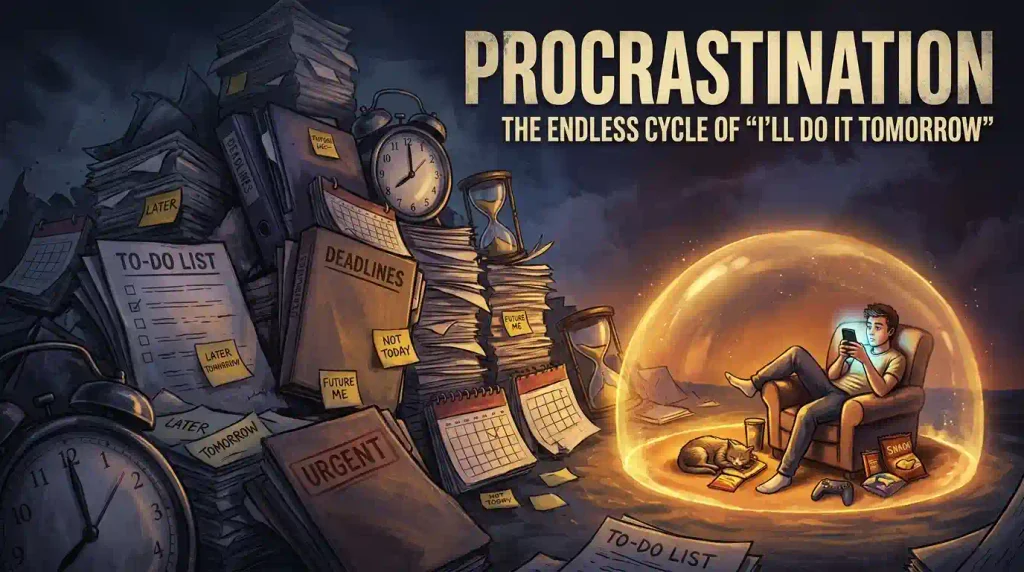
A metaphor for procrastination describes the habit of delaying important tasks through a vivid comparison. Procrastination can be a rocking chair that keeps you moving without taking you anywhere, a locked gate between you and your goals, or a growing pile of unfinished work. The best metaphor depends on what you want to express: avoidance, lost time, mounting pressure, perfectionism, or the frustration of knowing what to do but not starting.
Quick Answer: What Is a Metaphor for Procrastination?
A metaphor for procrastination compares delaying a task to something that captures its effects or emotional experience. For example, “Procrastination is a thief of time” suggests that putting things off steals valuable hours, while “Procrastination is quicksand” describes how repeated delays can make a problem harder to escape. These comparisons make procrastination easier to picture in essays, poems, stories, and everyday conversation.
Metaphors for Procrastination: Meanings at a Glance
| Metaphor | Meaning | Metaphor | Meaning |
| A thief of time | Wastes valuable hours | A mountain of tomorrow | Keeps pushing work into the future |
| A rocking chair | Creates activity without progress | A ticking time bomb | Builds pressure as a deadline approaches |
| A locked gate | Blocks progress toward a goal | A comfort trap | Makes avoidance feel appealing |
| A leaking hourglass | Lets precious time slip away | A tangled fishing net | Makes unfinished responsibilities harder to manage |
These are familiar-style and original metaphorical descriptions, not quotations attributed to a particular author. The following sections explain the strongest examples and show when to use them.
Best Metaphors for Procrastination
1. Procrastination Is a Thief of Time
This familiar expression presents procrastination as a thief that steals hours without giving anything valuable in return. It works well when you want to emphasize lost opportunities or regret over wasted time.
Example: Procrastination was a thief of time, stealing the quiet hours I needed to finish my assignment.
2. Procrastination Is Quicksand
Quicksand represents a situation that becomes increasingly difficult to escape the longer someone remains stuck. This metaphor suits unfinished projects that grow more stressful with every delay.
Example: Each day I postponed the report, I sank deeper into the quicksand of procrastination.
3. Procrastination Is a Rocking Chair
A rocking chair moves back and forth but stays in the same place. This original comparison captures the feeling of being busy with preparations, plans, and excuses without completing the actual task.
Example: I spent the afternoon organizing my desk instead of writing; procrastination had turned my workday into a rocking chair.
4. Procrastination Is a Locked Gate
A locked gate represents a barrier between you and a goal. It works particularly well when you know what needs to be done but struggle to take the first step.
Example: My fear of making mistakes became a locked gate between me and the finished essay.
5. Procrastination Is a Ticking Time Bomb
This metaphor emphasizes the pressure that builds as a deadline approaches. It highlights the consequences of leaving work until the last minute.
Example: With the presentation due tomorrow, my unfinished slides had become a ticking time bomb.
6. Procrastination Is a Mountain of Tomorrow
This original metaphor describes the habit of repeatedly moving responsibilities into the future until they become an overwhelming pile of obligations.
Example: Every time I said I would start tomorrow, I added another rock to the mountain of tomorrow.
7. Procrastination Is a Comfort Trap
A comfort trap represents the appealing feeling of choosing an easy distraction over an uncomfortable responsibility. It suits situations where watching videos, browsing social media, or taking unnecessary breaks replaces meaningful work.
Example: One more episode became a comfort trap that kept me from preparing for my exam.
8. Procrastination Is a Leaking Hourglass
An hourglass measures time, while a leak suggests that something valuable escapes unnoticed. Together, this original image expresses the frustration of watching time disappear while a task remains unfinished.
Example: As I scrolled through my phone, my afternoon became a leaking hourglass.
Metaphors for Different Types of Procrastination
Not all procrastination feels the same. Some people avoid tasks because they fear making mistakes, while others lose time to distractions or underestimate how much work remains. Choosing a metaphor that matches the reason for the delay makes your writing more precise.
9. Procrastination Is a Foggy Windshield
A foggy windshield represents unclear priorities and difficulty seeing the next step. Use it when a task feels confusing or overwhelming rather than simply boring.
Example: With five deadlines competing for my attention, procrastination fogged my windshield and made every direction look uncertain.
10. Procrastination Is a Perfectionist’s Waiting Room
This original metaphor describes waiting for the perfect idea, mood, plan, or set of circumstances before beginning. It is particularly useful for essays, creative projects, and professional work.
Example: I kept revising my outline instead of drafting the article, trapped in a perfectionist’s waiting room.
11. Procrastination Is a Magnet for Distractions
A magnet attracts objects toward itself. This comparison presents procrastination as a force that pulls attention away from important work and toward easier, more entertaining activities.
Example: Whenever I opened my laptop to study, procrastination became a magnet for notifications, videos, and unrelated searches.
12. Procrastination Is a Knot in the Clock’s Hands
This original metaphor combines tangled movement with the passage of time. It suggests that hesitation interrupts the rhythm of work and makes it difficult to move forward.
Example: My indecision tied a knot in the clock’s hands while the deadline kept approaching.
13. Procrastination Is a Doorway Guarded by Fear
This metaphor focuses on emotional resistance. The task itself may be manageable, but worry about failure, criticism, or an uncertain outcome makes starting feel difficult.
Example: Fear stood at the doorway of my first draft, demanding that I turn back before writing a single sentence.
Funny Metaphors for Procrastination
Humorous metaphors make the habit relatable without turning every delay into a serious personal failure. They work particularly well for captions, informal essays, and conversations with friends.
14. Procrastination Is an Olympic Sport I Keep Training For
This playful original metaphor exaggerates how much effort someone puts into postponing work.
Example: I have mastered the art of opening my assignment, staring at it, and finding something else to do; procrastination is my Olympic sport.
15. Procrastination Is a Snooze Button for Ambition
A snooze button delays the moment when you must get up and act. This metaphor humorously describes repeatedly postponing goals while reassuring yourself that you will pursue them soon.
Example: Every time I postponed my writing session, I hit the snooze button on my ambition.
16. Procrastination Is a Vacation My To-Do List Never Approved
This original comparison turns avoidance into an unauthorized holiday. It suits casual writing about unfinished chores, assignments, or office tasks.
Example: While I watched another movie, my to-do list was stuck at work without me; procrastination had booked a vacation it never approved.
17. Procrastination Is a Professional Excuse Collector
This metaphor portrays someone as a collector who gathers reasons to delay instead of completing the task. It is best used humorously or self-deprecatingly, rather than to criticize someone facing genuine obstacles.
Example: I blamed the weather, the noise, and my missing notebook until procrastination promoted me to professional excuse collector.
Metaphors for Procrastination in Essays and Creative Writing
Some metaphors work better in formal or emotional writing than in humorous conversation. These examples focus on accumulating consequences and the distance between intention and action.
18. Procrastination Is a Garden of Unfinished Seeds
This original metaphor compares uncompleted plans to seeds that never receive the attention they need to grow. It works well in reflective essays about potential, commitment, and missed opportunities.
Example: My notebook was full of promising ideas, but without action, it became a garden of unfinished seeds.
19. Procrastination Is a Bridge That Ends Before the Other Side
A bridge should connect two places, but this one stops before reaching its destination. The image represents the gap between making a plan and completing the work needed to achieve it.
Example: I had researched, outlined, and planned the entire project, yet procrastination left me standing on a bridge that ended before the other side.
20. Procrastination Is a Broken Compass
A broken compass represents a loss of direction. This metaphor works when someone keeps switching between tasks, changing plans, or searching for the perfect approach without committing to one.
Example: I jumped between three projects all morning, following the broken compass of procrastination.
Procrastination Meaning With Examples
Procrastination means delaying or postponing a task you intend or need to complete, often in favor of something easier or more enjoyable. It can happen when a task feels difficult, boring, stressful, or overwhelming.
Example: I kept putting off my essay until the night before the deadline, leaving myself only a few hours to finish it.
Other everyday examples include:
- A student watches videos instead of studying for an upcoming exam.
- An employee repeatedly delays writing an important report.
- Someone plans to exercise every morning but continually postpones the first workout.
Procrastination is not simply taking a break. It involves postponing an intended task, often despite the possibility of negative consequences.
Procrastination Synonyms and Opposites
What Is a Good Synonym for Procrastination?
Useful synonyms for procrastination include delay, postponement, stalling, and foot-dragging. Each word carries a slightly different meaning.
- Delay: Making something happen later than planned.
- Postponement: Arranging for something to happen at a later time.
- Stalling: Delaying action, sometimes through excuses or distractions.
- Foot-dragging: Acting slowly or reluctantly, especially when someone does not want to proceed.
- Putting things off: An informal expression for repeatedly delaying tasks.
For creative writing, procrastination is a thief of time offers a more vivid alternative than a simple synonym because it emphasizes the time and opportunities that repeated delays can consume.
What Is the Opposite of Procrastination?
The opposite of procrastination is taking timely action rather than unnecessarily delaying a task. Depending on the context, useful opposites include promptness, initiative, diligence, decisiveness, and timely completion.
For example:
- Procrastination: “She kept postponing her assignment.”
- Opposite behavior: “She started her assignment early and completed it on schedule.”
In a metaphorical sentence, you might describe initiative as a door opening toward progress. This image suggests moving from intention to action instead of remaining stuck in hesitation.
Procrastination Pronunciation
In American English, procrastination is pronounced approximately “proh-kras-tuh-NAY-shun,” with the strongest stress on the “NAY” syllable.
The word has five syllables: pro-cras-ti-na-tion.
Its related verb, procrastinate, is pronounced approximately “proh-KRAS-tuh-nayt,” with the main stress on “KRAS.”
Knowing the pronunciation can help when using the word in presentations, classroom discussions, or professional conversations.
Procrastination in Tagalog
The English word procrastination can be expressed in Tagalog as pagpapaliban, meaning postponement or delaying something. Another expression is pagpapabukas-bukas, which conveys repeatedly putting something off until later.
For example:
- English: “Procrastination prevents me from finishing my work.”
- Tagalog: “Ang pagpapaliban ay nakahahadlang sa akin na matapos ang aking gawain.”
A more conversational way to describe procrastinating is:
“Palagi kong ipinagpapabukas ang aking mga gawain.”
This means, “I always put my tasks off until later.”
The best translation depends on the sentence and context. Pagpapaliban emphasizes postponement, while pagpapabukas-bukas more clearly conveys the repeated habit of delaying something.
Procrastination as a Verb: Procrastinate and Procrastinating
What Is the Verb Form of Procrastination?
Procrastinate is the verb form of procrastination. The noun describes the behavior, while the verb describes the act of delaying a task.
Examples:
- Noun: “Procrastination affected my productivity.”
- Verb: “I tend to procrastinate when a project feels difficult.”
- Past tense: “She procrastinated until the deadline approached.”
What Does Procrastinating Mean?
Procrastinating means delaying a task that you intend or need to complete. It is the -ing form of the verb procrastinate and can describe an ongoing action or function as a noun.
Examples:
- “I am procrastinating instead of preparing for my exam.”
- “Procrastinating often makes my workload feel heavier.”
- “He spent the afternoon procrastinating by browsing social media.”
In a metaphor, you could write, “I was feeding the monster of procrastination.” This original image suggests that every unnecessary delay makes the problem more difficult to manage.
What Is an Idiom About Procrastination?
An idiom or familiar expression about procrastination describes delaying action, avoiding responsibility, or leaving work until later.
Put It Off Until Tomorrow
Meaning: To postpone a task rather than do it now.
Example: I kept putting my assignment off until tomorrow until tomorrow became the day it was due.
Drag Your Feet
Meaning: To act slowly or reluctantly when something needs to be done.
Example: He dragged his feet on the application until the submission window nearly closed.
Leave It Until the Last Minute
Meaning: To wait until just before a deadline to complete something.
Example: She left her presentation until the last minute and had no time to practice.
Kick the Can Down the Road
Meaning: To postpone dealing with a problem rather than resolving it.
Example: By delaying the difficult decision again, the manager kicked the can down the road.
Choose drag your feet when reluctance matters, leave it until the last minute when a deadline matters, and kick the can down the road when someone avoids addressing a problem.
What Is a Good Quote About Procrastination?
A familiar expression associated with procrastination is “Procrastination is the thief of time.” It captures how repeated delays consume time that could have been used for productive or meaningful activities.
You can use this idea in an essay about time management, personal responsibility, or the consequences of avoiding difficult tasks.
For example:
“Procrastination is the thief of time because every postponed responsibility leaves less room for thoughtful, unhurried work.”
This explanatory sentence is original, not a quotation from a published author.
When including a quotation in academic writing, verify the exact wording and attribution before assigning it to a particular person. If you cannot verify an attribution, present the expression as a familiar saying rather than attaching an unsupported name.
What Is a Famous Saying About Procrastination?
“Never put off till tomorrow what you can do today” is a familiar saying that encourages people to act promptly rather than postpone tasks unnecessarily.
Its central message is straightforward: when a task can reasonably be completed now, delaying it may create avoidable pressure later.
For example, a student who begins an assignment several days before the deadline has more time to research, revise, and correct mistakes than someone who starts at the last moment.
However, the saying does not mean that every task must be completed immediately. Rest, careful planning, and setting priorities are valuable, too. The important distinction is between deliberately scheduling a task and repeatedly postponing it without a good reason.
What Symbolizes Procrastination?
Procrastination can be symbolized by objects or situations that represent delay, stalled progress, avoidance, or time slipping away. The most effective symbol depends on the meaning you want to communicate.
A Stopped Clock
A stopped clock symbolizes lost time or progress that has come to a halt. It works well in poetry and reflective writing about missed opportunities.
Example: The stopped clock on his desk reflected the years he had spent waiting for the perfect moment.
An Unfinished Staircase
An unfinished staircase represents a journey toward a goal that never reaches completion. It is useful when writing about abandoned ambitions or repeated false starts.
Example: Her unfinished staircase of plans rose toward success but never reached the final step.
A Growing Pile of Paperwork
A growing pile of paperwork symbolizes responsibilities accumulating because someone keeps delaying them. It is especially appropriate for workplace or academic writing.
Example: The growing pile of paperwork became a physical reminder of every task he had postponed.
A Roadblock
A roadblock symbolizes an obstacle that prevents forward movement. When it represents procrastination, it can suggest hesitation or avoidance standing between a person and a goal.
Example: Fear of failure became a roadblock on her path toward completing the project.
A symbol represents a broader idea, while a metaphor directly describes one thing as another. Depending on how you use these images, they can function as either metaphors or symbols.
What Are Some Metaphors for Being Lazy?
Metaphors for laziness often describe inactivity, reluctance, or unused energy. Procrastination overlaps with laziness in some situations, but the two are not identical: someone can care deeply about a task and still delay it because of anxiety, uncertainty, or perfectionism.
A Parked Engine
This original metaphor compares unused ability to an engine that is ready to run but remains switched off.
Example: His talent was a parked engine, full of potential but going nowhere.
A Sleeping Giant
This metaphor suggests strength or ability that remains inactive. It can sound encouraging when it implies that someone has the potential to act.
Example: Her creativity was a sleeping giant waiting for a reason to wake.
A Stone in a Field
This original image conveys stillness and inactivity. It works best in poetic writing when the goal is to create a quiet, motionless scene.
Example: He sat like a stone in a field while the unfinished work waited on his desk.
Choose a metaphor that describes the actual behavior rather than labeling every delayed task as laziness. That distinction creates more accurate and thoughtful writing.
Metaphor vs. Simile: What Is the Difference?
A metaphor describes one thing as another to create a figurative comparison. A simile makes the comparison explicit, usually with the words like or as.
| Type | Example | Why it fits |
| Metaphor | Procrastination is quicksand. | Directly identifies procrastination with a trap. |
| Simile | Procrastination is like quicksand. | Explicitly compares the two using “like.” |
| Literal statement | I delayed my assignment until the last day. | Describes the behavior without figurative language. |
All three forms can communicate the same basic idea, but each creates a different effect. A metaphor often sounds more direct, a simile makes the comparison more explicit, and a literal statement prioritizes factual clarity.
FAQs Metaphor for Procrastination
What Is the Best Metaphor for Procrastination?
“Procrastination is a thief of time” is a strong general choice because it captures how delay consumes hours that could be spent on meaningful work. For a more specific meaning, use a rocking chair for activity without progress or a ticking time bomb for rising deadline pressure.
What Is a Short Metaphor for Procrastination?
“Procrastination is quicksand” is a concise metaphor that suggests becoming increasingly stuck through repeated delays. Another option is “procrastination is a roadblock,” which emphasizes an obstacle to progress.
What Is a Funny Metaphor for Procrastination?
“Procrastination is an Olympic sport I keep training for” humorously exaggerates the habit of postponing responsibilities. It works well in casual writing and social media captions.
How Do You Describe Procrastination in a Sentence?
You can write, “Procrastination was a locked gate between me and my goals.” This sentence uses a metaphor to show how delaying action can feel like an obstacle that prevents progress.
Is “Procrastination Is Quicksand” a Metaphor or a Simile?
It is a metaphor because it directly describes procrastination as quicksand. “Procrastination is like quicksand” is a simile because it explicitly compares the two using the word “like.”
What Does Procrastination Symbolize in Literature?
Procrastination can symbolize avoidance, fear, indecision, wasted potential, or the consequences of postponing responsibility. The precise interpretation depends on the surrounding story, character, and context; it does not have one universal literary meaning.
Conclusion
A good metaphor for procrastination does more than describe a delay. It reveals what that delay feels like and why it matters. A rocking chair captures effort without progress, a ticking time bomb communicates deadline pressure, and a garden of unfinished seeds represents potential left unrealized.
Whether you are writing an essay, a poem, a story, or a social media caption, choose the image that matches your meaning, tone, and audience. One precise metaphor can communicate more clearly than a paragraph of repeated comparisons—and help your reader see procrastination in a new way.

Qaiser Abbas is an award-winning author, leadership coach, and motivational speaker known for his work on personal growth, leadership, and human potential. Through his writing and speaking, Qaiser focuses on turning challenges into opportunities and helping people build the mindset to achieve meaningful growth.