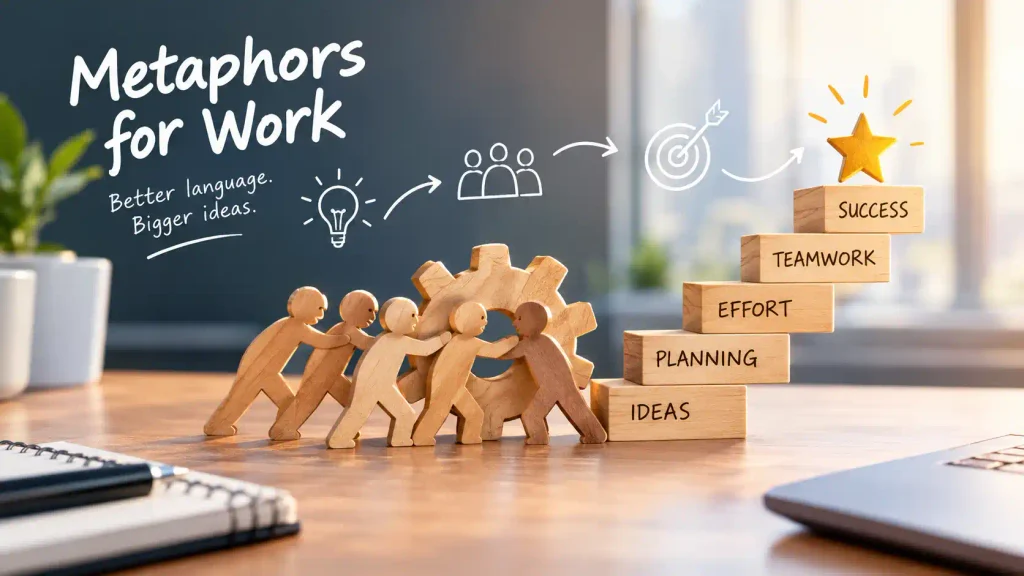
A metaphor for work describes a job, career, task, or working life by comparing it directly to something else. Work can be a marathon when it requires endurance, a puzzle when it demands problem-solving, or a garden when people and ideas need time to grow. The right metaphor helps readers understand not just what work involves, but how it feels and why it matters.
What Is a Metaphor for Work?
A metaphor for work compares working life to another thing to express its meaning, challenges, or rewards. Examples include “work is a marathon,” which emphasizes endurance; “work is a bridge,” which represents a path toward opportunity; and “work is a puzzle,” which highlights problem-solving. Writers use these comparisons to describe careers, teamwork, hard work, workplace stress, and professional growth more vividly.
25 Metaphors for Work With Meanings and Examples
The following examples cover different experiences, from meaningful careers to demanding deadlines. Familiar expressions are identified separately from original metaphors created for this article.
1. Work Is a Marathon
Meaning: Work requires patience, consistency, and sustained effort rather than a quick burst of energy.
Example: Building a successful career is a marathon, not a sprint.
Best use: Describing long-term projects, career development, and goals that take years to achieve.
2. Work Is a Journey
Meaning: A career develops through different stages, experiences, setbacks, and opportunities.
Example: Her career was a journey of discovery that led her from a small classroom to an international research team.
Best use: Essays, professional biographies, speeches, and reflections on career growth.
3. Work Is a Puzzle
Meaning: Work involves connecting information, solving problems, and figuring out how different pieces fit together.
Example: Running the marketing campaign was a puzzle, and every customer insight helped complete the picture.
Best use: Analytical jobs, research, strategy, planning, and complex assignments.
4. Work Is a Bridge
Meaning: Work connects a person’s present circumstances to future opportunities.
Example: Her first internship was a bridge between university life and a career in journalism.
Best use: Discussing education, entry-level jobs, career changes, and professional development.
5. Work Is a Garden
Meaning: Work grows through care, patience, attention, and consistent effort.
Example: Our team is a garden where good ideas grow when everyone has room to contribute.
Best use: Leadership, teaching, mentoring, creative work, and supportive workplaces.
6. Work Is a Mountain
Meaning: A demanding job or project can feel like a steep climb that requires persistence.
Example: Preparing the company for its product launch was a mountain, but each completed task brought us closer to the summit.
Best use: Describing major challenges, ambitious goals, and difficult assignments.
7. Work Is a Machine
Meaning: Work can operate as a coordinated system in which different people or processes perform connected roles.
Example: The production department is a well-oiled machine when every team member understands their responsibilities.
Best use: Operations, logistics, process improvement, and efficient teamwork.
Important distinction: Calling a team a machine can praise its efficiency, but describing an employee as a machine can suggest that the person is expected to work without rest or individuality.
8. Work Is a Compass
Meaning: Work can provide direction, helping someone decide where to focus their skills and ambitions.
Example: Her commitment to public service became a compass for every career decision she made.
Best use: Purpose-driven careers, leadership, personal development, and professional values.
9. Work Is a Classroom
Meaning: Work is a place to learn new skills, gain experience, and improve through mistakes.
Example: His first job was a classroom that taught him more about communication than any textbook could.
Best use: Internships, entry-level positions, training, and career transitions.
10. Work Is a Team Sport
Meaning: Success depends on cooperation, communication, and people contributing their individual strengths.
Example: Managing the event was a team sport; no single department could have delivered it alone.
Best use: Team projects, management, collaboration, and workplace communication.
11. Work Is a Tightrope
Meaning: Work can require careful decisions when competing demands leave little room for error.
Example: Balancing customer expectations with a limited budget was a tightrope walk.
Best use: Management, negotiations, high-stakes decisions, and competing priorities.
12. Work Is a Treadmill
Meaning: Work can feel repetitive when someone stays busy without making meaningful progress.
Example: Without clear priorities, the weekly reporting process became a treadmill of numbers and meetings.
Best use: Criticizing inefficient routines, repetitive tasks, or a lack of career progress.
13. Work Is a Storm
Meaning: Work can become chaotic, intense, and difficult to control.
Example: The unexpected system failure turned an ordinary afternoon into a storm of urgent requests.
Best use: Describing busy periods, crises, urgent deadlines, and stressful workplaces.
14. Work Is a Heavy Backpack
Meaning: Work can become a burden when responsibilities accumulate beyond what a person can comfortably manage.
Example: Every unfinished assignment added another stone to the heavy backpack she carried through the week.
Best use: Discussing workload, responsibility, emotional pressure, and the need for support.
This is an original metaphor created for this article.
15. Work Is a Workshop
Meaning: Work is a place where raw ideas become useful results through practice, skill, and revision.
Example: Our design studio is a workshop where rough concepts become finished products.
Best use: Creative teams, product development, craftsmanship, and hands-on learning.
This is an original metaphor created for this article.
16. Work Is a Lighthouse
Meaning: Work can offer purpose or direction when a person has a clear goal.
Example: Her desire to improve public education was a lighthouse that guided her through difficult career choices.
Best use: Purpose-driven work, mentoring, leadership, and personal mission statements.
17. Work Is a Relay Race
Meaning: A successful project depends on people completing their parts and handing the work to the next person at the right time.
Example: The product launch was a relay race, with research, design, production, and marketing passing responsibility from one team to another.
Best use: Cross-functional projects, production schedules, and coordinated deadlines.
18. Work Is a Fireplace
Meaning: Meaningful work can provide warmth, energy, and a sense of connection when it aligns with a person’s interests and values.
Example: Teaching became a fireplace in her life, giving her a steady sense of purpose even on difficult days.
Best use: Reflective writing about passion, fulfillment, and meaningful careers.
This is an original metaphor created for this article.
19. Work Is a Chessboard
Meaning: Some workplaces require planning, careful judgment, and an understanding of how decisions affect others.
Example: The negotiations were a chessboard, and every proposal changed the next move.
Best use: Strategy, negotiations, management, and competitive professional environments.
Caution: This metaphor fits strategic situations, but it can make ordinary teamwork sound manipulative or overly competitive.
20. Work Is a Factory Line
Meaning: Work can become a sequence of standardized tasks focused on producing consistent results.
Example: When every article followed the same rigid template, the writing process started to feel like a factory line.
Best use: Repetitive processes, standardized production, and criticism of work that leaves little room for creativity.
21. Work Is a Seedbed
Meaning: Work can provide the conditions in which skills, ideas, and future opportunities develop.
Example: The small research project became a seedbed for ideas that later shaped the entire department.
Best use: Innovation, professional learning, early-stage projects, and creative development.
This is an original metaphor created for this article.
22. Work Is an Engine
Meaning: Work can drive progress and keep an organization or project moving toward its goals.
Example: Clear communication was the engine behind the team’s steady progress.
Best use: Business writing, leadership, organizational performance, and project management.
23. Work Is a Lighthouse in the Fog
Meaning: A clear purpose can help someone make decisions when a job feels uncertain or confusing.
Example: During the company’s restructuring, her commitment to customer care was a lighthouse in the fog.
Best use: Career uncertainty, organizational change, leadership, and reflective writing.
This is an original variation on the established lighthouse image.
24. Work Is a Balancing Act
Meaning: Work requires managing several responsibilities without allowing one to overwhelm the others.
Example: Running a business while caring for a family can become a balancing act.
Best use: Work-life balance, competing deadlines, leadership responsibilities, and time management.
This is a familiar metaphorical expression rather than a newly invented comparison.
25. Work Is a Forge
Meaning: Difficult work can develop skill, discipline, and resilience through sustained effort.
Example: Years of challenging assignments became a forge that strengthened her judgment and confidence.
Best use: Personal development, demanding professions, apprenticeships, and stories about perseverance.
This is an original metaphorical use of the forge image.
Metaphors for Work Compared by Meaning and Tone
| Metaphor | Main meaning | Tone | Best use |
| Work is a marathon | Sustained effort | Encouraging | Long-term goals |
| Work is a journey | Career development | Reflective | Essays and biographies |
| Work is a puzzle | Problem-solving | Curious | Analytical tasks |
| Work is a garden | Growth and care | Positive | Mentoring and leadership |
| Work is a bridge | Opportunity | Hopeful | Career transitions |
| Work is a treadmill | Repetition without progress | Critical | Inefficient routines |
| Work is a storm | Chaos and pressure | Intense | Workplace crises |
| Work is a tightrope | Risk and precision | Tense | Difficult decisions |
| Work is a team sport | Cooperation | Collaborative | Team projects |
| Work is a forge | Growth through difficulty | Determined | Personal development |
Metaphors for Hard Work and Difficult Tasks
When describing hard work, choose an image that shows the kind of effort involved. A mountain conveys a major obstacle, a marathon emphasizes endurance, and a forge suggests that challenges can develop strength or skill.
Work Is an Uphill Climb
Meaning: Progress requires continuous effort because obstacles make the task difficult.
Example: Rebuilding customer trust after the service failure was an uphill climb.
This works particularly well when the task is difficult but progress remains possible.
Work Is a Heavy Load
Meaning: A person has significant responsibilities to carry.
Example: After two colleagues left, the remaining staff carried the weight of the entire department.
This image emphasizes responsibility more than difficulty itself.
Work Is a Furnace
Meaning: Intense pressure tests a person’s ability to remain focused and capable.
Example: The demanding apprenticeship was a furnace that tested every trainee’s patience.
This original metaphor is useful in dramatic or reflective writing, but it may sound too intense for routine workplace communication.
Work Is a Never-Ending Conveyor Belt
Meaning: Tasks keep arriving even when a person finishes the previous ones.
Example: Without a limit on new requests, her inbox became a never-ending conveyor belt.
This original metaphor captures an accumulating workload more precisely than a general phrase such as “hard work.”
Positive Metaphors for Work, Purpose, and Success
Not all work metaphors need to emphasize struggle. Some show how work creates opportunity, builds relationships, or gives life direction.
- Work is a bridge to opportunity: A job can provide access to skills, experience, and future roles.
- Work is a garden of possibilities: Effort and care help new ideas and abilities develop.
- Work is an engine of progress: Coordinated effort moves a project toward a goal.
- Work is a classroom without walls: Everyday challenges provide lessons beyond formal training.
- Work is a foundation for the future: Today’s effort supports later achievements.
For example, “My first job was a foundation for the future” suggests that early experience created a base for later success. It does not promise that every job leads to promotion; it emphasizes the value that experience can provide.
Negative Metaphors for Stressful or Unfulfilling Work
Use a more critical metaphor when the goal is to communicate exhaustion, repetition, or a lack of control.
- Work is a treadmill: Constant activity produces little visible progress.
- Work is a cage: A job feels restrictive or limits personal freedom.
- Work is a storm: Unexpected demands create confusion and pressure.
- Work is a weight on the shoulders: Responsibilities feel emotionally or mentally heavy.
- Work is a factory line: Repetition leaves little room for independent judgment or creativity.
Context matters. Calling work a cage expresses a stronger sense of restriction than calling it a treadmill. The first suggests limited freedom; the second suggests repetitive effort without progress.
Metaphors for Teamwork and Collaboration
Workplace metaphors can explain how people contribute to a shared result.
A Team Is a Well-Oiled Machine
The team coordinates its tasks efficiently, with each person understanding their role.
Example: The event staff became a well-oiled machine once everyone knew the schedule and responsibilities.
A Team Is an Orchestra
Different people contribute distinct skills while working toward a coordinated outcome.
Example: The product launch was an orchestra of designers, engineers, writers, and marketers working in harmony.
A Team Is a Relay Team
People depend on one another to complete connected stages of a project.
Example: The approval process was a relay team: each department had to finish its work before the next could begin.
These metaphors are not interchangeable. A machine emphasizes efficiency, an orchestra emphasizes coordination between different talents, and a relay team emphasizes timing and handoffs.
Common Idioms and Expressions About Work
Idioms are familiar expressions whose meanings may go beyond their literal words. They can enrich an article about work, but they are not all original metaphors.
| Expression | Meaning | Example |
| Burn the midnight oil | Work late into the night | She burned the midnight oil to finish the proposal. |
| Have your nose to the grindstone | Work steadily and diligently | He kept his nose to the grindstone until the report was ready. |
| Be snowed under | Have too much work to manage easily | I’m snowed under with client requests this week. |
| Carry the load | Take responsibility for a large share of work | One experienced employee carried the load during the transition. |
| Climb the career ladder | Progress toward higher professional positions | She climbed the career ladder through experience and training. |
| Wear many hats | Perform several different roles | At a small company, everyone wears many hats. |
| Go the extra mile | Make an additional effort | The support team went the extra mile to help the customer. |
| Keep the ball rolling | Maintain progress | A short planning meeting helped keep the project rolling. |
For more precise writing, distinguish the expression’s conventional meaning from a metaphor you create specifically for your sentence. For example, “My career is a garden” is a direct metaphor, while “burn the midnight oil” is an established idiom about working late.
Short Metaphors for Work
Short metaphors for work make professional experiences easier to describe in essays, speeches, captions, and everyday conversations. Each comparison communicates a different idea about effort, progress, or collaboration.
- Work is a marathon. It requires patience and consistent effort.
- Work is a bridge. It connects people to new opportunities.
- Work is a puzzle. It involves solving problems and connecting ideas.
- Work is a garden. It grows through care and attention.
- Work is a mountain. It presents challenges that require persistence.
- Work is an engine. It drives progress toward a goal.
- Work is a classroom. It provides opportunities to learn.
- Work is a balancing act. It requires managing competing responsibilities.
Choose the metaphor that matches your intended message. A marathon emphasizes endurance, while a bridge emphasizes opportunity.
Teamwork Makes the Dream Work: Metaphor and Meaning
“Teamwork makes the dream work” is a familiar motivational expression that emphasizes how collaboration helps people achieve shared goals. It is not a strict standalone metaphor in the same way as “a team is an orchestra,” but it communicates a figurative idea: individual contributions combine to make a larger achievement possible.
A Team Is an Orchestra
Each person contributes a different skill, just as musicians play different instruments to create a coordinated performance.
Example: Our design team is an orchestra, with every specialist contributing to the final product.
A Team Is a Puzzle
Each team member provides a piece that helps complete the overall picture.
Example: The project came together when every department supplied its missing piece of the puzzle.
A Team Is a Well-Oiled Machine
Team members coordinate their work efficiently to achieve a shared outcome.
Example: Once everyone understood their responsibilities, the team became a well-oiled machine.
Roles at Work: Metaphors for Different Responsibilities
Workplace roles can be explained through metaphors that show how individual responsibilities contribute to a larger organization. These comparisons are useful in professional writing, presentations, and discussions about teamwork.
A Leader Is a Compass
A leader helps a team establish direction and make decisions without necessarily controlling every step.
Example: During the reorganization, our manager was a compass that helped the team stay focused.
An Employee Is a Piece of the Puzzle
Every employee contributes particular skills and knowledge that support the wider organization.
Example: The new analyst was an important piece of the puzzle because she connected customer feedback with product decisions.
A Manager Is a Bridge
A manager can connect employees, departments, and organizational goals.
Example: The project manager served as a bridge between the engineering team and senior leadership.
A Mentor Is a Lighthouse
A mentor provides guidance when someone faces uncertainty or makes important career decisions.
Example: His former supervisor became a lighthouse during his first year in the profession.
What Are 10 Simple Metaphors?
Simple metaphors compare one thing directly to another without using “like” or “as.” Here are 10 easy examples, including several that describe work and everyday experiences.
- Work is a marathon. Work requires sustained effort.
- Time is money. Time is a valuable resource.
- Knowledge is power. Knowledge can provide influence and opportunity.
- Her smile is sunshine. Her smile brings warmth or happiness.
- The classroom was a zoo. The classroom was noisy or chaotic.
- His words were daggers. His words caused emotional pain.
- Life is a journey. Life involves change and different stages.
- The office is a beehive. The office is full of activity.
- Hope is a light. Hope provides encouragement during difficulty.
- The team is an orchestra. Different people work together toward a shared result.
These examples are metaphors because they make direct comparisons rather than explicitly saying that one thing is “like” another.
What Are 5 Examples of a Metaphor?
Here are five straightforward metaphors with meanings and example sentences.
1. Work Is a Marathon
Meaning: Work requires patience and endurance.
Example: Completing the yearlong project was a marathon, not a sprint.
2. The Office Is a Beehive
Meaning: The office is full of activity.
Example: The office became a beehive before the product launch.
3. Knowledge Is Power
Meaning: Knowledge can help people make informed decisions and gain opportunities.
Example: She believed knowledge was power, so she continued studying after work.
4. His Mind Is a Library
Meaning: He has a large store of information and ideas.
Example: His mind is a library filled with details about history and science.
5. Teamwork Is an Orchestra
Meaning: People with different abilities coordinate to achieve a common goal.
Example: The successful launch showed that teamwork is an orchestra in which every contribution matters.
What Are the 8 Metaphors?
There is no single universally accepted set of eight metaphors. The term can refer to any group of eight examples selected for a particular topic or learning activity. For work-related writing, these eight metaphors offer a useful starting point.
- Work is a marathon. It emphasizes patience and endurance.
- Work is a bridge. It represents access to opportunity.
- Work is a puzzle. It highlights problem-solving.
- Work is a garden. It represents growth through care.
- Work is a mountain. It emphasizes a challenging goal.
- Work is an engine. It represents progress and momentum.
- Work is a classroom. It highlights learning through experience.
- Work is a balancing act. It represents the challenge of managing competing responsibilities.
Each metaphor highlights a different aspect of work, so the best choice depends on the message and context.
How to Choose the Right Metaphor for Work
The strongest metaphor matches the message you want to communicate.
| Your purpose | Good choice | Why it fits |
| Describe long-term effort | Work is a marathon | Emphasizes endurance |
| Show career development | Work is a journey | Highlights stages and change |
| Explain a difficult assignment | Work is a mountain | Makes the obstacle tangible |
| Praise collaboration | Work is a team sport | Highlights shared responsibility |
| Describe repetitive work | Work is a treadmill | Suggests activity without progress |
| Show a job’s educational value | Work is a classroom | Emphasizes learning |
| Explain a clear professional purpose | Work is a compass | Connects work with direction |
| Describe a stressful workload | Work is a heavy backpack | Makes accumulated responsibility visible |
For Essays and Creative Writing
Choose a metaphor that supports the main point rather than decorating every paragraph. A journey works for a personal career story, a garden suits a discussion of learning and growth, and a treadmill can communicate frustration with repetitive work.
For Workplace Communication
Prefer clear, professional metaphors that help people understand a situation. “We’re climbing a steep hill with this deadline” is more constructive than describing the workplace as a battlefield when the goal is to encourage cooperation.
For Speeches and Motivational Writing
Use metaphors that reinforce the message. A marathon can encourage patience, a bridge can represent opportunity, and a forge can illustrate growth through challenge. Avoid suggesting that exhaustion is always necessary for success.
For Describing Work Stress
Choose an image that explains the actual problem. Use a storm for chaos, a heavy load for excessive responsibility, or a treadmill for repetitive tasks without meaningful progress. Specific images make it easier for readers to understand the source of the pressure.
What Is the Difference Between a Metaphor and a Simile for Work?
A metaphor directly describes one thing as another. A simile makes a comparison using words such as “like” or “as.”
| Metaphor | Simile |
| Work is a marathon. | Work is like a marathon. |
| Her office is a pressure cooker. | Her office is like a pressure cooker. |
| The team is an orchestra. | The team works like an orchestra. |
| His career is a journey. | His career is like a journey. |
Both figures of speech help readers visualize work. Metaphors make a direct comparison, while similes signal the comparison explicitly.
FAQs About Metaphors for Work
What is a good metaphor for work?
“Work is a marathon” is a useful metaphor for work that requires patience and sustained effort. For career development, “work is a journey” may fit better, while “work is a puzzle” suits tasks that require problem-solving.
What is a metaphor for hard work?
“Work is a mountain” presents a difficult task as a challenging climb. “Work is a marathon” emphasizes endurance, while “work is a forge” suggests that difficult experiences can strengthen skills and character.
What is a positive metaphor for work?
“Work is a garden” is a positive metaphor that presents effort as something that helps people and ideas grow. “Work is a bridge to opportunity” is another useful choice when discussing career development.
What is a metaphor for being busy at work?
“Work is a storm” conveys a chaotic period filled with urgent demands. “My inbox is a never-ending conveyor belt” is an original metaphor for tasks that keep arriving faster than they can be completed.
Is “work is a marathon” a metaphor or a simile?
“Work is a marathon” is a metaphor because it directly identifies work with a marathon. “Work is like a marathon” is a simile because it uses “like” to make the comparison.
What is a metaphor for teamwork?
“A team is an orchestra” is a metaphor for collaboration because it presents people with different skills working together toward a coordinated result. “A team is a well-oiled machine” emphasizes efficiency and smooth coordination.
Conclusion
A strong metaphor for work makes an abstract experience easier to picture. Work can be a marathon when it demands endurance, a garden when it nurtures growth, a puzzle when it requires problem-solving, or a treadmill when effort produces little progress. Choose the comparison that reflects the actual experience, audience, and tone you want to convey. A precise metaphor communicates more than a long list of dramatic expressions ever could.

Qaiser Abbas is an award-winning author, leadership coach, and motivational speaker known for his work on personal growth, leadership, and human potential. Through his writing and speaking, Qaiser focuses on turning challenges into opportunities and helping people build the mindset to achieve meaningful growth.