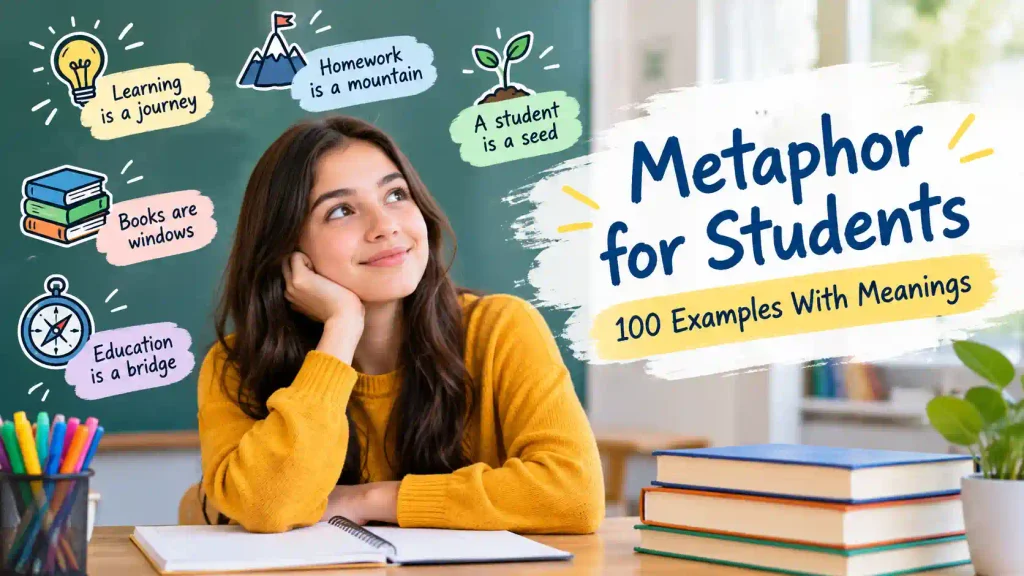
A metaphor for students compares students, student life, learning, or the classroom to something familiar in a non-literal way. For example, “A student is a sponge” suggests that the learner absorbs information quickly. Metaphors make abstract ideas easier to picture and can give student writing more personality and detail.
The most useful distinction is between a metaphor about students themselves and one about learning or school. “She is a sponge” describes a student, while “Learning is a journey” describes the learning process.
Quick Answer
A metaphor for students is a figurative comparison that describes a student or the student experience as something else. Examples include “A student is a sponge” for someone who absorbs knowledge quickly, “A student is a seed” for someone with room to grow, and “A student is an explorer” for someone who discovers new ideas. Good student metaphors should match the quality or experience you want to emphasize.
Student Metaphors by Meaning
Different metaphors communicate different qualities. Choosing the right one matters more than choosing the fanciest phrase.
| Metaphor | Meaning | Tone | Best Use |
| A sponge | Absorbs knowledge | Positive | Learning ability |
| A seed | Has potential to grow | Hopeful | Education essays |
| An explorer | Discovers new ideas | Curious | Creative writing |
| A builder | Constructs knowledge | Active | Academic writing |
| A detective | Investigates problems | Energetic | Science and inquiry |
| A flame | Shows enthusiasm | Inspirational | Speeches |
| A butterfly | Changes and develops | Poetic | Personal growth |
| A puzzle | Has individual qualities | Thoughtful | Student diversity |
| A compass | Finds direction | Reflective | Future and goals |
| A book in progress | Continues to develop | Warm | Personal essays |
What Is a Metaphor for Students?
A metaphor directly connects two different things to communicate a shared quality. It does not mean that the two things are literally the same.
For example:
The student is a sponge.
A student is obviously not a sponge. The metaphor transfers the idea of absorbing from a sponge to a learner.
Another example is:
The classroom was a beehive.
The classroom is not literally a beehive. The comparison suggests that students were busy, active, and constantly moving or communicating.
Metaphors are common in everyday language as well as literature. They can create imagery, emphasize a quality, or make a complicated idea easier to understand.
Metaphor vs. Simile
A metaphor makes a direct figurative comparison:
My teacher is a lighthouse.
A simile usually makes the comparison with “like” or “as”:
My teacher is like a lighthouse.
The two sentences can communicate a similar idea, but they use different forms. Also, simply removing “like” or “as” does not automatically turn any sentence into a metaphor; the sentence still needs to make a meaningful figurative comparison.
20 Metaphors for Students With Meaning
These are some of the strongest choices when you specifically want to describe students as people or learners.
1. A Student Is a Sponge
Meaning: The student absorbs new information quickly.
Example:
Maya is a sponge in science class; she remembers almost everything she learns.
Best use: Essays, classroom descriptions, and positive descriptions of eager learners.
2. A Student Is a Seed
Meaning: The student has potential and can develop with time, care, and learning.
Example:
Every student is a seed waiting for the right conditions to grow.
Best use: Inspirational writing and essays about education.
3. A Student Is an Explorer
Meaning: The student discovers unfamiliar ideas, subjects, and possibilities.
Example:
Every student becomes an explorer when a new subject opens the door to unfamiliar ideas.
Best use: Creative writing and descriptions of curiosity.
4. A Student Is a Builder
Meaning: The student actively constructs knowledge and skills.
Example:
Each lesson gives the student another brick for the building of knowledge.
Best use: Essays about learning and personal development.
5. A Student Is a Gardener
Meaning: A learner cultivates knowledge through effort and patience.
Example:
A good student is a gardener, patiently tending the ideas that will eventually grow.
Best use: Reflective or poetic writing.
6. A Student Is a Flame
Meaning: The student has curiosity, energy, or intellectual enthusiasm.
Example:
Her curiosity was a flame that kept burning long after class ended.
Best use: Positive and inspirational writing.
7. A Student Is a Compass
Meaning: The student learns to find direction and make choices.
Example:
Education gave him a compass for navigating an uncertain future.
Best use: Essays about independence and personal growth.
8. A Student Is a Book in Progress
Meaning: A student is still developing and has more experiences and knowledge ahead.
Example:
Every student is a book in progress, with new chapters added every year.
Best use: Personal essays and graduation writing.
9. A Student Is a Puzzle
Meaning: Every learner has different abilities, experiences, challenges, and strengths.
Example:
Each student is a different puzzle, and one teaching method cannot fit every piece.
Best use: Writing about individual differences.
10. A Student Is a Bridge
Meaning: A student can connect ideas, experiences, cultures, or stages of life.
Example:
The student became a bridge between two different ways of thinking.
Best use: More advanced academic or reflective writing.
11. A Student Is a Butterfly
Meaning: The student changes and develops over time.
Example:
College became the place where she transformed from a hesitant learner into a confident thinker.
Best use: Transformation and growth.
12. A Student Is a Seedling
Meaning: The student is young, developing, and capable of growth.
Example:
The classroom gave every seedling room to reach toward the light.
Best use: Elementary education and poetic writing.
13. A Student Is a Detective
Meaning: The student investigates questions and searches for answers.
Example:
During the experiment, every student became a detective searching for clues.
Best use: Science, inquiry, and problem-solving.
14. A Student Is a Sculptor
Meaning: The student gradually shapes their skills and identity through practice.
Example:
Every assignment was another stroke from the sculptor shaping his future.
Best use: Creative and reflective essays.
15. A Student Is a Runner on a Long Track
Meaning: Education involves progress, effort, setbacks, and persistence.
Example:
She saw herself as a runner on a long track, improving one step at a time.
Best use: Writing about academic perseverance.
16. A Student Is a Light
Meaning: The student brings ideas, curiosity, or positive energy.
Example:
His questions were a light in every classroom discussion.
Best use: Positive descriptions.
17. A Student Is a Key
Meaning: A student can unlock possibilities through knowledge and learning.
Example:
Education gave her the key to opportunities she had never imagined.
Best use: Essays about education and opportunity.
18. A Student Is a Seed of Tomorrow
Meaning: Students represent future possibilities and development.
Example:
Today’s students are seeds of tomorrow’s ideas and discoveries.
Best use: Speeches and educational writing.
19. A Student Is a Sponge in a River of Knowledge
Meaning: The student absorbs information from many sources.
Example:
As a sponge in a river of knowledge, he absorbed ideas from every book and conversation.
Best use: More creative essays.
20. A Student Is a Traveler on a Learning Road
Meaning: Education is an ongoing process with progress, obstacles, and discoveries.
Example:
Every student is a traveler on a learning road, taking a different route toward understanding.
Best use: Essays, speeches, and reflective writing.
Metaphors for Learning and Student Life
Not every useful metaphor needs to describe the student directly. Some describe the experience surrounding the student.
Learning Is a Journey
This metaphor presents learning as a process with a beginning, progress, obstacles, discoveries, and new destinations.
Learning is a journey with no final map.
Knowledge Is a Toolbox
This metaphor suggests that knowledge gives students resources they can use to solve different problems.
Every new skill is another tool in the student’s toolbox.
Education Is a Bridge
This metaphor presents education as something that connects a person’s present situation with future opportunities.
Education can become a bridge between where a student is and where they want to go.
Homework Is a Mountain
This metaphor emphasizes difficulty, effort, or the feeling of having a large amount of work to complete.
After three assignments arrived at once, my homework became a mountain.
An Exam Is a Hurdle
This metaphor presents an exam as an obstacle that requires preparation and effort.
The final exam was the last hurdle before graduation.
The Classroom Is a Laboratory
This metaphor emphasizes experimentation, questions, discovery, and learning through experience.
The classroom became a laboratory of ideas.
The Classroom Is a Beehive
This metaphor emphasizes activity, conversation, cooperation, and movement.
The classroom was a beehive before the science fair.
The Library Is a Treasure Chest
This metaphor emphasizes the value and abundance of books and information.
The library was a treasure chest filled with stories.
A Book Is a Window
This metaphor suggests that reading gives students a view into other experiences, cultures, ideas, or worlds.
Every novel became a window into another life.
Education Is a Ladder
This metaphor emphasizes progress through successive steps.
Each new skill was another rung on her educational ladder.
10 Examples of Metaphors for Students in English
If you need simple English examples for schoolwork, these are easy to understand:
- The student is a sponge.
- My classroom is a beehive.
- Homework is a mountain.
- Learning is a journey.
- Knowledge is a key.
- The library is a treasure chest.
- Education is a bridge.
- The exam is a hurdle.
- My teacher is a lighthouse.
- Books are windows to other worlds.
These examples work because each one creates a non-literal comparison that highlights a particular quality.
5 Simple Metaphor Examples for Students
For a short assignment, you do not need 20 or 100 examples. These five are enough to demonstrate the basic idea:
- The student is a sponge. — The student learns quickly.
- The classroom is a beehive. — The classroom is busy and active.
- Knowledge is a key. — Knowledge opens opportunities.
- Homework is a mountain. — The work feels difficult or extensive.
- Learning is a journey. — Learning develops gradually over time.
Funny Metaphors for Students
Funny metaphors work particularly well in informal writing, classroom activities, captions, and creative assignments.
My Backpack Is a Brick Factory
It suggests that the backpack is extremely heavy.
My backpack is a brick factory after I packed every textbook.
My Homework Is a Hungry Monster
It suggests that assignments keep demanding more time.
My homework is a hungry monster that never seems satisfied.
The School Bus Is a Sardine Can
It suggests that the bus is crowded.
The morning school bus was a sardine can on wheels.
My Alarm Clock Is My Morning Enemy
It humorously presents the alarm as something the student wants to defeat.
At 6 a.m., my alarm clock is my morning enemy.
Exam Week Is a Survival Game
It presents a stressful week as a demanding challenge.
Exam week felt like a survival game with no pause button.
These are original metaphors created for this article, rather than quotations or established sayings.
Pencil Metaphors for Students
A pencil is particularly useful when writing about learning, mistakes, practice, and growth.
A Pencil Is a Student’s Smallest Teacher
It can represent the idea that mistakes and revision teach students.
A Pencil Is a Road Builder
It creates a path of words and ideas across the page.
A Pencil Is a Key
It can unlock ideas by turning thoughts into visible words.
A Pencil Is a Bridge
It connects an idea in the mind to something another person can read.
A Pencil Is a Sculptor
It shapes rough thoughts into finished writing through revision.
For example:
Her pencil was a sculptor, turning scattered thoughts into a clear essay.
100 Metaphor Examples for Students
If you need a larger collection for practice, here are 100 student-friendly examples. The meanings are intentionally short so you can quickly identify the idea behind each metaphor.
Students and Learners
- The student is a sponge. — Absorbs knowledge quickly.
- The student is a seed. — Has room to grow.
- The student is an explorer. — Discovers new ideas.
- The student is a builder. — Constructs knowledge.
- The student is a detective. — Searches for answers.
- The student is a flame. — Shows enthusiasm.
- The student is a butterfly. — Changes and develops.
- The student is a puzzle. — Has unique qualities.
- The student is a compass. — Seeks direction.
- The student is a book in progress. — Continues developing.
- The student is a gardener. — Cultivates knowledge.
- The student is a sculptor. — Shapes their abilities.
- The student is a traveler. — Moves through a learning journey.
- The student is a lighthouse. — Can guide others with ideas.
- The student is a key. — Can unlock possibilities.
- The student is a seedling. — Is still developing.
- The student is a river. — Continues moving and changing.
- The student is a canvas. — Receives and develops new ideas.
- The student is a growing tree. — Develops roots and branches of knowledge.
- The student is a spark. — Can ignite curiosity.
Learning and Knowledge
- Learning is a journey. — It develops over time.
- Knowledge is a key. — It opens possibilities.
- Knowledge is a toolbox. — It provides useful resources.
- Education is a bridge. — It connects present and future.
- Learning is a ladder. — Progress happens step by step.
- Learning is a river. — Knowledge keeps flowing.
- Knowledge is light. — It makes understanding clearer.
- Learning is a garden. — Ideas grow with care.
- Education is a doorway. — It leads to new possibilities.
- Learning is a map. — It provides direction.
- Knowledge is a seed. — It can grow into understanding.
- Learning is a puzzle. — Pieces gradually form understanding.
- Education is a passport. — It can open access to new experiences.
- Learning is a staircase. — Each step represents progress.
- Knowledge is an ocean. — It contains enormous depth.
- Learning is a workout. — Practice strengthens ability.
- Education is a foundation. — It supports future development.
- Learning is a compass. — It helps people navigate unfamiliar territory.
- Knowledge is a treasure chest. — It contains valuable ideas.
- Learning is a bridge between questions and answers. — It connects curiosity with understanding.
Classroom Metaphors
- The classroom is a beehive. — It is busy and active.
- The classroom is a laboratory. — Students experiment with ideas.
- The classroom is a garden. — Students and ideas can grow.
- The classroom is a workshop. — Students practice and create.
- The classroom is a stage. — Students communicate and perform.
- The classroom is a launchpad. — It prepares students for what comes next.
- The classroom is a melting pot of ideas. — Different perspectives come together.
- The classroom is a canvas. — Students create something new.
- The classroom is a doorway. — It introduces new knowledge.
- The classroom is a greenhouse. — It provides conditions for growth.
- The classroom is a crossroads. — Different ideas and experiences meet.
- The classroom is a workshop of minds. — Students develop ideas together.
- The classroom is a theater of ideas. — Concepts are explored and expressed.
- The classroom is a map room. — Students explore different directions.
- The classroom is a toolbox. — It supplies skills and resources.
Schoolwork and Exams
- Homework is a mountain. — It feels large or difficult.
- Homework is a puzzle. — It requires problem-solving.
- Homework is a workout. — It requires practice.
- An exam is a hurdle. — It presents a challenge to overcome.
- Exam week is a marathon. — It requires endurance.
- A difficult assignment is a maze. — Finding the answer can be complicated.
- A textbook is a roadmap. — It guides learning.
- A notebook is a garden. — Ideas grow across its pages.
- A pencil is a bridge. — It connects thought with writing.
- A pencil is a sculptor. — It shapes ideas into words.
- A test is a mirror. — It can reveal what a student understands.
- Revision is a polishing cloth. — It improves rough writing.
- Feedback is a flashlight. — It reveals what needs attention.
- Practice is a ladder. — Repetition helps students progress.
- A deadline is a finish line. — It marks the end of a task.
Books, Reading, and Writing
- A book is a window. — It offers a view into another world.
- A book is a doorway. — It leads readers into new experiences.
- A library is a treasure chest. — It contains valuable knowledge and stories.
- A novel is a journey. — The reader travels through its story.
- A paragraph is a building block. — It contributes to a larger piece of writing.
- An essay is a bridge. — It connects the writer’s ideas with the reader.
- Words are paint. — Writers use them to create pictures.
- Vocabulary is a toolbox. — Words provide different ways to express ideas.
- A sentence is a thread. — It can connect ideas within a larger piece.
- A story is a river. — Events flow from one point to another.
Student Life and Growth
- Student life is a roller coaster. — It includes highs and lows.
- School is a journey. — Students progress through different stages.
- Graduation is a doorway. — It marks entry into a new stage.
- A goal is a finish line. — It gives students a destination.
- Failure is a stepping stone. — Mistakes can contribute to progress.
- A challenge is a mountain. — It requires effort to overcome.
- Curiosity is a spark. — It starts interest and investigation.
- Confidence is an anchor. — It can provide stability.
- Doubt is a shadow. — It can follow a person’s thinking.
- Hope is a compass. — It provides direction during uncertainty.
More Creative Examples
- Ideas are seeds. — They can develop into larger concepts.
- Questions are doors. — They can lead to discovery.
- Mistakes are stepping stones. — They can support improvement.
- Experience is a teacher. — It provides lessons through real situations.
- Curiosity is a magnet. — It draws attention toward new information.
- Imagination is a window. — It lets the mind see possibilities.
- Creativity is a river. — Ideas can keep flowing.
- A difficult subject is a locked door. — It requires effort to understand.
- A good question is a flashlight. — It illuminates an unclear problem.
- Education is a seed planted for the future. — Learning can support later growth.
Which Metaphor Should You Use?
The best metaphor depends on what you want the reader to understand.
- For a school essay: Choose clear metaphors such as “Education is a bridge,” “Knowledge is a key,” or “Learning is a journey.”
- For a creative-writing assignment: Use more vivid images such as “The classroom is a beehive” or “Curiosity is a spark.”
- For poetry: More imaginative metaphors such as “The student is a flame” or “The notebook is a garden” can create stronger imagery.
- For describing a hardworking student: Try “The student is a runner,” “The student is a builder,” or “The student is a gardener.”
- For describing a curious student: “The student is an explorer” or “The student is a detective” communicates curiosity more clearly.
- For describing academic growth: “The student is a seed,” “The student is a seedling,” or “The student is a growing tree” emphasizes development.
- For a funny assignment: Use playful comparisons such as “Homework is a hungry monster” or “My backpack is a brick factory.”
The strongest metaphor is not necessarily the most unusual one. Choose the image that communicates your intended meaning immediately.
Why Metaphors Help Students
Metaphors give students a way to connect an unfamiliar or abstract idea with something they already understand. In English education, metaphors are used to help learners recognize, interpret, and produce figurative language. Educational resources also use activities such as identifying metaphors, comparing metaphors with similes, and explaining why a particular comparison works.
Metaphors can also encourage deeper thinking. Instead of simply saying that a student is “curious,” for example, calling the student an explorer gives the reader a mental picture of someone actively searching for something new.
That is why the explanation matters as much as the metaphor itself.
Frequently Asked Questions
What is a metaphor example for students?
A simple example is “The student is a sponge.” The student is not literally a sponge; the metaphor suggests that the student absorbs information quickly.
What are 10 examples of metaphors for students?
Ten simple examples are:
- The student is a sponge.
- The student is a seed.
- The student is an explorer.
- The student is a builder.
- The student is a detective.
- The student is a flame.
- The student is a butterfly.
- The student is a puzzle.
- The student is a compass.
- The student is a book in progress.
What are some metaphors for a classroom?
Useful classroom metaphors include “The classroom is a beehive,” “The classroom is a laboratory,” “The classroom is a garden,” “The classroom is a workshop,” and “The classroom is a launchpad.” Each emphasizes a different quality, such as activity, experimentation, growth, practice, or preparation.
What are 20 metaphors for students?
Examples include a sponge, seed, explorer, builder, gardener, flame, compass, book in progress, puzzle, butterfly, detective, sculptor, traveler, lighthouse, key, seedling, river, canvas, growing tree, and spark.
What are 100 examples of metaphors for students?
The article above provides 100 student-friendly metaphor examples, covering students, learning, classrooms, schoolwork, exams, reading, writing, and student life. The examples include short meanings so they can be used for English practice, essays, creative writing, and classroom assignments.
Can I use these metaphor examples in a PDF or school assignment?
Yes. The examples can be copied into study notes or adapted for an assignment. If you need a printable resource, the examples can also be organized into a worksheet or PDF format. Educational websites commonly provide downloadable metaphor worksheets for student practice.
Conclusion
A good metaphor for students does more than make writing sound creative. It gives the reader a clear image of a student’s qualities, challenges, growth, or learning experience.
For a learner who absorbs information quickly, “a sponge” works well. For someone developing over time, “a seed” captures potential. The curiosity, “an explorer” creates a stronger image. For persistence, “a runner” or “builder” can communicate continued effort.
When choosing a metaphor, start with the meaning you want to express and then choose an image that makes that meaning easy to see.

Qaiser Abbas is an award-winning author, leadership coach, and motivational speaker known for his work on personal growth, leadership, and human potential. Through his writing and speaking, Qaiser focuses on turning challenges into opportunities and helping people build the mindset to achieve meaningful growth.