
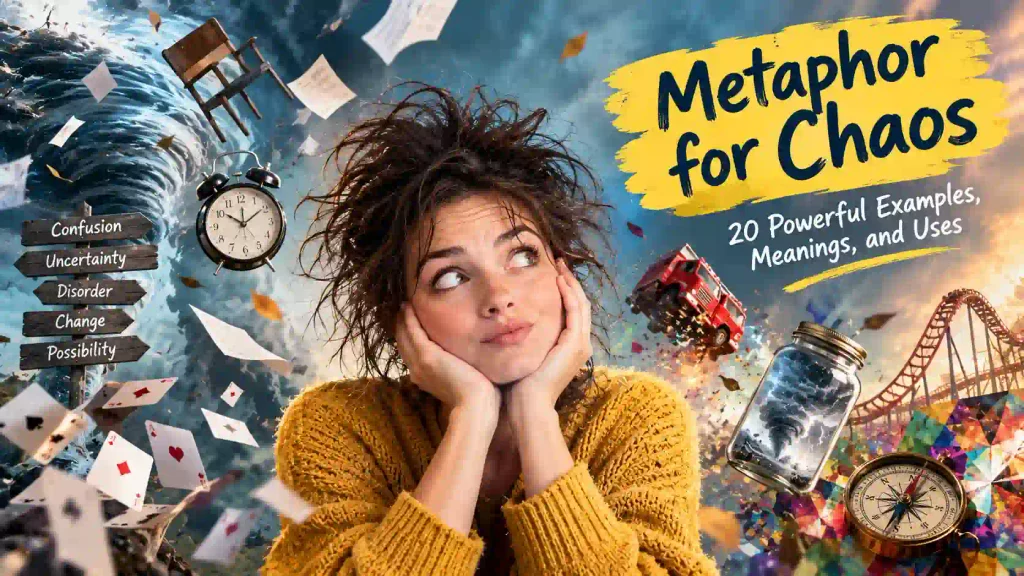
A metaphor for chaos turns disorder, confusion, instability, or overwhelming activity into a vivid image. Instead of saying “everything was chaotic,” you can describe a situation as a runaway train, a tangled web, or a storm trapped in a bottle.
The strongest metaphor depends on the type of chaos you mean. A storm suggests turbulence, a maze suggests confusion, a wildfire suggests rapidly spreading disorder, and a broken compass suggests a complete loss of direction.
Chaos Metaphor
A strong metaphor for chaos is “a storm without a forecast.” It suggests uncertainty, constant change, and the feeling that nobody knows what will happen next. Other useful metaphors include “a tangled web,” “a runaway train,” “a three-ring circus,” “a wildfire,” and “a maze with moving walls.” The best choice depends on whether you want to emphasize confusion, speed, instability, noise, or loss of control.
20 Metaphors for Chaos
| Metaphor | Meaning | Metaphor | Meaning |
| A storm without a forecast | Uncertainty and unpredictable change | A tangled web | Problems becoming interconnected and difficult to untangle |
| A runaway train | Events moving beyond control | A maze with moving walls | Confusion that keeps changing as you try to navigate it |
| A wildfire | Disorder spreading rapidly | A broken compass | Confusion caused by a lack of direction |
| A three-ring circus | Many confusing things happening simultaneously | A shaken snow globe | Everything suddenly thrown into motion |
| A pressure cooker | Tension building toward an eruption | A river breaking its banks | Events overflowing their normal boundaries |
| A deck of cards in a hurricane | Plans or information scattered beyond control | A room full of ringing alarms | Too many urgent problems demanding attention |
| A carousel with no brakes | Continuous activity that refuses to slow down | A puzzle with the pieces falling off the table | A situation becoming harder to organize |
| A storm trapped in a bottle | Intense energy or conflict confined to a small space | A traffic light stuck on every color | Contradictory signals and uncertain decisions |
| A swarm of bees | Fast, noisy, restless activity | A clock with loose gears | A system that has stopped functioning in an orderly way |
| A house of dominoes | One disruption triggering another | A river with no banks | Activity spreading without boundaries |
| A kaleidoscope with broken glass | Constantly shifting disorder | A map covered in crossed-out roads | Too many failed directions or plans |
| A drumline with no conductor | Noise and activity without coordination | A jigsaw puzzle caught in the wind | Information and plans scattered everywhere |
| A snowball rolling downhill | A small problem rapidly becoming larger | A door in a hurricane | Constant movement with no stability |
| A swarm of thoughts | Too many ideas competing at once | A ship in rough water | Difficulty maintaining stability during turmoil |
Metaphors for Different Kinds of Chaos
A Storm Without a Forecast
This metaphor emphasizes uncertainty. The problem is not simply that things are messy; nobody can reliably predict what will happen next.
Example:
The negotiations were a storm without a forecast, changing direction every few hours.
Best for: uncertainty, emotional turmoil, unpredictable situations, fiction, and reflective writing.
A Tangled Web
This metaphor emphasizes complexity and interconnected problems. One issue connects to another, making the whole situation difficult to understand or resolve.
Example:
The investigation became a tangled web of conflicting stories.
Best for: complicated problems, relationships, investigations, and confusing situations.
A Runaway Train
A runaway train represents momentum without control. Once events start moving, stopping them becomes increasingly difficult.
Example:
The argument became a runaway train after both sides stopped listening.
Best for: escalating conflicts, deadlines, crises, and rapidly worsening situations.
A Wildfire
A wildfire suggests chaos that spreads quickly. One small problem can create several larger problems.
Example:
One missed deadline became a wildfire of complications across the project.
Best for: spreading rumors, organizational problems, social conflict, and cascading failures.
A Broken Compass
A broken compass represents loss of direction rather than noise or physical disorder.
Example:
Without a clear plan, the team was a broken compass, moving in different directions.
Best for: leadership problems, confused decisions, uncertain plans, and organizational disorder.
A Shaken Snow Globe
A shaken snow globe creates an image of everything suddenly moving at once. It works particularly well for temporary chaos.
Example:
The office became a shaken snow globe after the unexpected announcement.
Best for: sudden disruption, busy workplaces, family situations, and short-lived disorder.
A Pressure Cooker
A pressure cooker emphasizes building tension rather than random confusion.
Example:
The crowded meeting room became a pressure cooker after hours of disagreement.
Best for: arguments, stressful environments, emotional tension, and situations close to breaking point.
A Three-Ring Circus
A three-ring circus is an established English expression for a situation packed with confusing, noisy, or simultaneous activity. Dictionary sources identify it as an informal expression for a busy and confusing situation.
Example:
The airport terminal became a three-ring circus after several flights were canceled.
Best for: humorous descriptions of busy public places, family gatherings, offices, events, and complicated situations.
A Maze With Moving Walls
This original metaphor emphasizes confusion that changes while you are trying to solve it.
Example:
Managing the project felt like walking through a maze with moving walls.
Best for: complicated projects, bureaucracy, changing requirements, and difficult decisions.
A House of Dominoes
This metaphor suggests that one failure triggers another.
Example:
The supply problem became a house of dominoes, knocking down one deadline after another.
Best for: cascading problems, business disruptions, technical failures, and complex systems.
Funny Metaphors for Chaos
Chaos does not always need a dramatic image. For casual writing, humor can make the description more memorable.
Try:
- A drumline with no conductor — lots of noise without coordination.
- A traffic light stuck on every color — contradictory instructions.
- A jigsaw puzzle caught in the wind — everything scattered at once.
- A carousel with no brakes — activity that never seems to stop.
- A shaken snow globe — sudden, temporary disorder.
- A room full of ringing alarms — too many urgent problems at once.
Example:
Monday morning was a drumline with no conductor.
That sentence creates a playful image without simply saying, “Monday was chaotic.”
What Is a Beautiful Word for Chaos?
If you want a more literary word than chaos, maelstrom is one of the strongest choices. Cambridge defines it as a situation involving great confusion, violence, or destruction, while its literal sense refers to powerful circular water movement.
Example:
The city disappeared into a maelstrom of noise and movement.
Other useful words include:
- Pandemonium — wild, noisy confusion.
- Turmoil — a state of great disturbance or uncertainty.
- Bedlam — extreme confusion and noise.
- Disarray — a lack of organization.
- Mayhem — violent or disorderly confusion.
- Commotion — noisy or excited activity.
- Havoc — widespread damage or disorder.
- Tumult — loud, confused, or violent disturbance.
These words overlap, but they are not identical. Disarray focuses on lack of organization, while maelstrom carries a much stronger sense of turbulent, overwhelming circumstances.
What Is an Idiom That Describes Chaos?
One of the clearest established idioms is “a three-ring circus.” It describes a situation filled with confusing or simultaneous activity.
Another familiar expression is “all hell broke loose,” which describes a sudden eruption of disorder or uncontrolled activity.
Example:
When the power failed during the concert, all hell broke loose.
“In a pickle” is different. It describes being in a difficult or awkward situation rather than chaos itself, so it works when the emphasis is on being stuck in trouble. Oxford lists it as an informal idiom meaning to be in a difficult or unpleasant situation.
The distinction is useful: three-ring circus describes a chaotic scene, while in a pickle describes a difficult predicament.
What Is the Symbolism of Chaos?
Chaos commonly symbolizes disorder, uncertainty, instability, conflict, and the loss of control. In creative writing, it can also symbolize a transition between an old state and a new one.
The symbolism becomes especially interesting in mythology. In Hesiod’s Theogony, Chaos appears at the beginning of the cosmic creation sequence. The text then introduces figures including Gaia, Tartarus, and Eros. In that older Greek context, Chaos did not simply mean the modern idea of a messy or disorganized situation; it referred to a primordial condition or void.
That gives chaos two useful symbolic directions:
Chaos as destruction:
A system loses structure, stability, or control.
Chaos as possibility:
An existing structure breaks apart, creating the conditions for something new.
This dual meaning can make chaos a powerful literary symbol. A storm can destroy a landscape, but it can also mark the beginning of a dramatic transformation.
Chaos in Poetry and Creative Writing
Chaos metaphors work particularly well when the writer wants readers to feel disorder rather than simply understand it.
Compare:
Everything was chaotic.
with:
Every thought was a loose gear spinning inside the machine.
The second sentence gives chaos a physical image. Readers can imagine movement, friction, noise, and malfunction.
For poetry, more open-ended images can work well:
- A sky with no horizon
- A river forgetting its banks
- A compass dreaming of every direction
- A storm carrying pieces of yesterday
- A room where the walls keep moving
These are original metaphors rather than established sayings. They are best treated as creative language, not quotations or traditional expressions.
Metaphor vs. Simile for Chaos
A metaphor directly identifies one thing with another:
The meeting was a circus.
A simile makes the comparison explicit with like or as:
The meeting was like a circus.
Both can describe chaos effectively, but they are grammatically different.
This distinction matters because many online pages use the word “metaphor” loosely and include similes in the same list. Current search results show this pattern repeatedly.
For precise writing, call a direct comparison a metaphor and a comparison using like or as a simile.
Choosing the Right Metaphor
| Metaphor | Meaning | Tone | Best Use |
| A storm without a forecast | Uncertainty | Poetic | Essays, fiction |
| A tangled web | Complexity | Serious | Descriptive writing |
| A runaway train | Loss of control | Strong | Everyday and creative writing |
| A wildfire | Rapid spread | Dramatic | Reports, fiction |
| A broken compass | Loss of direction | Reflective | Essays, speeches |
| A shaken snow globe | Sudden disruption | Vivid | Creative writing |
| A pressure cooker | Building tension | Strong | Emotional writing |
| A three-ring circus | Busy confusion | Humorous | Everyday conversation |
| A maze with moving walls | Changing confusion | Imaginative | Fiction |
| A house of dominoes | Cascading problems | Serious | Essays and analysis |
| A swarm of bees | Noisy activity | Energetic | Everyday description |
| A drumline with no conductor | Activity without coordination | Funny | Casual writing |
For an essay
Choose a metaphor that clarifies the idea rather than distracting from it. A broken compass works well when discussing uncertainty or poor direction.
For poetry
Choose an image with room for interpretation. A storm without a forecast or a river with no banks can carry emotional meaning without explaining everything.
For fiction
Match the image to the scene. A crowded emergency room might become a room full of ringing alarms, while a character’s conflicting thoughts might become a maze with moving walls.
For everyday conversation
Established expressions usually sound more natural. Three-ring circus is especially useful for describing a busy, confusing situation.
For humorous writing
Use an exaggerated image such as a traffic light stuck on every color or a drumline with no conductor.
Ten Simple Examples of Metaphor for Chaos
If you need quick examples, these ten cover different kinds of disorder:
- The meeting was a three-ring circus.
- The project became a runaway train.
- Her thoughts were a tangled web.
- The office was a storm without a forecast.
- The rumor became a wildfire.
- The team was a broken compass.
- The crisis became a house of dominoes.
- The classroom was a shaken snow globe.
- The argument was a pressure cooker.
- The schedule was a maze with moving walls.
Each example emphasizes a different quality, which makes the list more useful than ten variations of “chaos is a storm.”
FAQs About Metaphors for Chaos
What is a metaphor for chaos?
A metaphor for chaos describes disorder, confusion, instability, or unpredictability through a vivid comparison. Examples include a runaway train, a tangled web, a wildfire, and a broken compass.
What are 10 examples of a metaphor?
Ten examples include a storm without a forecast, a tangled web, a runaway train, a wildfire, a broken compass, a shaken snow globe, a pressure cooker, a maze with moving walls, a house of dominoes, and a drumline with no conductor.
What is a beautiful word for chaos?
Maelstrom is a particularly vivid word for chaos because it suggests overwhelming confusion and turbulent movement. Other choices include pandemonium, turmoil, bedlam, disarray, mayhem, and tumult. Maelstrom carries a stronger and more dramatic tone than disarray.
What is an idiom that describes chaos?
“A three-ring circus” is an established idiomatic expression for a situation filled with confusing, busy, or simultaneous activity. “All hell broke loose” is another informal expression for a sudden eruption of disorder.
What is the symbolism of chaos?
Chaos can symbolize disorder, uncertainty, conflict, instability, transformation, or the breakdown of an existing structure. In Hesiod’s Greek creation story, Chaos appears at the beginning of the cosmic sequence, giving the concept an older association with a primordial void or condition rather than simply modern disorder.
What is the difference between a metaphor and a simile for chaos?
A metaphor makes a direct comparison, such as “The meeting was a circus.” A simile uses like or as, such as “The meeting was like a circus.” Both create imagery, but they are different forms of figurative language.
Conclusion
A strong metaphor for chaos does more than replace the word chaos. It shows readers what kind of disorder is happening.
Use a tangled web for complexity, a broken compass for lost direction, a wildfire for rapidly spreading problems, a runaway train for events beyond control, and a three-ring circus for noisy, confusing activity.
For literary writing, maelstrom offers a powerful vocabulary choice. For poetry, original images can make chaos feel personal and vivid. And for everyday conversation, familiar expressions often sound more natural than elaborate comparisons.

Qaiser Abbas is an award-winning author, leadership coach, and motivational speaker known for his work on personal growth, leadership, and human potential. Through his writing and speaking, Qaiser focuses on turning challenges into opportunities and helping people build the mindset to achieve meaningful growth.