
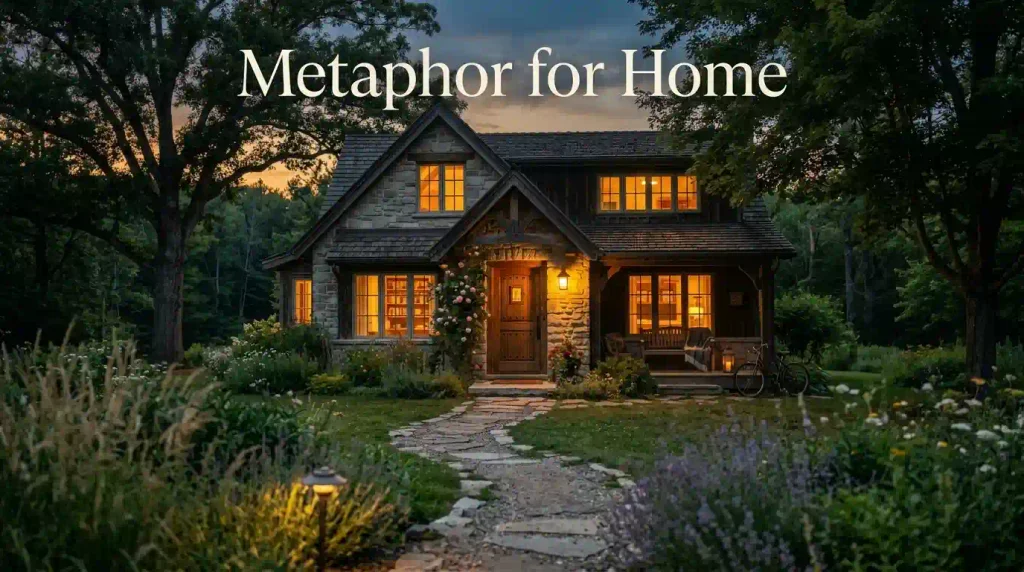
A metaphor for home describes home as something else to express an idea that a literal description cannot fully capture. Home can become a harbor for safety, an anchor for stability, a memory box for the past, or a heart for love and belonging. The best metaphor depends on what you want “home” to mean in your writing.
Strong Home Metaphor
A strong metaphor for home is “Home is a harbor.” It suggests that home gives you shelter, rest, and protection when life becomes difficult. Other useful home metaphors include “home is an anchor” for stability, “home is a garden” for growth, “home is a treasure chest” for memories, and “home is a lighthouse” for guidance. Home can also represent love, identity, belonging, or a place where you can finally be yourself.
Metaphors for Home: 25 Examples and Meanings
The following examples include familiar figurative expressions and original metaphors created for this article. Original examples are marked clearly so they aren’t mistaken for established sayings.
| Metaphor | Meaning | Metaphor | Meaning |
| Home is a harbor | Safety and rest | Home is an anchor | Stability and grounding |
| Home is a nest | Care and protection | Home is a garden | Growth and nurturing |
| Home is a lighthouse | Guidance and hope | Home is a treasure chest | Precious memories |
| Home is a warm hearth | Comfort and family | Home is a bridge | Connection and belonging |
| Home is a root system | Origins and identity | Home is a soft landing | Relief after hardship |
| Home is a sanctuary | Peace and refuge | Home is a compass | Direction and values |
| Home is a quilt | Shared memories and relationships | Home is a mirror | Identity and self-reflection |
| Home is a garden gate | Welcome and belonging | Home is a heartbeat | Life and emotional importance |
| Home is a sheltering tree | Protection and shade | Home is a book | Family history and memories |
| Home is a campfire | Warmth and togetherness | Home is an island | Escape from chaos |
| Home is a doorway back to myself | Self-acceptance | Home is a quiet song | Familiarity and peace |
| Home is a stitched map | Places and memories connected together | Home is a key | Access to belonging |
The strongest home metaphors usually work because they connect a physical image with an emotional quality. Home as a harbor emphasizes safety, while home as a garden emphasizes growth. Home as a mirror shifts the focus toward identity.
Metaphors for Home and What They Express
Home as Safety and Protection
If you want your metaphor to emphasize security, refuge, or relief, use imagery associated with shelter.
Home is a harbor.
A harbor protects ships from rough water, so this metaphor presents home as a place where a person can recover from life’s difficulties.
Example: After months of uncertainty, her apartment became a harbor where she could finally rest.
Home is a sanctuary.
This metaphor emphasizes peace, privacy, and emotional safety.
Example: His small house became a sanctuary after a stressful day.
Home is a sheltering tree.
The image suggests shade, protection, and a place to pause.
Example: Her grandparents’ house was a sheltering tree in every difficult season of her childhood.
Home is a soft landing.
This works particularly well when describing a return after failure, exhaustion, travel, or hardship.
Example: After losing his job, his family gave him the soft landing he needed to begin again.
Home as Love and Belonging
Sometimes home has little to do with walls. It describes the people, relationships, and emotional connections that make a person feel accepted.
Home is a heartbeat.
This metaphor presents home as something essential and alive.
Example: Her family was the heartbeat that kept her connected to her roots.
Home is a campfire.
A campfire brings people together around warmth and shared time.
Example: Their kitchen was a campfire where stories, arguments, and laughter gathered every evening.
Home is a bridge.
This metaphor emphasizes connection between people, generations, or places.
Example: Their old house became a bridge between childhood memories and adult life.
Home is a garden gate.
The image focuses on welcome: the gate opens to a place where someone belongs.
Example: Her grandmother’s porch felt like a garden gate that was always open.
Home as Memory
A home can hold memories long after furniture, rooms, or even people have changed.
Home is a treasure chest.
This metaphor suggests that a house contains valuable memories rather than physical treasure.
Example: Their childhood home was a treasure chest filled with birthdays, photographs, and family stories.
Home is a quilt.
A quilt contains many pieces stitched together, making it useful for describing a life made from separate experiences.
Example: Their home was a quilt of Sunday dinners, old photographs, and late-night conversations.
Home is a book.
Each room, object, and familiar corner can represent a page in a family’s history.
Example: Every room in the old house was a page in the book of her childhood.
Home is a stitched map.
This original metaphor works especially well for people whose idea of home includes several cities, families, or stages of life.
Example: After years of moving, she carried a stitched map of every place she had once called home.
Metaphors for Home and Identity
One of the most interesting uses of a home metaphor is to describe identity. A house can represent more than shelter; it can symbolize where a person comes from, what shaped them, and where they feel they belong.
Literary discussions of home often connect it with belonging, identity, safety, memory, love, and return. The idea of the house can therefore expand beyond a physical building and become a way of thinking about the self and one’s relationship to community.
Home is a root system.
Roots connect a tree to its origin while continuing to support its growth. This makes the image useful for family history, heritage, and personal identity.
Example: Her hometown was the root system beneath everything she became.
Home is a mirror.
This metaphor suggests that home reflects the people who live there and the experiences that shaped them.
Example: The cluttered shelves were a mirror of the family’s wonderfully complicated history.
Home is a doorway back to myself.
This original metaphor emphasizes authenticity and self-acceptance.
Example: Whenever she returned to her childhood neighborhood, it felt like a doorway back to herself.
Home is a compass.
This metaphor works when home represents values, direction, or principles.
Example: The lessons he learned at home became his compass when life became uncertain.
Metaphors for Home and Growth
Home doesn’t have to represent a place where nothing changes. It can represent the environment that helps someone grow.
Home is a garden.
A garden requires care, patience, and time, making it a strong metaphor for family and personal development.
Example: Their home was a garden where curiosity and kindness could grow.
Home is a lighthouse.
A lighthouse does not physically carry someone to safety; it provides a visible point of direction. That makes it useful for describing guidance from family or one’s roots.
Example: Her mother’s advice remained a lighthouse whenever she lost her way.
Home is a book.
This can also express growth because people continually add new chapters to their lives.
Example: Moving away didn’t close the book of home; it simply started another chapter.
Positive and Negative Metaphors for Home
Not every home metaphor needs to be warm or comforting. Writers sometimes use home imagery to express confinement, conflict, isolation, or emotional distance.
For example:
- Home is a fortress — emphasizes protection, but can also suggest isolation.
- Home is a cage — suggests confinement or a lack of freedom.
- Home is a battlefield — presents family life as conflict.
- Home is a museum — suggests a place dominated by the past.
- Home is an empty shell — suggests that the physical building remains while its emotional meaning has disappeared.
These darker metaphors can be especially effective in fiction, poetry, memoir, and emotional writing because they acknowledge that a physical house does not always feel like home.
Five Simple Metaphor Examples for Home
If you need five metaphor examples for an assignment, speech, or short piece of writing, these are easy to understand:
- Home is a harbor — it gives me safety.
- Home is an anchor — it keeps me grounded.
- Home is a garden — it helps me grow.
- Home is a treasure chest — it holds my memories.
- Home is a lighthouse — it guides me when I feel lost.
These examples cover five different meanings rather than repeating the same idea of comfort.
Metaphor for Home Love
A metaphor for home love should emphasize warmth, acceptance, connection, or emotional security.
Home is a warm hearth.
The image of a hearth connects home with warmth and togetherness.
Example: Their family was the warm hearth that welcomed everyone back.
Home is a heartbeat.
This works when love makes home feel essential to life.
Example: Her children’s laughter was the heartbeat of the house.
Home is a blanket of love.
This original metaphor emphasizes emotional comfort and protection.
Example: His family wrapped around him like a blanket of love when everything else felt uncertain.
Metaphor for Home Memories
For home memories, choose images that suggest storage, history, layers, or preservation.
Good choices include:
- Home is a treasure chest — memories have emotional value.
- Home is a book — every room contains a story.
- Home is a quilt — many small moments create one larger history.
- Home is a museum — the past remains visible in familiar objects.
- Home is a time capsule — a place preserves moments from another period of life.
For example:
My childhood home was a time capsule, preserving the voices, photographs, and ordinary routines I thought I had forgotten.
Home Metaphor Poem Ideas
A home metaphor poem works best when one central image carries the poem rather than when every line introduces a different comparison.
For example, an original poem could treat home as a lighthouse:
Home is the light I recognize
when every road looks unfamiliar,
a quiet window in the distance,
still glowing when I turn back.
The poem uses one sustained image: home as a source of direction and return.
Another approach is to treat home as a garden, where rooms become paths, memories become seeds, and relationships become roots. That structure lets the metaphor develop naturally instead of turning the poem into a list of comparisons.
What Is the House a Metaphor For?
A house can metaphorically represent the self, family, identity, memory, belonging, security, or a person’s inner life. The intended meaning depends on the context.
In literature, a house may function as a physical setting and a symbolic structure at the same time. A damaged house might reflect a damaged family relationship; an unfamiliar house might represent alienation; a childhood house might symbolize memory or identity. Literary scholarship has also treated the house as a figure for home, community, and the process of rebuilding a sense of self.
So when someone asks, “What is the house a metaphor for?”, the best answer is not always “home.” It can stand for whatever emotional or psychological world the writer connects to the building.
What’s a Fancy Way of Saying Home?
If you want a more literary or elegant way to say home, consider:
- Sanctuary — emphasizes peace and protection.
- Haven — emphasizes refuge.
- Abode — formal or literary.
- Dwelling — neutral and somewhat formal.
- Hearth — emphasizes family and warmth.
- Retreat — emphasizes privacy and rest.
- Homestead — suggests a settled family place.
- Place of belonging — emphasizes emotional connection.
- Haven of comfort — poetic and warm.
- Place of return — emphasizes memory and attachment.
The best choice depends on tone. “Abode” sounds formal, while “hearth” sounds warmer and more literary.
What Are Some Idioms About Home?
Several established expressions use home figuratively:
- Home is where the heart is — your true home is where you feel emotionally connected and loved.
- Home away from home — another place feels as comfortable as your own home.
- Home sweet home — expresses pleasure at being home, sometimes sincerely and sometimes ironically.
- Close to home — something affects you personally or feels especially relevant.
- Charity begins at home — people should care for their own family or immediate community before helping others.
Oxford’s learner dictionary lists these and other established expressions associated with “home.” The phrase “home is where the heart is” is also an established saying rather than an original metaphor; the Oxford English Dictionary records examples of the expression from the 19th century.
Metaphor vs. Simile for Home
The distinction is simple:
Metaphor:
Home is a harbor.
Simile:
Home is like a harbor.
A metaphor states the comparison directly. A simile usually signals the comparison with “like” or “as.”
Both can work well, but metaphors often create a stronger, more immediate image in poetry and creative writing.
Choosing the Right Metaphor for Home
Choose the image according to the feeling you want the reader to experience.
| If home means… | Choose imagery such as… | Best for… |
| Safety | Harbor, sanctuary, shelter | Essays, speeches |
| Love | Hearth, heartbeat, embrace | Emotional writing |
| Memories | Book, treasure chest, time capsule | Poetry, memoir |
| Belonging | Bridge, garden gate, roots | Essays, personal writing |
| Stability | Anchor, foundation, compass | Speeches, reflective writing |
| Growth | Garden, tree, lighthouse | Essays, poetry |
| Identity | Mirror, roots, doorway | Literary writing |
| Conflict | Battlefield, cage, empty shell | Fiction, poetry |
| Nostalgia | Museum, old book, time capsule | Memoir, poetry |
| Freedom | Open door, horizon, safe harbor | Creative writing |
The strongest metaphor is not necessarily the most beautiful one. It is the one that communicates your intended meaning without requiring a long explanation.
A Note About “Mohawk Home Metaphor”
Some searches for “mohawk home metaphor”, “mohawk® home metaphor solid bubble bath rug,” and “mohawk home metaphor bath rug” refer to a product rather than figurative language.
Mohawk Home has a Metaphor bath-rug collection, including chenille bath rugs. Retail listings describe the product as a plush bath rug available in multiple sizes and colors.
Frequently Asked Questions
What is a good metaphor for home?
A strong metaphor for home is “home is a harbor.” It suggests safety, comfort, and a place where you can rest after facing difficulties. Other useful metaphors include “home is an anchor” for stability, “home is a garden” for growth, and “home is a treasure chest” for cherished memories.
What is a metaphor for home and love?
“Home is a warm hearth” is a fitting metaphor for home and love because it connects home with warmth, family, comfort, and togetherness. You could also say “home is a heartbeat” to suggest that the people you love give a home its emotional life.
What is the house a metaphor for?
A house can represent identity, family, memory, safety, belonging, or the inner self, depending on the context. In literature, a house may also symbolize a person’s relationships or emotional condition. For example, a damaged house might represent a troubled family or a fractured sense of belonging.
What are five metaphor examples for home?
Five simple examples are “home is a harbor,” “home is an anchor,” “home is a garden,” “home is a treasure chest,” and “home is a lighthouse.” Each emphasizes a different meaning: safety, stability, growth, memories, and guidance.
What are some idioms about home?
Common home-related idioms and expressions include “home is where the heart is,” “home away from home,” “home sweet home,” “close to home,” and “charity begins at home.” These expressions use home to communicate ideas about belonging, comfort, personal connection, or family.
What’s a fancy way of saying home?
Depending on the tone, you can use “sanctuary,” “haven,” “abode,” “hearth,” “homestead,” or “place of belonging.” “Haven” emphasizes refuge, “hearth” emphasizes warmth and family, while “abode” has a more formal or literary tone.
Final Takeaway
A home metaphor becomes powerful when it captures something that a literal description cannot. “Home is a harbor” expresses safety, “home is a garden” suggests growth, “home is a treasure chest” evokes memories, and “home is a mirror” explores identity.
For a poem, choose an image that can develop across several lines. And for an essay, choose a metaphor with a clear meaning. For emotional writing, focus on love, belonging, or memory. And when the subject is complicated, don’t be afraid to describe home as a battlefield, cage, museum, or empty shell.
The most effective metaphor for home is the one that makes the reader feel what home means—not simply picture a building.

Qaiser Abbas is an award-winning author, leadership coach, and motivational speaker known for his work on personal growth, leadership, and human potential. Through his writing and speaking, Qaiser focuses on turning challenges into opportunities and helping people build the mindset to achieve meaningful growth.