
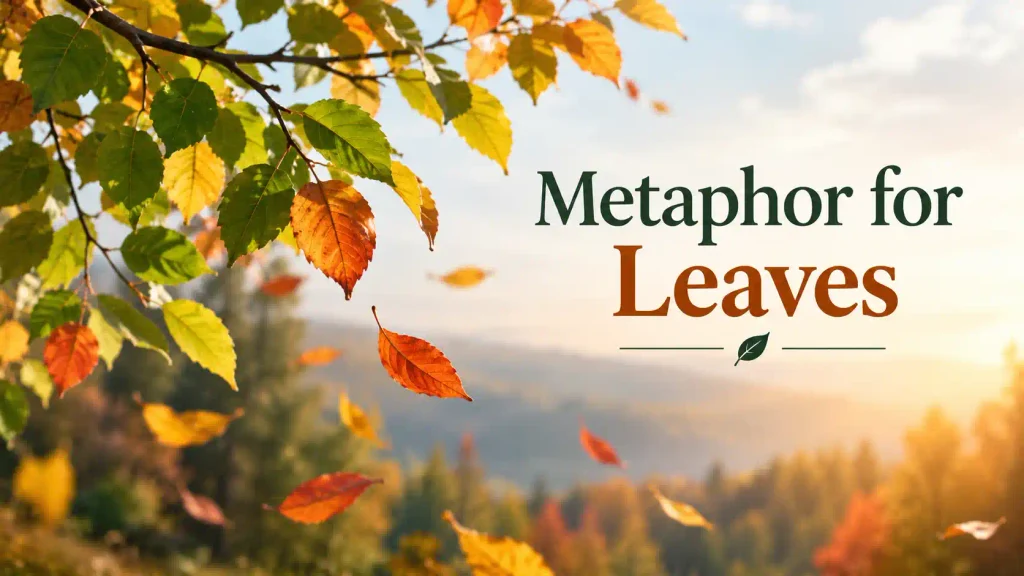
A metaphor for leaves describes leaves as something else to express their color, movement, beauty, or deeper meaning. Leaves can become nature’s artwork, green lanterns, pages of memory, or autumn’s farewell letters. The best metaphor depends on what you want readers to notice: the freshness of spring, the warmth of fall, the fragility of a single leaf, or the changes that leaves represent throughout the year.
Quick Answer
A metaphor for leaves describes them through an imaginative comparison without using “like” or “as.” For example, “The leaves were nature’s stained-glass windows” emphasizes the colors and patterns created when sunlight passes through foliage. Leaves can also represent growth, renewal, change, impermanence, and the passage of time. Writers use leaf metaphors in poetry, essays, stories, and descriptive passages to turn ordinary details of nature into vivid images.
25 Best Metaphors for Leaves
These examples explore different qualities of leaves, from their appearance and movement to their connection with the seasons and human experiences. Each metaphor includes its meaning and an example sentence.
| Metaphor | Meaning | Metaphor | Meaning |
| Nature’s stained-glass windows | Color illuminated by sunlight | The tree’s green fingers | Leaves spreading from branches |
| Autumn’s farewell letters | The ending of a season | Emerald shields | Protection and shelter |
| Pages of the forest | Stories and the passage of time | Green lanterns | Light filtering through foliage |
| The earth’s confetti | Colorful leaves scattered across the ground | A canopy of living lace | Delicate, intricate foliage |
| Summer’s green crown | The fullness of a leafy tree | Nature’s paint palette | A range of seasonal colors |
| The tree’s breathing skin | The living surface of a tree | Golden memories | Nostalgia and the beauty of the past |
| Whispers of the wind | The soft rustling of leaves | The forest’s tiny sails | Leaves catching the breeze |
| Green coins of sunlight | Leaves glowing in bright light | A blanket of green | Dense foliage covering the ground |
| The season’s final sparks | Bright leaves near the end of autumn | Fragile paper wings | A leaf’s delicate shape and movement |
| The tree’s open hands | Branches and leaves reaching outward | A calendar of color | Seasonal changes made visible |
| Nature’s brief poems | The temporary beauty of individual leaves | The forest’s living mosaic | Many shapes and colors forming a whole |
| Little ships of autumn | Fallen leaves carried by the wind or water | Green promises | New growth and fresh beginnings |
| The tree’s fading jewels | Leaves losing their color and falling | The earth’s quiet storytellers | Leaves reflecting the passage of seasons |
Some expressions in this table are familiar descriptive patterns, while others are original metaphors created for this guide. They are creative suggestions, not quotations or claims about established literary expressions.
Metaphors for Green Leaves and Fresh Growth
Green leaves often suggest energy, abundance, and renewal. Choose a metaphor that emphasizes the shade, shape, or vitality you want to describe.
1. Nature’s Stained-Glass Windows
Meaning: Leaves become colored windows when sunlight shines through them, creating bright patterns and translucent shades.
Example: Morning sunlight turned the maple leaves into nature’s stained-glass windows.
Best use: Descriptive writing, nature essays, and poetry about sunlight.
2. The Tree’s Green Fingers
Meaning: Leaves appear to be fingers extending from branches, giving the tree a reaching, almost human quality.
Example: The tree’s green fingers stretched across the garden, catching the afternoon light.
Best use: Children’s stories and vivid descriptions of trees.
3. Emerald Shields
Meaning: Green leaves resemble protective shields, suggesting shelter and the dense coverage of a leafy canopy.
Example: Emerald shields guarded the forest floor from the harsh summer sun.
Best use: Nature writing that emphasizes shade, protection, or abundance.
4. Green Lanterns
Meaning: Leaves become small lanterns when sunlight illuminates them, making the tree seem bright and alive.
Example: Green lanterns glowed above the trail as sunlight filtered through the branches.
Best use: Peaceful scenes and descriptions of a sunlit forest.
5. Summer’s Green Crown
Meaning: A tree covered in leaves resembles a crown, emphasizing its fullness, height, and presence.
Example: The old oak wore summer’s green crown above the quiet meadow.
Best use: Fiction, landscape descriptions, and celebratory nature poetry.
Metaphors for Autumn Leaves and Falling Leaves
Autumn leaves offer a different kind of imagery. Their changing colors can suggest beauty, memory, transition, and endings. Falling leaves can also create a sense of movement, freedom, or loss.
6. Autumn’s Farewell Letters
Meaning: Falling leaves resemble letters that mark the end of a season and the arrival of colder weather.
Example: Autumn scattered its farewell letters across the empty sidewalk.
Best use: Reflective poetry and writing about endings or transitions.
7. The Earth’s Confetti
Meaning: Colorful leaves become scattered pieces of a natural celebration.
Example: Red and yellow leaves covered the park like the earth’s confetti after a woodland festival.
Best use: Cheerful autumn descriptions and family-friendly writing.
8. Golden Memories
Meaning: Golden leaves represent treasured memories that become more meaningful with time.
Example: The golden memories of childhood seemed to gather beneath the old trees each fall.
Best use: Nostalgic stories, personal essays, and reflective poems.
9. The Season’s Final Sparks
Meaning: Bright red, orange, and yellow leaves resemble the last glowing sparks of a fire before winter arrives.
Example: The hillside flickered with the season’s final sparks before the trees stood bare.
Best use: Dramatic autumn scenes and writing about fleeting beauty.
10. Little Ships of Autumn
Meaning: Fallen leaves resemble small vessels traveling across the ground or floating along a stream.
Example: Little ships of autumn sailed down the rain-filled gutter.
Best use: Children’s poetry, playful descriptions, and stories about movement.
11. The Tree’s Fading Jewels
Meaning: Leaves become jewels that gradually lose their brilliance as the season changes.
Example: The tree’s fading jewels trembled in the cold November wind.
Best use: Poetic descriptions of fading color and the approach of winter.
Metaphors for Leaves That Represent Life and Change
Leaves grow, mature, change color, and eventually fall. This cycle makes them useful symbols for human experiences, including new beginnings, aging, personal transformation, and letting go.
12. Pages of the Forest
Meaning: Leaves become pages in a book, each marking a moment in the natural world.
Example: Every fallen leaf was a page of the forest’s story, recording another passing season.
Best use: Essays, reflective writing, and stories about memory or time.
13. A Calendar of Color
Meaning: Changes in leaf color serve as a visual record of the changing seasons.
Example: The oak’s canopy became a calendar of color, moving from fresh green to amber and rust.
Best use: Educational writing, nature descriptions, and reflections on time.
14. Green Promises
Meaning: Young leaves represent the possibility of growth and the hope associated with a fresh start.
Example: The first buds opened into green promises after a long, gray winter.
Best use: Inspirational writing, spring poetry, and stories about new beginnings.
15. Nature’s Brief Poems
Meaning: Each leaf represents a small, beautiful creation whose presence is temporary.
Example: The delicate leaves were nature’s brief poems, beautiful even as they drifted toward the ground.
Best use: Literary writing and reflections on beauty or impermanence.
16. The Tree’s Fading Jewels
Meaning: The changing leaves represent something valuable that is slowly passing away.
Example: As the cold deepened, the tree released its fading jewels one by one.
Best use: Writing about aging, loss, and the natural end of a cycle.
17. The Earth’s Quiet Storytellers
Meaning: Leaves reflect changes in weather, growth, and seasons without speaking.
Example: The earth’s quiet storytellers covered the trail in shades of copper and gold.
Best use: Nature essays and reflective descriptions of the outdoors.
Metaphors for Leaf Shape, Texture, and Movement
Sometimes the strongest metaphor focuses on what leaves look or sound like rather than what they symbolize.
18. A Canopy of Living Lace
Meaning: The fine shapes and overlapping patterns of leaves resemble delicate lace.
Example: A canopy of living lace filtered the sunlight into intricate patterns on the path.
Best use: Descriptive essays and lyrical nature writing.
19. Nature’s Paint Palette
Meaning: Leaves provide a range of colors, from pale spring green to deep summer green and autumn red.
Example: The hillside became nature’s paint palette when the maples turned crimson and gold.
Best use: Travel writing, landscape descriptions, and art-related writing.
20. The Tree’s Breathing Skin
Meaning: Leaves form a living outer covering that responds to sunlight, air, and changing conditions.
Example: The tree’s breathing skin shimmered whenever the breeze passed through its branches.
Best use: Reflective nature writing. This is a figurative description, not a literal botanical definition.
21. Whispers of the Wind
Meaning: Leaves become the voice of the breeze through their soft rustling.
Example: Whispers of the wind traveled through the leaves while the garden rested in the shade.
Best use: Peaceful scenes, short stories, and poetry.
22. The Forest’s Tiny Sails
Meaning: Leaves resemble sails catching moving air, suggesting motion and lightness.
Example: The forest’s tiny sails tilted and fluttered as the wind swept through the branches.
Best use: Dynamic nature descriptions and writing for young readers.
23. Green Coins of Sunlight
Meaning: Sunlit leaves appear like small, valuable discs scattered throughout the canopy.
Example: Green coins of sunlight shimmered above the woodland path.
Best use: Descriptions of bright, leafy trees and dappled light.
24. The Tree’s Open Hands
Meaning: Leaf-covered branches resemble hands reaching toward the sky or welcoming visitors.
Example: The tree’s open hands reached over the fence, offering shade to anyone who passed.
Best use: Personified nature scenes and welcoming imagery.
25. The Forest’s Living Mosaic
Meaning: Different leaf shapes, colors, and sizes combine to create a richly patterned whole.
Example: The forest’s living mosaic shifted from deep green beneath the pines to bright gold around the birches.
Best use: Detailed landscape descriptions and writing about biodiversity.
What Do Leaves Symbolize?
Leaves can carry different meanings depending on their condition, color, and setting. Their symbolism is not fixed; context determines which interpretation makes the most sense.
| Leaf image | Possible symbolism | Why it works |
| Fresh green leaves | Growth and renewal | New foliage suggests the beginning of a cycle. |
| Full summer leaves | Vitality and abundance | A dense canopy conveys fullness and energy. |
| Golden autumn leaves | Memory and transition | Changing colors suggest time passing. |
| Falling leaves | Letting go and impermanence | Leaves separate from branches and move toward the ground. |
| Withered leaves | Decline and fragility | Dryness and fading color suggest diminished vitality. |
| Budding leaves | Hope and possibility | New growth suggests potential that has not yet unfolded. |
These are possible literary interpretations rather than universal meanings. A falling leaf might suggest freedom in one poem and grief in another.
The Idiom “Turn Over a New Leaf”
“Turn over a new leaf” is an established English idiom meaning to make a fresh start or change your behavior for the better.
For example: “After years of procrastination, Daniel turned over a new leaf and began completing his assignments on time.”
The expression works because a leaf can represent a page in a book. Turning it suggests moving beyond the past and beginning a different chapter.
This idiom is different from an original metaphor such as “spring unfolded a green promise.” The first is a familiar expression with a conventional meaning; the second is a creative comparison designed to evoke a particular image.
Metaphor vs. Simile for Leaves
A metaphor describes one thing as another, while a simile explicitly compares two things using words such as “like” or “as.”
| Type | Example | Effect |
| Metaphor | The leaves were golden letters from autumn. | Makes leaves into a symbolic image. |
| Simile | The leaves fluttered like golden letters. | Highlights a resemblance between leaves and letters. |
| Personification | The leaves whispered secrets to the wind. | Gives leaves a human action. |
| Literal description | Golden leaves fluttered across the lawn. | Describes what happened without a figurative comparison. |
Metaphors for Leaves Rustling in the Wind
Leaves rustling in the wind can be described through metaphors that suggest whispers, music, movement, or quiet conversation. These comparisons help readers imagine not only how leaves sound but also the atmosphere surrounding them.
- The trees were whispering secrets. This metaphor turns rustling leaves into a quiet conversation between the trees.
- The leaves were nature’s orchestra. The changing sounds of foliage become music conducted by the wind.
- The branches wore green wind chimes. This original metaphor suggests leaves producing delicate sounds as the breeze moves them.
- The forest was a book turning its pages. The moving leaves resemble pages shifting in an invisible hand.
- The leaves were the wind’s soft applause. Their rustling becomes a gentle expression of movement and celebration.
Example sentence: The trees whispered their secrets as the evening breeze swept through the garden.
For peaceful writing, use “the trees were whispering secrets.” For a livelier scene, “the leaves were nature’s orchestra” creates a stronger sense of sound and movement.
Metaphors for Falling Leaves and Autumn Leaves
Falling leaves often symbolize change, endings, the passage of time, and the beauty of letting go. Autumn leaves also provide striking images through their red, orange, yellow, and golden colors.
- Autumn’s farewell letters: Falling leaves mark the end of a season.
- The earth’s confetti: Colorful leaves scattered across the ground resemble a natural celebration.
- Golden memories: Yellow and golden leaves evoke nostalgia and treasured moments.
- The season’s final sparks: Bright autumn foliage resembles the last glowing embers of a fire.
- Little ships of autumn: Leaves carried by the wind or water resemble tiny vessels on a journey.
- The tree’s fading jewels: Changing leaves represent beauty that gradually disappears.
- Nature’s final fireworks: Brilliant autumn colors create a dramatic display before winter.
- The forest’s closing chapter: Falling leaves suggest the completion of a seasonal cycle.
Example sentence: The wind scattered autumn’s farewell letters across the empty road.
A falling-leaf metaphor can express sadness, but it does not have to. “The earth’s confetti” suggests celebration, while “the tree’s fading jewels” emphasizes loss and impermanence.
Short Metaphors for Leaves
Short metaphors for leaves work well in school assignments, captions, poems, and concise descriptive writing. Each example communicates an image without requiring a lengthy explanation.
- Leaves are nature’s artwork.
- Leaves are green lanterns.
- Leaves are golden letters.
- Leaves are the tree’s crown.
- Leaves are nature’s confetti.
- Leaves are tiny sails.
- Leaves are pages of time.
- Leaves are emerald shields.
- Leaves are green promises.
- Leaves are autumn’s jewels.
These are creative metaphors rather than quotations from established literary works. Choose one based on the meaning you want to convey. For example, “leaves are green promises” suggests hope and new growth, whereas “leaves are golden letters” evokes autumn and the passing of time.
Metaphors for Leaves in a Sentence
A metaphor becomes easier to understand when you see how it works in a complete sentence. The following leaf metaphor examples are suitable for essays, creative writing, poetry, and classroom assignments.
| Metaphor | Example sentence |
| Nature’s stained-glass windows | The sunlight transformed the leaves into nature’s stained-glass windows. |
| Green lanterns | Green lanterns glowed above the woodland path. |
| Autumn’s farewell letters | Autumn scattered its farewell letters across the lawn. |
| Pages of the forest | Every fallen leaf was a page in the forest’s story. |
| Nature’s confetti | Red and yellow leaves covered the sidewalk in nature’s confetti. |
| The tree’s green fingers | The tree’s green fingers reached across the garden wall. |
| Golden memories | The golden memories of summer lingered beneath the old oak. |
| Little ships of autumn | Little ships of autumn sailed along the rain-filled gutter. |
| Green promises | Green promises unfolded on the branches after winter. |
| A canopy of living lace | A canopy of living lace filtered the sunlight into delicate patterns. |
For example, “The leaves were golden memories scattered across the lawn” connects autumn foliage with nostalgia. This works especially well in reflective writing because it combines a visible image with an emotional meaning.
Metaphors for Leaves and Trees
Leaves and trees naturally work together in metaphors because leaves form the tree’s canopy, change with the seasons, and respond to wind and sunlight. These images can emphasize shelter, growth, strength, or the relationship between an individual part and a larger whole.
- The tree was a giant green umbrella. Its branches and leaves provided shade and shelter.
- The leaves were the tree’s crown. This metaphor emphasizes the tree’s beauty and fullness.
- The tree was a book, and its leaves were pages. This image connects nature with stories, memory, and time.
- The branches were arms wearing emerald gloves. This original metaphor combines the shape of branches with the green foliage at their ends.
- The forest was a living cathedral. Tall trees and overlapping canopies create a sense of grandeur and enclosure.
- The tree was a green lighthouse. This creative image can describe a distinctive tree that stands out as a landmark in a landscape.
Example sentence: The old oak stood like a giant green umbrella, sheltering the children from the summer sun.
The relationship between leaves and trees can also express broader ideas. A tree may represent stability, while its changing leaves represent the experiences and transitions that occur throughout life.
How to Describe Leaves in Creative Writing
To describe leaves effectively in creative writing, focus on their color, shape, texture, movement, sound, and symbolic meaning. A strong metaphor connects a visible feature of the leaves to an image that supports the mood of the scene.
1- Describe leaves by color
- Emerald coins: Deep green leaves catching bright sunlight.
- Copper flames: Reddish-brown leaves glowing in autumn.
- Golden confetti: Yellow leaves scattered across the ground.
- Silver mirrors: Leaves reflecting pale moonlight or a silvery sky.
2- Describe leaves by movement
- Tiny dancers: Leaves moving rhythmically in the breeze.
- Paper boats: Fallen leaves drifting along a stream.
- Fluttering wings: Delicate leaves trembling on thin branches.
3- Describe leaves by sound
- Nature’s orchestra: Leaves creating layered sounds in the wind.
- Whispering secrets: Soft rustling in a quiet garden.
- A green percussion section: Leaves and branches producing a lively pattern of natural sounds.
4- Describe leaves through emotion
- Green promises: New leaves that suggest hope.
- Autumn’s farewell letters: Falling leaves that suggest an ending.
- The tree’s fading jewels: Leaves that evoke loss or the temporary nature of beauty.
Example paragraph:
The old maple stood at the edge of the garden, its copper flames flickering in the wind. Beneath its branches, golden confetti covered the path. Each falling leaf seemed to carry a small memory of summer, and the tree slowly emptied its pockets of color.
The paragraph uses three related autumn images to create a consistent mood. When writing your own description, avoid mixing too many unrelated comparisons in a single passage.
What Can Leaves Symbolize?
Leaves can symbolize growth, renewal, change, beauty, fragility, and the passage of time. Their meaning depends on the season, the surrounding imagery, and the writer’s purpose.
| Leaf imagery | Possible symbolic meaning |
| Fresh green leaves | New beginnings, hope, and growth |
| Dense summer foliage | Vitality, abundance, and protection |
| Golden autumn leaves | Memories, maturity, and transition |
| Falling leaves | Change, letting go, and impermanence |
| Withered leaves | Decline, vulnerability, or endings |
| Budding leaves | Possibility and emerging potential |
| Leaves surviving harsh weather | Resilience and endurance |
What are leaves symbolic of in literature?
In literature, leaves often help writers represent a character’s changing circumstances or the natural cycles of life. Fresh foliage may accompany a new beginning, while falling leaves may reinforce a theme of separation or loss.
However, leaf symbolism is not universal. A falling leaf can represent freedom if the writer emphasizes its journey, or sadness if the scene focuses on what the tree has lost.
What Are Some Famous Sayings About Leaves?
Several established English expressions use leaves to communicate ideas about change, renewal, and interpretation. The following examples are familiar sayings and idioms rather than newly invented metaphors.
“Turn over a new leaf”
This established idiom means to make a fresh start or change your behavior for the better.
Example: After struggling to manage his time, Marcus turned over a new leaf and began following a daily schedule.
The expression connects the idea of a leaf or page with the possibility of beginning again.
“Take a leaf out of someone’s book”
This expression means to imitate someone’s behavior or learn from their example.
Example: I decided to take a leaf out of my colleague’s book and prepare for meetings the night before.
Here, a leaf represents a page containing a useful lesson or approach.
“Read the tea leaves”
This established expression means to interpret clues or signs to predict what might happen.
Example: The manager read the tea leaves and realized that the team needed to prepare for a major change.
Although this expression mentions tea leaves rather than tree leaves, it belongs in a broader discussion of leaf-related expressions because it uses leaves as a basis for figurative interpretation.
These expressions have conventional meanings in English. By contrast, a phrase such as “autumn’s farewell letters” is an original metaphor created to describe the appearance and emotional associations of falling leaves.
What Are Some Metaphors About Plants?
Plant metaphors describe growth, resilience, relationships, learning, and personal development. They can help writers explain abstract ideas through familiar features of the natural world.
- Knowledge is a garden. Learning requires attention, patience, and continued care.
- Hope is a seed. A small possibility can develop into something meaningful.
- Friendship is a growing tree. Strong relationships develop over time.
- Ideas are branches of thought. A single idea can lead to several related possibilities.
- Memories are roots. Past experiences help shape a person’s identity.
- Ambition is a climbing vine. Determination can help someone move toward a goal.
- A community is a forest. Different individuals can grow together while retaining their distinct qualities.
- Patience is fertile soil. Good conditions and time allow progress to develop.
Example sentence: Her curiosity was a seed that grew into a lifelong love of science.
These plant metaphors can complement leaf metaphors in essays about nature, personal development, education, and relationships. Keep the intended meaning clear so the imagery strengthens rather than distracts from the message.
What Is the Metaphorical Meaning of Tea Leaves?
Tea leaves can serve as a metaphor for clues, signs, and patterns that people interpret to understand an uncertain situation. This meaning is especially apparent in the established expression “read the tea leaves.”
In traditional tea-leaf reading, a person interprets patterns left by tea leaves in a cup. Figuratively, the expression refers to drawing conclusions from available clues, particularly when the future remains uncertain.
Examples:
- The company’s declining sales were a warning sign; investors began reading the tea leaves.
- Her brief answers and canceled plans gave him reason to read the tea leaves and reconsider their relationship.
- The changing market offered clues, but analysts still had to interpret the tea leaves carefully.
The metaphor emphasizes interpretation rather than certainty. Reading the tea leaves means making sense of signs, not knowing the future with complete accuracy.
What Does “Blood on the Leaves” Mean as a Metaphor
The phrase “blood on the leaves” can create a disturbing image by placing the idea of blood against the natural beauty of foliage. Depending on its context, it may suggest violence, death, suffering, guilt, or the lasting consequences of conflict.
The contrast is central to its emotional effect: leaves usually evoke life, nature, or seasonal change, while blood suggests injury and loss.
Original example sentence: The garden’s green leaves seemed to carry the blood of a conflict no one wanted to remember.
In this original sentence, the image makes nature appear connected to human suffering. It is a creative illustration, not a quotation from a song or poem.
The phrase may also be searched in connection with a particular artistic work. If you intend to discuss a specific song, poem, or literary passage, identify that work and interpret the phrase within its actual context rather than assuming that every use has the same meaning.
Leaf Metaphor Quotes, Sayings, and Lyrics
Leaf imagery appears naturally in creative writing because leaves can represent beauty, change, memory, and renewal. When researching leaf metaphor quotes or lyrics, it is important to distinguish verified quotations from original examples.
Original lines using leaf metaphors
The following lines are original examples written for this article, not famous quotations.
- “Every fallen leaf is a letter from a season that has passed.”
- “The trees wear green crowns when spring returns.”
- “Autumn scatters its golden memories across the earth.”
- “The wind turns the forest’s pages one leaf at a time.”
- “New leaves are small promises written in green.”
These lines can inspire poems, captions, essays, or descriptive passages, but they should not be attributed to a famous writer.
How to understand leaf metaphors in song lyrics
In songs, leaves may function as images of changing relationships, fading memories, the passage of time, or the natural world. The meaning depends on the song’s surrounding lyrics, tone, and broader themes.
When analyzing a song, ask:
- Do the leaves represent growth, decline, or a change in circumstances?
- Does the songwriter associate the leaves with a particular season?
- Does the imagery create a mood of hope, nostalgia, grief, or freedom?
- Does the phrase take on a specific meaning because of the song’s wider subject?
How to Choose the Right Metaphor for Leaves
The best metaphor depends on the scene, the meaning, and the tone you want to create.
- For a school essay: Choose a clear metaphor such as “leaves are nature’s calendar” to explain seasonal change.
- For a poem: Use an evocative image such as “autumn’s farewell letters” to express transition or loss.
- For fiction: Choose a metaphor that fits the character’s mood. A peaceful character might notice “green lanterns,” while a grieving character might see “fading jewels.”
- For descriptive writing: Focus on a visible feature. “A canopy of living lace” highlights intricate patterns, while “the forest’s tiny sails” emphasizes movement.
- For inspirational writing: Use “green promises” to suggest growth, hope, and a fresh beginning.
- For children’s writing: Use concrete, easy-to-picture images such as “little ships of autumn” or “the tree’s green fingers.”
Avoid mixing too many unrelated metaphors in the same passage. A tree described simultaneously as a ship, a crown, a book, and a lantern may confuse readers. Choose one dominant image and develop it naturally.
Frequently Asked Questions
1. What is a simple metaphor for leaves?
Leaves are nature’s artwork is a simple metaphor. It suggests that their shapes, colors, and patterns create natural beauty. Another straightforward example is “the tree’s green fingers,” which describes leaves extending from branches.
2. What is a metaphor for falling leaves?
Falling leaves are autumn’s farewell letters is a metaphor that presents leaves as messages marking the end of a season. It works especially well in poetry and reflective writing about change or letting go.
3. What is a beautiful metaphor for green leaves?
Green leaves are nature’s stained-glass windows is a vivid metaphor for foliage illuminated by sunlight. It emphasizes the leaves’ colors, delicate surfaces, and glowing appearance.
4. What do leaves represent in literature?
Leaves can represent growth, renewal, change, impermanence, memory, and the passage of time. Their meaning depends on the context. Fresh leaves may suggest new beginnings, while falling or withered leaves may evoke endings, vulnerability, or loss.
5. What is the difference between a leaf metaphor and a simile?
A metaphor identifies one thing with another, as in “the leaves were golden letters.” A simile makes the comparison explicit, as in “the leaves fluttered like golden letters.” Both create imagery, but they use different grammatical structures.
6. What does “turn over a new leaf” mean?
“Turn over a new leaf” is an established idiom meaning to change your behavior or make a fresh start. For example, someone who abandons an unhelpful habit and adopts a better one has turned over a new leaf.
Conclusion
The best metaphors for leaves do more than describe their color or shape. They help readers picture sunlight passing through a canopy, feel the melancholy of falling foliage, or recognize the promise of new growth. Whether you choose “nature’s stained-glass windows,” “autumn’s farewell letters,” or “green promises,” select an image that supports the meaning and mood of your writing. A precise metaphor can turn a familiar leaf into a memorable detail.

Qaiser Abbas is an award-winning author, leadership coach, and motivational speaker known for his work on personal growth, leadership, and human potential. Through his writing and speaking, Qaiser focuses on turning challenges into opportunities and helping people build the mindset to achieve meaningful growth.