
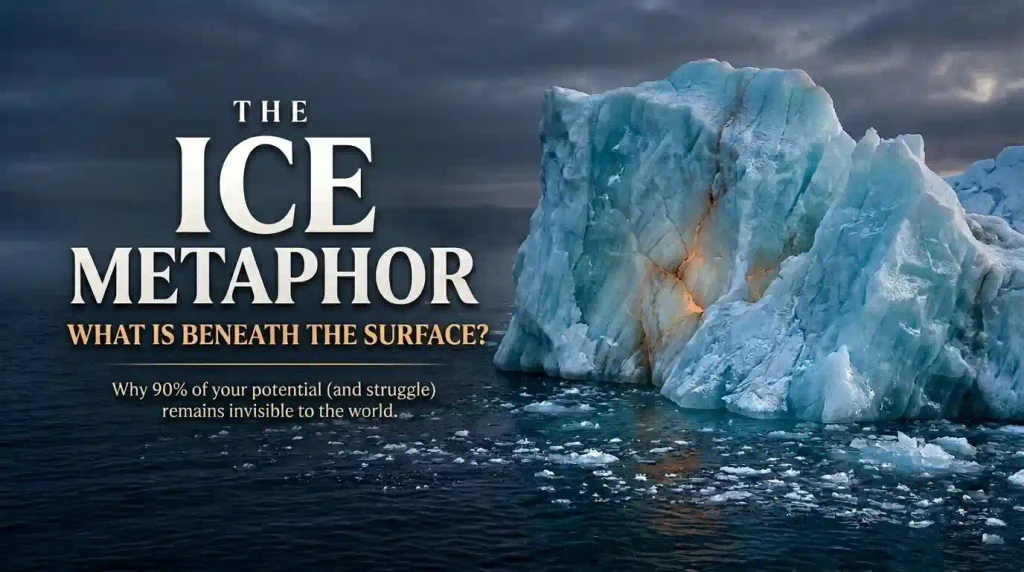
Ice can represent much more than freezing temperatures. A metaphor for ice can describe an emotionally distant person, a fragile relationship, a hidden danger, or a situation that seems stable but could suddenly change. The most effective ice metaphors draw on the material’s contrasting qualities: it can look solid yet crack, appear transparent yet conceal depth, and preserve something while preventing movement.
Below, you’ll find established expressions, examples for creative writing, and explanations of related idioms and symbolism.
Strong Metaphor for Ice
A metaphor for ice compares ice with an emotion, person, relationship, or situation to communicate a shared quality. For example, “Her heart was a block of ice” suggests emotional distance, while “Their agreement was thin ice” suggests an unstable situation. Ice can symbolize coldness, fragility, hidden danger, stillness, or transformation, depending on the context.
25 Metaphors for Ice and What They Mean
These examples cover emotional coldness, fragility, danger, silence, and change. Each entry identifies whether the expression is established English usage or an created for this article.
Ice metaphors for emotions and relationships
1. Her heart was a block of ice.
Meaning: She seemed emotionally distant, unkind, or unwilling to show affection.
Example: After the argument, her heart seemed like a block of ice, untouched by his apology.
2. Frost covered their friendship.
Meaning: A once-warm friendship has become distant or uncomfortable.
Example: Months of unspoken resentment left frost covering their friendship.
3. Their trust was a sheet of cracking ice.
Meaning: Their trust was fragile and close to breaking.
Example: One more lie could turn their cracking sheet of ice into scattered fragments.
4. Their love was a frozen river.
Meaning: Love remains present, but its natural flow has stopped.
Example: Their love had become a frozen river, holding years of memories beneath its surface.
5. Kindness was the first crack in his icy walls.
Meaning: Compassion began to weaken someone’s emotional defenses.
Example: Her patience became the first crack in his icy walls.
Ice metaphors for danger, uncertainty, and hidden problems
6. Their relationship was thin ice.
Meaning: The relationship was in a risky or unstable state.
Example: After another broken promise, their relationship was thin ice.
7. His confidence was black ice.
Meaning: His apparent confidence concealed an unexpected weakness or risk.
Example: His confidence looked unshakable, but it was black ice beneath a polished surface.
8. The argument was the tip of an iceberg.
Meaning: The visible disagreement revealed only a small part of a much larger problem.
Example: Their argument about money was the tip of an iceberg that concealed years of resentment.
9. His words were shards of ice.
Meaning: His words were painfully cold, cutting, or cruel.
Example: Every sentence landed like a shard of ice, leaving her unwilling to answer.
10. The plan was a frozen fault line.
Meaning: A plan appeared stable but contained a weakness that could trigger failure.
Example: The missing safety checks were a frozen fault line running through the entire project.
Ice metaphors for silence, stillness, and isolation
11. Silence was a frozen lake.
Meaning: The silence felt deep, still, and difficult to disturb.
Example: After the accusation, silence spread across the room like a frozen lake.
12. He was an island locked in ice.
Meaning: He felt isolated from others and unable to connect.
Example: Even among friends, he remained an island locked in ice.
13. The house was a frozen memory.
Meaning: The house seemed trapped in the past, preserving memories without allowing life to move forward.
Example: After her grandmother died, the empty house became a frozen memory of childhood.
14. His ambition was a frozen waterfall.
Meaning: His drive remained visible, but it could no longer move forward.
Example: Without a chance to grow, his ambition became a frozen waterfall.
15. Her composure was a crystal prison.
Meaning: Her calm exterior concealed emotions she felt unable to express.
Example: Her composure was a crystal prison, beautiful to others but confining to her.
Ice metaphors for change, fragility, and resilience
16. His anger was melting ice.
Meaning: His anger was gradually losing its intensity.
Example: A sincere conversation turned his anger into melting ice.
17. Hope was the spring beneath the ice.
Meaning: Hope continued to exist beneath an appearance of despair.
Example: Even after the setback, hope remained the spring beneath the ice.
18. His certainty was a cracking glacier.
Meaning: His once-solid beliefs were beginning to weaken under pressure.
Example: New evidence turned his certainty into a cracking glacier.
19. The truth was a light beneath the ice.
Meaning: The truth remained hidden but continued to reveal itself gradually.
Example: Each interview uncovered another glimmer of truth beneath the ice.
20. Memory was a frost pattern on glass.
Meaning: Memories were intricate and beautiful but could fade or distort with time.
Example: His childhood memories remained like frost patterns on glass, vivid in places and missing in others.
Ice metaphors for writing, imagery, and everyday situations
21. Her beauty was carved from ice.
Meaning: Her beauty seemed striking, delicate, and distant.
Example: Her beauty was carved from ice, dazzling beneath the lights yet difficult to approach.
22. The morning was a sheet of glass.
Meaning: The morning felt still, smooth, and almost unnaturally quiet, like a frozen surface.
Example: The morning was a sheet of glass, and every sound seemed to disturb its stillness.
23. His secret was an iceberg in calm water.
Meaning: A hidden problem remained dangerous even when everything looked peaceful.
Example: Their unresolved debt was an iceberg in calm water, invisible until the damage became obvious.
24. The deadline was a wall of ice.
Meaning: A deadline felt like a rigid barrier that restricted progress.
Example: With half the work unfinished, Friday’s deadline became a wall of ice.
25. Change was water waiting inside the ice.
Meaning: Transformation already existed as a possibility within something that appeared rigid.
Example: Beneath his stubborn habits, change was water waiting inside the ice.
Metaphor Table: Ice Expressions and Their Meanings
Use this table to find an expression quickly and choose one that matches the situation.
| Metaphor or expression | Meaning | Best use |
| A heart of ice | Emotional coldness | Character descriptions |
| Frost on a friendship | Growing distance | Relationships |
| A frozen river | Stalled affection or progress | Poetry and fiction |
| Thin ice | A risky situation | Everyday conversation |
| Black ice | Hidden danger | Suspense and warnings |
| The tip of an iceberg | A small visible part of a bigger issue | Essays and analysis |
| Shards of ice | Painfully cold words | Emotional writing |
| A frozen lake | Deep stillness or silence | Descriptive writing |
| An island locked in ice | Isolation | Character development |
| Melting ice | Weakening anger or resistance | Reconciliation |
| A spring beneath the ice | Hope beneath hardship | Inspirational writing |
| A crystal prison | Confining emotional restraint | Poetry and fiction |
| A wall of ice | A barrier to progress | Speeches and commentary |
| A light beneath the ice | Hidden truth or hope | Mystery and reflection |
| A frozen memory | The past preserved without change | Memoir and fiction |
What Does Ice Symbolize?
Ice can symbolize several ideas at once. Its meaning depends on the surrounding imagery, the character’s behavior, and whether the ice remains frozen, cracks, melts, or blocks a path.
- Emotional coldness: Ice can represent a lack of warmth, empathy, affection, or openness.
- Fragility: A frozen surface may appear solid but break under pressure.
- Hidden danger: Ice can conceal hazards beneath a smooth or attractive exterior.
- Stillness and isolation: A frozen landscape can suggest silence, loneliness, or a life that has stopped moving forward.
- Preservation: Ice can represent a memory, grievance, or feeling that remains unchanged over time.
- Transformation: Melting ice can symbolize emotional release, reconciliation, or a transition into a new stage of life.
- Clarity and concealment: Transparent ice may reveal what lies beneath it, while thick or cloudy ice can hide it.
One useful distinction is that frozen does not necessarily mean dead. A frozen relationship may still have the potential to thaw, whereas an image of ashes might suggest that something has already ended. Writers can use this difference to communicate whether a situation feels recoverable.
Ice metaphor psychology: what does emotional ice suggest?
In figurative language, ice often describes emotional distance, guardedness, or suppressed expression. Someone described as icy may appear calm or controlled while keeping other people at a distance.
For example:
- “His icy silence shut down the conversation” presents silence as a barrier.
- “She wore a mask of ice” suggests that a person hides vulnerable feelings behind a rigid exterior.
- “Warmth slowly returned to their frozen friendship” suggests that affection can recover.
These phrases are literary descriptions, not psychological diagnoses. Calling someone “cold as ice” does not establish what they actually feel or why they behave that way. The metaphor communicates the observer’s impression.
Common Ice Idioms and Expressions
An idiom is a conventional expression whose intended meaning goes beyond its literal words. Some ice expressions function as metaphors, while others have become familiar phrases used in everyday English.
Idioms Academy
+2
1. Break the ice
Meaning: To reduce awkwardness and help people begin talking comfortably.
Example: The new teacher told a funny story to break the ice on the first day of class.
The literal image is of breaking a frozen barrier to open a path. Figuratively, a friendly remark or activity clears the way for conversation. The phrase has a long history in English; its earlier figurative use also referred to taking the first step in a difficult undertaking.
Idiom Insider
+1
2. Walking on thin ice
Meaning: Doing something risky that could lead to trouble.
Example: After ignoring two warnings, the employee knew he was walking on thin ice.
This expression emphasizes the danger of continuing a behavior when the margin for error is small.
3. The tip of the iceberg
Meaning: The small, visible part of a much larger problem or situation.
Example: The missed deadline was only the tip of the iceberg; the project had deeper management problems.
The metaphor works especially well in reports, essays, and analytical writing because it separates visible evidence from hidden causes.
4. Put something on ice
Meaning: To postpone or temporarily suspend an activity, plan, or decision.
Example: The company put the expansion on ice until funding became available.
Unlike a metaphor of destruction, this expression often suggests delay rather than permanent cancellation.
5. Ice in one’s veins
Meaning: Exceptional composure under pressure, especially in a demanding or high-stakes moment.
Example: The goalkeeper had ice in his veins when he faced the final penalty.
Here, ice suggests cool control rather than cruelty.
6. Cut no ice
Meaning: To fail to persuade or influence someone.
Example: His excuses cut no ice with the manager.
This expression describes a lack of impact, not necessarily an absence of emotion.
7. Break the ice metaphor: what does it represent?
The break the ice metaphor represents removing a barrier that prevents movement or connection. In social situations, that barrier is awkwardness; in a broader context, it can be hesitation or resistance to beginning something new.
A thoughtful question can break the ice between strangers, while an early success can break the ice on a difficult project.
Fire and Ice Metaphor: What Does It Mean?
The Fire and ice create a powerful contrast because they suggest opposite physical conditions. Fire commonly evokes heat, energy, desire, anger, or destruction. Ice can suggest coldness, restraint, emotional distance, or stillness.
In writing, a fire and ice metaphor can represent:
- Passion versus emotional restraint.
- Anger versus calmness.
- Desire versus indifference.
- Destruction through intensity versus destruction through coldness.
- Two opposing forces competing within one person or relationship.
For example, “She was fire; he was ice” presents two people with contrasting temperaments. One may act passionately while the other remains controlled or distant.
What is the metaphor in Fire and Ice?
If you’re asking about Robert Frost’s poem Fire and Ice, the two elements represent contrasting forces that could bring about the world’s destruction. Fire is associated with desire, while ice is associated with hatred and emotional coldness. The poem considers how opposing human impulses can both lead to ruin.
This interpretation is more specific than saying that fire means passion and ice means coldness. Frost uses the contrast to explore destructive human tendencies, rather than merely describe two different personalities.
Funny Metaphors for Ice
A funny metaphor works best when it exaggerates an everyday experience in an unexpected way.
- My freezer is an Arctic retirement home for forgotten leftovers. — For food that has sat in the freezer for months.
- That ice cube is a tiny iceberg with a deadline. — For an ice cube melting in a drink.
- His cold shoulder was a refrigerated brick wall. — For someone refusing to engage in conversation.
- The frozen sidewalk was nature’s surprise obstacle course. — For a slippery winter walk.
- My brain was an ice machine running out of ideas. — For struggling to think creatively.
- Her stare was a freezer with a personal grudge. — For an exaggerated, icy glare.
These are original, humorous comparisons rather than established idioms. Use them in casual conversation, captions, or lighthearted creative writing.
Metaphors for Ice Cream
Ice cream calls for a different kind of imagery. Instead of emphasizing emotional distance or danger, metaphors for ice cream often focus on sweetness, pleasure, texture, indulgence, and melting.
| Metaphor | Meaning | Example |
| A little cloud of sweetness | Light, soft, and pleasant | The vanilla scoop was a little cloud of sweetness. |
| Summer in a cone | A treat associated with warm weather and enjoyment | That strawberry cone was summer in a cone. |
| A velvet dream | Smooth, rich, and indulgent | The chocolate ice cream was a velvet dream. |
| A spoonful of happiness | A small source of pleasure | After a difficult day, the dessert was a spoonful of happiness. |
| A melting masterpiece | An attractive treat that quickly loses its shape | The elaborate sundae was a melting masterpiece. |
These examples are s. They demonstrate how figurative language can make a food description more vivid than a list of literal qualities.
Figurative language metaphor for ice cream: metaphor vs. simile
A metaphor identifies one thing with another, while a simile explicitly compares two things using words such as like or as.
- Metaphor: The ice cream was a velvet dream.
- Simile: The ice cream was as smooth as velvet.
- Personification: The ice cream surrendered to the summer heat.
All three can make descriptive writing more engaging, but each creates a different effect.
Simile for Cold: Is “As Cold as Ice” a Metaphor?
A simile compares two things using like or as. A metaphor describes one thing as another without an explicit comparison word.
| Expression | Type | Meaning |
| Her hands were ice. | Metaphor | Her hands were extremely cold. |
| Her hands were as cold as ice. | Simile | Her hands felt very cold. |
| Her icy stare stopped him. | Figurative description | Her stare appeared unfriendly or intimidating. |
| The room was a freezer. | Metaphor | The room was extremely cold. |
| The room was as cold as a freezer. | Simile | The room’s temperature was compared with a freezer’s. |
Is “as cold as ice” a metaphor? Strictly speaking, it is a simile because it explicitly compares one thing with ice using as. It is also a familiar expression that communicates extreme coldness.
Is “ice cold” a metaphor? It depends on context. When it describes an actual drink or surface, it can be a literal temperature description. When it describes someone’s manner or attitude, it is figurative.
What is a metaphor for cold? Examples include “the room was a freezer,” “her voice was winter,” and “his welcome was a wall of frost.” Each creates a different image: physical cold, emotional distance, or an unwelcoming atmosphere.
How to Choose the Right Ice Metaphor
The best expression depends on what you want the reader to feel or understand.
| Purpose | Best choice | Why it works |
| Describe an unkind person | A heart of ice | Communicates emotional coldness immediately |
| Show a risky decision | Walking on thin ice | Suggests danger and a narrow margin for error |
| Reveal a larger problem | The tip of the iceberg | Distinguishes visible symptoms from hidden causes |
| Describe a silent scene | A frozen lake | Creates stillness and atmosphere |
| Show a relationship improving | Melting ice | Suggests gradual emotional change |
| Describe hidden vulnerability | Black ice | Emphasizes a danger that is difficult to see |
| Create a playful caption | An Arctic retirement home | Uses exaggerated humor |
| Write about opposing emotions | Fire and ice | Highlights contrast between intense and restrained feelings |
For an essay, choose an established expression when clarity matters more than originality, for poetry or fiction, an original image can offer more control over mood and interpretation. For everyday conversation, familiar idioms are usually easier for people to understand.
A useful rule is to match the metaphor to the kind of coldness or difficulty involved. Emotional coldness, physical danger, silence, and temporary stagnation are different experiences, even when all four can be represented by ice.
Frequently Asked Questions
1. What is a metaphor for ice?
A metaphor for ice describes a person, feeling, or situation through a quality associated with frozen water. For example, “Her heart was a block of ice” suggests emotional distance, while “Their friendship was a frozen river” suggests that a once-active relationship has stalled.
2. What is an idiom about ice?
“Break the ice” is a common ice-related idiom. It means to ease tension and help people feel comfortable enough to begin talking. Other examples include “walking on thin ice,” “the tip of the iceberg,” and “put something on ice.”
3. What does ice symbolize in literature?
Ice can symbolize emotional distance, isolation, fragility, hidden danger, preservation, or resistance to change. Its meaning depends on the work. Melting ice may suggest recovery or renewed connection, while a frozen landscape may communicate stillness or loneliness.
4. What is the metaphor in fire and ice?
Fire and ice often represent opposing forces. Fire may suggest desire, passion, or destructive intensity, while ice may suggest hatred, coldness, or restraint. In Robert Frost’s poem Fire and Ice, these contrasting elements explore destructive human impulses.
5. What are some catchy phrases with ice?
Here are several catchy phrases with ice for captions, creative writing, or conversation:
- Ice in my veins: Calmness under pressure.
- Break the ice: Start a conversation or ease tension.
- On thin ice: In a risky situation.
- A heart of ice: Emotionally distant.
- Cool as ice: Calm and composed, or emotionally detached depending on context.
- The tip of the iceberg: A small visible part of a larger issue.
For an original caption, try “A little frost, a lot of fire” to suggest a person with a cool exterior and a passionate inner life.
6. What are some slang meanings of “ice”?
In some English-speaking contexts, ice is slang for expensive diamond jewelry. In drug-related slang, it can refer to crystal methamphetamine. The intended meaning depends on the setting and surrounding conversation. These slang uses are distinct from ice as a literary metaphor.
What about “Metaphor: ReFantazio” and the ice dragon?
Searches such as “how to beat the ice dragon in Metaphor: ReFantazio” refer to the video game, not to figurative language. That is a separate gaming search intent and would be better answered in a dedicated game walkthrough. Including detailed battle instructions in this article would distract readers looking for metaphors.
Conclusion
Ice is a versatile metaphor because it can communicate emotional coldness, fragile trust, concealed danger, stillness, and the possibility of change. Expressions such as “a heart of ice,” “walking on thin ice,” and “the tip of the iceberg” offer familiar meanings, while original comparisons give writers more freedom to create a specific mood.
Choose the image that matches your message. Use thin ice for risk, a frozen river for stalled progress, and melting ice for gradual change. The strongest metaphor does more than mention ice: it helps the reader understand something that would otherwise be difficult to express.

Qaiser Abbas is an award-winning author, leadership coach, and motivational speaker known for his work on personal growth, leadership, and human potential. Through his writing and speaking, Qaiser focuses on turning challenges into opportunities and helping people build the mindset to achieve meaningful growth.