
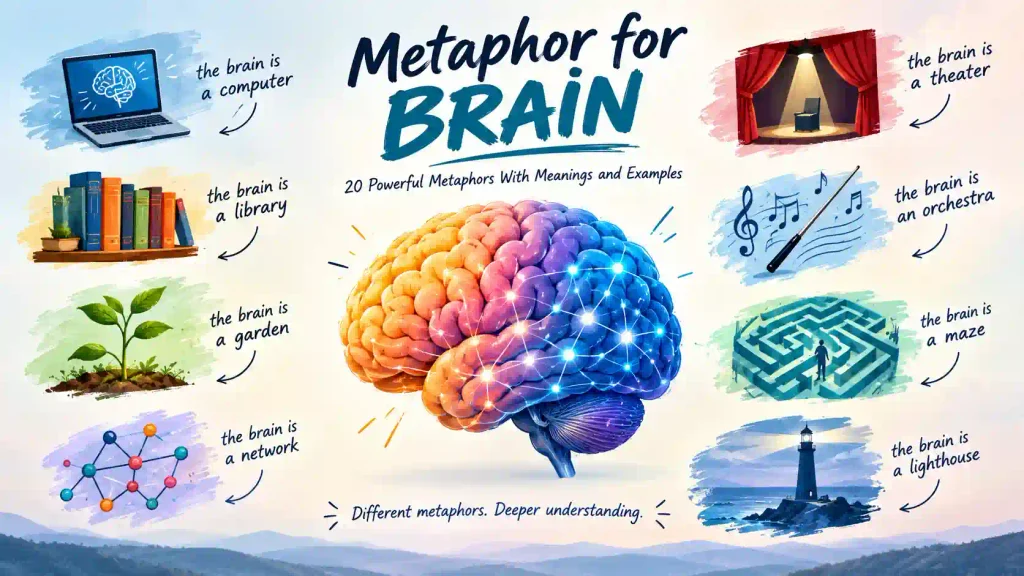
A metaphor for the brain describes the brain by connecting it to something familiar, such as a computer, library, garden, theater, network, or workshop. The best metaphor depends on what you want to emphasize: memory, learning, creativity, decision-making, coordination, or the complexity of thought.
Some brain metaphors are well-established in psychology, neuroscience, education, and everyday language. Others are original expressions that work especially well in creative writing. The key is to choose a comparison that explains one aspect of the brain without pretending that the brain literally works like the object in the metaphor.
Quick Answer
The most widely recognizable metaphor for the brain is “the brain is a computer” because it captures information processing, storage, and retrieval. However, it is not a complete description of the brain. For memory, a library works well; for learning and growth, a garden is more useful; for coordination, an orchestra or control center fits better; and for complex thinking, a maze can create a stronger image.
Brain Metaphors at a Glance
| Metaphor | Meaning | Tone | Best Use |
| Computer | Processing information | Analytical | Psychology, science |
| Library | Memory and knowledge | Reflective | Essays, education |
| Garden | Growth and learning | Positive | Education, personal growth |
| Network | Connections | Technical | Science, psychology |
| Control center | Coordination | Practical | Explanations |
| Theater | Consciousness and attention | Philosophical | Psychology, literature |
| Workshop | Creativity and problem-solving | Productive | Creative writing |
| Factory | Production of ideas | Energetic | Productivity |
| Switchboard | Communication and connections | Technical | Science/history |
| Sponge | Absorbing information | Informal | Learning |
| Maze | Complexity and confusion | Negative | Emotional writing |
| Orchestra | Coordination | Poetic | Complex systems |
| Compass | Direction and judgment | Positive | Decision-making |
| Lighthouse | Clarity | Inspirational | Poetry, essays |
| Newsroom | Filtering information | Modern | Information overload |
| Greenhouse | Nurturing ideas | Positive | Learning |
| Mosaic | Combined experiences | Reflective | Memory, identity |
| Map room | Planning and possibilities | Thoughtful | Fiction, essays |
| River system | Flow and connection | Poetic | Creative writing |
| Sculptor | Change and development | Positive | Learning, growth |
The Best Metaphors for the Brain
Here are 20 useful metaphors, divided between commonly used expressions and original metaphors created for descriptive writing.
1. The brain is a computer
Type: Commonly used metaphor
This metaphor emphasizes information processing, memory, calculation, and problem-solving. It is especially useful in psychology, technology writing, and educational explanations.
Example:
“Her brain was a computer, sorting through every possibility before she made a decision.”
Best for: Psychology, science writing, essays, technology, and explanations of information processing.
2. The brain is a library
Type: Commonly used metaphor
A library emphasizes knowledge, memories, stored information, and retrieval. It works particularly well when you want to describe a mind full of experiences or facts.
Example:
“His brain was a library filled with memories from every chapter of his life.”
Best for: Memory, knowledge, education, essays, and reflective writing.
3. The brain is a garden
Type: Commonly used metaphor
A garden highlights growth, learning, development, care, and change. It is particularly effective when describing the idea that learning develops over time.
Example:
“Her brain was a garden, and every new idea planted another seed.”
Best for: Education, personal growth, learning, children’s writing, and motivational content.
4. The brain is a network
Type: Commonly used metaphor
A network emphasizes connections between different parts and processes. It can help explain why one thought may connect with another.
Example:
“His brain was a vast network, linking every new idea to something he already knew.”
Best for: Psychology, neuroscience, technology, and academic writing.
5. The brain is a control center
Type: Commonly used metaphor
This metaphor focuses on coordination, regulation, and decision-making. It gives the brain the image of a central place directing multiple activities.
Example:
“Her brain was the control center of a body responding to everything around her.”
Best for: Science explanations, school assignments, and descriptions of coordination.
6. The brain is a theater
Type: Established conceptual metaphor
The theater metaphor has been used to discuss consciousness, attention, perception, and the distinction between what reaches conscious awareness and what remains outside it.
Example:
“His consciousness was a theater, with one thought stepping into the spotlight while others waited backstage.”
Best for: Psychology, philosophy, consciousness, literature, and reflective writing.
7. The brain is a workshop
Type: Common creative metaphor
A workshop suggests active construction, experimentation, problem-solving, and creativity.
Example:
“Her brain was a workshop where unfinished ideas became useful solutions.”
Best for: Creativity, brainstorming, invention, and writing about problem-solving.
8. The brain is a factory
Type: Established metaphorical model
A factory emphasizes production and coordinated processes. It can describe the brain as a place where many activities happen simultaneously.
Example:
“His brain was a factory of ideas, producing possibilities faster than he could write them down.”
Best for: Creativity, productivity, analytical writing, and figurative descriptions of mental activity.
9. The brain is a switchboard
Type: Historical/common scientific metaphor
A switchboard emphasizes communication and connections. Historically, telephone-exchange imagery has been used to conceptualize how neural signals and connections might operate.
Example:
“Her brain was a switchboard, connecting memories, sensations, and decisions.”
Best for: Historical discussions of brain metaphors, communication, and network imagery.
10. The brain is a sponge
Type: Common metaphor
A sponge emphasizes the ability to absorb information. It is especially familiar in educational writing, although it should be treated as a figurative image rather than a literal scientific description.
Example:
“The young student’s brain was a sponge, soaking up every new word.”
Best for: Learning, children, education, and informal writing.
11. The brain is a maze
Type: Common creative metaphor
A maze represents complexity, confusion, uncertainty, and difficult thought processes.
Example:
“After hours of conflicting thoughts, her brain felt like a maze without an exit.”
Best for: Confusion, overthinking, difficult decisions, fiction, and emotional writing.
12. The brain is an orchestra
Type: Established conceptual metaphor
An orchestra suggests coordination among many different parts working together. It is useful when the goal is to emphasize interaction rather than one central mechanism.
Example:
“His brain was an orchestra, with countless processes playing together to produce a single thought.”
Best for: Complex systems, neuroscience-inspired writing, music-related imagery, and creative essays.
13. The brain is a compass
Type: Original metaphor for this article
A compass suggests direction, judgment, and the ability to navigate uncertainty.
Example:
“When every choice seemed uncertain, her brain became a compass pointing toward the most sensible path.”
Best for: Decision-making, life choices, speeches, and inspirational writing.
14. The brain is a lighthouse
Type: Original metaphor for this article
A lighthouse represents clarity in uncertainty. This metaphor works particularly well when describing reasoning that helps someone find direction.
Example:
“Reason was a lighthouse in his brain, cutting through the fog of confusion.”
Best for: Poetry, reflective writing, emotional essays, and descriptions of clarity.
15. The brain is a newsroom
Type: Original metaphor for this article
A newsroom suggests incoming information, competing stories, editing, selection, and interpretation.
Example:
“Her brain was a newsroom, gathering fragments of information and deciding which story mattered.”
Best for: Information overload, media writing, decision-making, and modern creative writing.
16. The brain is a greenhouse
Type: Original metaphor for this article
A greenhouse extends the garden metaphor by emphasizing the environment in which ideas can develop.
Example:
“His brain was a greenhouse where curiosity gave fragile ideas room to grow.”
Best for: Learning, creativity, education, personal development, and poetic writing.
17. The brain is a mosaic
Type: Original metaphor for this article
A mosaic represents many separate pieces forming a larger picture. It works well for memories, experiences, knowledge, and identity.
Example:
“Her brain was a mosaic of childhood memories, lessons, mistakes, and dreams.”
Best for: Memoirs, personal essays, identity, memory, and literary writing.
18. The brain is a map room
Type: Original metaphor for this article
A map room suggests that the brain contains information used to understand places, relationships, choices, and possibilities.
Example:
“His brain was a map room crowded with routes he could take and consequences he could imagine.”
Best for: Decision-making, planning, fiction, and philosophical writing.
19. The brain is a river system
Type: Original metaphor for this article
A river system emphasizes movement, connections, branching paths, and constantly changing patterns.
Example:
“Her brain was a river system, carrying old memories into new ideas.”
Best for: Creativity, thought, memory, poetry, and descriptions of mental flow.
20. The brain is a sculptor
Type: Original metaphor for this article
A sculptor emphasizes development and change. It works especially well when writing about learning and how experience can reshape the brain.
Example:
“Every new experience was a chisel in the sculptor of his brain.”
Best for: Learning, development, personal growth, education, and motivational writing.
What Is the Best Metaphor for the Brain?
There isn’t one universally best metaphor because each comparison highlights a different feature.
- If you need a metaphor for information processing, the computer is the clearest familiar choice.
- If you’re describing memory, use the library.
- For learning and growth, the garden works better.
- For connections, choose the network.
- For conscious awareness, the theater offers a useful image.
- For complexity or confusion, the maze is more expressive.
- For development and change, the sculptor provides a strong creative image.
This distinction matters because a metaphor always emphasizes some features while hiding others.
The Brain-as-Computer Metaphor: Useful but Limited
The computer is probably the most famous modern metaphor for the brain. Cognitive psychology has long used information-processing language to describe processes such as encoding, storage, retrieval, and decision-making. Academic discussions also describe the computer metaphor as highly influential in thinking about mind and brain.
But the metaphor has limits.
A laptop is an engineered device with a clearly defined architecture and purpose. A biological brain develops, changes, interacts with the body and environment, and supports processes that cannot be reduced to a simple picture of a computer running programs.
That doesn’t make the metaphor useless. It means you should use it for the specific feature it explains rather than treating it as a complete description.
A good rule is:
Use a metaphor as a lens, not as the whole landscape.
This is one reason modern scholarship continues to examine alternative metaphors, including networks, music, gardening, theater, and other models.
Metaphor for Brain Psychology: Why Brain Metaphors Matter
A metaphor for brain psychology can make an abstract psychological idea easier to picture.
For example:
- Computer → information processing
- Library → memory and retrieval
- Garden → learning and development
- Network → connected mental processes
- Theater → attention and conscious awareness
- Maze → complicated or conflicting thoughts
- Orchestra → coordinated activity
- Workshop → problem-solving and creativity
Psychology has repeatedly used metaphors to make complicated models of mind and cognition more understandable. Researchers have also cautioned that metaphors can shape what people notice and what they overlook.
What Are Some Metaphors About the Mind?
The mind and brain overlap in everyday language, but they aren’t always interchangeable. A metaphor for the mind often focuses more on thoughts, awareness, emotion, or subjective experience.
Useful examples include:
- The mind is a theater — thoughts and perceptions take the stage.
- The mind is a river — thoughts continuously flow and change.
- The mind is a garden — ideas grow through attention and care.
- The mind is a mirror — it reflects experiences and interpretations.
- The mind is a compass — it helps represent direction and judgment.
- The mind is a window — it provides a perspective on the world.
- The mind is a storm — thoughts and emotions can become turbulent.
- The mind is a landscape — different experiences occupy different regions of thought.
Conceptual metaphor research also identifies recurring patterns such as understanding as seeing, thinking as moving, and ideas as objects.
Five Short Metaphor Examples for the Brain
If you need short examples for a worksheet, caption, or assignment, these are easy to use:
- My brain is a computer.
- Her brain is a library.
- His brain is a maze.
- Your brain is a garden.
- My brain is an orchestra.
Each one emphasizes something different, which makes the examples more useful than simply collecting similar phrases.
Activities to Teach About the Brain Using Metaphors
Brain metaphors can work particularly well in classrooms because students can connect an unfamiliar concept with something they already understand. Educational guidance on using metaphors and analogies recommends identifying both the similarities and the limits of the comparison rather than treating the metaphor as literally true.
Metaphor Match
Give students five brain functions—such as memory, learning, coordination, creativity, and decision-making.
Ask students to match each function with a metaphor:
- Memory → library
- Learning → garden
- Coordination → orchestra
- Decision-making → compass
- Creativity → workshop
Then ask students to explain why each comparison works.
Build a Brain Metaphor
Give students one source object, such as a library, garden, computer, or theater.
Ask them to identify:
- What the object does.
- Which brain function shares that feature.
- Where the comparison stops working.
- A sentence using the metaphor.
This teaches students that a metaphor highlights selected similarities rather than making two things identical.
Find the Limits
Write:
“The brain is a computer.”
Ask students:
- What does this explain?
- What does it fail to explain?
- What other metaphor might explain the missing feature?
This turns a simple metaphor exercise into critical thinking.
What Is a Fancy Way to Say “Brain”?
There isn’t one perfect fancy synonym for brain, because the correct word depends on what you mean.
- Mind — thoughts, awareness, or mental activity
- Intellect — reasoning and intellectual ability
- Cognition — mental processes involved in knowing and thinking
- Consciousness — awareness and subjective experience
- Neural system — a more technical biological description
- Cerebrum — a specific anatomical part of the brain, not a general synonym
For creative writing, mind or intellect often sounds more elegant than repeating “brain.” For scientific writing, use the precise anatomical or cognitive term instead.
What Is a Famous Metaphor for the Brain?
“The brain is a computer” is one of the most famous modern metaphors associated with the brain and mind. It became especially influential alongside the development of cognitive science and information-processing approaches.
Other well-known conceptual models include the brain as a network, mind as theater, brain as library, and brain as machine. A 2026 review of scientific metaphors for mind and brain identifies historical examples involving hydraulic systems, telephone exchanges, factories, libraries, theaters, gardening, networks, and other source domains.
A Note About “Eight Metaphors”
There is no single universal list called “the 8 metaphors of the brain.” Different educational, psychological, literary, and organizational frameworks use different sets.
If you simply need eight strong brain metaphors for an assignment, these make a balanced group:
- Computer — information processing
- Library — memory
- Garden — learning
- Network — connections
- Theater — consciousness
- Workshop — creativity
- Maze — complexity
- Orchestra — coordination
The important distinction is that this is a practical selection, not a universally recognized official list.
Metaphor for Brain PDF: What Should a Printable Version Include?
If you’re preparing a metaphor for brain PDF for students, an assignment, or a presentation, keep the material compact.
A useful one-page version could contain:
- The definition of metaphor
- Eight brain metaphors
- One-line meanings
- One example sentence for each
- A short metaphor-vs-simile exercise
- One question asking students to identify the limits of a metaphor
That format is more useful for classroom work than a long list of dozens of nearly identical metaphors.
Metaphor Definition: Brain Examples vs. Similes
A metaphor directly describes one thing in terms of another:
“The brain is a library.”
A simile makes the comparison explicit with words such as like or as:
“The brain is like a library.”
Both can communicate a similar idea, but the metaphor makes the identification more direct.
For creative writing, metaphors often feel stronger because they invite the reader to interpret the connection rather than simply announcing that two things are similar.
How Do You Say “I Love You” in Metaphor?
This isn’t specifically a brain metaphor, but it appears as a related search around metaphor examples.
For a romantic metaphor, you could write:
“You are the home my thoughts return to.”
Or:
“You are the quiet light in the room of my life.”
These are original metaphors, not established quotations. The first connects love with belonging; the second connects love with comfort and guidance.
Choosing the Right Brain Metaphor
Choose the metaphor according to the idea you want the reader to feel or understand.
- For an essay: Use computer, library, network, or garden.
- For psychology: Use computer, theater, network, or orchestra, depending on the concept.
- For education: Use garden, library, sponge, or workshop.
- For poetry: Use river, lighthouse, mosaic, landscape, or theater.
- For fiction: Use maze, newsroom, map room, storm, or workshop.
- For a simple classroom explanation: Use computer, library, garden, or orchestra.
- For emotional writing: Use lighthouse, garden, river, or mosaic.
The strongest metaphor isn’t necessarily the most dramatic one. It is the one whose image matches the specific idea you want to communicate.
Frequently Asked Questions
What is a good metaphor for the brain?
A good metaphor for the brain depends on the idea you want to express. “The brain is a computer” works for information processing, “the brain is a library” suits memory and knowledge, and “the brain is a garden” works well for learning and growth. For creative writing, “the brain is a maze” can represent complexity or confusion.
What are some metaphors about the mind?
Common metaphors about the mind include a theater, a garden, a river, a mirror, a landscape, a window, a storm, and a compass. Each emphasizes a different aspect of mental experience, such as consciousness, growth, thought, perception, emotion, or decision-making.
What is the best metaphor for the brain in psychology?
There is no single best metaphor for every psychological concept. The computer metaphor can describe information processing, the theater can represent conscious attention, the network can represent connections, and the garden can illustrate learning and development. The most useful metaphor depends on the psychological process being discussed.
What is a metaphor for the brain in an essay?
For an essay, “the brain is a library” is a strong choice when discussing memory and knowledge. “The brain is a garden” works well for learning and personal development, while “the brain is a network” fits essays about connections and complex mental processes. Choose the metaphor that directly supports your main argument.
What is the famous metaphor of the brain?
“The brain is a computer” is one of the best-known modern metaphors for the brain and mind. It became particularly influential through information-processing approaches in cognitive science. However, it describes only certain aspects of cognition and should not be treated as a complete literal explanation of how the biological brain works.
What are 5 metaphor examples for the brain?
Five simple brain metaphor examples are:
- The brain is a computer.
- The brain is a library.
- The brain is a garden.
- The brain is a maze.
- The brain is an orchestra.
Each comparison highlights a different quality, including processing, memory, growth, complexity, and coordination.
What is a fancy way to say “brain”?
The best alternative depends on the context. Mind can refer to thought and consciousness, intellect emphasizes reasoning ability, cognition refers to mental processes, and cerebrum refers specifically to a major anatomical part of the brain. These terms aren’t perfect interchangeable synonyms, so precision matters in formal writing.
What are the 8 metaphors for the brain?
There is no universally accepted list called “the eight metaphors for the brain.” For a practical set, you could use computer, library, garden, network, theater, workshop, maze, and orchestra. Each represents a different aspect of cognition, from information processing and memory to creativity, consciousness, complexity, and coordination.
How can metaphors be used to teach about the brain?
Teachers can ask students to match brain functions with familiar objects. For example, students might connect memory with a library, learning with a garden, coordination with an orchestra, and information processing with a computer. A useful follow-up is to ask where each metaphor stops being accurate, helping students distinguish an explanatory analogy from a literal scientific description.
Final Thoughts
A good metaphor for brain does more than make writing colorful. It gives the reader a mental model.
The computer emphasizes processing. The library emphasizes memory. The garden emphasizes growth. The network emphasizes connection. The theater emphasizes consciousness. The maze emphasizes complexity. The orchestra emphasizes coordination.
The most effective approach is to choose the metaphor that matches your purpose—and remember that every metaphor is selective. It reveals one part of an idea while leaving other parts outside the frame.

Qaiser Abbas is an award-winning author, leadership coach, and motivational speaker known for his work on personal growth, leadership, and human potential. Through his writing and speaking, Qaiser focuses on turning challenges into opportunities and helping people build the mindset to achieve meaningful growth.