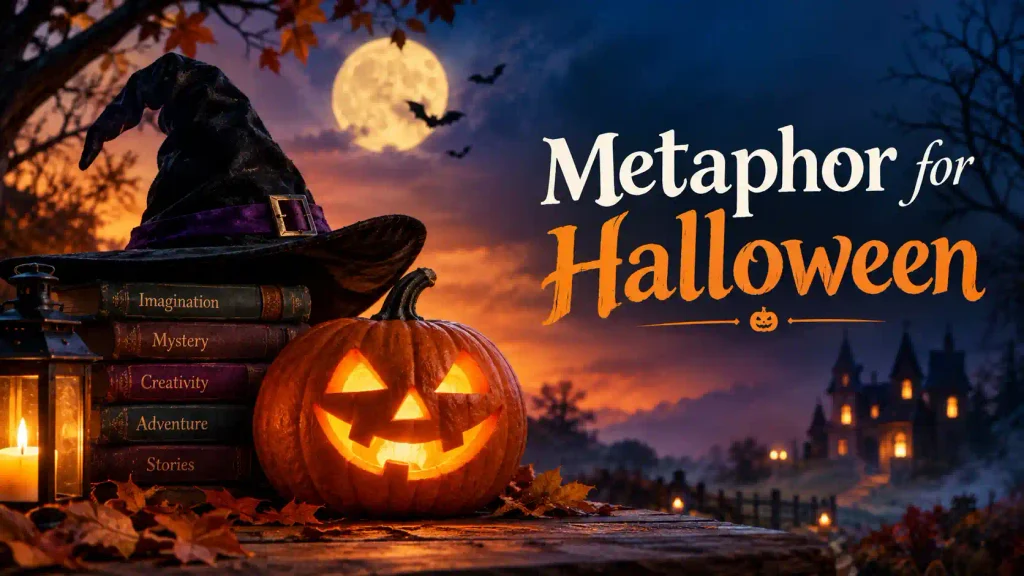
A metaphor for Halloween describes the holiday through an imaginative comparison, such as “Halloween is a doorway to the unknown” or “The night is a haunted house.” Good Halloween metaphors can make writing feel spooky, magical, playful, mysterious, or even nostalgic.
The strongest metaphor depends on the mood you want. A haunted house creates a darker image, while a doorway to another world suggests mystery and adventure.
Best metaphor for Halloween
A good metaphor for Halloween is “Halloween is a doorway to the unknown.” It captures the holiday’s mystery, costumes, stories, and sense of adventure without using a literal comparison. Other useful metaphors include “Halloween is a playground for imagination,” “the night is a haunted house,” “the moon is Halloween’s lantern,” and “Halloween is a mask hiding ordinary life.”
20 Metaphors for Halloween
Some expressions below are familiar figurative ideas, while others are original metaphors created specifically for this article. Original examples are clearly labeled so they are not mistaken for established sayings.
1. Halloween Is a Doorway to the Unknown
Type: Original metaphor
This presents Halloween as an entrance into mystery, imagination, and unfamiliar experiences.
Example:
Halloween is a doorway to the unknown, and every costume gives you a new way to step through it.
Best for: Essays, stories, poetry, and reflective writing.
2. Halloween Is a Playground for Imagination
Type: Original metaphor
This metaphor focuses on creativity rather than fear. Costumes, decorations, characters, and stories allow people to temporarily enter imagined worlds.
Example:
For children, Halloween is a playground for imagination where monsters, heroes, and witches can roam freely.
Best for: School essays, children’s writing, and positive Halloween descriptions.
3. The Night Is a Haunted House
Type: Original metaphor
This turns the entire night into a place filled with mystery and unexpected moments.
Example:
Under the October moon, the night became a haunted house with a secret behind every shadow.
Best for: Horror stories and atmospheric writing.
4. The Moon Is Halloween’s Lantern
Type: Original metaphor
The moon becomes a giant natural lamp illuminating the Halloween night.
Example:
The moon was Halloween’s lantern, glowing above the silent streets.
Best for: Poetry, descriptive writing, and captions.
5. Halloween Is a Mask
Type: Original metaphor
This metaphor emphasizes transformation. People temporarily hide their ordinary identities behind costumes and characters.
Example:
Halloween is a mask that lets ordinary people become someone completely different for a night.
Best for: Reflective essays and creative writing.
6. Halloween Is a Theater of Shadows
Type: Original metaphor
This presents Halloween as a performance in which darkness, costumes, lights, and movement create the scene.
Example:
The neighborhood became a theater of shadows as costumed children moved from porch to porch.
Best for: Literary writing and vivid descriptions.
7. Halloween Is a Cauldron of Imagination
Type: Original metaphor
A cauldron suggests many ingredients mixing together. Here, costumes, stories, candy, fear, humor, and creativity combine.
Example:
Halloween is a cauldron of imagination where every family adds its own strange and wonderful ingredient.
Best for: Essays and creative descriptions.
8. The Neighborhood Is a Haunted Stage
Type: Original metaphor
Porches, costumes, decorations, and trick-or-treaters become part of one large performance.
Example:
By sunset, the neighborhood was a haunted stage filled with skeletons, witches, and glowing pumpkins.
Best for: Descriptive writing.
9. Halloween Is a Night of Disguises
Type: Original metaphor
This emphasizes the temporary transformation created by costumes.
Example:
Halloween is a night of disguises when superheroes and monsters walk beside ordinary families.
Best for: Simple essays and school assignments.
10. The Pumpkin Patch Is a Sea of Orange
Type: Original metaphor
The pumpkins become waves or a large body of orange color.
Example:
The pumpkin patch was a sea of orange beneath the fading October sun.
Best for: Descriptive writing and poetry.
11. The Darkness Is a Black Blanket
Type: Original metaphor
This gives darkness a physical presence and creates a cozy or eerie image depending on context.
Example:
A black blanket covered the neighborhood as the last light disappeared.
Best for: Atmospheric writing.
12. Halloween Is a Treasure Chest of Stories
Type: Original metaphor
This focuses on the abundance of legends, ghost stories, costumes, and traditions associated with the holiday.
Example:
Halloween is a treasure chest of stories, with a different strange tale hiding beneath every lid.
Best for: Essays and storytelling.
13. A Costume Is a Ticket to Another World
Type: Original metaphor
The costume becomes a passport or ticket that allows the wearer to adopt a new identity.
Example:
Her pirate costume was a ticket to another world, and suddenly the backyard became an ocean.
Best for: Children’s writing, fiction, and costume descriptions.
14. Halloween Is a Candle in the Dark
Type: Original metaphor
This can emphasize how Halloween brings excitement, warmth, and human connection into an otherwise dark setting.
Example:
For the children on the street, Halloween was a candle in the dark.
Best for: Positive, emotional, or nostalgic writing.
15. Halloween Is a Ghost Story Come to Life
Type: Original metaphor
This image blends storytelling with the physical experience of costumes, decorations, and nighttime celebrations.
Example:
With fog covering the street and lanterns glowing on every porch, Halloween felt like a ghost story come to life.
Best for: Fiction and descriptive essays.
16. The Street Is a River of Costumes
Type: Original metaphor
The moving crowd becomes a flowing river.
Example:
A river of costumes flowed down the street as families searched for the next decorated house.
Best for: Descriptive writing and photography captions.
17. Halloween Is a Costume Carnival
Type: Original metaphor
This emphasizes celebration, color, creativity, and social activity rather than horror.
Example:
The school transformed Halloween into a costume carnival of colors, characters, and laughter.
Best for: School events and cheerful writing.
18. Fear Is Halloween’s Shadow
Type: Original metaphor
Fear becomes something that follows the celebration without necessarily controlling it.
Example:
Fear is Halloween’s shadow, but laughter usually walks beside it.
Best for: Reflective writing and essays.
19. Halloween Is a Bridge Between Reality and Fantasy
Type: Original metaphor
This captures the temporary movement from ordinary life into imagined characters and supernatural themes.
Example:
Halloween is a bridge between reality and fantasy, crossed one costume at a time.
Best for: Essays and literary writing.
20. The Jack-o’-Lantern Is a Small Sun in the Dark
Type: Original metaphor
The pumpkin becomes a miniature source of light against darkness.
Example:
Every jack-o’-lantern looked like a small sun glowing on the porch.
Best for: Poetry, captions, and descriptive writing.
The Best Halloween Metaphors by Mood
The right metaphor depends on the feeling you want to create.
| Metaphor | Meaning | Tone | Best Use |
|---|---|---|---|
| Doorway to the unknown | Mystery and discovery | Mysterious | Essays, stories |
| Playground for imagination | Creativity and fun | Positive | School writing |
| Haunted house | Fear and uncertainty | Spooky | Horror writing |
| Theater of shadows | Drama and atmosphere | Dark, literary | Fiction |
| Cauldron of imagination | Many creative elements combined | Magical | Essays |
| Candle in the dark | Warmth and connection | Emotional | Reflective writing |
| Bridge between reality and fantasy | Temporary transformation | Thoughtful | Essays |
| River of costumes | A moving crowd | Playful | Descriptive writing |
| Costume carnival | Celebration and creativity | Cheerful | Events |
| Ghost story come to life | A vivid supernatural atmosphere | Eerie | Fiction |
What Is a Metaphor for Halloween?
A metaphor for Halloween is a figurative comparison that describes the holiday as something else to communicate a particular feeling or idea.
For example:
Halloween is a doorway to the unknown.
The sentence does not literally say that Halloween is a physical doorway. The doorway represents mystery, discovery, and the transition from ordinary life into a world of costumes, imagination, and spooky stories.
A metaphor does not need the words “like” or “as.” That distinction helps separate it from a simile.
What Are 10 Metaphors?
If you need exactly 10 metaphors for a Halloween assignment, these are concise options:
- Halloween is a doorway to the unknown.
- Halloween is a playground for imagination.
- The night is a haunted house.
- The moon is Halloween’s lantern.
- Halloween is a mask.
- The night is a theater of shadows.
- Halloween is a cauldron of imagination.
- The neighborhood is a haunted stage.
- The street is a river of costumes.
- Halloween is a bridge between reality and fantasy.
Each comparison creates a different image, so you can choose one based on the tone of your assignment.
Metaphor for a Halloween Costume
A metaphor for a Halloween costume can describe the costume as a new identity, a doorway, or a disguise.
Try:
- A costume is a ticket to another world.
- A costume is a second skin.
- A costume is a mask for a hidden character.
- A costume is a doorway into another identity.
- A costume is a passport to imagination.
For example:
Her witch costume was a passport to a world where she could become someone completely different.
These are metaphors because they directly identify the costume with another concept.
What Is a Metaphor for a Nightmare?
A nightmare can be described metaphorically as a dark maze, a storm in the mind, a prison without walls, or a shadow that refuses to disappear.
For example:
The nightmare was a maze with no exit.
This suggests confusion, fear, and the inability to escape.
Other original examples include:
- The nightmare was a storm trapped inside my head.
- The nightmare was a locked room in the mind.
- The nightmare was a shadow that followed me into daylight.
- The nightmare was a broken movie playing behind my eyes.
For a Halloween story, “a maze with no exit” creates a particularly strong sense of fear and helplessness.
Halloween Idioms and Phrases
Not every spooky expression is a metaphor. Halloween-related language includes idioms, expressions, puns, greetings, and seasonal phrases.
Common examples include:
Scared stiff
Means extremely frightened.
Example:
The haunted-house actor scared me stiff.
Scared out of your wits
Means extremely frightened.
Example:
That unexpected scream scared me out of my wits.
Skeletons in the closet
An idiom referring to hidden secrets or embarrassing information from the past.
Example:
Everyone has a few skeletons in the closet.
Come back to haunt someone
Means that a past action or mistake creates problems later.
Example:
That careless decision came back to haunt him.
Dig your own grave
Means to create serious problems for yourself through your own actions.
Example:
By lying repeatedly, he was digging his own grave.
Give up the ghost
Means to stop working, stop trying, or die, depending on context.
Example:
My old laptop finally gave up the ghost.
Ghost town
A place that has very few people and little activity.
Example:
The shopping district became a ghost town after midnight.
Witching hour
A phrase traditionally associated with a late-night period when supernatural activity is imagined to be especially strong.
Example:
We started telling ghost stories around the witching hour.
Make your blood boil
Means to make someone extremely angry.
Example:
That unfair decision made my blood boil.
Jump out of your skin
Means to react with sudden fright or surprise.
Example:
The scream made me jump out of my skin.
These expressions are useful for Halloween writing, but they do not all function as literal metaphors. English-language resources commonly group them together as Halloween idioms and expressions because their imagery fits the theme.
What Are 10 Idiomatic Expressions for Halloween?
If you need 10 idiomatic expressions with a Halloween connection, use:
- Scared stiff
- Scared out of your wits
- Skeletons in the closet
- Come back to haunt someone
- Dig your own grave
- Give up the ghost
- Ghost town
- Witching hour
- Make your blood boil
- Jump out of your skin
Several of these expressions are used throughout the year, not only on Halloween. Their connection to Halloween comes from their spooky imagery.
Halloween Expressions, Sayings, and Phrases
For a broader collection of Halloween expressions, you can mix figurative language with seasonal phrases:
- Trick or treat
- Happy Halloween
- Spooktacular night
- Fangtastic fun
- Boo to you
- Have a hauntingly good time
- Have a wickedly wonderful Halloween
- Let the spooky season begin
- Creep it real
- Have a gourd time
The last several examples are playful seasonal wordplay rather than traditional idioms.
Halloween Sayings: Short and Funny
For captions, cards, texts, or party decorations, short lines work better than long explanations.
- Creep it real.
- Boo crew.
- Witch, please.
- Too cute to spook.
- Fangs for the memories.
- Resting witch face.
- If you’ve got it, haunt it.
- Boo-yah!
- Trick or treat yourself.
- Spook now, snack later.
These are best treated as Halloween wordplay or sayings, not as formal idioms.
Halloween Puns
Halloween puns usually depend on sound, spelling, or a playful double meaning.
Examples include:
- Witch better have my candy.
- Fang-tastic!
- Have a spook-tacular night.
- You’re fang-nificent.
- Bone appetit.
- Let’s have some skele-fun.
- I’m here for the boos.
- Gourd vibes only.
- Resting witch face.
- Creep it real.
Puns are particularly useful for Halloween cards, social posts, party signs, and costume captions.
Cute Halloween Quotes and Original Lines
If you need cute Halloween quotes, short original lines can work well without pretending that they came from a famous person.
Here are original Halloween lines suitable for cards or captions:
- “A little spooky, a lot of sweet.”
- “May your Halloween be full of treats and tiny thrills.”
- “Every pumpkin has a little magic inside.”
- “Keep your heart warm and your Halloween spooky.”
- “Tonight, even the moon gets dressed for the party.”
- “A little fright makes the night brighter.”
- “Let your imagination wear its favorite costume.”
- “May your night glow brighter than a jack-o’-lantern.”
These are original lines, not quotations attributed to public figures.
Halloween Idioms Worksheet
This simple Halloween idioms worksheet can help students practice figurative language.
Fill in the blank
Choose the best expression:
- The sudden scream made me __________.
- Everyone has a few __________ that they would rather keep secret.
- That old computer finally __________.
- If you keep lying, you are __________.
- The mistake could __________ years later.
- The abandoned town looked like a __________.
- The scary movie made my __________.
- We stayed up until the __________ telling ghost stories.
- The frightening mask left the children __________.
- The surprise made her __________.
Word bank:
- ghost town
- scared stiff
- skeletons in the closet
- jump out of my skin
- give up the ghost
- come back to haunt me
- digging your own grave
- blood boil
- witching hour
- scared out of her wits
Answer Key
- jump out of my skin
- skeletons in the closet
- give up the ghost
- digging your own grave
- come back to haunt me
- ghost town
- blood boil
- witching hour
- scared stiff
- scared out of her wits
Interactive classroom searches such as “Wordwall Halloween idioms” can also lead to quizzes and matching activities built around Halloween vocabulary and idiomatic expressions. Wordwall currently has Halloween-themed idiom and vocabulary activities, including a Halloween idioms quiz.
Metaphor, Simile, Idiom, or Pun?
These categories often get mixed together, so here’s the simplest distinction.
| Type | Example | What it does |
|---|---|---|
| Metaphor | Halloween is a doorway to the unknown. | Directly compares two unlike things |
| Simile | The moon glowed like a lantern. | Uses “like” or “as” to compare |
| Idiom | Skeletons in the closet | Has a figurative meaning understood as an expression |
| Pun | Witch better have my candy. | Uses wordplay for humor |
| Seasonal phrase | Trick or treat! | A familiar Halloween expression |
A metaphor directly transfers an image or idea from one thing to another, while a simile typically makes the comparison with “like” or “as.”
This distinction matters in school assignments. If your teacher asks for a metaphor, don’t automatically submit a Halloween idiom or simile just because it sounds figurative.
How to Choose the Right Halloween Metaphor
Choose your metaphor according to the effect you want.
For a spooky essay
Use:
“The night is a haunted house.”
It creates an immediate image of uncertainty and fear.
For a creative story
Use:
“Halloween is a doorway to the unknown.”
It leaves room for adventure and mystery.
For a children’s assignment
Use:
“Halloween is a playground for imagination.”
It keeps the tone positive and easy to understand.
For poetry
Use:
“The moon is Halloween’s lantern.”
The image is short, visual, and easy to develop.
For a nostalgic piece
Use:
“Halloween is a treasure chest of stories.”
It emphasizes memories, traditions, and childhood experiences.
For a costume description
Use:
“The costume is a ticket to another world.”
It highlights transformation rather than simply describing clothing.
FAQs
What is a metaphor for Halloween?
A metaphor for Halloween is a figurative comparison that describes the holiday through another image or concept. “Halloween is a doorway to the unknown” is one example because it presents Halloween as an entrance into mystery and imagination.
What are some Halloween idioms?
Common Halloween-related idioms and expressions include “scared stiff,” “skeletons in the closet,” “come back to haunt someone,” “dig your own grave,” “give up the ghost,” and “jump out of your skin.”
What is a metaphor for a nightmare?
A strong metaphor for a nightmare is “The nightmare was a maze with no exit.” Other possibilities include “a storm in the mind,” “a locked room in the mind,” and “a shadow that follows you into daylight.”
What is a catchy Halloween phrase?
Short phrases such as “Creep it real,” “Too cute to spook,” “Fang-tastic,” “Boo crew,” and “Gourd vibes only” work well for captions, cards, signs, and social posts.
What are some cute Halloween quotes?
For original Halloween lines, try “A little spooky, a lot of sweet,” “Every pumpkin has a little magic inside,” or “Let your imagination wear its favorite costume.” These are original lines rather than quotations attributed to famous people.
Is “scared stiff” a metaphor?
Not exactly. “Scared stiff” is an idiomatic expression meaning extremely frightened. It uses vivid imagery, but calling every figurative expression a metaphor would blur an important distinction in figurative language.
Conclusion
A strong metaphor for Halloween does more than add spooky vocabulary. It gives the reader a specific way to see the holiday.
“Halloween is a doorway to the unknown” emphasizes mystery. “Halloween is a playground for imagination” emphasizes creativity. “The night is a haunted house” creates fear, while “the moon is Halloween’s lantern” creates a more poetic image.
Halloween language also includes idioms, puns, sayings, and seasonal expressions. Knowing the difference lets you choose the right form for an essay, story, classroom worksheet, caption, costume description, or Halloween greeting.
The best figurative language isn’t simply the spookiest. It is the language that creates exactly the image and mood your reader needs.

Qaiser Abbas is an award-winning author, leadership coach, and motivational speaker known for his work on personal growth, leadership, and human potential. Through his writing and speaking, Qaiser focuses on turning challenges into opportunities and helping people build the mindset to achieve meaningful growth.