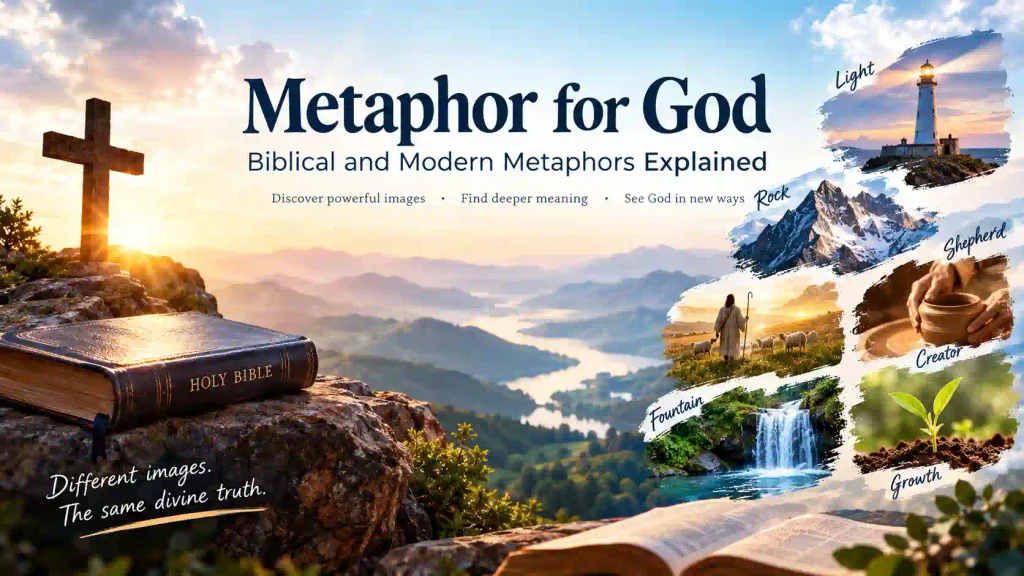
A metaphor for God uses a familiar image to express an aspect of the divine that can be difficult to describe directly. In the Bible, God appears through images such as light, rock, shepherd, fortress, father, shield, fire, king, and dwelling place. Each image emphasizes something different: guidance, protection, strength, authority, love, holiness, or presence.
The key is not to treat these metaphors as interchangeable. “God is light” communicates something different from “God is my rock.” One emphasizes illumination and truth; the other emphasizes stability and refuge.
Quick Answer
A strong metaphor for God is light because light can represent guidance, truth, goodness, revelation, and the removal of darkness. The Bible also uses images such as rock, shepherd, fortress, shield, father, fire, king, and dwelling place to communicate different aspects of God. Modern writers may also use images such as an architect, compass, gardener, or anchor, depending on the meaning they want to express.
20 Metaphors for God: Quick Reference Table
| Metaphor | Meaning | Tone | Best Use |
| Light | Truth, goodness, guidance, revelation | Hopeful | Essays, poetry, faith writing |
| Rock | Strength, stability, faithfulness | Strong | Essays, sermons, reflection |
| Shepherd | Guidance, care, protection | Gentle | Religious writing, poetry |
| Fortress | Safety and protection | Powerful | Faith writing |
| Shield | Defense and security | Protective | Essays, prayers |
| Father | Relationship, care, authority | Personal | Christian writing |
| Fire | Holiness, power, purification | Intense | Poetry, biblical analysis |
| Potter | Creation, shaping, sovereignty | Reflective | Essays, devotional writing |
| Eagle | Protection, strength, renewal | Uplifting | Poetry, biblical writing |
| Shade | Nearness, protection, relief | Comforting | Poetry, reflection |
| Sun | Light, goodness, life | Hopeful | Poetry, essays |
| Fountain | Life, spiritual renewal, abundance | Refreshing | Faith writing |
| Dwelling Place | Home, refuge, lasting presence | Peaceful | Essays, reflection |
| King | Authority, sovereignty, rule | Majestic | Biblical writing |
| Judge | Justice and moral authority | Serious | Theology, essays |
| Anchor | Stability during uncertainty | Reassuring | Modern writing |
| Compass | Direction and guidance | Practical | Modern metaphor |
| Architect | Order, purpose, design | Thoughtful | Modern metaphor |
| Gardener | Growth, care, cultivation | Gentle | Modern metaphor |
| Bridge | Connection, reconciliation, access | Hopeful | Modern metaphor |
The first group draws from established biblical imagery. Scripture uses metaphors extensively to communicate aspects of God’s character and relationship with people. The final four are modern/original metaphors, so they should not be presented as biblical quotations or established biblical descriptions.
Biblical Metaphors for God
The Bible rarely relies on only one image for God. Instead, it uses a collection of images that illuminate different aspects of divine character.
1. God Is Light
Meaning: Light is one of the clearest metaphors for God’s truth, goodness, holiness, guidance, and revelation.
First John 1:5 explicitly says that “God is light,” connecting the image with the absence of darkness.
This metaphor works because light helps people see. In figurative language, it can therefore represent understanding, moral clarity, hope, and direction.
Example 1: “When I felt lost, my faith became a light that helped me see the next step.”
Example 2: “The writer presents God as light breaking through the darkness of fear.”
Best for: essays, poetry, devotional writing, and discussions about guidance or truth.
2. God Is a Rock
Meaning: The rock metaphor communicates strength, permanence, stability, and refuge.
Psalm 18:2 combines the images of rock, fortress, deliverer, shield, and stronghold.
Unlike light, which emphasizes illumination, the rock emphasizes something that does not easily move when circumstances change.
Example 1: “When everything around her changed, she saw God as a rock beneath her feet.”
Example 2: “His faith became a rock during the hardest season of his life.”
Best for: essays about resilience, faith, hardship, and stability.
3. God Is a Shepherd
Meaning: The shepherd represents guidance, care, protection, provision, and a personal relationship with those being led.
Psalm 23 makes this image especially familiar in Christian writing. Biblical sources also identify shepherd as an established metaphor for God.
Example 1: “She trusted God as a shepherd who would guide her through unfamiliar territory.”
Example 2: “The shepherd metaphor presents God as both a guide and a protector.”
Best for: personal reflection, poetry, devotional writing, and discussions about guidance.
4. God Is a Fortress
Meaning: A fortress represents safety, defense, security, and a place of refuge during danger.
Psalm 18:2 places the fortress image beside rock, shield, and stronghold, creating a cluster of protective metaphors.
Example 1: “In the middle of uncertainty, she imagined God as a fortress around her.”
Example 2: “The fortress metaphor emphasizes the security that faith can provide.”
Best for: writing about fear, danger, uncertainty, and protection.
5. God Is a Shield
Meaning: A shield represents protection against harm and the ability to stand firm under pressure.
Psalm 84:11 describes the Lord as both sun and shield, joining provision and protection in a single image.
Example 1: “He thought of his faith as a shield against despair.”
Example 2: “The shield metaphor emphasizes God’s protective role.”
Best for: writing about courage, danger, adversity, and trust.
6. God Is a Father
Meaning: The father metaphor emphasizes relationship, care, authority, belonging, and provision.
The Bible uses father imagery for God, including in Deuteronomy and other biblical passages. Biblical reference works identify Father as one of the established metaphors for God.
This image can feel more personal than metaphors such as fortress or rock because it describes a relationship rather than only a function.
Example 1: “The father metaphor presents God as someone who welcomes and cares for His children.”
Example 2: “For the writer, calling God Father expresses belonging rather than distance.”
Best for: personal essays, devotional writing, and relationship-focused discussions.
7. God Is Fire
Meaning: Fire can represent holiness, power, judgment, purification, and God’s overwhelming presence.
Deuteronomy 4:24 uses the image of consuming fire in describing God. The image should not be reduced to one meaning because fire can both destroy and purify.
Example 1: “The poet describes God’s holiness as a fire that exposes what is false.”
Example 2: “The image of fire communicates both power and purity.”
Best for: biblical analysis, poetry, and writing about holiness or transformation.
8. God Is a Potter
Meaning: The potter represents creation, shaping, authority, and the relationship between the maker and what has been made.
This image is especially useful when discussing the idea that human life is being shaped with purpose.
Example 1: “The potter metaphor presents God as the one who shapes a life with patience.”
Example 2: “She described her changing character as clay in the hands of a skilled potter.”
Best for: essays about identity, growth, creation, and purpose.
9. God Is an Eagle
Meaning: Eagle imagery can communicate protection, strength, movement, and attentive care.
Deuteronomy 32 uses eagle imagery to describe God’s care for Israel. This is an example where the surrounding passage matters because the metaphor develops through the eagle’s behavior rather than through the animal alone.
Example 1: “The eagle became a symbol of God’s strength as He carried His people through danger.”
Example 2: “The poem compares divine care to an eagle watching over its young.”
Best for: poetry and biblical interpretation.
10. God Is Shade
Meaning: Shade represents protection, relief, nearness, and shelter from harsh conditions.
Psalm 121:5 describes the Lord as shade at the right hand.
This metaphor feels quieter than fortress or shield. It suggests that protection does not always have to look dramatic.
Example 1: “In the heat of uncertainty, she imagined God’s presence as shade.”
Example 2: “The shade metaphor presents faith as a place of quiet relief.”
Best for: poetry, reflective essays, and comforting language.
11. God Is the Sun
Meaning: The sun can represent light, life, warmth, goodness, and sustaining presence.
Psalm 84:11 directly combines the images of sun and shield.
Example 1: “The writer uses the sun as a metaphor for God’s life-giving presence.”
Example 2: “Like the morning sun, faith gave him a sense of renewed hope.”
Best for: poetic and inspirational writing.
12. God Is a Fountain of Living Water
Meaning: Water can represent life, renewal, nourishment, and spiritual dependence.
Jeremiah 2:13 describes God as the “fountain of living waters,” contrasting that source with broken cisterns.
Example 1: “The fountain metaphor presents God as a source of renewal when life feels empty.”
Example 2: “She described prayer as returning to a fountain after a long journey.”
Best for: devotional writing and discussions of renewal.
13. God Is a Dwelling Place
Meaning: A dwelling place represents home, refuge, stability, belonging, and lasting presence.
Psalm 90:1 describes God as a dwelling place across generations.
This metaphor emphasizes where a person feels secure, rather than how God acts in a particular situation.
Example 1: “For him, faith became a dwelling place when the rest of life felt uncertain.”
Example 2: “The dwelling-place metaphor suggests that God represents a lasting spiritual home.”
Best for: essays about belonging, faith, identity, and security.
14. God Is King
Meaning: The king metaphor represents authority, sovereignty, rule, and ultimate power.
Psalm 47:7 explicitly calls God the King of all the earth.
Example 1: “The king metaphor emphasizes God’s authority over creation.”
Example 2: “The writer uses the image of a king to communicate divine sovereignty.”
Best for: biblical essays, theology, and formal religious writing.
15. God Is Judge
Meaning: The judge metaphor represents justice, moral authority, accountability, and the evaluation of human actions.
This metaphor works differently from “Father.” The father image emphasizes relationship and care, while the judge image emphasizes moral responsibility and justice.
Example 1: “The judge metaphor reminds the reader that actions have moral consequences.”
Example 2: “The passage presents God as a fair judge rather than a distant observer.”
Best for: theological essays and discussions about justice.
16. God Is a Refuge
Meaning: A refuge is a safe place where someone can escape danger.
The Bible repeatedly combines refuge imagery with God, especially in the Psalms. The idea overlaps with fortress and shelter, but its emotional emphasis is different: refuge focuses on where someone runs when trouble arrives.
Example 1: “During the crisis, faith became a refuge rather than an explanation.”
Example 2: “The writer portrays God as a refuge for people facing fear.”
Best for: emotional writing, prayers, poetry, and essays about hardship.
Modern Metaphors for God
Not every metaphor needs to come directly from Scripture. Modern writers sometimes create new metaphors to communicate spiritual ideas.
These should be labeled honestly as modern or original metaphors, not presented as biblical descriptions.
17. God Is an Anchor
Meaning: An anchor represents stability when circumstances become unpredictable.
Example 1: “When everything around me shifts, faith is an anchor.”
Example 2: “She described God as an anchor that kept her from drifting through uncertainty.”
This works particularly well for modern personal essays and inspirational writing.
18. God Is a Compass
Meaning: A compass represents direction, guidance, and a reliable point of orientation.
Example 1: “He saw God as a compass when he had to choose a new direction.”
Example 2: “Her faith acted like a compass, helping her decide what mattered most.”
This is an original modern metaphor, not a quotation from Scripture.
19. God Is an Architect
Meaning: An architect represents order, design, structure, and intentional creation.
Example 1: “The architect metaphor presents God as the designer behind a purposeful creation.”
Example 2: “He described his faith as trusting the Architect even when he could not see the whole design.”
The architect metaphor can work well in essays about creation, purpose, and meaning, but it should not be presented as a direct biblical metaphor.
20. God Is a Gardener
Meaning: A gardener represents patience, cultivation, growth, care, and transformation.
Example 1: “She imagined God as a gardener patiently cultivating growth in her life.”
Example 2: “The gardener metaphor suggests that spiritual growth takes time, care, and patience.”
This is another modern/original metaphor, rather than a standard biblical description.
Which Metaphor for God Works Best?
The best metaphor depends on the quality you want to emphasize.
| If you want to express… | Try… |
| Guidance | Light or Compass |
| Strength | Rock |
| Protection | Shield, Fortress, or Refuge |
| Care | Shepherd or Father |
| Holiness | Fire |
| Truth | Light |
| Stability | Rock or Anchor |
| Spiritual renewal | Fountain of Living Water |
| Belonging | Dwelling Place |
| Authority | King |
| Justice | Judge |
| Growth | Gardener |
| Creation and order | Architect |
| Comfort | Shade |
| Life and warmth | Sun |
This distinction is important because not every metaphor says the same thing about God. A rock suggests stability; light suggests revelation; a shepherd suggests guidance; and a father suggests relationship.
What Is a Metaphor for God’s Love?
Some of the strongest metaphors for God’s love are a shelter, an embrace, a light, a fountain, a shepherd, and an unbreakable bond.
Biblical language often describes God’s love through relationships and protective images rather than through one single fixed metaphor. Romans 8:38–39, for example, emphasizes the idea that nothing in creation can separate believers from God’s love in Christ.
For creative writing, you could write:
- God’s love is a shelter in the storm.
- God’s love is a light that refuses to go out.
- God’s love is a river that keeps flowing.
- God’s love is an embrace that reaches beyond fear.
These last examples are original expressions, not biblical quotations.
Why Is Light a Metaphor for God?
Light works as a metaphor for God because people naturally associate light with seeing, understanding, direction, goodness, and life.
The Bible makes the connection especially explicit in 1 John 1:5, which says that God is light and contains no darkness.
The metaphor therefore works on several levels:
- Light reveals what darkness hides.
- Light guides people who cannot see the way.
- Light represents goodness in contrast with darkness.
- Light provides hope after a frightening or uncertain period.
- Light makes understanding possible.
So when someone asks, “How is light an accurate metaphor for God?”, the answer is that light gives people a concrete way to understand qualities that are otherwise abstract.
It does not mean that God is physical light. The metaphor uses something familiar to communicate something beyond ordinary physical experience.
Metaphors for Jesus
The Bible also uses many powerful metaphors and images for Jesus.
Some of the best-known include:
- Bread of Life — spiritual nourishment.
- Light of the World — guidance, truth, and revelation.
- Good Shepherd — care and leadership.
- Door — access and entry.
- Vine — connection and dependence.
- Cornerstone — foundation and central importance.
- Bridegroom — covenant relationship with the church.
- Lamb — sacrifice and redemption.
Bible reference material identifies several of these as established metaphors for Jesus, including Bread of Life, Good Shepherd, and Light of the World.
What Is a Metaphor for Jesus?
A strong metaphor for Jesus is the Good Shepherd because it communicates care, guidance, protection, and a personal relationship with his followers.
Light of the World is another strong choice when the focus is truth or spiritual guidance.
Metaphors for the Bible
The Bible itself is also described through figurative images. Common examples include:
- Lamp — guidance.
- Light — direction and understanding.
- Mirror — self-examination.
- Sword — penetrating power and discernment.
- Seed — growth and spiritual development.
- Fire — consuming or transformative power.
- Hammer — force that breaks or reshapes.
For example, Psalm 119 uses lamp and light imagery for God’s word, while James 1 uses the image of a mirror to describe what happens when people hear the word but fail to act on it. Other biblical passages use sword, seed, fire, and hammer imagery.
If you searched for “metaphors in the Bible PDF,” remember that the useful part is not simply collecting a large number of images. The important step is understanding what each image communicates in its specific context.
Biblical Metaphors for the Church
The New Testament also describes the church through several major metaphors.
The most common include:
- Body of Christ — unity and different roles.
- Bride of Christ — covenant love and relationship.
- Temple — God’s dwelling among His people.
- Flock — belonging and shepherding.
- Family or household — community and shared responsibility.
- People of God — collective identity.
These images serve different purposes. The body emphasizes interdependence, the bride emphasizes relationship, and the flock emphasizes guidance and care.
This is why biblical metaphors for the church should not be treated as synonyms. Each image highlights a different part of what the church means.
Bible Metaphors and Similes: What’s the Difference?
A metaphor directly identifies one thing with another:
God is light.
A simile makes the comparison explicit with words such as “like” or “as”:
God is like a light in the darkness.
The Bible uses both forms of figurative language. The difference matters because a metaphor compresses the comparison into a stronger statement, while a simile makes the comparison more explicit.
For example:
- Metaphor: “The Lord is my shepherd.”
- Simile: “God is like a shepherd caring for his flock.”
Both can communicate guidance and care, but they use different grammatical structures.
Is God a Metaphor?
The answer depends on what someone means by the question.
In biblical writing, metaphors help describe aspects of God through familiar images. Rock, light, shepherd, fortress, and father are not necessarily claims that God is literally a physical rock, light source, shepherd, or human parent.
In philosophy and religious studies, some thinkers use metaphor more broadly to explain how humans conceptualize an abstract or transcendent reality. Research on metaphors for God similarly notes that people use concrete concepts to make an intangible idea easier to understand.
So “God is a metaphor” is not one universally accepted theological definition. It can be a philosophical interpretation, while traditional religious writing may use metaphors to communicate something it considers real about God.
What If God Is a Metaphor for the Universe?
Some philosophical positions identify God closely with the universe, while others distinguish God from the universe or understand God as transcending it.
For that reason, saying “God is a metaphor for the universe” expresses a particular philosophical interpretation rather than a universal religious definition.
A related idea appears in discussions of pantheism and panentheism, but these positions are not identical: pantheism identifies God with the universe, while panentheism generally describes the universe as existing in God while God also transcends it.
For an essay, a careful sentence would be:
“Some philosophical interpretations use God as a metaphor for the universe or for a reality that transcends ordinary human categories.”
That wording avoids presenting one philosophical position as established fact.
What Does “God Is a Metaphor for That Which Transcends” Mean?
This phrase treats “God” as a way of pointing toward something beyond ordinary human categories.
In this interpretation, the word God does not simply identify an object within the universe. Instead, it points toward ideas such as:
- ultimate reality,
- transcendence,
- meaning,
- mystery,
- ultimate value,
- or the ground of existence.
This is a philosophical use of metaphor rather than a simple biblical definition. It can be useful in philosophy or comparative religion, but writers should identify the viewpoint they are presenting.
Is Aslan a Metaphor for God?
Aslan, the lion in C. S. Lewis’s The Chronicles of Narnia, is widely understood as a literary representation of Christ, rather than simply a generic metaphor for God.
Lewis’s Narnia imagery draws strongly on Christian ideas, and scholarship on the series connects Aslan with Christ and the Christian understanding of divine incarnation.
For that reason, it is more precise to say:
Aslan is a Christ figure or literary representation of Jesus in Narnia.
Calling Aslan merely “a metaphor for God” loses some of the specific literary and theological role the character plays.
What Is “God’s Beard” a Metaphor For?
The image of a bearded God is better understood as an anthropomorphic image than as one of the Bible’s central metaphors for God.
People often imagine God using familiar human characteristics, including an elderly male figure with a beard. Research on how people metaphorically describe God has identified “bearded man” among the categories used in people’s descriptions.
That does not mean the Bible establishes God’s beard as a standard metaphor. It is better treated as a cultural or artistic representation of God.
What Are 7 Synonyms for “God”?
Strictly speaking, many words people call “synonyms for God” are actually names, titles, descriptions, or theological terms rather than perfect synonyms.
Seven commonly used terms include:
- Lord
- Creator
- Almighty
- Father
- King
- Holy One
- Maker
The exact choice depends on religious tradition and context. Biblical traditions also use names such as Elohim, Adonai, and other titles with distinct meanings. Sources discussing biblical names emphasize that these names and titles often highlight different aspects of God’s character.
What Can I Say Instead of “God”?
If you need an alternative expression, choose one that matches the context rather than replacing the word mechanically.
You could use:
- the Lord
- the Creator
- the Almighty
- the Divine
- the Holy One
- the Eternal
- the Maker
- the Father
- the Divine Presence
These terms are not interchangeable in every religious tradition, so context matters.
Why Is 7 Called God’s Number?
Seven is often associated with completeness or fullness in biblical interpretation, but calling it simply “God’s number” can oversimplify the subject.
Genesis describes God’s work of creation as completed and followed by rest on the seventh day. Revelation also repeatedly uses groups of seven, and some Bible study notes explicitly associate seven with fullness and completeness.
A better statement is:
Seven is often associated with completeness and fullness in biblical symbolism.
That is more accurate than saying that seven is universally or officially “God’s number.”
What Are 100 Names for God?
There is no single universally agreed list of exactly 100 names for God across all religions and Christian traditions.
Different devotional traditions compile different lists of names and titles. Some Christian resources describe more than 100 names or titles, including names such as Elohim, Adonai, Creator, Redeemer, Savior, Holy One, and Wonderful Counselor.
It is therefore better to distinguish names, titles, attributes, and metaphors rather than treating all 100 items as the same type of expression.
What Are 5 Examples of Metaphors?
Five simple examples of metaphors are:
- God is light. — God represents truth and guidance.
- God is a rock. — God represents strength and stability.
- God is a shepherd. — God represents guidance and care.
- God is a fortress. — God represents protection.
- God is a fountain of living water. — God represents life and renewal.
These examples show why metaphor matters: each image communicates a different quality.
What Are 10 Metaphors?
Ten strong metaphors for God are:
- Light
- Rock
- Shepherd
- Fortress
- Shield
- Father
- Fire
- Potter
- Dwelling Place
- Fountain of Living Water
They cover several distinct ideas, including guidance, protection, strength, relationship, holiness, creation, belonging, and renewal.
What Are 20 Metaphors?
Twenty useful metaphors for God include:
- Light
- Rock
- Shepherd
- Fortress
- Shield
- Father
- Fire
- Potter
- Eagle
- Shade
- Sun
- Fountain
- Dwelling Place
- King
- Judge
- Refuge
- Anchor
- Compass
- Architect
- Gardener
The first sixteen are grounded in biblical imagery or closely established biblical descriptions. The final four are modern/original metaphors and should be labeled accordingly.
Did Jesus Love LGBTQ People?
Jesus’ teachings in the Gospels strongly emphasize love of neighbor and love for others. In Matthew 22:37–40, Jesus identifies love of God and love of neighbor as the two great commandments. In John 13:34, he tells his disciples to love one another as he loved them.
The modern term LGBTQ did not exist in the historical setting of Jesus, and the question of how Jesus’ teachings apply to contemporary LGBTQ identities and relationships is interpreted differently across Christian traditions.
Therefore, a careful answer is:
Jesus explicitly taught love of neighbor and love for others, but Christians disagree about how his teachings and the broader biblical tradition should be applied to contemporary LGBTQ relationships and sexual ethics.
That distinction avoids claiming that a modern category appears directly in the Gospel texts while still acknowledging the importance of Jesus’ teachings about love.
Is Heaven a Metaphor?
Heaven can be discussed both literally and metaphorically, depending on the theological tradition and the passage being interpreted.
Christian theology has not always treated every reference to heaven in exactly the same way. Some descriptions refer to heaven as God’s dwelling or a transcendent reality, while theological writers have also explored metaphorical meanings. The St Andrews Encyclopaedia of Theology notes that the treatment of heaven as literal and metaphorical has developed differently across Christian history.
For an article or essay, avoid saying simply “heaven is a metaphor.” A more accurate statement is:
“Some descriptions of heaven have metaphorical significance, but Christian traditions differ on how literally particular references to heaven should be understood.”
Frequently Asked Questions
What is a metaphor for God?
A metaphor for God uses a familiar image to communicate an aspect of God’s character or relationship with people. Common biblical examples include light, rock, shepherd, fortress, shield, father, fire, and dwelling place. Each metaphor emphasizes a different quality rather than defining God completely.
What is the best metaphor for God?
There is no single best metaphor for every purpose. Light works especially well for truth and guidance, rock for strength and stability, shepherd for care and guidance, and fortress for protection. The best choice depends on the quality you want to emphasize.
How is light a metaphor for God?
Light works as a metaphor for God because it represents qualities such as truth, goodness, guidance, revelation, and the removal of darkness. First John 1:5 directly uses the image of light for God.
What is a metaphor for God’s love?
Useful metaphors for God’s love include a shelter, light, fountain, shepherd, embrace, and unbreakable bond. These images emphasize protection, guidance, renewal, care, closeness, or permanence.
What is a metaphor for Jesus?
Common biblical metaphors for Jesus include the Bread of Life, Light of the World, Good Shepherd, Door, Vine, Cornerstone, Bridegroom, and Lamb. Each image communicates a different aspect of Jesus’ identity or role.
Is God a metaphor?
God can be described through metaphors, but saying God itself is merely a metaphor is a philosophical or theological position rather than a universal definition. Biblical writers use concrete images to communicate aspects of an otherwise abstract or transcendent subject.
Conclusion
The strongest metaphors for God do more than make religious writing sound poetic. They help readers understand different aspects of an idea that is difficult to describe directly.
Light communicates truth and guidance. Rock communicates strength and stability. Shepherd communicates care and direction. Fortress and shield communicate protection. Father communicates relationships. Fire communicates holiness and power. Fountain communicates life and renewal.
That variety is the real strength of biblical metaphor. No single image needs to explain everything. Each one gives the reader a different window into the meaning being communicated.
For essays, poetry, sermons, devotional writing, or personal reflection, choose the metaphor that matches the quality you want to express. A precise metaphor will always communicate more than a long list of disconnected comparisons.

Qaiser Abbas is an award-winning author, leadership coach, and motivational speaker known for his work on personal growth, leadership, and human potential. Through his writing and speaking, Qaiser focuses on turning challenges into opportunities and helping people build the mindset to achieve meaningful growth.