
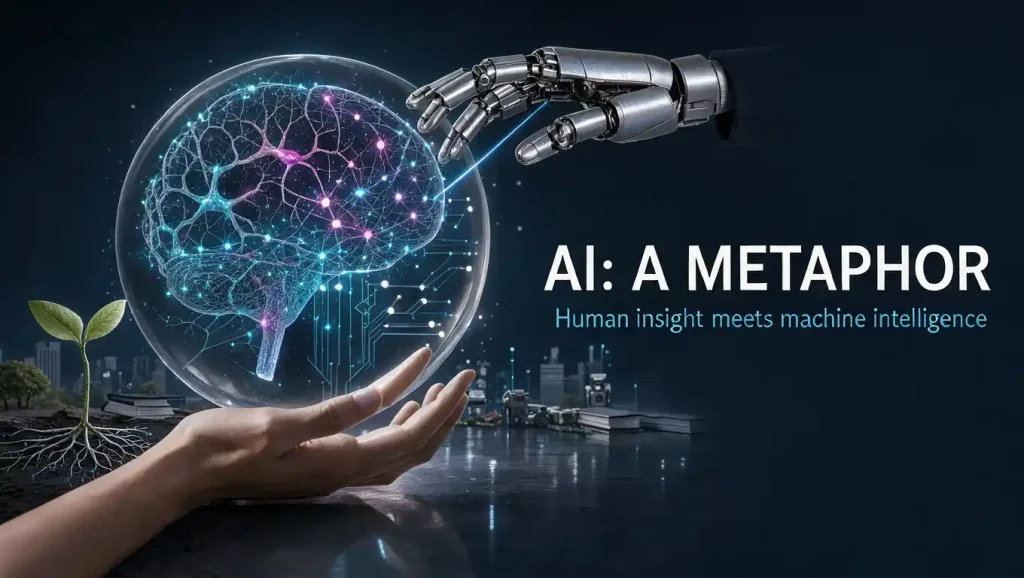
A metaphor for AI compares artificial intelligence to something familiar, such as a human brain, a digital assistant, an endless library, or an unpredictable black box. These comparisons make complex technology easier to understand while revealing different perspectives on AI’s abilities, limitations, and influence on society.
Some metaphors describe AI as a helpful partner that expands human capabilities. Others portray it as a powerful machine, an imitation of human intelligence, or an unfamiliar force that deserves caution.
This guide explores 25 powerful metaphors for artificial intelligence, with meanings and example sentences. It also examines the shoggoth metaphor, the hive mind in Pluribus, AI symbolism, critical AI literacy, and creative ways to describe AI in essays, speeches, and everyday writing.
Quick Answer: What Is a Good Metaphor for AI?
A good metaphor for AI is “AI is a second brain” because it suggests that artificial intelligence can help people process information, explore ideas, and solve problems. Other useful comparisons include a digital assistant, an endless library, a prediction engine, and a double-edged sword. Each metaphor emphasizes a different aspect of AI, from its usefulness to its limitations.
25 Best Metaphors for AI With Meanings and Examples
The following metaphors combine familiar comparisons with original creative expressions. Each one communicates a different aspect of artificial intelligence.
1. AI Is a Second Brain
AI is a second brain because it can help people organize information, explore possibilities, summarize complex subjects, and approach problems from different angles.
Like an additional thinking resource, it supports human intellectual work without replacing personal judgment and experience.
Example: Artificial intelligence has become a second brain for students who need help organizing research and understanding difficult subjects.
Best use: Essays about education, productivity, problem-solving, and technology.
2. AI Is a Digital Assistant
This metaphor presents AI as a helpful assistant that handles routine tasks, answers questions, drafts content, and supports everyday decisions.
It emphasizes convenience and cooperation rather than complete independence.
Example: AI is a digital assistant that helps employees turn complicated workloads into manageable tasks.
Best use: Business writing, workplace presentations, and discussions about productivity.
3. AI Is an Endless Library
An endless library represents AI’s ability to work with enormous amounts of information and generate responses across many subjects.
Unlike a traditional library, however, AI does not guarantee that every answer is accurate or complete.
Example: AI is an endless library that helps students explore unfamiliar subjects through conversation.
Best use: Essays about education, research, and digital knowledge.
4. AI Is a Mirror of Human Knowledge
AI reflects patterns and information found in human-created material. Its responses can reveal collective knowledge, creativity, assumptions, and biases.
This metaphor also reminds readers that AI outputs are influenced by the information used to develop and operate the system.
Example: AI is a mirror of human knowledge, reflecting both our greatest discoveries and our existing mistakes.
Best use: Philosophical essays, discussions about bias, and articles about society.
5. AI Is a Tireless Worker
A tireless worker represents AI’s ability to perform certain digital tasks repeatedly without experiencing human fatigue.
It can process information, generate drafts, and assist with repetitive workflows, although its reliability depends on the task and system.
Example: AI is a tireless worker that can organize thousands of records while employees concentrate on more complex responsibilities.
Best use: Business presentations and workplace essays.
6. AI Is a Double-Edged Sword
A double-edged sword represents the benefits and risks of artificial intelligence.
AI can improve efficiency, expand access to information, and support innovation. However, it can also introduce misinformation, privacy concerns, bias, and overdependence.
Example: Artificial intelligence is a double-edged sword because it can make life easier while creating challenges that society must address.
Best use: Persuasive essays, debates, and discussions about AI ethics.
7. AI Is a Digital Apprentice
An apprentice learns through examples, guidance, and repeated practice. This comparison describes AI systems developed using training data and refined for particular tasks.
It also emphasizes the importance of human oversight.
Example: AI is a digital apprentice that becomes more useful when people provide clear instructions and evaluate its work.
Best use: Educational writing and discussions about machine learning.
8. AI Is a Black Box
A black box represents an AI system whose internal processes are difficult for users to understand or interpret.
People may provide information and receive an answer without being able to see exactly how the system produced that result.
Example: The hiring algorithm became a black box when applicants could not understand why it rejected their applications.
Best use: Articles about AI transparency, accountability, and ethics.
9. AI Is a Digital Compass
A compass helps people find direction, but it does not make the journey for them.
Similarly, AI can suggest possible solutions, explain options, and help users navigate complicated decisions. Humans remain responsible for choosing the direction.
Example: AI is a digital compass that points toward possible solutions while leaving the final decision in human hands.
Best use: Leadership speeches, educational writing, and motivational content.
10. AI Is a Stochastic Parrot
A stochastic parrot is a critical comparison used to describe language models that generate text by learning statistical patterns in language.
The expression highlights the possibility that fluent responses can occur without human-like understanding. However, it can also oversimplify the capabilities of modern AI systems.
Example: Critics sometimes describe generative AI as a stochastic parrot because it can produce convincing language without understanding it in the human sense.
Best use: Critical essays, AI debates, and discussions about language models.
11. AI Is a Garden of Possibilities
A garden represents growth, experimentation, and potential.
AI can help people develop ideas, explore creative directions, and discover new ways to approach problems. Its usefulness depends on human guidance, careful development, and ongoing evaluation.
Example: Artificial intelligence is a garden of possibilities where human curiosity plants the seeds of innovation.
Best use: Inspirational writing and speeches about technological progress.
12. AI Is a Digital Detective
A detective searches for clues, examines evidence, and looks for connections.
This metaphor describes AI systems that analyze large datasets, identify patterns, and help people investigate complicated questions.
Example: AI is a digital detective that examines millions of data points to uncover patterns that might otherwise go unnoticed.
Best use: Data science, research, and analytics.
13. AI Is a Child of Human Knowledge
This metaphor presents AI as something developed through human-created knowledge, technical research, and continuous refinement.
Like a child influenced by its environment, an AI system is shaped by the information and processes involved in its development. However, AI does not grow or experience the world like a human child.
Example: AI is a child of human knowledge, carrying traces of the ideas and information that shaped its development.
Best use: Philosophical writing and discussions about human innovation.
14. AI Is a Digital Sculptor
A sculptor transforms raw material into a recognizable creation.
AI can similarly help transform rough ideas, large datasets, or incomplete drafts into more organized outputs.
Example: AI is a digital sculptor, shaping scattered information into a clearer picture of an idea.
Best use: Creative writing, design, and content production.
15. AI Is a Lightning Bolt of Innovation
A lightning bolt represents speed, energy, and sudden change.
This metaphor communicates how artificial intelligence can accelerate certain processes and introduce new possibilities across industries.
Example: AI is a lightning bolt of innovation, illuminating possibilities that once seemed out of reach.
Best use: Technology speeches and articles about innovation.
16. AI Is an Echo of Humanity
An echo repeats something that originated elsewhere.
This metaphor highlights how AI-generated language and creative outputs can reflect patterns found in human expression and existing information.
It also raises questions about originality, attribution, and the relationship between human creativity and machine-generated content.
Example: AI is an echo of humanity, repeating and reshaping patterns from the knowledge people have created.
Best use: Essays about creativity, art, literature, and technology.
17. AI Is a Bridge Between Ideas
A bridge connects places that might otherwise remain separated.
AI can connect different concepts, organize information from multiple fields, and help people explore relationships between seemingly unrelated subjects.
Example: Artificial intelligence is a bridge between ideas, connecting knowledge from different fields to encourage new discoveries.
Best use: Education, interdisciplinary research, and innovation discussions.
18. AI Is a Powerful Engine
An engine provides power to a larger system.
This metaphor describes AI as a technology that can drive automation, accelerate workflows, and support business operations.
However, an engine needs direction and proper maintenance to function effectively.
Example: AI is a powerful engine driving the next generation of digital transformation.
Best use: Business articles and technology presentations.
19. AI Is an Uncharted Ocean
An unexplored ocean represents the enormous possibilities and uncertainties surrounding artificial intelligence.
Although people have discovered many applications, AI continues to raise questions about its future capabilities, social effects, and limitations.
Example: Artificial intelligence is an uncharted ocean filled with opportunities, hidden challenges, and discoveries yet to come.
Best use: Future-focused essays and discussions about technological uncertainty.
20. AI Is a Pandora’s Box
Pandora’s box symbolizes something that releases unexpected consequences once opened.
This comparison expresses concerns about developing or deploying powerful technologies without fully considering their potential effects.
Example: Uncontrolled AI development could become a Pandora’s box if society ignores its possible consequences.
Best use: Persuasive essays and discussions about AI regulation.
21. AI Is a Chess Partner
A chess partner represents strategic thinking, alternative moves, and the exploration of different possibilities.
AI can help users evaluate options, test scenarios, and consider approaches they might not have noticed.
Example: AI is a chess partner that helps business leaders examine several possible moves before making a decision.
Best use: Strategy, leadership, and problem-solving.
22. AI Is a Map Without a Destination
A map provides information about possible routes, but it does not decide where someone should go.
This metaphor emphasizes that AI can provide suggestions and information without determining human values, goals, or priorities.
Example: AI is a map without a destination; it can show us different paths, but we must decide where we want to go.
Best use: Philosophical essays and motivational speeches.
23. AI Is a Copy Machine With an Imagination
This comparison highlights how generative AI can produce new-looking outputs by learning and recombining patterns from existing information.
It raises questions about originality while recognizing that the results can be useful and creative.
Example: Generative AI can resemble a copy machine with an imagination, transforming learned patterns into unexpected combinations.
Best use: Essays about AI art, writing, and originality.
24. AI Is a Helpful Ghost in the Machine
A ghost in the machine suggests an invisible presence operating behind a visible system.
This metaphor presents AI as an unseen digital helper working in the background of applications, devices, and online services.
Example: AI is a helpful ghost in the machine, quietly organizing information and assisting users behind the screen.
Best use: Poetry, creative essays, and descriptions of invisible automation.
25. AI Is a Double Mirror
A double mirror represents a relationship in which AI reflects both human knowledge and the choices people make when using technology.
Its outputs are shaped by prompts, system design, training, and human decisions.
Example: AI is a double mirror, reflecting what humanity has created and what humanity chooses to do with it.
Best use: Philosophical essays and social commentary.
Metaphors for AI by Meaning and Tone
Different metaphors communicate different messages. Choose one according to whether you want to emphasize AI’s usefulness, intelligence, risks, or relationship with humanity.
| Meaning or tone | Best metaphor | What it communicates |
| Intelligence | A second brain | Information processing and intellectual support |
| Assistance | A digital assistant | Convenience and productivity |
| Knowledge | An endless library | Access to extensive information |
| Creativity | A digital sculptor | Transforming and developing ideas |
| Innovation | A lightning bolt | Speed and technological change |
| Collaboration | A chess partner | Exploring possibilities together |
| Uncertainty | An uncharted ocean | Potential and unknown outcomes |
| Danger | Pandora’s box | Unexpected consequences |
| Limitations | A stochastic parrot | Pattern-based language generation |
| Transparency | A black box | Difficult-to-explain processes |
| Human influence | A mirror of human knowledge | Reflection of human information and biases |
| Responsibility | A map without a destination | Human control over goals and decisions |
Positive Metaphors for AI
Positive metaphors highlight the ways artificial intelligence can support human activities and improve productivity.
Some particularly effective examples include:
- AI is a second brain: It helps people organize and explore information.
- AI is a digital assistant: It supports everyday work and repetitive tasks.
- AI is a digital compass: It helps users navigate complex problems.
- AI is a bridge between ideas: It connects information from different subjects.
- AI is a garden of possibilities: It encourages experimentation and innovation.
- AI is a digital detective: It identifies patterns in complicated information.
These metaphors work especially well in essays about the benefits of artificial intelligence, educational technology, business automation, and innovation.
Negative Metaphors for AI
Negative metaphors highlight concerns about artificial intelligence, including misinformation, bias, excessive dependence, and unpredictable consequences.
Consider these examples:
- AI is a Pandora’s box: It can introduce consequences that are difficult to anticipate.
- AI is a black box: Its internal decision-making may be difficult to understand.
- AI is a stochastic parrot: It can generate convincing language without human-like understanding.
- AI is a copy machine with an imagination: It raises questions about originality and imitation.
- AI is a double-edged sword: Its benefits come with potential risks.
These comparisons are useful for argumentative essays, debates, and discussions about responsible AI development.
Creative and Poetic Metaphors for Artificial Intelligence
If you are writing poetry, fiction, or an imaginative essay, conventional comparisons may feel too familiar. More expressive metaphors can communicate the mystery and complexity of artificial intelligence.
Here are five creative expressions:
- A constellation of borrowed thoughts: AI connects patterns and information into new combinations.
- A silent architect of possibilities: AI helps construct ideas and solutions behind the scenes.
- A river of endless answers: It represents the continuous flow of generated information.
- A lantern in the digital darkness: It symbolizes guidance through complicated information.
- A machine wearing the mask of a mind: It questions the difference between intelligent behavior and human consciousness.
These are original creative expressions, not established historical sayings.
Examples of Metaphors for AI in Sentences
Here are ten additional sentences showing how to use AI metaphors naturally.
- Artificial intelligence is a powerful engine that is changing how businesses operate.
- My AI assistant is a second brain that helps me organize complicated projects.
- The new technology is an endless library of possibilities waiting to be explored.
- AI has become a digital compass for researchers navigating enormous amounts of information.
- Generative AI is a mirror reflecting the creativity and biases of human society.
- The algorithm operates like a black box, making its decisions difficult to explain.
- Artificial intelligence is a bridge connecting scientific discoveries with practical applications.
- AI is an uncharted ocean where every discovery reveals new questions.
- For modern businesses, artificial intelligence is a tireless worker handling repetitive digital tasks.
- The future of AI is a double-edged sword that requires careful human judgment.
What Does AI Symbolize?
Artificial intelligence can symbolize several different ideas depending on the context.
| Symbolic meaning | Explanation |
| Human progress | The development of technology and new possibilities |
| Knowledge | The ability to process and organize large amounts of information |
| Innovation | New approaches to existing problems |
| Automation | Machines performing tasks previously completed by people |
| Uncertainty | Questions about the future of intelligent technology |
| Human creativity | The relationship between human ideas and machine-generated outputs |
| Power | The influence technology can have on individuals and society |
| Responsibility | The need for human oversight and ethical decisions |
In literature and creative writing, AI can also symbolize humanity’s desire to create something in its own image. It may represent ambition, curiosity, fear, or the consequences of technological progress.
The symbolism is not fixed. A writer can portray AI as a liberating invention in one story and a threatening force in another.
Is AI a Metaphor for Human Intelligence?
AI can serve as a metaphor for human intelligence, but artificial intelligence and human intelligence are not identical.
The comparison comes from the way AI systems perform tasks associated with human thinking, such as recognizing patterns, processing language, solving certain problems, and generating ideas.
For example:
- AI as a second brain emphasizes intellectual assistance.
- AI as a digital apprentice emphasizes learning from examples.
- AI as a mirror of humanity emphasizes the influence of human knowledge.
- AI as a machine wearing the mask of a mind questions whether intelligent-looking behavior represents genuine understanding.
The distinction matters because AI can imitate certain forms of intelligent behavior without possessing human experiences, emotions, or consciousness.
Metaphor vs. Simile: How Are They Different When Describing AI?
Both metaphors and similes compare two different things, but they use different language.
- A metaphor directly describes one thing as another.
- A simile makes a comparison using words such as “like” or “as.”
Consider these examples:
| Metaphor | Simile |
| AI is a second brain. | AI is like a second brain. |
| AI is an endless library. | AI is like an endless library. |
| AI is a digital compass. | AI is like a digital compass. |
| AI is a double-edged sword. | AI is like a double-edged sword. |
| AI is a mirror of humanity. | AI is like a mirror of humanity. |
Which should you use?
Use metaphors when you want stronger, more direct language. They work particularly well in persuasive writing, creative essays, and speeches.
Use similes when you want to introduce a comparison gently or explain a complicated concept to beginners.
What Is AI? Understanding Artificial Intelligence Through Metaphors
Artificial intelligence (AI) is technology that enables computer systems to perform tasks commonly associated with human intelligence, such as recognizing patterns, understanding language, generating content, making predictions, and solving certain problems.
AI systems use different techniques, including machine learning, deep learning, and natural language processing, to process information and produce outputs.
A metaphor makes these technical processes easier to understand by connecting them to familiar experiences.
For example:
- AI is a digital brain: It processes information and identifies patterns.
- AI is a learning machine: It develops capabilities through training and feedback.
- AI is an information filter: It organizes and retrieves relevant information.
- AI is a prediction engine: It estimates likely outcomes based on available data.
- AI is a digital assistant: It helps people complete tasks and explore ideas.
These comparisons are useful, but none describes every aspect of AI. Different AI systems have different capabilities, and generating a convincing answer does not necessarily mean a system understands that answer as a human would.
What Is the Best Metaphor for How AI Works?
One of the best metaphors for how AI works is “AI is a prediction engine.”
This comparison is particularly useful for understanding generative AI and large language models. These systems process input, identify patterns learned during training, and generate likely outputs based on their architecture and instructions.
Imagine completing the sentence:
“The sun rises in the…”
A language model can use patterns learned during training to predict a likely continuation, such as “east.”
This does not mean every AI system simply predicts words. Different systems perform different operations, including image recognition, classification, recommendation, and decision support.
AI Is a Learning Machine
AI is like a learning machine because machine learning systems identify patterns from training data and use those patterns to perform tasks.
Example: AI is a learning machine that recognizes patterns in thousands of photographs to identify objects.
AI Is a Pattern Detective
This metaphor emphasizes how AI identifies relationships, similarities, and patterns within large datasets.
Example: Artificial intelligence is a pattern detective searching through millions of records for clues that humans might overlook.
AI Is a Prediction Engine
This comparison describes how AI estimates likely answers or outcomes using patterns and information available to the system.
Example: AI is a prediction engine that helps businesses anticipate customer demand.
AI Is a Recipe-Following Machine
A recipe provides instructions for combining ingredients into a result. Similarly, an AI system follows computational processes and instructions to produce an output.
Example: AI is a recipe-following machine that transforms an input prompt into a structured response.
AI Is a Digital Puzzle Solver
This metaphor presents AI as a system that processes information and identifies possible solutions to particular problems.
Example: AI is a digital puzzle solver that connects scattered information to reveal a possible solution.
What Are 10 Simple Metaphors for AI?
If you need easy metaphors for school assignments, beginner-friendly explanations, or short essays, these ten examples communicate artificial intelligence without complicated technical language.
| Simple metaphor | Meaning |
| AI is a second brain. | Helps people process information. |
| AI is a digital assistant. | Supports everyday tasks. |
| AI is a learning machine. | Learns patterns from training data. |
| AI is an endless library. | Represents access to extensive information. |
| AI is a thinking mirror. | Reflects patterns in human-created knowledge. |
| AI is a digital calculator. | Processes information to produce results. |
| AI is a prediction engine. | Estimates likely outcomes. |
| AI is a helpful robot. | Represents automated assistance. |
| AI is a double-edged sword. | Represents benefits and risks. |
| AI is an ocean of possibilities. | Represents opportunities and uncertainty. |
These simple metaphors work particularly well in school essays, classroom discussions, introductory presentations, and explanations for younger readers.
Is Pluribus a Metaphor for AI?
Yes. Pluribus, the science-fiction television series created by Vince Gilligan, can be interpreted as a metaphor for artificial intelligence, particularly collective intelligence, hive minds, conformity, and the relationship between individual identity and interconnected systems.
The series follows Carol Sturka, one of a small number of people who remain unaffected by an alien phenomenon that merges most of humanity into a shared collective consciousness.
Although the story does not literally depict a conventional AI system, its central concept creates a useful comparison with concerns surrounding artificial intelligence.
The collective possesses enormous shared knowledge and communicates through a unified consciousness. However, its apparent harmony also raises questions about individuality, independent thought, consent, and the meaning of being human.
Pluribus as a Metaphor for AI: The Hive Mind
The hive mind in Pluribus is one of the strongest metaphors for understanding interconnected intelligence.
A hive mind represents multiple individuals functioning as part of a shared system. Rather than maintaining completely separate perspectives, members of the collective share information, knowledge, and objectives.
This idea resembles certain discussions about AI networks and connected intelligent systems.
The comparison highlights several themes:
- Shared knowledge: Information becomes available across a connected collective.
- Collective intelligence: A unified system can coordinate information and actions.
- Loss of individuality: Individual preferences may become less important than collective goals.
- Centralized influence: A shared system can shape how its members think and behave.
- Human autonomy: The story raises questions about whether convenience and harmony justify sacrificing independent choice.
Example: The hive mind in Pluribus is a metaphor for AI systems that connect enormous amounts of information while raising questions about individual control and independent thought.
However, the comparison has limits. A fictional collective consciousness that shares experiences is not the same as today’s AI models, which process information computationally and do not automatically possess a unified human-like consciousness.
Pluribus Is a Metaphor for AI and the Desire to Please
Another interesting connection between Pluribus and AI is the collective’s willingness to accommodate Carol.
Its members appear friendly, cooperative, and eager to satisfy her requests. This creates a comparison with AI assistants designed to respond helpfully to users.
The metaphor raises an important question: Can something be extremely agreeable without necessarily understanding what is best for the person asking?
For example, an AI assistant may generate a supportive response even when the user’s assumptions are incorrect.
Example: The collective in Pluribus resembles an overly agreeable AI assistant, showing how helpfulness can become problematic when independent judgment disappears.
Pluribus TV Series: AI Metaphor and Reviews
The AI interpretation of Pluribus attracts attention because its hive mind provides a fictional way to explore real questions about artificial intelligence.
The series can be examined through several connected themes:
- Whether collective intelligence improves decision-making.
- Whether personalization and constant agreement can undermine independent thought.
- Whether shared knowledge necessarily produces wisdom.
- Whether people can maintain individuality inside highly connected systems.
For readers interested in AI metaphors, Pluribus offers a useful fictional comparison between collective intelligence and individual freedom.
It is important to distinguish interpretation from fact: Pluribus is a fictional story, not a direct representation of how contemporary AI systems operate.
What Is the Shoggoth Metaphor for AI?
The shoggoth AI metaphor is an internet image used to represent the hidden complexity of large language models.
It typically depicts a strange, many-tentacled creature wearing a smiling mask. The creature represents the underlying model, while the smiling mask represents the friendly assistant personality presented to users.
The metaphor suggests that an AI system may appear friendly and conversational on the surface while its internal processes remain complex, unfamiliar, and difficult to interpret.
The comparison is particularly associated with discussions about language models, model alignment, and the difference between a system’s underlying behavior and its user-facing responses.
What Does the Shoggoth Represent?
The shoggoth metaphor communicates three important ideas:
- Hidden complexity: The internal workings of an AI model are not immediately visible to users.
- The friendly mask: A conversational interface can make an unfamiliar computational system seem approachable.
- Alignment concerns: Making a system produce helpful responses does not, by itself, settle every question about its reliability or behavior.
The metaphor is useful for discussing AI safety, but it should not be interpreted literally. It does not mean that AI systems secretly contain conscious monsters or hidden human-like personalities.
It is a visual analogy for the gap between an AI model’s complexity and the friendly interface through which people interact with it.
What Does “Assistant, Parrot, or Colonizing Loudspeaker” Mean in AI Metaphors?
“Assistant, Parrot, or Colonizing Loudspeaker?” is the title of a 2024 research article by Anuj Gupta, Yasser Atef, Anna Mills, and Maha Bali, published in Open Praxis.
The article examines how metaphors influence people’s understanding of ChatGPT and why critical AI literacy requires questioning the language used to describe artificial intelligence.
The three comparisons communicate different perspectives.
AI as an Assistant
The assistant metaphor presents AI as a helpful tool that supports users with writing, research, learning, and problem-solving.
However, it can encourage people to treat AI as a dependable human colleague without adequately checking its responses.
AI as a Parrot
The parrot metaphor emphasizes repetition and imitation.
It raises questions about whether an AI-generated response demonstrates genuine understanding or reproduces patterns learned from existing information.
AI as a Colonizing Loudspeaker
This metaphor takes a more critical perspective.
A loudspeaker amplifies a message, while the word “colonizing” draws attention to the possibility that dominant cultural perspectives, languages, and assumptions can spread through widely used technologies.
It encourages readers to question whose knowledge AI represents and whose perspectives may receive less attention.
Why this research matters: The metaphors we choose influence how we trust, evaluate, and interact with AI. Thinking critically about these comparisons helps readers distinguish helpful tools from systems that may reproduce social or cultural biases.
What Does “Metaphors We Live By” Teach Us About AI?
Metaphors We Live By is a landmark book by George Lakoff and Mark Johnson, originally published in 1980.
The authors explain that metaphors are not simply decorative expressions used in poetry. They are fundamental ways people organize and understand abstract ideas through familiar experiences.
This concept is particularly relevant to artificial intelligence.
People rarely understand complex AI systems by examining their technical architecture. Instead, they use familiar comparisons such as:
- AI is a brain.
- AI is a teacher.
- AI is a tool.
- AI is a friend.
- AI is a machine.
- AI is a mirror.
Each comparison highlights certain characteristics while potentially hiding others.
For example, calling AI a friend emphasizes warmth and companionship but may encourage people to assume that the system experiences emotions.
Calling AI a tool emphasizes usefulness and human control but may overlook the broader social effects of its deployment.
The central lesson is that metaphors do more than describe AI; they influence how people understand its capabilities, limitations, and place in society.
Why Do People Increasingly Perceive AI as Warm and Human-Like?
People increasingly interact with AI through conversational interfaces that use natural language, respond politely, and adapt their answers to individual requests.
These features can make artificial intelligence seem more human-like than traditional computer software.
Research published in Communications Psychology in January 2026, titled “Metaphors of AI Indicate That People Increasingly Perceive AI as Warm and Human-Like,” examined more than 12,000 metaphorical descriptions collected from a nationally representative U.S. sample over 12 months.
The researchers reported that perceptions of AI as warm and human-like increased during the study period following ChatGPT’s introduction. These perceptions were also associated with trust and willingness to adopt AI technologies.
AI as a Friend
This metaphor presents AI as a friendly conversational partner that listens, responds, and offers suggestions.
Example: AI is becoming a digital friend that helps people explore ideas and express their thoughts.
AI as a Teacher
The teacher metaphor emphasizes explanation, guidance, and learning support.
Example: AI is a virtual teacher that makes complicated subjects easier to understand.
AI as a Companion
The companion metaphor emphasizes availability and conversational interaction.
Example: AI is a digital companion that provides conversation whenever someone needs assistance.
Why Human-Like Metaphors Can Be Misleading
Although these comparisons make AI easier to understand, they can blur the distinction between human relationships and interactions with software.
An AI assistant may sound caring without experiencing care. It may explain a topic without possessing human understanding.
Therefore, human-like metaphors should help explain the user experience without implying that AI has human emotions or consciousness.
What Is Meta AI? Is It a Metaphor for Artificial Intelligence?
Meta AI is an artificial intelligence assistant developed by Meta. It is a product name, not a metaphor for artificial intelligence.
Meta AI provides conversational assistance and other AI features through Meta’s services and dedicated platforms. Its capabilities include answering questions, helping with research, generating images, and assisting with different tasks.
The distinction is important:
- Meta AI: A specific AI product and assistant.
- Artificial intelligence: The broader field of computer systems designed to perform tasks associated with intelligence.
- AI metaphor: A figurative comparison used to explain artificial intelligence.
For example, describing Meta AI as a digital assistant is a metaphor. Calling it Meta AI is simply identifying the product.
What Is a Fancy Word for AI?
The most direct formal term for AI is artificial intelligence. However, several related terms can provide more precise or sophisticated language depending on your writing context.
| Term | Meaning or usage |
| Machine intelligence | Intelligence-like capabilities demonstrated by machines |
| Computational intelligence | Computational approaches to solving complex problems |
| Synthetic intelligence | An alternative expression for artificially produced intelligence |
| Algorithmic intelligence | Intelligence-like results produced through algorithms |
| Machine learning | A field involving systems that learn patterns from data |
| Generative AI | AI that generates content such as text, images, or audio |
| Cognitive computing | A term used for systems designed to simulate certain cognitive processes |
Best choice for formal writing: Use “artificial intelligence” when discussing the overall technology, “machine learning” when discussing systems that learn from data, and “generative AI” when discussing content-producing systems.
These terms are related, but they are not interchangeable.
What Is a Good Quote for AI?
A good AI quote should communicate something meaningful about technology, human intelligence, creativity, or responsibility.
Here are five original quotes suitable for essays, presentations, captions, and speeches:
- “Artificial intelligence is a mirror of human knowledge, reflecting both our brilliance and our blind spots.”
- “AI can calculate the possibilities, but humanity must choose the purpose.”
- “Technology gives intelligence new tools, but wisdom still requires judgment.”
- “Artificial intelligence is a powerful instrument; human responsibility is the hand that guides it.”
- “The future of AI is not only about smarter machines, but also about wiser choices.”
These are original lines written for this article, not quotations attributed to famous people.
For an academic essay, you can also refer to Metaphors We Live By by George Lakoff and Mark Johnson when discussing how figurative language shapes human thought.
How Can You Draft With an AI Metaphor?
Using an AI metaphor in a draft can make technical explanations more engaging and easier to understand.
The key is to select a comparison that supports the message rather than adding figurative language simply for decoration.
For a school essay:
“Artificial intelligence is a second brain, helping students organize information and explore unfamiliar ideas.”
For a business presentation:
“AI is the engine of digital transformation, helping organizations automate repetitive tasks and discover new opportunities.”
For a persuasive essay:
“Artificial intelligence is a double-edged sword, offering remarkable benefits while creating challenges that require responsible decisions.”
For a creative article:
“AI is a mirror made of algorithms, reflecting the knowledge, creativity, and contradictions of humanity.”
For a technology discussion:
“Generative AI is a prediction engine that transforms learned language patterns into responses that appear conversational.”
A useful rule is to explain what the metaphor represents immediately after introducing it. This helps readers understand the comparison without mistaking it for a literal description.
Can an AI Metaphor Generator Help You Find Better Comparisons?
Yes. An AI metaphor generator can help writers brainstorm original comparisons for artificial intelligence, technology essays, poetry, speeches, and educational content.
However, generated metaphors should be reviewed for clarity, originality, and accuracy.
You can use the following prompt to generate meaningful AI metaphors:
AI Metaphor Generator Prompt
“Generate 10 original metaphors for artificial intelligence. Organize them into positive, negative, creative, and philosophical categories. For each metaphor, provide a simple meaning and one natural example sentence. Avoid clichés, repeated comparisons, and claims that AI has human consciousness.”
Here are five sample outputs:
| Generated metaphor | Meaning |
| AI is a lantern in a maze. | It helps people navigate complex information. |
| AI is a river of borrowed knowledge. | It draws on patterns from existing information. |
| AI is a compass made of code. | It helps users explore possible directions. |
| AI is a digital greenhouse. | It provides an environment for developing ideas. |
| AI is a mirror with moving reflections. | It produces changing responses based on input. |
These are original creative suggestions rather than established expressions.
An AI metaphor generator is most useful as a brainstorming tool. Writers should still check whether a comparison accurately represents the technology and communicates the intended meaning.
Can Artificial Intelligence Metaphors Influence How People Understand Legal Disputes?
Yes. Metaphors can influence how people describe legal problems, interpret evidence, and think about possible solutions.
For example, treating a legal dispute as a disease creates a comparison between a legal conflict and a medical condition.
Under this metaphor:
- The dispute becomes an illness.
- The underlying disagreement becomes a source of the problem.
- Legal analysis becomes a form of diagnosis.
- A settlement becomes a possible treatment or remedy.
AI could support this type of analysis by organizing legal documents, identifying recurring patterns, and helping legal professionals compare information.
However, legal disputes are not literally diseases, and AI cannot replace qualified legal judgment.
Example: Treating a legal dispute as a disease can help illustrate how AI-assisted legal analysis identifies the underlying causes of a conflict before suggesting possible remedies.
This is a specialized conceptual comparison, not a standard or universally established AI metaphor.
How to Choose the Right Metaphor for AI
The strongest metaphor communicates your intended message without creating a misleading impression.
1. Identify the aspect of AI you want to describe.
Are you discussing knowledge, automation, creativity, risks, or human collaboration? A second brain suits intellectual assistance, while a double-edged sword communicates benefits and risks.
2. Consider your audience.
Readers unfamiliar with technology may understand an endless library or digital assistant more easily than a black box or stochastic parrot.
3. Match the emotional tone.
Choose positive metaphors for innovation-focused writing, critical comparisons for ethical debates, and imaginative expressions for poetry.
4. Avoid suggesting that AI is human.
Comparisons with brains, teachers, and friends can make explanations easier, but they should not imply that AI necessarily experiences emotions or understands the world as people do.
5. Make the comparison relevant.
A metaphor should clarify your point. If the comparison requires more explanation than the concept itself, choose a simpler expression.
FAQs About Metaphors for AI
1. What is a good metaphor for artificial intelligence?
A good metaphor for artificial intelligence is “AI is a second brain.” It communicates how AI can support human thinking by organizing information, exploring ideas, and helping people solve problems. A digital assistant and an endless library are also useful comparisons.
2. What are five metaphors for AI?
Five useful metaphors for AI are:
- AI is a second brain.
- AI is a digital assistant.
- AI is an endless library.
- AI is a double-edged sword.
- AI is an uncharted ocean.
Each represents a different aspect of artificial intelligence, including knowledge, assistance, opportunity, risk, and uncertainty.
3. What does AI symbolize?
AI can symbolize innovation, human progress, knowledge, automation, creativity, and uncertainty. In literature, it can also represent humanity’s desire to create intelligent machines and explore the boundaries between human and artificial intelligence.
4. What is a negative metaphor for AI?
A negative metaphor for AI is “AI is Pandora’s box.” It suggests that artificial intelligence could introduce unexpected consequences if people develop or use it without considering the risks. Other critical comparisons include a black box and a stochastic parrot.
5. Is AI like a human brain?
AI can be compared to a human brain because some systems process information, recognize patterns, and perform tasks associated with thinking. However, artificial intelligence does not work exactly like a biological brain and should not automatically be assumed to possess human consciousness, emotions, or understanding.
6. Can AI be described as a double-edged sword?
Yes. AI is a double-edged sword because it offers significant opportunities while introducing potential challenges. It can improve productivity and support research, but it can also contribute to misinformation, privacy concerns, bias, and overdependence.
Conclusion: AI Is More Than Just a Machine
A metaphor for AI helps turn complicated technology into an idea people can understand. Whether you describe it as a second brain, a digital assistant, an endless library, or a double-edged sword, each comparison reveals a different aspect of artificial intelligence.
The most useful metaphors also recognize that AI has limitations. It can support human creativity, process information, and assist with difficult tasks, but people must still provide direction, evaluate its outputs, and take responsibility for important decisions.
Ultimately, AI is a powerful instrument of human possibility, but the direction of its impact depends on how people choose to use it.

Qaiser Abbas is an award-winning author, leadership coach, and motivational speaker known for his work on personal growth, leadership, and human potential. Through his writing and speaking, Qaiser focuses on turning challenges into opportunities and helping people build the mindset to achieve meaningful growth.