
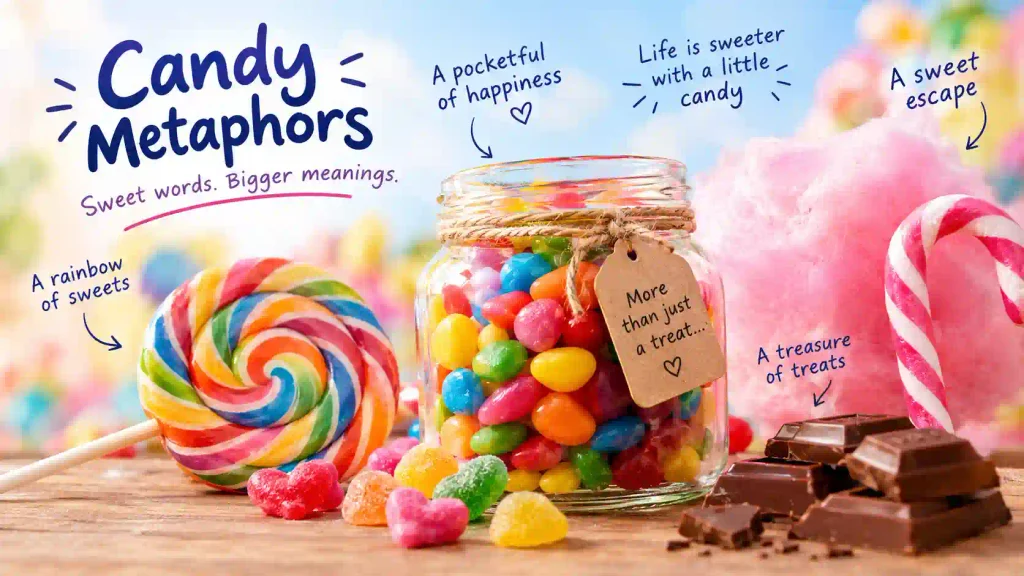
A metaphor for candy describes candy as something else to express its sweetness, appearance, texture, or emotional appeal. Candy can become a pocket-sized treasure, a burst of sunshine, or a tiny celebration wrapped in paper. Writers can also use candy imagery to describe temptation, childhood memories, and pleasures that disappear too quickly. The best metaphor depends on whether you want to create a playful, comforting, romantic, or cautionary mood.
Quick Answer
A metaphor for candy compares candy to something else without using “like” or “as” to make a direct comparison. For example, “Candy is a pocketful of sunshine” presents candy as a small source of happiness. Other original examples include “a rainbow in a jar,” “a sugar-coated secret,” and “a tiny celebration.” These expressions help writers describe candy’s colors, flavors, textures, and emotional meaning in vivid, memorable language.
25 Best Metaphors for Candy
The following table offers a quick overview of candy metaphors, their meanings, and their best uses. Some expressions are familiar language patterns, while others are original examples created for this guide.
| Metaphor | Meaning | Best Use |
| A pocketful of sunshine | A small source of happiness | Creative writing |
| A rainbow in a jar | A colorful assortment | Descriptive writing |
| A treasure chest of sweetness | A collection of delightful treats | Stories |
| A tiny celebration | A small moment of pleasure | Everyday writing |
| A sugar-coated secret | Something attractive that hides the truth | Critical writing |
| A burst of sunshine | A bright, cheerful flavor or feeling | Sensory descriptions |
| A childhood time machine | Something that brings back childhood memories | Personal essays |
| A velvet blanket for the tongue | A smooth, comforting texture | Food descriptions |
| A firework of flavor | An intense, exciting taste | Food reviews |
| A jewel of sugar | A small, sparkling, attractive sweet | Descriptive writing |
| A sticky little memory | A memory that stays with you | Nostalgic writing |
| A spoonful of celebration | A small source of festive joy | Stories and essays |
| A delicious distraction | Something enjoyable that takes attention away from other things | Informal writing |
| A golden drop of comfort | A rich, soothing treat | Emotional writing |
| A parade of colors | A lively display of different candy colors | Visual descriptions |
| A cloud of sweetness | Something soft, light, and sugary | Creative writing |
| A sugar-coated promise | An appealing promise that may conceal disappointment | Persuasive or critical writing |
| A spark of temptation | Something that creates a desire for more | Reflective writing |
| A melting moment | A brief pleasure that quickly disappears | Poetry |
| A pocket-sized reward | A small treat earned or enjoyed | Everyday conversation |
| A little edible artwork | Candy with an attractive design | Product descriptions |
| A symphony of flavors | A combination of complementary tastes | Food reviews |
| A sweet escape | A brief break from ordinary life | Lifestyle writing |
| A sugary disguise | Something that hides an unpleasant reality behind an appealing appearance | Fiction |
| A miniature festival | A colorful, exciting collection of sweets | Children’s stories |
Note: These examples are not all established English idioms. Many are original metaphors designed to demonstrate how candy imagery can work in different contexts.
Metaphors for Candy Based on Appearance
Candy often attracts attention before anyone tastes it. Bright wrappers, glossy chocolate, colorful gummies, and sparkling sugar crystals provide rich material for visual metaphors.
1. A Rainbow in a Jar
This metaphor describes a collection of candies with many bright colors. It suggests variety, cheerfulness, and visual excitement.
Example: The glass jar was a rainbow in a jar, filled with red gummies, green drops, and golden candies.
Best for: Descriptive essays, children’s stories, and product descriptions.
2. A Treasure Chest of Sweetness
This metaphor presents a box or bag of candy as something valuable waiting to be discovered. It emphasizes abundance and the excitement of choosing a favorite treat.
Example: The Halloween bucket was a treasure chest of sweetness, packed with chocolate bars and colorful candies.
Best for: Halloween stories, birthday descriptions, and playful writing.
3. A Jewel of Sugar
This original metaphor describes an attractive piece of candy as a precious gemstone. It works especially well for shiny hard candies, decorative sweets, and sugar crystals.
Example: The crystal candy was a jewel of sugar resting on the silver plate.
Best for: Elegant descriptions, food photography captions, and creative writing.
4. A Parade of Colors
This metaphor turns a mixture of candies into a lively procession of colors. It emphasizes movement and variety, even when the candy itself remains still.
Example: The candy display was a parade of colors stretching across the bakery counter.
Best for: Visual storytelling and descriptions of candy shops or party tables.
5. A Little Edible Artwork
This metaphor describes candy that looks carefully designed rather than merely prepared for eating. It fits decorated chocolates, elaborate sugar sculptures, and hand-painted sweets.
Example: The chocolatier’s creations were little edible artworks, each with its own pattern and color.
Best for: Reviews, food blogs, and descriptions of handmade sweets.
Metaphors for Candy Based on Taste and Texture
Taste and texture can make candy memorable. A strong metaphor translates those physical sensations into an image readers can easily imagine.
6. A Firework of Flavor
This metaphor describes candy with an intense or surprising taste, especially sour, fizzy, spicy, or strongly flavored varieties.
Example: The sour candy was a firework of flavor that made my whole face tighten.
Best for: Food reviews and lively sensory descriptions.
7. A Velvet Blanket for the Tongue
This original metaphor suggests a smooth, rich, and comforting texture. It suits soft caramel, creamy chocolate, or a silky truffle filling.
Example: The caramel was a velvet blanket for the tongue, smooth and rich in every bite.
Best for: Food writing that emphasizes texture and indulgence.
8. A Cloud of Sweetness
This metaphor describes candy that feels soft, airy, or delicate. Cotton candy and fluffy marshmallows are natural subjects for this image.
Example: The cotton candy was a cloud of sweetness that dissolved before I could take another bite.
Best for: Children’s writing, playful descriptions, and sensory essays.
9. A Symphony of Flavors
This metaphor presents several flavors as musicians working together. It is especially useful when a candy combines chocolate, nuts, caramel, fruit, or contrasting sweet and salty notes.
Example: The chocolate assortment was a symphony of flavors, with every piece contributing a different note.
Best for: Gourmet candy reviews and sophisticated food descriptions.
10. A Golden Drop of Comfort
This original metaphor suits golden-colored sweets, such as honey candies or rich butterscotch. It also connects the taste of candy with the emotional comfort of enjoying a familiar treat.
Example: The butterscotch was a golden drop of comfort on a cold winter afternoon.
Best for: Nostalgic stories, reflective essays, and cozy descriptions.
Metaphors for Candy That Express Happiness and Comfort
Candy frequently appears in celebrations, gifts, and childhood memories. These metaphors focus less on physical appearance and more on the feelings a sweet treat can represent.
11. A Pocketful of Sunshine
This metaphor describes candy as a small source of joy that brightens an ordinary day. It works particularly well when someone receives an unexpected treat.
Example: The chocolate in my lunchbox was a pocketful of sunshine on a difficult school day.
Best for: Positive messages, personal essays, and children’s stories.
12. A Tiny Celebration
This original metaphor presents a piece of candy as a small event worth enjoying. It emphasizes simple pleasures rather than a major occasion.
Example: After finishing her final exam, Maya treated herself to a strawberry candy, her tiny celebration of success.
Best for: Everyday stories, motivational writing, and descriptions of small rewards.
13. A Childhood Time Machine
Candy can bring back memories of school parties, family trips, holidays, or visits to a favorite shop. This metaphor captures that connection between taste and memory.
Example: The peppermint candy was a childhood time machine, taking him back to winter evenings at his grandmother’s house.
Best for: Memoirs, personal essays, and nostalgic fiction.
14. A Spoonful of Celebration
This metaphor presents candy as a symbol of a happy occasion. It fits birthday parties, holiday gatherings, and small family traditions.
Example: The colorful sweets were a spoonful of celebration scattered across the birthday table.
Best for: Festive descriptions and family stories.
15. A Sweet Escape
This expression portrays candy as a brief pleasure that offers a break from routine or stress. It focuses on the experience rather than the candy’s physical qualities.
Example: For a few minutes, the chocolate bar was her sweet escape from a demanding afternoon.
Best for: Lifestyle writing and reflective essays.
Metaphors for Candy That Express Temptation or Deception
Candy can also suggest something attractive that encourages people to overlook a problem. These metaphors work especially well in stories, persuasive writing, and discussions of misleading promises.
16. A Sugar-Coated Secret
This original metaphor describes something that looks pleasant but conceals information beneath the surface. The sweetness attracts attention while the hidden truth remains undiscovered.
Example: His cheerful explanation was a sugar-coated secret that concealed the real reason for the delay.
Best for: Fiction, character descriptions, and critical essays.
17. A Sugar-Coated Promise
This metaphor describes a promise that sounds appealing but may not deliver what it offers. It draws on the idea of covering something less pleasant with a sweet exterior.
Example: The company’s offer was a sugar-coated promise, full of attractive words but short on practical details.
Best for: Opinion writing, persuasive essays, and discussions of misleading claims.
18. A Sugary Disguise
This original metaphor suggests that an appealing appearance can hide an unpleasant reality. Unlike a simple description of sweetness, it emphasizes concealment.
Example: The villain’s generosity was a sugary disguise for his selfish intentions.
Best for: Fiction, character analysis, and literary writing.
19. A Spark of Temptation
This metaphor captures the moment when something desirable creates an urge to give in. It is especially suitable for describing the appeal of a favorite candy.
Example: The chocolate display was a spark of temptation every time she passed the bakery.
Best for: Narrative writing and descriptions of desire.
20. A Delicious Distraction
This metaphor presents candy as an enjoyable diversion that pulls attention away from work, worries, or other responsibilities.
Example: The bowl of jelly beans became a delicious distraction while the students waited for the meeting to begin.
Best for: Humor, informal writing, and everyday situations.
Metaphors for Candy in Poetry and Creative Writing
Candy can provide more than colorful description. Writers can use it to explore time, memory, desire, and the contrast between outward appeal and deeper meaning.
21. A Melting Moment
This metaphor represents a brief pleasure that cannot last. It works especially well for candy that melts quickly and for scenes that emphasize the passing of time.
Example: Their afternoon together was a melting moment, sweet and gone before either wanted it to end.
Best for: Poetry, romance, and reflective fiction.
22. A Sticky Little Memory
This original metaphor describes a memory that stays with someone long after the event has passed. The stickiness suggests that the experience remains attached to the mind.
Example: The taste of strawberry candy was a sticky little memory she carried from childhood into adulthood.
Best for: Memoirs, personal narratives, and nostalgic poetry.
23. A Pocket-Sized Reward
This metaphor presents candy as a small, portable reward for effort or patience. It emphasizes how a little treat can make an ordinary achievement feel meaningful.
Example: The peppermint was a pocket-sized reward for completing the long hike.
Best for: Children’s stories and everyday narratives.
24. A Miniature Festival
This metaphor describes candy as a concentrated burst of color, flavor, and excitement. It works particularly well for assorted sweets shared at parties.
Example: The candy bowl was a miniature festival, with every wrapper promising a different flavor.
Best for: Creative writing, party descriptions, and playful storytelling.
25. A Sweetness That Slips Away
This original metaphor presents pleasure as temporary. Like candy that dissolves on the tongue, a happy experience can disappear while leaving behind a memory.
Example: Summer vacation was a sweetness that slipped away, leaving only photographs and the memory of shared ice cream.
Best for: Poetry, reflective essays, and writing about growing up.
Interesting Metaphors About Candy
Interesting candy metaphors turn an ordinary sweet into an image that communicates emotion, appearance, or meaning. These examples are useful for creative writing, poetry, essays, and descriptive sentences.
A Candy Store Is a Wonderland
This original metaphor describes a candy store as a magical place filled with color, excitement, and endless choices.
Example: The candy store was a wonderland where every shelf promised a new adventure.
Candy Is a Pocketful of Happiness
This metaphor presents candy as a small source of joy that can brighten an ordinary day.
Example: The strawberry drops were a pocketful of happiness on a rainy afternoon.
Candy Is a Sweet Little Trap
This original metaphor suggests that candy can be tempting enough to make someone forget their intentions.
Example: The chocolate box was a sweet little trap for anyone trying to avoid dessert.
Candy Is a Memory Wrapped in Sugar
This metaphor connects candy with childhood, family traditions, and nostalgic experiences.
Example: Every peppermint was a memory wrapped in sugar, reminding her of Christmas at home.
What Is a Metaphor for Sweets?
A metaphor for sweets describes a sweet treat as something else to highlight its taste, appearance, or emotional meaning. For example, “sweets are little treasures” presents them as valuable discoveries, while “chocolate is edible comfort” emphasizes the pleasure of eating it.
Here are three more examples:
- Sweets are miniature celebrations. This suggests that even a small treat can make an ordinary moment feel special.
- Chocolate is a velvet blanket. This emphasizes its smooth, rich, comforting texture.
- A bowl of sweets is a rainbow of temptation. This combines colorful imagery with the desire to taste the treats.
Best Metaphors for Candy in English
English candy metaphors can be literal descriptions transformed into figurative images or familiar expressions that communicate a broader meaning.
| Metaphor | Meaning | Example sentence |
| A sugar-coated dream | An appealing but potentially unrealistic hope | His plan was a sugar-coated dream with no practical foundation. |
| A rainbow of sweets | A colorful assortment of candy | The glass bowl held a rainbow of sweets. |
| A burst of sweetness | An intense, pleasant experience | The first bite was a burst of sweetness. |
| A treasure of treats | A valuable or exciting collection | The gift bag was a treasure of treats. |
| A sweet escape | A brief break from everyday pressures | The chocolate was her sweet escape after work. |
These expressions are suitable for school assignments, creative writing, and everyday descriptions. Some are original metaphors rather than established idioms.
Funny Metaphors for Candy
Funny candy metaphors use exaggeration, unexpected comparisons, or playful personification to make readers smile.
Candy Is a Tiny Sugar Monster
This metaphor makes candy sound mischievous and irresistible.
Example: That tiny sugar monster disappeared before the movie even started.
Chocolate Is My Emergency Happiness Button
This humorous metaphor presents chocolate as an instant source of comfort.
Example: Monday meetings are easier when my emergency happiness button is within reach.
Jelly Beans Are Colorful Little Liars
This metaphor humorously suggests that colorful jelly beans can surprise you with unexpected flavors.
Example: The jelly beans were colorful little liars; the purple one tasted nothing like I expected.
A Candy Jar Is a Self-Control Test
This metaphor turns a jar of sweets into a challenge.
Example: The candy jar on my desk is a daily self-control test that I keep failing.
Candy Idioms and Their Meanings
An idiom is an established expression whose meaning may differ from the literal meanings of its words. English has several familiar expressions involving candy or sweets, although not every expression is specifically about confectionery.
| Idiom or expression | Meaning | Example |
| Eye candy | Something visually attractive but not necessarily substantial | The movie offers plenty of eye candy. |
| Arm candy | An attractive person accompanying someone, often at a social event | The tabloids described him as arm candy. |
| Like taking candy from a baby | Extremely easy to do | Winning the beginner’s game was like taking candy from a baby. |
| Sugar-coat something | Make an unpleasant truth sound more appealing | Don’t sugar-coat the results; explain what went wrong. |
| Life isn’t all candy and roses | A playful variation meaning life is not always pleasant | She learned that life isn’t all candy and roses. |
The last example is a creative variation, not a standard idiom. The other expressions are established English expressions, though eye candy and arm candy can sound dismissive or objectifying depending on context.
Catchy Candy Phrases
Catchy candy phrases are short, memorable lines that work well for packaging, social media captions, party decorations, and candy-shop promotions.
- A little sweetness goes a long way.
- Life is sweeter with a little candy.
- Unwrap a little happiness.
- Small treats, big smiles.
- One bite, a thousand happy thoughts.
- Keep calm and enjoy something sweet.
- A pocketful of joy in every wrapper.
- Make today a little sweeter.
- Good things come in colorful wrappers.
- Sweet moments, one piece at a time.
These are original creative phrases, not quotations attributed to famous people.
Candy Phrases for Everyday English
Candy-related phrases can describe attraction, ease, sweetness, or appearance. Their meanings depend on context.
- Eye candy: Something visually attractive.
- Sugar rush: A phrase commonly used for a sudden feeling of energy or excitement after eating something sweet.
- Sugar-coat the truth: Make an unpleasant fact sound less harsh.
- Candy-coated: Covered in a sweet coating; figuratively, made to appear more appealing.
- Sweet tooth: A strong liking for sweet foods.
- Like a kid in a candy store: Extremely excited by many appealing choices.
Example: When the collector entered the candy shop, she was like a kid in a candy store, eager to try everything.
Short Funny Candy Quotes
The following are original, short lines for captions, greeting cards, and playful writing.
- “Chocolate understands my mood.”
- “Candy first, grown-up decisions later.”
- “My sweet tooth has expensive taste.”
- “Life is short. Save room for candy.”
- “I came, I saw, I ate the chocolate.”
- “Candy calories are invisible to the happy.”
- “A balanced diet includes a sweet surprise.”
- “My candy stash is none of your business.”
These lines are original humorous captions, not famous quotations or established sayings.
What Does Candy Symbolize?
Candy can symbolize happiness, childhood, affection, temptation, celebration, or fleeting pleasure. Its meaning depends on the situation in which it appears.
- Happiness: A small sweet can represent a simple pleasure or reward.
- Childhood: Familiar candies can evoke memories of family, school, and holidays.
- Love and affection: Candy given as a gift can express thoughtfulness or romantic interest.
- Temptation: Attractive sweets can represent desire or the struggle to resist something enjoyable.
- Impermanence: Candy that melts or disappears can symbolize a pleasure that does not last.
- False appearances: A sweet exterior can represent something attractive that conceals a less pleasant truth.
For example, candy given to a child in a happy family scene may suggest comfort and affection. The same candy in a story about deception could represent temptation or a misleading promise.
Metaphor for a Candy Cane
A candy cane can represent holiday joy, childhood wonder, or a small symbol of celebration. Its curved shape, bright colors, and association with Christmas provide several possibilities for figurative writing.
A Candy Cane Is a Frozen Ribbon of Christmas
This original metaphor describes the candy cane as a colorful decoration that captures the festive spirit of the holiday season.
Example: The candy cane was a frozen ribbon of Christmas hanging from the tree.
A Candy Cane Is a Sweet Winter Wand
This metaphor presents the candy cane as a magical object in a winter story.
Example: The child waved her sweet winter wand and pretended to turn the snowflakes into stars.
A Candy Cane Is a Stripe of Holiday Cheer
This metaphor emphasizes the candy cane’s recognizable colors and festive appearance.
Example: Each stripe of red and white was a stripe of holiday cheer tucked into the stocking.
These are original literary metaphors, not claims about the historical origin of candy canes.
Cotton Candy Metaphor
The Cotton candy is especially useful in metaphor because of its airy appearance, delicate texture, bright colors, and tendency to dissolve quickly.
Cotton Candy Is a Cloud Made of Sugar
This metaphor compares cotton candy’s fluffy shape to a cloud.
Example: The pink cotton candy was a cloud made of sugar floating above the festival crowd.
Cotton Candy Is a Dream That Melts
This original metaphor suggests something beautiful and enjoyable that does not last.
Example: Their carefree afternoon was a dream that melted like cotton candy in the summer sun.
Cotton Candy Is a Puff of Childhood
This metaphor connects cotton candy with fairs, carnivals, and childhood memories.
Example: The blue cotton candy was a puff of childhood that brought back memories of summer fairs.
Candy Slang: What Does “Candy” Mean in Drug Slang?
In some English-speaking contexts, “candy” is slang for an illicit drug, including certain drugs in powder or pill form. The exact meaning depends on the speaker and context. The word can also refer to ordinary sweets or something visually attractive, as in eye candy.
For example, in a conversation about a candy shop, the word almost certainly refers to confectionery. In a conversation about drug use, it may have a different meaning.
Because slang varies by community, do not assume that every use of candy refers to drugs. In formal writing, use the specific, accurate term whenever the meaning is known.
What Does “Candyland” Mean in Slang?
Candyland can refer literally to a colorful, fantasy-like place associated with sweets. Figuratively, it can describe a situation that seems unusually cheerful, attractive, or unreal.
Example: The lavish resort looked like Candyland, with colorful decorations and desserts at every table.
The meaning of Candyland in a particular song, online post, or conversation may differ. Without that specific context, it would be misleading to assign one universal slang definition.
The Candy Metaphor in Grave of the Fireflies
In the animated film Grave of the Fireflies, the candy tin associated with Setsuko and her brother Seita carries meaning beyond the sweets it once contained.
The tin of Sakuma fruit drops initially represents childhood comfort, small moments of happiness, and the siblings’ memories of a safer life. As the children face hunger and hardship during wartime, the dwindling candy becomes connected to their fading hope. After Setsuko’s death, Seita uses the tin to hold her remains, transforming an object associated with sweetness into a painful reminder of loss.
The candy tin therefore works primarily as a symbol, rather than simply as a metaphor for candy. Its changing role connects childhood innocence with deprivation, grief, memory, and the devastating effects of war.
Which Candy Metaphor Should You Choose?
The most effective metaphor depends on the idea you want to communicate. Use the following guide to match the expression to your purpose.
| Writing purpose | Recommended metaphor | Why it works |
| School essay | A rainbow in a jar | Clear, visual, and easy to explain |
| Poem about time | A melting moment | Connects sweetness with impermanence |
| Children’s story | A treasure chest of sweetness | Creates excitement and a sense of discovery |
| Romantic writing | A spoonful of celebration | Suggests warmth and shared happiness |
| Food review | A symphony of flavors | Emphasizes a combination of tastes |
| Critical essay | A sugar-coated promise | Highlights attractive but potentially misleading claims |
| Nostalgic writing | A childhood time machine | Connects candy with personal memories |
| Social media caption | A pocketful of sunshine | Short, cheerful, and memorable |
| Product description | A little edible artwork | Highlights visual craftsmanship |
| Reflective writing | A sweet escape | Suggests temporary comfort or relief |
Choose a metaphor that supports your message instead of one that merely sounds clever. For example, “a rainbow in a jar” works for colorful candy, but it would not communicate the same idea as “a sugar-coated promise.” One emphasizes visual variety; the other suggests an attractive surface that may hide disappointment.
Is “Candy Is Sweetness” a Metaphor?
“Candy is sweetness” can function as a metaphor in a suitable context, but it is less vivid than an expression such as “candy is a pocketful of sunshine.” The latter transforms an ordinary treat into an image of happiness.
A strong metaphor does more than state a quality. It helps readers imagine or interpret that quality through another concept.
Compare these examples:
- Literal description: The candy was colorful.
- Metaphor: The candy was a rainbow in a jar.
- Literal description: The chocolate was comforting.
- Metaphor: The chocolate was a velvet blanket for the tongue.
The metaphors create more specific images and give readers a clearer sense of the experience.
What Is the Difference Between a Candy Metaphor and a Simile?
A metaphor describes one thing as another, while a simile explicitly compares two things using words such as “like” or “as.”
| Type | Example | Why |
| Metaphor | The candy was a rainbow in a jar. | The candy is presented as a rainbow. |
| Simile | The candy looked like a rainbow in a jar. | “Like” signals an explicit comparison. |
| Metaphor | The caramel was velvet for the tongue. | The caramel is described through the image of velvet. |
| Simile | The caramel was as smooth as velvet. | “As” makes the comparison explicit. |
Both forms can improve descriptive writing. Metaphors often create a more direct image, while similes make the comparison easier to recognize.
Frequently Asked Questions
1. What is a good metaphor for candy?
“Candy is a pocketful of sunshine” is a good choice when you want to express happiness, comfort, or a small moment of pleasure. For colorful candy, “a rainbow in a jar” creates a stronger visual image. Choose the expression that best matches the intended meaning.
2. What are five examples of metaphors for candy?
Here are five original examples:
- Candy is a pocketful of sunshine.
- The chocolate was a velvet blanket for the tongue.
- The candy bowl was a miniature festival.
- The sour sweet was a firework of flavor.
- The peppermint was a childhood time machine.
Each metaphor emphasizes a different quality, from happiness and texture to excitement and memory.
3. Can candy symbolize happiness?
Yes. Candy can symbolize happiness because people often associate sweets with gifts, celebrations, rewards, and childhood memories. In creative writing, a piece of candy might represent a small comfort during a difficult day or a reminder of a joyful experience. The meaning depends on the surrounding context.
4. Can candy be a metaphor for temptation?
Yes. Candy can represent temptation because its appealing appearance and taste can create a desire for something pleasurable. An expression such as “a spark of temptation” emphasizes that desire, while “a sugar-coated promise” suggests that something attractive may conceal a drawback.
5. What is a short metaphor for candy?
“Candy is sunshine.” This short metaphor connects candy with warmth, happiness, and pleasure. Other concise options include “a sugar jewel,” “a sweet escape,” and “a flavor firework.” These are creative examples rather than necessarily established expressions.
6. How do you use a candy metaphor in a sentence?
Choose a quality you want to emphasize, then connect candy to an image that communicates that quality. For example, “The candy bowl was a treasure chest waiting to be explored” emphasizes discovery and abundance. For a more emotional sentence, try “The peppermint was a childhood time machine that brought back memories of winter holidays.”
Conclusion
Candy offers writers a flexible set of images for describing sweetness, color, comfort, excitement, temptation, and memory. A rainbow in a jar can bring a scene to life, while a melting moment can express how quickly pleasure passes.
The key is to choose a metaphor with a clear purpose. Use vivid sensory imagery when describing taste or texture, warm comparisons when expressing happiness, and sugar-coated imagery when exploring deception or temptation. A well-chosen metaphor makes candy more than a sweet treat: it gives the reader an image, an emotion, or an idea worth remembering.

Qaiser Abbas is an award-winning author, leadership coach, and motivational speaker known for his work on personal growth, leadership, and human potential. Through his writing and speaking, Qaiser focuses on turning challenges into opportunities and helping people build the mindset to achieve meaningful growth.