
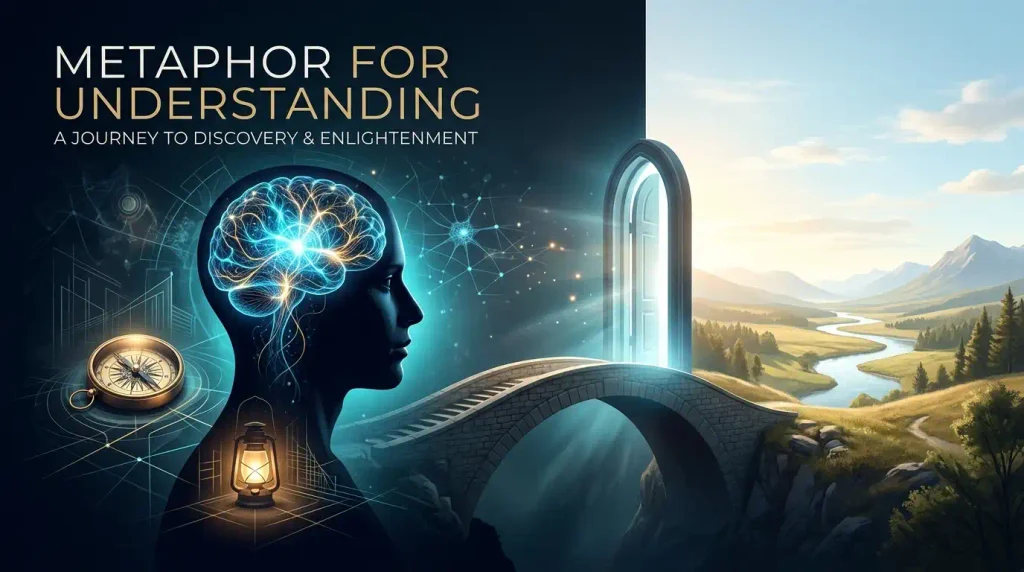
A metaphor for understanding describes the experience of gaining clarity by comparing it with something familiar, such as light, a key, a puzzle, a bridge, or a map. Some expressions are already common in English, while others work better as original creative metaphors. The strongest choice depends on whether you want to emphasize clarity, connection, discovery, depth, or finally “getting” an idea.
Quick Answer
A strong metaphor for understanding is “understanding is a light.” It suggests that confusion is darkness and that comprehension brings clarity. Other useful metaphors include “I see your point,” “I grasp the idea,” “the pieces fell into place,” “the fog lifted,” and “understanding is a bridge.” Each creates a slightly different image, so the best metaphor depends on what kind of understanding you want to express.
Best Metaphors for Understanding
Here are 20 useful metaphors and metaphorical expressions, organized by the kind of understanding they communicate.
1. Understanding Is a Light
Meaning: Understanding brings clarity to something that was previously confusing.
Example:
“Once she understood the concept, it was as if a light had switched on.”
Best for: Essays, teaching, explanations, and everyday writing.
Type: Established conceptual metaphor.
This is one of the clearest ways to express understanding because English commonly connects knowledge and clarity with light.
2. I See Your Point
Meaning: To understand someone’s argument, perspective, or reasoning.
Example:
“I see your point now, even though I initially disagreed.”
Best for: Conversation, essays, discussions, and professional communication.
Type: Established expression.
The metaphor treats understanding as a form of seeing. This reflects a broader pattern in English in which people talk about ideas as things that can be “seen,” “clear,” or “visible.”
3. I Grasp the Idea
Meaning: You have mentally captured or understood an idea.
Example:
“After the teacher gave another example, I finally grasped the idea.”
Best for: Academic writing and everyday conversation.
Type: Established metaphorical expression.
The image comes from physically grasping something with your hand. Here, the mind metaphorically “holds” an idea.
4. The Pieces Fell Into Place
Meaning: Separate facts or ideas suddenly formed a coherent whole.
Example:
“When I reread the chapter, all the pieces finally fell into place.”
Best for: Learning, reading, problem-solving, and storytelling.
Type: Established metaphorical expression.
This works especially well when understanding develops gradually from several pieces of information.
5. The Fog Lifted
Meaning: Confusion disappeared and clarity emerged.
Example:
“Once she understood the formula, the fog lifted.”
Best for: Emotional or reflective writing.
Type: Established metaphorical expression.
The metaphor creates a strong contrast between confusion as fog and understanding as clear visibility.
6. Understanding Is a Bridge
Meaning: Understanding connects two ideas, people, perspectives, or areas of knowledge.
Example:
“Good teaching builds a bridge between a difficult idea and the student’s existing knowledge.”
Best for: Essays, education, communication, and speeches.
Type: Original metaphor.
This metaphor emphasizes connection, rather than simply saying that understanding creates clarity.
7. Understanding Is a Key
Meaning: Understanding unlocks something that was previously inaccessible.
Example:
“Understanding the basic principles was the key to solving the problem.”
Best for: Academic writing and motivational writing.
Type: Common conceptual metaphor.
Use this when you want to emphasize access, discovery, or the ability to move forward.
8. Understanding Is a Map
Meaning: Understanding gives you a mental structure that helps you navigate a complicated subject.
Example:
“Once I understood the main argument, the chapter became a map of the entire subject.”
Best for: Essays, explanations, education, and technical subjects.
Type: Original metaphor.
This is particularly useful when the subject contains many connected ideas rather than one isolated fact.
9. Understanding Is Putting Together a Puzzle
Meaning: Understanding develops as separate pieces of information form a complete picture.
Example:
“Each new fact was another piece of the puzzle.”
Best for: Research, mysteries, complex subjects, and storytelling.
Type: Common metaphorical concept.
It emphasizes that understanding may require patience and the combination of multiple clues.
10. Connecting the Dots
Meaning: Recognizing relationships between separate facts or ideas.
Example:
“After studying the examples, I finally connected the dots.”
Best for: Problem-solving, research, analysis, and conversation.
Type: Established metaphorical expression.
This differs slightly from the puzzle metaphor: connecting the dots emphasizes relationships between pieces, while a puzzle emphasizes assembling a complete picture.
11. Opening a Door
Meaning: Understanding something creates access to new knowledge or possibilities.
Example:
“Learning how the system works opened a door to a much deeper subject.”
Best for: Education, personal development, and creative writing.
Type: Common conceptual metaphor.
It works especially well when understanding one idea leads to further discovery.
12. Turning on a Switch
Meaning: Understanding arrives suddenly after a period of confusion.
Example:
“When she saw the diagram, it felt like someone had flipped a switch.”
Best for: Informal writing and personal storytelling.
Type: Original metaphorical expression.
Unlike the light metaphor, this version emphasizes the sudden moment of realization.
13. The Pieces Clicked Together
Meaning: Separate ideas suddenly became coherent.
Example:
“Once he understood the first principle, the rest of the lesson clicked together.”
Best for: Learning and informal explanation.
Type: Original metaphorical expression.
The image suggests that understanding happens when separate parts fit correctly.
14. Understanding Is a Lens
Meaning: Understanding changes how clearly you can examine or interpret something.
Example:
“History gave her a new lens through which to understand the novel.”
Best for: Literary analysis, essays, criticism, and academic writing.
Type: Common conceptual metaphor.
This metaphor emphasizes perspective rather than simply clarity.
15. Understanding Is a Window
Meaning: Understanding gives you a view into something previously unfamiliar.
Example:
“Reading the memoir became a window into a world I had never experienced.”
Best for: Literature, essays, cultural writing, and reflective prose.
Type: Common metaphorical concept.
A window suggests observation and access without implying that the reader now knows everything about the subject.
16. Understanding Is a Thread
Meaning: One idea helps you follow a subject through many connected details.
Example:
“The central argument became the thread that guided me through the entire chapter.”
Best for: Essays, literary analysis, and complex explanations.
Type: Original metaphor.
This metaphor works particularly well when a subject contains many details but one central idea helps hold everything together.
17. Understanding Is a Foundation
Meaning: Basic understanding supports more advanced knowledge.
Example:
“Knowing the fundamentals gave her a solid foundation for advanced mathematics.”
Best for: Education and academic writing.
Type: Common conceptual metaphor.
Use this when the important idea is that one level of understanding supports another.
18. The Fog Became a Clear Sky
Meaning: Confusion gradually gave way to complete clarity.
Example:
“After several explanations, the confusing subject became a clear sky in her mind.”
Best for: Poetry, creative writing, and reflective prose.
Type: Original metaphor.
This is more poetic than simply saying “the fog lifted.”
19. Understanding Is a Bridge Between Minds
Meaning: Understanding allows people to share perspectives and communicate more deeply.
Example:
“Listening carefully can become a bridge between minds that see the world differently.”
Best for: Speeches, relationship writing, communication, and essays.
Type: Original metaphor.
The focus here is not merely understanding an idea. It is understanding another person.
20. The Picture Became Clear
Meaning: Individual facts or observations formed a coherent understanding.
Example:
“After reading the final chapter, the whole picture became clear.”
Best for: Everyday conversation, essays, and storytelling.
Type: Established metaphorical expression.
This is a natural choice when you want a simple expression without sounding overly poetic.
Understanding Metaphors at a Glance
| Metaphor | Meaning | Tone | Best Use |
| Understanding is a light | Clarity replaces confusion | Clear | Essays, teaching |
| I see your point | I understand your perspective | Conversational | Discussion |
| I grasp the idea | I mentally understand it | Direct | Academic/everyday |
| Pieces fell into place | Ideas became coherent | Natural | Learning, reading |
| The fog lifted | Confusion disappeared | Reflective | Creative writing |
| Understanding is a bridge | Ideas or people become connected | Thoughtful | Essays, speeches |
| Understanding is a key | Knowledge unlocks access | Positive | Education |
| Understanding is a map | Knowledge provides direction | Practical | Complex subjects |
| Connecting the dots | Relationships became clear | Conversational | Analysis |
| Understanding is a lens | Knowledge changes perspective | Academic | Literary analysis |
Metaphors for Understanding Something
When you specifically need a metaphor for understanding something, choose an image based on what happened mentally.
- If confusion disappeared, use “the fog lifted.”
- If the idea suddenly became clear, use “a light switched on.”
- If separate facts connected, use “I connected the dots.”
- If several ideas formed a whole, use “the pieces fell into place.”
- If knowledge gave you access to something new, use “understanding opened a door.”
- If the knowledge changed your perspective, use “understanding gave me a new lens.”
- If the knowledge connected two ideas, use “understanding built a bridge.”
- If you finally understood an argument, use “I see your point.”
That distinction makes the metaphor more precise instead of treating every expression for understanding as interchangeable.
Metaphors for Learning and Understanding
Learning and understanding overlap, but they aren’t exactly the same.
Learning often describes the process of gaining knowledge, while understanding describes the ability to make sense of that knowledge.
That difference changes which metaphor sounds most natural.
Learning is a journey
This emphasizes progress over time.
Example: “Learning is a journey with unexpected turns.”
Learning is a seed
This emphasizes growth.
Example: “Every new idea was a seed waiting to grow.”
Learning is a foundation
This emphasizes building knowledge from the basics upward.
Example: “Basic reading skills form the foundation for deeper learning.”
Understanding is a light
This emphasizes the moment when something becomes clear.
Example: “The explanation brought light to a difficult concept.”
Understanding is a puzzle
This emphasizes assembling separate pieces into a coherent whole.
Example: “Each experiment gave us another piece of the puzzle.”
Research on learning metaphors shows why these distinctions can matter: metaphors can provide a shared way to think about learning, but their effects depend on the context and on how learners interpret them.
What Is a Metaphor for Reading?
A useful metaphor for reading is “reading is opening a window.”
The metaphor suggests that a book gives you a view into another person’s ideas, another period, another culture, or an imagined world.
Other possibilities include:
- Reading is a journey — emphasizes exploration.
- A book is a doorway — emphasizes access to another world or idea.
- Reading is a conversation — emphasizes interaction between reader and text.
- A book is a mirror — emphasizes self-reflection.
- Reading is a lens — emphasizes seeing an idea or experience from a new perspective.
For a school essay, “books are windows” can work well because the image is immediately understandable. For poetry or fiction, a more original image can create a stronger emotional effect.
What Is a Metaphor for Teaching?
A common metaphor for teaching is “teaching is lighting a fire.”
The image suggests that a teacher can spark curiosity rather than simply transfer information.
Other useful teaching metaphors include:
- Teaching is planting seeds — emphasizes long-term growth.
- Teaching is building a foundation — emphasizes essential knowledge.
- Teaching is opening doors — emphasizes new opportunities.
- Teaching is providing a map — emphasizes guidance.
- Teaching is building a bridge — emphasizes helping learners move from what they know to what they don’t yet understand.
The best metaphor depends on the aspect of teaching you want to emphasize: inspiration, guidance, knowledge, growth, or connection.
What Is a Metaphor for the Brain?
Common metaphors for the brain include:
- The brain is a computer — emphasizes information processing.
- The brain is a library — emphasizes stored knowledge and retrieval.
- The brain is a garden — emphasizes growth and development.
- The brain is a city — emphasizes interconnected systems.
- The brain is a network — emphasizes connections.
These are useful explanatory models, but none should be taken as a literal description of how the brain works. Scientific literature has used metaphors such as the brain as a computer, factory, library, or telephone exchange to make aspects of cognition easier to conceptualize. Researchers also point out that different metaphors highlight different features and can therefore shape how people think about the subject.
Why Are Metaphors Powerful?
Metaphors are powerful because they connect an unfamiliar or abstract idea with something more familiar.
For example:
“I understand the concept.”
is accurate but plain.
Compare it with:
“The pieces finally fell into place.”
The second sentence gives the reader an image of separate pieces becoming one coherent picture.
Research on metaphor and learning suggests that creating or processing a metaphor can help people connect new concepts with existing knowledge. At the same time, a metaphor highlights selected similarities rather than providing a complete literal explanation.
That is why a good metaphor should clarify something without pretending to explain everything.
How to Choose the Right Metaphor for Understanding
Think about what kind of understanding you mean.
- For sudden realization:
Use “a light switched on” or “it clicked.” - For gradual clarity:
Use “the fog lifted.” - For connecting information:
Use “connecting the dots.” - For combining several ideas:
Use “the pieces fell into place.” - For understanding another person’s viewpoint:
Use “I see your point.” - For gaining a new perspective:
Use “understanding is a lens.” - For connecting two areas of knowledge:
Use “understanding is a bridge.” - For academic writing:
Use a precise metaphor such as “understanding is a foundation,” “understanding is a lens,” or “understanding is a map.” - For poetry or creative writing:
Use a more vivid image such as “the fog became a clear sky.”
The strongest metaphor isn’t necessarily the most dramatic one. It is the one whose image matches the exact idea you want the reader to feel or understand.
Simple Metaphors Kids Can Understand
If you’re looking for common metaphors that kids can understand, choose concrete images they already know.
- Understanding is a light.
- Knowledge is a key.
- Learning is a journey.
- The brain is a sponge.
- Ideas are seeds.
- Books are windows.
- Learning is building a house.
- Understanding is putting together a puzzle.
These examples work because children can visualize the objects before they connect them to the abstract idea.
Metaphor vs. Simile
A metaphor directly presents one thing as another:
Understanding is a light.
A simile makes the comparison explicit with “like” or “as”:
Understanding is like a light in a dark room.
Both can communicate the same underlying idea, but metaphors often feel more direct and compact.
For a school assignment, remember that a comparison isn’t automatically a metaphor. The comparison needs to create a figurative relationship between two different things.
FAQs Common Metaphor Questions
What are 5 metaphor examples?
Five simple examples are:
- Understanding is a light.
- Knowledge is a key.
- Learning is a journey.
- Books are windows.
- Ideas are seeds.
Each metaphor compares an abstract concept with something concrete and familiar.
What are the 8 metaphors?
There is no single universal set called “the eight metaphors.” The number eight can refer to a particular framework, lesson, textbook, or list. If you’re looking for examples, useful metaphors include light, a bridge, a key, a map, a puzzle, a lens, a window, and a foundation.
What are 20 metaphors?
There is no official list of exactly 20 metaphors. The 20 examples above are a curated set focused specifically on understanding rather than an arbitrary collection of unrelated metaphors.
How do you create a good metaphor?
Start with the idea you want to explain, identify its most important quality, and find a familiar object or experience that shares that quality.
For example:
Abstract idea: Understanding
Important quality: It removes confusion
Familiar image: Light
Metaphor: Understanding is a light.
The metaphor works because the shared quality—clarity—is easy to recognize.
What’s a poetic way of saying “I love you” in metaphor?
Although it is a different subject from understanding, a metaphorical expression could be:
“You are the light in my quietest hours.”
This uses light as an image for comfort, affection, and emotional importance.
What is a good metaphor to describe yourself?
Choose an image that reflects a specific quality rather than trying to describe your entire personality.
For example:
“I am a compass, always looking for a meaningful direction.”
This suggests curiosity and purpose without claiming that a single metaphor completely defines a person.
Conclusion
The best metaphor for understanding depends on what you want to communicate. “Understanding is a light” works when you want to emphasize clarity. “The pieces fell into place” works when separate ideas become coherent. “I see your point” expresses understanding another person’s perspective, while “understanding is a bridge” emphasizes connection.
Rather than choosing the longest or most unusual metaphor, choose the image that captures the specific kind of understanding you mean. A precise metaphor can make an abstract idea easier to picture, remember, and communicate.

Qaiser Abbas is an award-winning author, leadership coach, and motivational speaker known for his work on personal growth, leadership, and human potential. Through his writing and speaking, Qaiser focuses on turning challenges into opportunities and helping people build the mindset to achieve meaningful growth.