
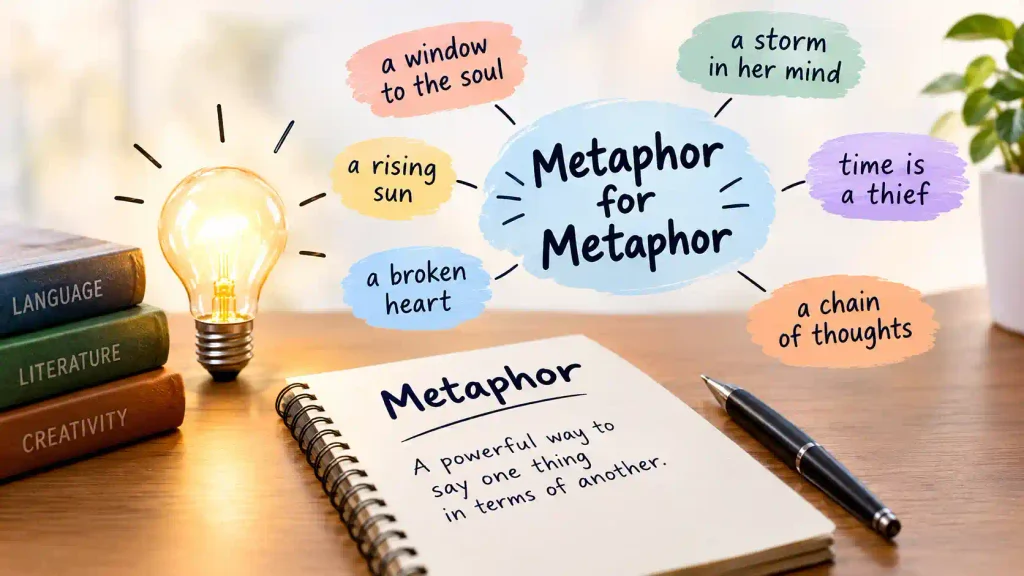
A metaphor for metaphor is a figurative way to describe how metaphors work: they connect one idea to another to make meaning easier to understand, more vivid, or more memorable. A metaphor can be described as a bridge between ideas, a lens for seeing the world, or a key that unlocks an abstract concept. If you’re looking for ordinary metaphor examples, literary uses, or another word for metaphor, the following guide explains the differences with clear examples.
Quick Answer
A metaphor is a figure of speech that describes one thing in terms of another, usually by stating that one thing is another without a literal comparison. For example, “Time is a thief” suggests that time takes away valuable moments. A metaphor for metaphor itself might be “a bridge between ideas,” because a metaphor connects something unfamiliar or abstract to something readers already understand.
What Is a Metaphor for Metaphor?
A metaphor for metaphor describes the function of figurative language through another figurative comparison. Instead of defining a metaphor in technical terms, it uses a familiar image to explain how metaphors transfer meaning from one idea to another.
Consider these original examples:
1. A Bridge Between Ideas
A metaphor connects two different concepts so readers can understand one through the other.
Example: A good metaphor is a bridge between an unfamiliar idea and a familiar experience.
2. A Lens for the Mind
A metaphor changes how someone sees or interprets a subject. The comparison directs attention toward particular qualities.
Example: A metaphor is a lens that brings hidden meanings into focus.
3. A Key to Abstract Ideas
A metaphor can make a complicated or intangible subject easier to grasp by connecting it to something concrete.
Example: A metaphor is a key that opens the door to an unfamiliar concept.
4. A Map of Meaning
A metaphor gives readers a way to navigate an idea by relating it to something they already recognize.
Example: A metaphor is a map that guides readers through unfamiliar territory.
5. A Window Into Imagination
A metaphor helps readers picture an idea beyond its literal description.
Example: A metaphor is a window through which an abstract thought becomes visible.
These are original explanatory metaphors, not established quotations or traditional expressions. Each highlights a different function: connection, perspective, understanding, navigation, or visualization.
Metaphor Examples and Their Meanings
The following table pairs familiar metaphors with original examples. The first two columns explain the images; the additional columns help readers compare their meanings without repeating the same expression.
| Metaphor | Meaning | Metaphor | Meaning |
| Time is a thief. | Time takes away moments we cannot recover. | Knowledge is a key. | Learning opens new opportunities. |
| Life is a journey. | Life involves change, choices, and progress. | Hope is a candle. | Hope offers light during difficult times. |
| The world is a stage. | People take on different roles in life. | Her mind is a library. | She holds extensive knowledge and ideas. |
| Love is a battlefield. | Love can involve conflict and emotional struggle. | Anger is a storm. | Anger can build, intensify, and overwhelm. |
| He is a rock. | He is dependable and strong. | Memory is a photograph album. | Memories preserve moments from the past. |
| The classroom is a garden. | Students develop through care and learning. | Words are seeds. | Words can grow into lasting ideas or actions. |
| Her voice is music. | Her voice sounds pleasant or expressive. | The city is a jungle. | The city feels competitive, crowded, or difficult to navigate. |
| Fear is a shadow. | Fear follows or influences someone. | An idea is a spark. | An idea can start something larger. |
| His heart is gold. | He is kind and generous. | The past is an anchor. | Past experiences can hold someone back. |
| The office is a pressure cooker. | The workplace feels tense and demanding. | Friendship is a shelter. | Friendship offers comfort and protection. |
Some examples are established English expressions, while others are newly written illustrations. Their interpretations depend on context; for example, an anchor can represent stability in one context and restriction in another.
Five Examples of Metaphors in Sentences
If you need five examples of metaphor for an assignment, these sentences demonstrate different ways metaphors communicate meaning.
- “The exam was a mountain.” The comparison presents the exam as a difficult challenge that requires effort to overcome.
- “Her smile was sunshine.” This metaphor suggests that her smile made others feel happier or more comfortable.
- “My brother is a walking encyclopedia.” The comparison emphasizes his extensive knowledge.
- “The rumor was wildfire.” This image suggests that the rumor spread rapidly from person to person.
- “His words were a shield.” The metaphor suggests that his words protected someone from criticism, blame, or emotional harm.
Each sentence describes a subject through another concept rather than making a literal claim.
What Is a Metaphor in Literature?
In literature, a metaphor helps writers develop imagery, reveal character, communicate emotion, and express themes. It can turn an abstract idea into something readers can picture and interpret.
For example, William Shakespeare’s As You Like It contains the famous metaphor “All the world’s a stage.” The comparison presents human life as a theatrical performance, with people occupying different roles as their circumstances change.
Other literary metaphors can compare grief to winter, ambition to fire, or memory to a locked room. These are illustrative possibilities rather than quotations from particular literary works.
Why Writers Use Metaphors
- To create imagery: A description such as “the sky was a blanket of gray” makes the sky easier to visualize.
- To communicate emotion: “Her heart was a locked room” suggests emotional distance or guarded feelings.
- To simplify abstract ideas: “Knowledge is a key” presents learning as a means of opening opportunities.
- To develop themes: An extended metaphor can connect a story’s individual events to a broader idea about life, power, identity, or change.
A strong literary metaphor does more than decorate a sentence. It gives the reader a useful way to interpret the subject.
What Is Another Word for Metaphor?
There is no perfect synonym for metaphor in every context. The closest alternative depends on whether you mean a figurative comparison, a broader explanation, or a related literary technique.
| Word or phrase | How it differs from metaphor |
| Figurative expression | A broad term for language used beyond its literal meaning. |
| Figure of speech | An umbrella term covering metaphors and many other rhetorical devices. |
| Analogy | Explains a relationship or similarity between things, often in greater detail. |
| Comparison | A general term that can include literal or figurative comparisons. |
| Symbol | Represents a broader idea, concept, or meaning. |
| Allegory | Uses a sustained narrative or system of symbols to communicate another meaning. |
| Simile | Compares things explicitly, typically using “like” or “as.” |
| Image | Creates a sensory or mental picture; it does not always constitute a metaphor. |
Metaphor Synonyms in Everyday Writing
If you want to avoid repeating the word metaphor, consider the purpose of the sentence.
- In an academic essay, use figurative comparison when describing how one idea represents another.
- In a literary analysis, use figure of speech when discussing a broader rhetorical technique.
- In an explanation, use analogy when you develop a comparison to clarify a relationship.
- In creative writing, use image when you mean a vivid mental picture rather than a specific literary device.
These alternatives overlap in some contexts, but they are not interchangeable in every sentence.
What Are the Four Types of Metaphors?
There is no single universally accepted list of exactly four metaphor types. Classifications vary by textbook and purpose. A practical introductory grouping includes the following four forms:
1. Standard Metaphor
A direct comparison that describes one thing as another.
Example: Her ideas are seeds.
The sentence suggests that her ideas may develop and produce results over time.
2. Implied Metaphor
A comparison that suggests a relationship without directly naming both sides of it.
Example: He barked orders at the team.
The verb barked implicitly compares his manner of speaking to a dog’s bark.
3. Extended Metaphor
A comparison that continues across several sentences, lines, or a larger passage.
Example: Life is a voyage. Some days bring calm seas, while others force us to navigate storms and search for a safe harbor.
The passage develops the journey comparison throughout several connected images.
4. Mixed Metaphor
A sentence or passage that combines images that do not fit together logically or consistently.
Example: We need to get the ball rolling and stay on the same page of the ship.
The sentence mixes the images of a ball, a page, and a ship. In formal writing, such combinations can confuse readers unless the writer uses them deliberately for a humorous or unconventional effect.
Some textbooks instead classify metaphors as dead, conceptual, visual, or other forms. When answering a school assignment, follow the categories your teacher or textbook specifies.
How Do You Say “I Love You” in a Metaphor?
To express love metaphorically, compare the person or feeling to something that conveys warmth, security, importance, or connection. The best choice depends on whether you want a romantic, poetic, gentle, or playful tone.
Here are five original examples:
- “You are the sunshine in my winter.” You bring warmth and happiness into difficult times.
- “You are the compass of my heart.” You help me find direction and purpose.
- “Our love is a garden.” Our relationship grows through patience, care, and attention.
- “You are my favorite chapter.” You are an important and cherished part of my life.
- “My heart has found its home in you.” You make me feel accepted, secure, and understood.
These metaphors communicate affection without relying on the exact words “I love you.” For a personal message, choose an image that reflects the relationship rather than using the most elaborate phrase.
Metaphor vs. Simile: What Is the Difference?
A metaphor describes one thing as another, while a simile explicitly compares two things, typically with like or as.
| Metaphor | Simile |
| Her voice is music. | Her voice is like music. |
| The classroom is a zoo. | The classroom is like a zoo. |
| His mind is a machine. | His mind works like a machine. |
Both devices create comparisons, but they present those comparisons differently. A metaphor can make the connection feel direct, while a simile signals the comparison more explicitly.
Remember that not every phrase containing like is a simile. The word can also express an ordinary preference or relationship. What matters is the figurative comparison.
How to Choose the Right Metaphor
The most effective metaphor depends on your audience, purpose, and intended tone. An image that works beautifully in poetry might sound overly dramatic in a business presentation.
| Purpose | Useful approach | Example |
| School essay | Use a clear, easy-to-explain comparison. | Knowledge is a key. |
| Poetry | Choose an image that creates emotion or multiple meanings. | Grief is a winter garden. |
| Fiction | Use imagery that reveals a character or advances the scene. | Suspicion was a seed in her mind. |
| Speech | Choose an image listeners can understand immediately. | Every small action is a brick in our shared future. |
| Social media | Keep it brief, vivid, and memorable. | Today is a blank page. |
| Romantic writing | Choose an image that conveys affection or intimacy. | You are the harbor where my restless heart rests. |
| Academic analysis | Explain what the comparison suggests and how it supports the argument. | The recurring storm reflects the character’s inner conflict. |
The examples in this table are illustrative, original formulations. Established expressions can work well too, especially when their meaning is familiar to the audience.
Before choosing a metaphor, ask three questions:
- What do I want to communicate? Identify the exact emotion, quality, or idea.
- What image expresses that meaning? Choose something readers can recognize and interpret.
- Does the comparison fit the context? Avoid images that distract from the message or create unintended meanings.
A simple, precise metaphor usually serves readers better than an elaborate comparison they must stop to decode.
Frequently Asked Questions
1. What does “metaphors meaning” refer to?
The meaning of a metaphor is the idea conveyed through a nonliteral comparison. In “Time is a thief,” time is not literally a person stealing something; the sentence suggests that time takes away opportunities and moments we cannot recover.
2. What is a metaphor for metaphor itself?
A metaphor for metaphor itself might be “a bridge between ideas.” This original comparison explains how figurative language connects a subject to a familiar image, helping readers understand the subject in a new way.
3. What are 10 examples of a metaphor?
Ten examples are: time is a thief, life is a journey, knowledge is a key, hope is a candle, love is a battlefield, the world is a stage, her voice is music, anger is a storm, words are seeds, and friendship is a shelter. Each phrase expresses an idea through a figurative comparison.
4. What is another word for metaphor?
Depending on context, alternatives include figurative comparison, figure of speech, analogy, and figurative expression. These terms have different meanings, so choose the one that best describes the technique you are discussing.
5. What are the four types of metaphors?
One practical introductory grouping includes standard, implied, extended, and mixed metaphors. However, classifications vary among textbooks and literary frameworks, so there is no universally required four-type list.
6. How do metaphors improve writing?
Metaphors make abstract ideas easier to visualize, communicate emotion, establish tone, and create memorable descriptions. They work best when the comparison clarifies the intended meaning rather than making the sentence harder to understand.
Conclusion
A metaphor is more than a comparison: it is a way of understanding one idea through another. Describing a metaphor as a bridge, lens, key, map, or window helps explain its role in communication, while familiar expressions such as “Time is a thief” show how figurative language works in everyday English. Whether you are writing an essay, interpreting literature, or expressing love, choose a metaphor that makes your meaning clearer and more memorable.

Qaiser Abbas is an award-winning author, leadership coach, and motivational speaker known for his work on personal growth, leadership, and human potential. Through his writing and speaking, Qaiser focuses on turning challenges into opportunities and helping people build the mindset to achieve meaningful growth.