
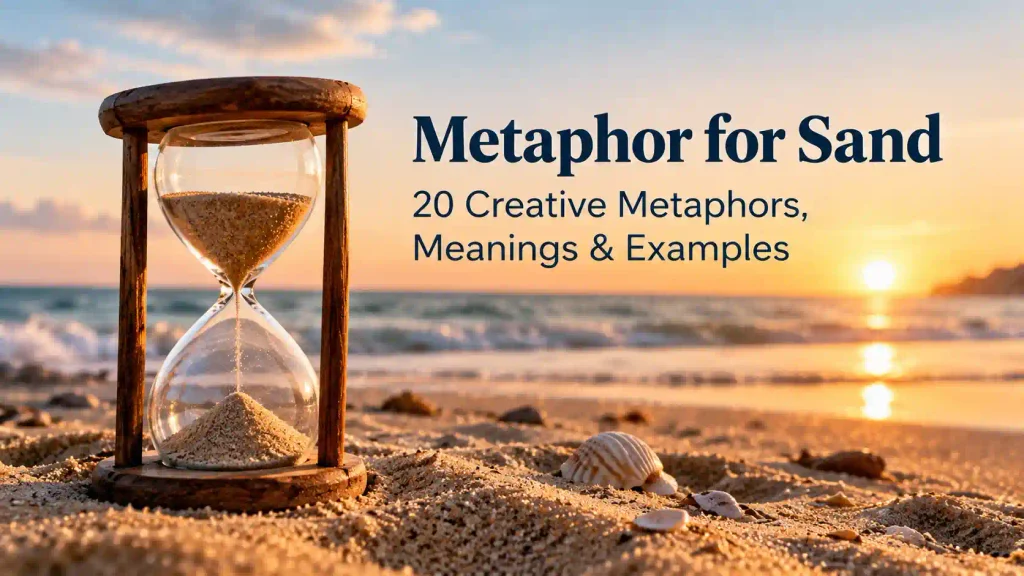
A metaphor for sand can compare it to time, memory, change, uncertainty, freedom, or countless other ideas. Because sand shifts, slips, gathers, and disappears beneath waves, it gives writers a rich way to describe things that feel temporary, unstable, endless, or constantly changing.
The best metaphor depends on what you want the sand to represent. A beach may suggest peace and freedom, while sand slipping through your fingers can suggest lost time or something you cannot hold onto.
Quick Answer
A strong metaphor for sand is “sand is a clock without hands” because its movement can suggest the passage of time without showing a conventional clock. Other useful metaphors include “sand is a sea of gold,” “sand is nature’s confetti,” and “sand is a blanket of tiny stars.” In literature, sand can also symbolize impermanence, memory, instability, abundance, or the passage of time.
Best Metaphors for Sand
Here are 20 distinct metaphors for sand, including established expressions and original comparisons.
1. Sand is a Sea of Gold
Type: Original metaphor
This metaphor compares golden beach sand to an ocean of shimmering treasure. It works especially well when you want to emphasize beauty, warmth, or abundance.
Example:
At sunset, the beach became a sea of gold beneath the fading light.
Best for: Poetry, travel writing, descriptive prose.
2. Sand Is a River Without Water
Type: Original metaphor
Sand flows and forms channels, dunes, and ripples, even though it does not behave exactly like liquid. This metaphor emphasizes movement and constant change.
Example:
The desert stretched before us like a river without water, flowing toward the horizon.
Best for: Fiction, poetry, nature writing.
3. Sand Is a Clock Without Hands
Type: Original metaphor
This metaphor connects sand with the passage of time. An hourglass makes the connection especially clear because falling sand measures passing moments.
Example:
The beach was a clock without hands, quietly measuring the afternoon grain by grain.
Best for: Reflective writing, poetry, essays.
4. Sand Is a Blanket of Stars
Type: Original metaphor
This works particularly well when sunlight catches individual grains or when pale sand spreads across a large beach.
Example:
Moonlight turned the beach into a blanket of stars.
Best for: Poetry and romantic descriptions.
5. Sand Is Nature’s Confetti
Type: Original metaphor
This comparison gives sand a playful, celebratory quality. It works especially well for beaches, summer scenes, and joyful writing.
Example:
The children kicked nature’s confetti into the air as they ran along the shore.
Best for: Casual writing, travel content, children’s writing.
6. Sand Is a Memory Keeper
Type: Original metaphor
Sand can preserve footprints for a short time before wind or water erases them. This makes it useful for writing about memories that fade.
Example:
The beach became a memory keeper, holding our footprints until the tide erased them.
Best for: Personal essays, poetry, reflective writing.
7. Sand Is a Shape-Shifter
Type: Original metaphor
Sand constantly changes form. Wind, water, footsteps, and weather can reshape it.
Example:
The desert was a shape-shifter, changing its dunes with every strong wind.
Best for: Fiction, essays, nature writing.
8. Sand Is a Thousand Tiny Mirrors
Type: Original metaphor
Under bright sunlight, individual grains can sparkle and reflect light. The metaphor creates a vivid visual image.
Example:
Under the morning sun, the shoreline looked like a thousand tiny mirrors.
Best for: Poetry and descriptive writing.
9. Sand Is a Soft Ocean of Earth
Type: Original metaphor
This comparison blends the visual movement of an ocean with the physical nature of earth.
Example:
The desert rolled around us like a soft ocean of earth.
Best for: Fiction, travel writing, poetry.
10. Sand Is Time Made Visible
Type: Original metaphor
This metaphor works because sand has a strong association with clocks, erosion, aging, and gradual change.
Example:
The old beach felt like time made visible, with every wave reshaping the shore.
Best for: Essays, poetry, philosophical writing.
11. Sand Is a Thousand Footprints Waiting to Fade
Type: Original metaphor
This metaphor focuses on impermanence. It works particularly well when writing about memories, relationships, or moments that do not last.
Example:
Our summer felt like a thousand footprints waiting to fade.
Best for: Reflective writing and poetry.
12. Sand Is a Living Canvas
Type: Original metaphor
Wind, water, animals, and people constantly create temporary patterns on sand.
Example:
The beach was a living canvas, rewritten by every wave.
Best for: Creative writing and descriptions of beaches.
13. Sand Is a Puzzle With No Final Picture
Type: Original metaphor
This metaphor emphasizes uncertainty and constant rearrangement.
Example:
The desert felt like a puzzle with no final picture, changing whenever the wind arrived.
Best for: Fiction, essays, and philosophical writing.
14. Sand Is a Whisper From the Mountains
Type: Original metaphor
This image works particularly well when writing about geological change because sand can originate from weathered rock.
Example:
Each grain felt like a whisper from the mountains that had traveled for centuries.
Best for: Poetry and nature writing.
15. Sand Is Freedom Under Your Feet
Type: Original metaphor
This comparison gives sand a positive emotional meaning associated with beaches, travel, openness, and escape.
Example:
With every step along the empty shore, the sand felt like freedom under my feet.
Best for: Travel writing, social media, lifestyle content.
16. Sand Is a Fragile Foundation
Type: Established symbolic idea
Sand can represent instability when something rests on an unreliable foundation. This meaning appears prominently in the biblical image of building a house on sand.
Example:
Their agreement was a fragile foundation, unable to survive the first serious disagreement.
Best for: Essays, speeches, and writing about instability.
17. Sand Is a River of Time
Type: Original metaphor
This metaphor combines movement with the idea of time continually moving forward.
Example:
We stood beside the dunes and watched a river of time disappear into the horizon.
Best for: Poetry and reflective writing.
18. Sand Is a Thousand Small Endings
Type: Original metaphor
Each disappearing footprint or shifting dune can represent something temporary. This creates a more emotional interpretation of sand.
Example:
The fading footprints looked like a thousand small endings along the shore.
Best for: Poetry and emotional prose.
19. Sand Is a Crowd of Tiny Travelers
Type: Original metaphor
Every grain can move through wind, water, rivers, beaches, and dunes. The metaphor gives sand a sense of journey and movement.
Example:
The wind carried a crowd of tiny travelers across the desert.
Best for: Children’s writing, fiction, and creative descriptions.
20. Sand Is an Hourglass Spread Across the Earth
Type: Original metaphor
This is one of the strongest metaphors when the subject involves time, aging, memory, or mortality.
Example:
The desert looked like an hourglass spread across the earth, counting centuries instead of minutes.
Best for: Poetry, essays, literary writing.
What Can Sand Symbolize?
What can sand symbolize? Sand can symbolize time, impermanence, change, instability, memory, abundance, freedom, and the temporary nature of life.
Its meaning changes according to context.
For example:
- Sand in an hourglass → the passage of time
- Footprints in sand → temporary memories or experiences
- Shifting dunes → change and instability
- Endless beach sand → abundance or vastness
- Sand slipping through fingers → loss or inability to hold onto something
- A house built on sand → an unstable foundation
- A peaceful beach → freedom, relaxation, or escape
- A sandcastle → beauty that does not last
This flexibility makes sand particularly useful as a literary symbol.
What Is a Metaphor for Sand?
A metaphor for sand directly compares sand with something else to communicate an idea beyond its literal appearance.
Some of the strongest examples include:
- Sand is time made visible.
- Sand is a sea of gold.
- Sand is a shape-shifter.
- Sand is a memory keeper.
- Sand is a living canvas.
- Sand is an hourglass spread across the earth.
The best choice depends on the meaning you want to create. If your subject involves time, “sand is a clock without hands” works well. If you want to describe beauty, “sand is a sea of gold” creates a warmer image.
Metaphor for Sand Beach: Which One Works Best?
If you need a metaphor for sand beach writing, choose an image that matches the atmosphere of the scene.
| Metaphor | Meaning | Tone | Best Use |
| A sea of gold | Beauty and warmth | Positive | Travel writing |
| A living canvas | Constant change | Creative | Poetry |
| A blanket of stars | Sparkling beauty | Dreamy | Romantic writing |
| Freedom under your feet | Escape and openness | Uplifting | Social media |
| A memory keeper | Temporary moments | Reflective | Essays |
| An hourglass spread across the earth | Passing time | Thoughtful | Poetry |
For a peaceful beach description, “a living canvas” gives you more movement than a simple beauty comparison. For a nostalgic scene, “a memory keeper” creates a stronger emotional connection.
What Words Describe Sand?
If you are looking for what words describe sand, start with the physical qualities and then choose words that match the scene.
Texture
- Grainy
- Gritty
- Fine
- Coarse
- Powdery
- Soft
- Rough
- Silky
Appearance
- Golden
- Pale
- White
- Tan
- Beige
- Shimmering
- Sparkling
- Sunlit
Movement
- Shifting
- Drifting
- Blowing
- Rippling
- Flowing
- Sifting
- Swirling
Environment
- Dry
- Warm
- Deserted
- Coastal
- Windswept
- Endless
- Scorching
- Damp
The right word depends on the type of sand you want to describe. “Powdery” suggests fine, soft sand, while “gritty” emphasizes texture. “Windswept” creates a stronger sense of movement and place.
What Is Sand of Time a Metaphor For?
The expression “sands of time” is a metaphor for the passage of time, especially the idea that time continually moves forward and eventually runs out. The image comes from sand flowing through an hourglass. Cambridge Dictionary also identifies “the sands of time” as a literary idiom referring to time and its rapid passage.
For example:
The sands of time are running out.
The phrase can suggest aging, mortality, deadlines, history, or the gradual disappearance of an era.
Another related image is “footprints on the sands of time,” which connects temporary footprints with the lasting mark a person leaves behind.
What Are Some Idioms About Sand?
Several familiar English expressions use sand or sand-related imagery.
The sands of time
This literary idiom refers to the passage of time, particularly time moving toward its end.
Example:
The sands of time are running out for the aging championship team.
Bury your head in the sand
This idiom means to deliberately ignore a problem rather than face it.
Example:
You cannot bury your head in the sand and expect the problem to disappear.
A house built on sand
This expression describes something based on an unstable or unreliable foundation.
Example:
Their business plan was a house built on sand.
Leave footprints on the sands of time
This literary expression suggests leaving a lasting influence or legacy despite the passing of time.
These expressions differ from original metaphors because English speakers recognize them as established figurative expressions.
The Sieve and the Sand: What Does It Mean?
The Sieve and the Sand is the title of Part Two of Ray Bradbury’s Fahrenheit 451. It refers to Guy Montag’s childhood memory of trying to fill a sieve with sand. Later, while Montag tries to read and remember a book, he compares his mind to that sieve: the knowledge he wants to retain keeps slipping away.
In the metaphor:
- The sieve represents Montag’s mind.
- The sand represents knowledge, truth, and meaning that Montag wants to retain.
The image captures his frustration. He wants to understand what he reads, but distractions and his lack of experience make it difficult for him to hold onto the ideas.
The metaphor therefore goes beyond simple forgetfulness. It represents the struggle to absorb, understand, and retain meaningful knowledge in a culture overwhelmed by distraction.
What Is the Sieve and the Sand a Metaphor For?
In Fahrenheit 451, the sieve and the sand is a metaphor for the difficulty of retaining knowledge and truth when the mind cannot properly process or hold them.
The sand represents the meaningful information Montag wants to keep, while the sieve represents his mind as he struggles to retain it.
This distinction matters because the metaphor does not simply mean “forgetting.” It also explores the difference between consuming information and actually understanding it.
Choosing the Right Sand Metaphor
The best metaphor depends on the feeling you want to create.
For time
Use:
“Sand is a clock without hands.”
It connects sand with moments passing without sounding overly dramatic.
For impermanence
Use:
“Sand is a thousand footprints waiting to fade.”
It works especially well for memories, relationships, and temporary experiences.
For beauty
Use:
“Sand is a sea of gold.”
This creates a warm, visual image for beaches and sunsets.
For change
Use:
“Sand is a shape-shifter.”
It highlights the way wind and water continually reshape sand.
For knowledge
Use “the sieve and the sand” when discussing Fahrenheit 451, because that expression has a specific literary meaning rather than functioning as a general metaphor for sand.
For freedom
Use:
“Sand is freedom under your feet.”
This works well for beaches, travel, summer, and escape.
Metaphor vs. Simile for Sand
A metaphor directly says one thing is another:
The beach is a sea of gold.
A simile compares two things using “like” or “as”:
The beach looks like a sea of gold.
Both devices create imagery, but a metaphor makes the comparison more directly.
For creative writing, metaphors often create a stronger sense of identification. Similes can make the comparison more explicit and easier to understand.
FAQs About Sand Metaphors
What is a good metaphor for sand?
A good metaphor depends on the intended meaning. “Sand is time made visible” works well for time and impermanence, while “sand is a sea of gold” works well for beauty and abundance.
What does sand symbolize in literature?
Sand can symbolize time, impermanence, memory, instability, change, abundance, or the temporary nature of human experience. Its meaning depends on the surrounding context.
What is a metaphor for sand on a beach?
“The beach is a living canvas” is a strong metaphor because waves, wind, and footprints continually change its surface. For a more romantic image, “the beach is a sea of gold” works well.
What does sand symbolize in an hourglass?
Sand in an hourglass symbolizes the passage of time. As the grains move from one chamber to another, they create a visual representation of time passing. This image gives rise to the established expression “the sands of time.”
What are some words for sand?
Useful descriptive words include grainy, gritty, fine, coarse, powdery, soft, golden, pale, shimmering, shifting, drifting, windswept, dry, and warm.
What does “The Sieve and the Sand” symbolize?
In Fahrenheit 451, the sieve represents Montag’s mind, while the sand represents knowledge and meaning that he struggles to retain. The image captures his difficulty processing and holding onto important ideas.
Final Thoughts
Sand works as a powerful metaphor because it can suggest opposite ideas at the same time. It can represent something countless and abundant, yet also something temporary and impossible to hold. It can evoke freedom on a beach, instability beneath a foundation, or the relentless movement of time through an hourglass.
For a simple metaphor about time, use “sand is a clock without hands.” And for memory, try “sand is a memory keeper.” For change, “sand is a shape-shifter” captures the idea clearly. And when you encounter “The Sieve and the Sand,” remember its specific literary meaning: Montag struggles to hold onto knowledge and truth as though he were trying to keep sand inside a sieve.

Qaiser Abbas is an award-winning author, leadership coach, and motivational speaker known for his work on personal growth, leadership, and human potential. Through his writing and speaking, Qaiser focuses on turning challenges into opportunities and helping people build the mindset to achieve meaningful growth.