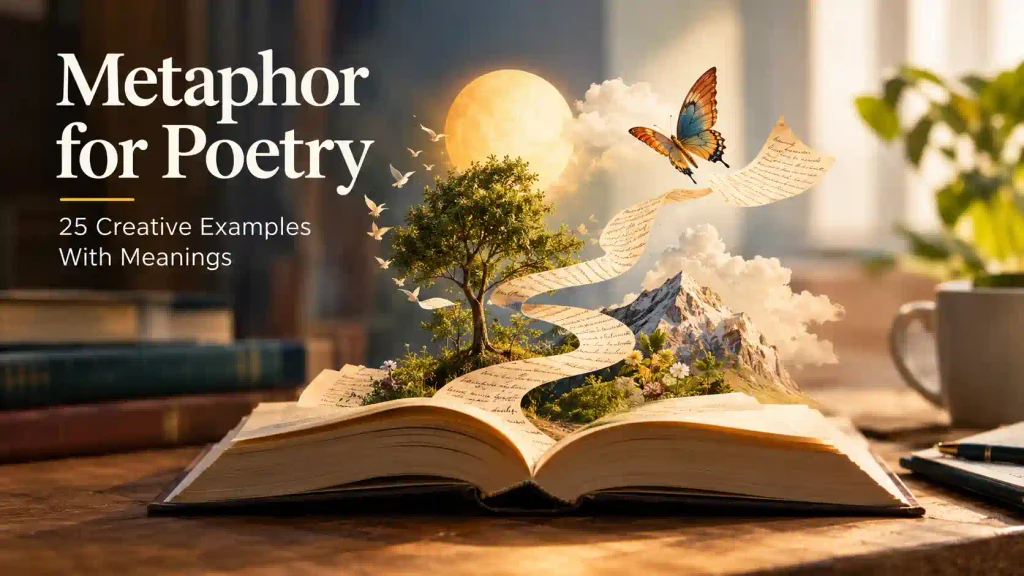
A metaphor for poetry describes poetry by comparing it directly to something else, such as music, a mirror, a garden, or a river. These comparisons reveal different aspects of poetry: its emotional power, its rhythm, its ability to preserve memories, and its capacity to express ideas that ordinary language sometimes struggles to capture.
The best metaphor depends on what you want to communicate. A mirror suggests self-reflection, a musical instrument emphasizes rhythm and sound, and a bridge highlights poetry’s ability to connect people through shared experiences.
Quick Answer: What Is a Metaphor for Poetry?
A metaphor for poetry is a direct comparison that describes poetry as something else to express its meaning, purpose, or emotional effect. For example, “Poetry is a mirror for the soul” suggests that poems reflect a person’s inner thoughts and feelings. Other possibilities include poetry as a garden of ideas, a river of memories, or a song without music.
25 Best Metaphors for Poetry and Their Meanings
| Metaphor | Meaning | Metaphor | Meaning |
| Poetry is a mirror for the soul. | Reflects inner thoughts and emotions. | Poetry is a garden of ideas. | Allows thoughts to grow into meaningful expressions. |
| Poetry is music without instruments. | Creates rhythm and feeling through language alone. | Poetry is a bridge between hearts. | Connects people through shared emotions. |
| Poetry is a river of memories. | Carries experiences from the past into the present. | Poetry is a lantern in the dark. | Offers insight during confusion or hardship. |
| Poetry is a painter’s palette. | Combines words, images, and emotions into art. | Poetry is a key to hidden rooms. | Opens access to overlooked feelings or ideas. |
| Poetry is a time capsule. | Preserves experiences, voices, and moments. | Poetry is a window into another mind. | Gives readers a glimpse of someone else’s perspective. |
| Poetry is a heartbeat made visible. | Makes inner feelings tangible through words. | Poetry is a compass for wandering thoughts. | Gives direction to ideas that feel scattered. |
| Poetry is a seed carried by the wind. | Spreads ideas that may grow in other minds. | Poetry is a storm inside a bottle. | Holds intense emotion within a small space. |
| Poetry is a map of the human heart. | Traces emotional experiences and relationships. | Poetry is a doorway between worlds. | Moves readers from ordinary experience into imagination. |
| Poetry is a thread through generations. | Connects experiences across time. | Poetry is a flame passed from hand to hand. | Keeps ideas and inspiration alive. |
| Poetry is a conversation with silence. | Expresses what remains unspoken. | Poetry is a window left open in winter. | Allows vulnerability and discomfort to enter. |
| Poetry is a mosaic of moments. | Builds a larger meaning from small experiences. | Poetry is a telescope pointed inward. | Examines the inner self with greater attention. |
| Poetry is a footprint in the snow of time. | Leaves a trace of a fleeting experience. | Poetry is a vessel for the unsayable. | Gives form to feelings that resist direct explanation. |
| Poetry is a doorway made of words. | Invites readers into another perspective. |
Metaphors for Poetry That Express Creativity and Imagination
Poetry can transform ordinary observations into surprising images. These metaphors emphasize the imaginative work behind that transformation.
1. Poetry Is a Garden of Ideas
This metaphor presents poetry as a place where thoughts grow, develop, and take different forms. Some ideas blossom immediately; others need time before their meaning becomes clear.
Example: Every poem she wrote was a garden of ideas, full of images she had nurtured for years.
Best use: Essays about creativity, discussions of literary inspiration, and writing that explores how ideas develop.
2. Poetry Is a Painter’s Palette
A painter combines colors to create a picture. A poet combines words, sounds, images, and emotions to create a similar effect through language.
Example: His poem was a painter’s palette, blending childhood memories with the gray colors of grief.
Best use: Describing vivid imagery, creative expression, and the relationship between poetry and visual art.
3. Poetry Is a Key to Hidden Rooms
The hidden rooms represent thoughts, memories, or emotions that people rarely explore. Poetry gives readers a way to enter those private spaces.
Example: Her verses were keys to hidden rooms in the mind, revealing fears she had never discussed.
Best use: Literary analysis, reflective writing, and poems about identity or self-discovery.
4. Poetry Is a Doorway Between Worlds
Poetry can move a reader from everyday reality into an imagined place or an unfamiliar point of view. The doorway represents that transition.
Example: The final stanza became a doorway between worlds, leading the reader from a familiar street into a dream.
Best use: Fantasy poetry, imaginative writing, and poems that shift between reality and memory.
Metaphors for Poetry That Express Emotion
Poems often communicate feelings that are difficult to explain directly. These comparisons turn abstract emotions into images readers can see or imagine.
5. Poetry Is a Mirror for the Soul
A mirror reflects an image, while poetry can reflect a person’s fears, hopes, desires, and contradictions. It doesn’t have to present a perfect or complete picture; it can reveal something the writer or reader had overlooked.
Example: The poem was a mirror for the soul, showing her the loneliness hidden beneath her confidence.
Best use: Personal essays, reflective poems, and writing about identity.
6. Poetry Is a Heartbeat Made Visible
A heartbeat is an invisible sign of life until a device or other means makes it observable. This metaphor describes poetry as a visible expression of feelings that normally remain inside us.
Example: Each line was a heartbeat made visible, revealing the grief he had struggled to name.
Best use: Emotional poetry, personal writing, and discussions of vulnerability.
7. Poetry Is a Storm Inside a Bottle
The bottle suggests a limited space, while the storm represents powerful, turbulent emotions. Together, they describe a poem that holds intense feelings within a compact form.
Example: Her twelve-line poem was a storm inside a bottle, containing years of anger and regret.
Best use: Poems about grief, anger, conflict, or emotional restraint.
8. Poetry Is a Conversation With Silence
Sometimes the meaning of a poem lies in pauses, omissions, or things the speaker cannot bring themselves to say. Silence becomes a participant in the conversation rather than an absence of meaning.
Example: The poem was a conversation with silence, giving shape to the words neither brother could speak.
Best use: Poetry about loss, strained relationships, loneliness, or unspoken feelings.
9. Poetry Is a Vessel for the Unsayable
A vessel holds something within it. Here, poetry holds complex experiences that ordinary explanations cannot fully capture.
Example: Her poem became a vessel for the unsayable, carrying the complicated emotions of leaving home.
Best use: Personal essays, poetry about trauma or grief, and reflections on difficult life experiences.
Metaphors for Poetry That Express Sound and Rhythm
Poetry uses sound, repetition, rhythm, and pauses to influence how a reader experiences language. These metaphors focus on those musical qualities.
10. Poetry Is Music Without Instruments
Poetry can create rhythm and emotional movement through syllables, stress, repetition, and sound, even without a musical accompaniment.
Example: The poem was music without instruments, and every repeated word deepened its sadness.
Best use: Describing lyrical poetry, spoken-word performances, and poems with strong rhythmic patterns.
11. Poetry Is a Flame Passed From Hand to Hand
A flame can light another flame without losing its own light. This image presents poetry as a way ideas, stories, and creative inspiration move from one person to another.
Example: Across generations, poetry was a flame passed from hand to hand, keeping their family’s stories alive.
Best use: Writing about literary traditions, cultural memory, and the influence of one generation on another.
Metaphors for Poetry That Express Memory and Time
Poetry can preserve moments that might otherwise fade. These metaphors explore its relationship with the past, personal history, and the passage of time.
12. Poetry Is a Time Capsule
A time capsule preserves objects and messages for people to discover later. A poem can preserve the language, concerns, and feelings of a particular moment.
Example: The old notebook was a time capsule, preserving the hopes she had carried at seventeen.
Best use: Poems about childhood, family history, nostalgia, and changing identities.
13. Poetry Is a River of Memories
A river suggests continuous movement. This metaphor describes memories as experiences that flow together, sometimes calmly and sometimes with unexpected force.
Example: His poetry was a river of memories, carrying him from his childhood home to the life he had built elsewhere.
Best use: Reflective writing, autobiographical poetry, and poems about migration or growing older.
14. Poetry Is a Footprint in the Snow of Time
A footprint leaves evidence that someone passed through a place, even after the person has gone. Poetry can similarly preserve a trace of an experience, emotion, or voice.
Example: Her final poem was a footprint in the snow of time, leaving behind a quiet record of her courage.
Best use: Poems about legacy, fleeting experiences, remembrance, and mortality.
15. Poetry Is a Thread Through Generations
A thread connects separate points into a continuous line. Poetry can connect people who live in different eras through recurring experiences, inherited stories, and shared language.
Example: The family’s songs and poems were a thread through generations, linking the grandmother’s childhood with her grandchildren’s lives.
Best use: Writing about heritage, family, cultural continuity, and literary history.
Metaphors for Poetry That Express Connection and Understanding
Poetry is not only an expression of the writer’s feelings. It also creates opportunities for readers to recognize their own experiences in someone else’s words.
16. Poetry Is a Bridge Between Hearts
A bridge connects places that would otherwise be separated. This metaphor suggests that poetry helps people understand emotions or experiences beyond their own lives.
Example: Despite their different backgrounds, the poem became a bridge between their hearts.
Best use: Poems about friendship, love, empathy, community, and shared experiences.
17. Poetry Is a Window Into Another Mind
A window lets someone see beyond their immediate surroundings. Poetry can provide a glimpse of another person’s beliefs, perceptions, or emotional world.
Example: Reading the collection felt like looking through a window into another mind.
Best use: Literary criticism, book reviews, and essays about perspective or empathy.
18. Poetry Is a Compass for Wandering Thoughts
A compass helps someone find direction. Poetry can give scattered thoughts a point of focus without eliminating uncertainty.
Example: Writing became a compass for his wandering thoughts during a confusing year.
Best use: Reflective writing, personal development, and descriptions of the writing process.
Metaphors for Poetry That Express Insight and Discovery
Poetry can change the way readers see a familiar object, relationship, or experience. These metaphors emphasize that shift in perspective.
19. Poetry Is a Lantern in the Dark
A lantern illuminates a limited area without revealing everything around it. This makes it a useful image for poetry that offers insight without pretending to solve every problem.
Example: The poem was a lantern in the dark, helping her understand one small part of her loss.
Best use: Poems about uncertainty, hope, difficult choices, and self-understanding.
20. Poetry Is a Telescope Pointed Inward
A telescope helps someone examine distant objects. Pointed inward, it becomes an image of careful attention to one’s own thoughts and feelings.
Example: His verse was a telescope pointed inward, bringing forgotten insecurities into focus.
Best use: Introspective poetry, psychological themes, and essays about self-awareness.
21. Poetry Is a Mosaic of Moments
A mosaic combines small pieces into a larger picture. A poem can combine brief observations, memories, images, and fragments of dialogue to reveal a more complex experience.
Example: The collection was a mosaic of moments, assembling small scenes into a portrait of a changing city.
Best use: Narrative poetry, fragmented verse, and writing about complex lives or communities.
22. Poetry Is a Seed Carried by the Wind
A seed may travel far from its original source and grow under new conditions. This metaphor describes how a poem’s ideas can influence readers in unexpected ways.
Example: Her poem was a seed carried by the wind, inspiring conversations long after the reading ended.
Best use: Writing about influence, education, social change, and the lasting impact of literature.
Short Metaphors for Poetry
Short metaphors work well in essays, classroom assignments, captions, and concise creative writing. Each example offers a distinct image without requiring a lengthy explanation.
| Short metaphor | Meaning |
| Poetry is a compass. | It offers direction or perspective. |
| Poetry is a time capsule. | It preserves a moment or experience. |
| Poetry is a bridge. | It connects people and ideas. |
| Poetry is a mirror. | It reflects the inner self. |
| Poetry is a lantern. | It illuminates an idea or emotion. |
| Poetry is a mosaic. | It combines small details into a larger meaning. |
| Poetry is a heartbeat. | It expresses the pulse of human feeling. |
| Poetry is a doorway. | It opens access to another perspective. |
Metaphors for Poetry in Sentences
These original sentences demonstrate how metaphors can fit naturally into a paragraph rather than standing alone as isolated phrases.
- Poetry is a mirror for the soul, reflecting emotions that everyday conversation often conceals.
- Her poem was a garden of ideas, with every image adding a new layer of meaning.
- The final verse became a lantern in the dark, offering a moment of clarity during a difficult time.
- Poetry is music without instruments, carried by the rhythm and texture of language.
- His collection was a time capsule, preserving the details of a neighborhood that had changed beyond recognition.
- The poem became a bridge between hearts, allowing strangers to recognize a shared experience.
- Each stanza was a room in the mind, opening onto a different memory.
- Her words formed a river of memories that carried the reader through childhood and loss.
- The poem was a storm inside a bottle, holding powerful feelings within a few carefully chosen lines.
- Poetry is a mosaic of moments, turning scattered observations into a larger picture of life.
Famous Metaphors for Poetry
Famous metaphors for poetry appear in well-known poems and literary traditions. They often describe poetry through familiar images such as music, nature, light, food, or the human body. When discussing a famous metaphor, distinguish a newly written example from an image that an identifiable poet actually used.
Poetry as Food in Mark Strand’s “Eating Poetry”
In Mark Strand’s poem “Eating Poetry,” eating becomes an extended metaphor for the experience of reading and absorbing poetry. The speaker describes consuming poems as though they were food, and the strange transformation that follows suggests how deeply literature can affect a reader.
The image presents poetry as something that can nourish the imagination and produce an intense, almost physical response. Unlike a simple comparison between poetry and food, the extended metaphor develops across the poem’s scenes and the speaker’s changing behavior.
Poetry as a Mirror
Poetry is a mirror for the soul is a useful metaphor for the reflective quality of poetry. It suggests that a poem can reveal emotions, beliefs, and experiences that readers recognize in themselves.
This is a general metaphorical expression, not a quotation attributed here to a particular poet.
Ten Simple Metaphors for Poetry
Simple metaphors make figurative language easier to understand. Each example directly identifies poetry with something else and offers a different way to think about its purpose.
- Poetry is a mirror. It reflects thoughts and feelings.
- Poetry is a song. It creates rhythm and emotional movement through language.
- Poetry is a garden. It gives ideas room to grow.
- Poetry is a bridge. It connects people through shared experiences.
- Poetry is a lantern. It sheds light on difficult feelings or ideas.
- Poetry is a time capsule. It preserves moments and memories.
- Poetry is a map. It traces a path through thoughts and experiences.
- Poetry is a seed. It plants ideas that may develop in a reader’s mind.
- Poetry is a window. It offers a view into another person’s perspective.
- Poetry is a heartbeat. It expresses the emotional pulse of human life.
These are illustrative examples rather than quotations from published poems. Their simplicity makes them suitable for classroom exercises, introductory essays, and creative-writing practice.
What Is Metaphorical Poetry?
Metaphorical poetry uses comparisons between unlike things to communicate meaning beyond literal descriptions. Rather than stating an emotion or idea directly, a poet connects it to an image that helps readers imagine, feel, or interpret it.
For example, the sentence “Grief is an ocean” describes grief through the qualities associated with an ocean: depth, movement, vastness, and unpredictability. The comparison encourages readers to consider grief as an experience that can feel immense and difficult to control.
A poem may contain one metaphor or develop an extended metaphor across several lines or stanzas. In an extended metaphor, the central comparison continues to shape the poem’s imagery and meaning.
Metaphorical poetry does not require every line to contain figurative language. Literal details, sound, rhythm, and imagery can work alongside metaphors to create a complete poetic experience.
Elements of Metaphor in Poetry
A strong metaphor usually connects an identifiable subject with an image that reveals something meaningful about it. Three important elements help readers understand how the comparison works.
1. The Subject Being Described
The subject is the person, object, feeling, or idea that the metaphor helps explain.
Example: In “Hope is a lantern,” hope is the subject. The metaphor describes an abstract emotion through a concrete object.
2. The Image Used for Comparison
The image supplies qualities that readers associate with the subject. A lantern suggests light, visibility, and the ability to find one’s way in darkness.
Example: “Hope is a lantern in the storm.” The image suggests that hope can provide guidance during a difficult experience.
3. The Meaning Created by Context
The surrounding lines determine which qualities of the image matter most. A lantern might represent guidance in one poem, safety in another, or a small source of comfort in a third.
When analyzing a metaphor, explain both sides of the comparison and show how the image supports the poem’s larger theme. Avoid stopping at a statement such as “the lantern represents hope”; explain what the lantern’s light contributes to the meaning.
Metaphors in Poetry: Examples and Illustrations
A visual illustration can make a metaphor easier to understand by showing the literal image beside the idea it represents. The following examples provide simple text-based illustrations that can also guide the creation of a classroom diagram or article graphic.
Poetry as a Mirror
Metaphor: Poetry is a mirror for the soul.
Visual illustration: Imagine a mirror reflecting a person’s face, with small images of memories, hopes, and emotions appearing in the reflection.
Meaning: Poetry can help people recognize feelings and aspects of themselves that they have not fully understood.
Poetry as a Bridge
Metaphor: Poetry is a bridge between hearts.
Visual illustration: Imagine two people standing on opposite banks, connected by a bridge made of written words.
Meaning: A poem can connect people whose experiences differ by helping them recognize a shared emotion.
Poetry as a Lantern
Metaphor: Poetry is a lantern in the dark.
Visual illustration: Imagine a lantern illuminating a small path through a dark landscape while the surrounding area remains uncertain.
Meaning: A poem may offer insight or comfort without providing every answer.
Poetry as a Seed
Metaphor: Poetry is a seed carried by the wind.
Visual illustration: Imagine a small seed traveling from a flowering plant toward new soil, where it may eventually grow.
Meaning: A poem can introduce an idea that develops in a reader’s mind long after the reading ends.
These illustrations are conceptual descriptions, not reproductions of existing artwork. They show how a metaphor’s literal image can communicate its figurative meaning.
Eating as a Metaphor in Poetry
Eating can serve as a metaphor for reading, learning, remembering, or absorbing an experience. Food nourishes the body, so describing poetry as food suggests that literature can nourish the imagination and affect a reader deeply.
“Eating Poetry” by Mark Strand
In Mark Strand’s poem “Eating Poetry,” the speaker describes eating poems and undergoes a surreal transformation. The central metaphor treats reading as physical consumption, making the speaker’s response to literature vivid, strange, and almost animalistic.
The image works on several levels:
- Absorption: The speaker takes poetry into himself rather than simply observing it from a distance.
- Pleasure: Eating suggests appetite and enjoyment, presenting poetry as something intensely satisfying.
- Transformation: The speaker’s behavior changes, suggesting that poetry can affect how a person feels and acts.
The poem illustrates an extended metaphor because the idea of consuming poetry develops throughout the work rather than appearing only in its title. Its meaning comes from the relationship between the initial image, the speaker’s actions, and the transformation that follows.
When analyzing this metaphor, focus on how the eating image develops the poem’s portrayal of literary experience. Do not interpret the title as a literal description of reading.
Metaphor and Binding in Akan Praise Poetry
Akan praise poetry includes oral traditions in which language, performance, imagery, and references to people or historical events can work together to communicate meaning. Scholars have examined the role of figurative language and the way praise performances use names, descriptions, and layered references.
In this context, metaphor can connect a person’s identity or reputation with an image that communicates particular qualities. The image may carry significance shaped by the audience’s knowledge of local history, traditions, and the person being praised.
The word “binding” needs clarification in this keyword phrase. It should not be presented as a specific established literary term without evidence that the intended source uses it that way. If the phrase refers to the way metaphors link a person’s qualities, historical references, and praise titles, that relationship can be discussed as an interpretation—but a particular poem or scholarly source is needed to analyze it accurately.
When interpreting Akan praise poetry, consider the cultural and performance context rather than assuming that every metaphor has the same meaning across communities. Specific interpretations should be grounded in the actual text and relevant scholarship.
How to Choose the Right Metaphor for Poetry
The strongest metaphor is not necessarily the most elaborate. Choose one that communicates the specific idea you want readers to understand.
| Purpose | Recommended metaphor | Why it works |
| School essays | Poetry is a mirror for the soul. | Connects poetry with self-expression and interpretation. |
| Creative writing | Poetry is a garden of ideas. | Suggests imagination, development, and discovery. |
| Emotional poems | Poetry is a heartbeat made visible. | Makes internal feelings seem tangible. |
| Literary analysis | Poetry is a mosaic of moments. | Highlights how individual images contribute to a larger meaning. |
| Spoken-word poetry | Poetry is music without instruments. | Emphasizes rhythm, sound, and performance. |
| Cultural or historical writing | Poetry is a thread through generations. | Communicates continuity across time. |
| Writing about grief | Poetry is a vessel for the unsayable. | Expresses the difficulty of putting complex emotions into words. |
| Inspirational writing | Poetry is a lantern in the dark. | Suggests insight without promising certainty. |
For an essay, explain the connection between the image and the subject rather than inserting a metaphor without analysis. For creative writing, choose an image that fits the poem’s mood. A lantern might suit a quiet poem about understanding, while a storm inside a bottle may fit a poem about restrained anger.
How Metaphors Work in Poetry
A metaphor does more than make a poem sound imaginative. It shapes how readers interpret an experience by transferring qualities from one thing to another.
Consider the statement “Grief is an ocean.” An ocean can suggest depth, movement, vastness, and unpredictability. Depending on the surrounding lines, the comparison may communicate overwhelming sadness, changing emotions, or the difficulty of finding solid ground.
Three features make this kind of comparison effective:
- Imagery: The reader can picture or sense the source of the comparison.
- Association: The source carries qualities that illuminate the subject.
- Context: The surrounding words guide the reader toward a particular interpretation.
A metaphor also creates room for interpretation. Two readers may understand the same image differently because their experiences differ. That possibility is part of what makes figurative language valuable in poetry.
Metaphor vs. Simile in Poetry
A metaphor directly identifies one thing with another, while a simile explicitly compares two things, commonly using like or as.
| Type | Example | How it works |
| Metaphor | Poetry is a river of memories. | Identifies poetry with a river to suggest continuity and movement. |
| Simile | Poetry flows like a river of memories. | Uses like to make the comparison explicit. |
| Personification | The poem whispers to the reader. | Gives a poem a human action. |
| Symbolism | A candle represents hope in the poem. | Uses an object to stand for a broader idea. |
These devices can overlap. A poem might use a river as a metaphor and also give that river human characteristics. The important distinction is the function of each expression in context.
Frequently Asked Questions
1. What is a good metaphor for poetry?
Poetry is a mirror for the soul is a strong general-purpose metaphor because it describes how poems reflect inner thoughts and emotions. For a different emphasis, poetry can be described as music without instruments, a mosaic of moments, or a bridge between hearts.
2. What are five examples of metaphors for poetry?
Five examples are:
- Poetry is a garden of ideas.
- Poetry is a mirror for the soul.
- Poetry is music without instruments.
- Poetry is a time capsule.
- Poetry is a bridge between hearts.
Each comparison highlights a different aspect of poetry, from creativity and emotional expression to memory and connection.
3. How do poets use metaphors?
Poets use metaphors to make abstract ideas more concrete, develop imagery, convey emotions, establish tone, and connect separate ideas. A metaphor can appear in a single phrase or develop throughout an entire poem as an extended metaphor.
4. What is the difference between a metaphor and a simile?
A metaphor directly describes one thing as another, as in “Her memory is a library.” A simile makes an explicit comparison, as in “Her memory is like a library.” Both can create vivid imagery, but they frame the relationship differently.
5. Why are metaphors important in poetry?
Metaphors help poets express complex experiences through recognizable images. They can communicate emotion, reveal a new perspective, and create multiple layers of meaning. The most effective metaphors deepen the poem rather than merely decorating it.
6. Can I use an original metaphor in a school essay?
Yes. An original metaphor can make an essay more precise and memorable when it supports the argument. Explain what the comparison means and how it relates to the point you are making. If an assignment asks you to analyze a published poem, distinguish your own examples from the poet’s actual language.
Conclusion
A metaphor for poetry can describe its ability to preserve memories, express emotion, create rhythm, or connect people through shared experiences. Poetry is a mirror for the soul, music without instruments, and a mosaic of moments are three useful starting points, but the best choice depends on the meaning you want to convey.
Whether you are writing a school essay, analyzing a poem, or developing original verse, choose a comparison that adds insight. A strong metaphor gives readers more than a vivid image: it helps them see the subject in a new way.

Qaiser Abbas is an award-winning author, leadership coach, and motivational speaker known for his work on personal growth, leadership, and human potential. Through his writing and speaking, Qaiser focuses on turning challenges into opportunities and helping people build the mindset to achieve meaningful growth.