
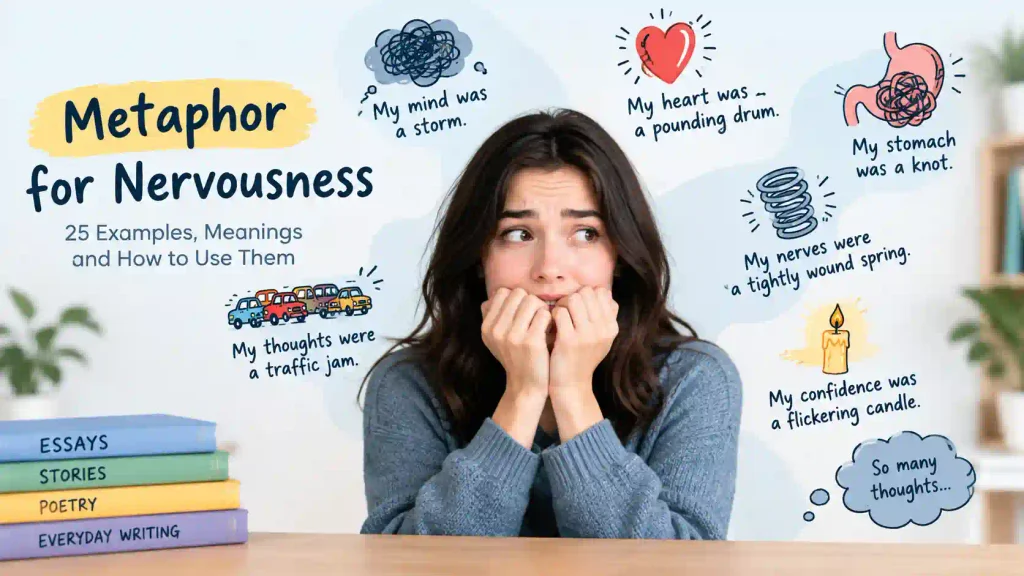
A metaphor for nervousness describes feelings of worry, tension, uncertainty, or anticipation by comparing them directly to something else. For example, “My stomach was a knot” expresses physical tension, while “My mind was a traffic jam” describes thoughts that feel crowded and difficult to organize. The best metaphor makes an invisible emotion easier to picture and helps readers understand exactly what a nervous person is experiencing.
What Is a Metaphor for Nervousness?
A metaphor for nervousness describes anxiety or uneasiness through a direct comparison. Examples include “My stomach was a knot,” “My mind was a storm,” and “My nerves were a tightly wound spring.” Each image communicates a different experience, from physical discomfort to racing thoughts and built-up tension. These expressions work in essays, stories, poems, speeches, and everyday conversation.
25 Best Metaphors for Nervousness
| Metaphor | Meaning |
| 1. My stomach was a knot. | Physical tension or uneasiness |
| 2. My mind was a storm. | Emotional turmoil and restless thoughts |
| 3. My nerves were a tightly wound spring. | Tension building before an important moment |
| 4. My thoughts were a traffic jam. | Too many thoughts competing for attention |
| 5. My heart was a pounding drum. | A strong, noticeable heartbeat |
| 6. My confidence was a flickering candle. | Confidence that feels fragile or uncertain |
| 7. My voice was a trembling thread. | Difficulty speaking steadily |
| 8. My courage was a shrinking shadow. | Confidence fading under pressure |
| 9. The interview was a tightrope. | A situation where every move feels risky |
| 10. My mind was a locked door. | Difficulty finding the right words or thoughts |
| 11. My stomach was a washing machine. | A churning, unsettled feeling |
| 12. My thoughts were loose papers in the wind. | Scattered attention and confusion |
| 13. The silence was a ticking clock. | Growing tension while waiting |
| 14. My body was a coiled wire. | Physical stiffness and readiness to react |
| 15. My confidence was a bridge in a storm. | Trying to remain steady under pressure |
| 16. My worries were a heavy backpack. | Carrying persistent mental pressure |
| 17. My mind was a maze without a map. | Feeling lost or unsure what to do |
| 18. My patience was a melting ice cube. | Calmness gradually disappearing |
| 19. My words were stones in my throat. | Struggling to speak because of nervousness |
| 20. My anticipation was a kettle nearing its whistle. | Excitement or tension building toward a moment |
| 21. My composure was a house of cards. | Calmness that could collapse easily |
| 22. My attention was a restless compass. | Difficulty focusing on one thing |
| 23. My nerves were live wires. | Feeling highly sensitive or easily startled |
| 24. My confidence was a boat leaving the shore. | Feeling less secure as a challenge approaches |
| 25. My thoughts were a room full of ringing phones. | Mental overload that makes concentration difficult |
Metaphors for Nervousness by Meaning and Situation
Nervousness can affect the body, disrupt thinking, weaken confidence, or make an ordinary situation feel unusually risky. These categories help you find a metaphor that matches the feeling you want to describe.
Metaphors for Physical Nervousness
Physical nervousness often appears through a racing heartbeat, a tense stomach, shaky hands, or difficulty speaking. Body-focused metaphors help readers picture those sensations instead of simply being told that a character feels anxious.
1. My Stomach Was a Knot
This familiar metaphor describes the tight, uncomfortable feeling that can accompany worry or anticipation.
Example: My stomach was a knot as I waited outside the principal’s office.
Best for: Exams, interviews, difficult conversations, and moments of uncertainty.
2. My Heart Was a Pounding Drum
This metaphor makes a strong heartbeat feel loud and almost impossible to ignore.
Example: As my name echoed through the auditorium, my heart became a pounding drum.
Best for: Public speaking, competitions, auditions, and high-pressure situations.
3. My Body Was a Coiled Wire
A coiled wire suggests stored tension. The person seems ready to react, even when nothing has happened yet.
Example: I sat in the waiting room with my body a coiled wire, listening for the doctor’s call.
Best for: Suspenseful scenes and situations that demand constant alertness.
4. My Words Were Stones in My Throat
This metaphor portrays nervousness as a barrier to speech. The words are there, but the speaker struggles to release them.
Example: When the interviewer asked about my biggest weakness, my words became stones in my throat.
Best for: Embarrassment, difficult questions, and emotionally charged conversations.
Metaphors for Racing Thoughts and Overthinking
Sometimes nervousness is less about physical shaking and more about thoughts that refuse to settle. These metaphors show what happens when the mind becomes crowded, confused, or distracted.
5. My Mind Was a Storm
A storm conveys mental turbulence and a feeling that thoughts are moving in several directions at once.
Example: Before the final exam, my mind was a storm of formulas, unfinished revision, and unanswered questions.
Best for: Worry, uncertainty, and emotionally intense scenes.
6. My Thoughts Were a Traffic Jam
A traffic jam captures the frustration of having too many thoughts competing for attention while useful thinking comes to a halt.
Example: My thoughts were a traffic jam, and I couldn’t decide which question to answer first.
Best for: Tests, interviews, deadlines, and decision-making.
7. My Mind Was a Maze Without a Map
This image suggests confusion and the fear of choosing the wrong direction.
Example: When the interviewer asked an unexpected question, my mind became a maze without a map.
Best for: Uncertainty, problem-solving, and characters who feel mentally lost.
8. My Thoughts Were Loose Papers in the Wind
Loose papers flying in different directions create a picture of attention that is difficult to control.
Example: During my presentation, my thoughts were loose papers in the wind, and I struggled to remember my next point.
Best for: Distracted thinking, nervous presentations, and creative writing.
Metaphors for Social Nervousness and Self-Consciousness
Social nervousness often involves worrying about how other people will respond. A person might fear saying something foolish, being judged, or attracting unwanted attention.
9. My Confidence Was a Flickering Candle
A flickering candle suggests confidence that remains present but struggles against uncertainty.
Example: My confidence was a flickering candle when I introduced myself to the new team.
Best for: First meetings, classroom participation, and unfamiliar social situations.
10. My Courage Was a Shrinking Shadow
This original metaphor shows courage becoming less noticeable as pressure grows.
Example: Standing before the audience, my courage was a shrinking shadow behind my growing doubts.
Best for: Speeches, auditions, and scenes involving self-doubt.
11. The Room Was a Spotlight
This metaphor makes a social setting feel as though all attention is focused on one person.
Example: When everyone turned toward me, the room became a spotlight, and I forgot my prepared introduction.
Best for: Public embarrassment, introductions, and performance anxiety.
12. My Voice Was a Trembling Thread
A thread is delicate and easy to disturb, making it a useful image for a voice that sounds uncertain or fragile.
Example: My voice was a trembling thread as I explained my idea to the panel.
Best for: Shy characters, difficult conversations, and nervous speakers.
Metaphors for Nervousness Before an Important Event
Waiting for an important moment can make tension build gradually. The following metaphors emphasize anticipation, risk, and the sense that something consequential is about to happen.
13. My Nerves Were a Tightly Wound Spring
A tightly wound spring stores tension and seems ready to release it. The metaphor suits someone trying to stay composed while anticipating a challenge.
Example: Minutes before the audition, my nerves were a tightly wound spring.
Best for: Competitions, interviews, performances, and important decisions.
14. The Silence Was a Ticking Clock
This image turns silence into a reminder that an important moment is approaching.
Example: While the judges reviewed our entries, the silence was a ticking clock.
Best for: Waiting rooms, examination results, and suspenseful scenes.
15. The Interview Was a Tightrope
A tightrope suggests that one small mistake might have serious consequences. It works especially well when a person feels pressure to choose every word carefully.
Example: The interview was a tightrope, and every answer felt like a step toward safety or failure.
Best for: Job interviews, negotiations, and high-stakes conversations.
16. My Anticipation Was a Kettle Nearing Its Whistle
A kettle nearing its whistle builds toward a release. This metaphor describes excitement and nervous energy gathering before an event.
Example: As the curtain remained closed, my anticipation was a kettle nearing its whistle.
Best for: Recitals, sports competitions, announcements, and performances.
Metaphors for Overwhelming Nervousness
When nervousness becomes difficult to manage, stronger images can communicate pressure, instability, and the struggle to remain calm. Choose these descriptions when a scene genuinely calls for greater intensity.
17. My Composure Was a House of Cards
A house of cards can collapse with a small disturbance. This metaphor shows how fragile someone’s outward calm feels.
Example: I smiled through the questions, but my composure was a house of cards.
Best for: Emotional tension, difficult interviews, and characters hiding their worry.
18. My Worries Were a Heavy Backpack
A heavy backpack represents the mental weight of concerns that accumulate over time.
Example: By the morning of the exam, my worries were a heavy backpack I couldn’t put down.
Best for: Ongoing stress, schoolwork, deadlines, and personal responsibilities.
19. My Nerves Were Live Wires
Live wires suggest heightened sensitivity and the possibility of an immediate reaction.
Example: After three sleepless nights, my nerves were live wires, and even a small interruption startled me.
Best for: Irritability, heightened tension, and suspenseful fiction.
20. My Confidence Was a Bridge in a Storm
A bridge in a storm suggests an effort to remain steady despite difficult conditions.
Example: My confidence was a bridge in a storm as I answered questions from the review panel.
Best for: Resilience, difficult conversations, and characters who continue despite uncertainty.
Short Metaphors for Nervousness
If you need a brief metaphor for a school assignment, caption, or line of dialogue, these options communicate nervousness without a long explanation.
- A knot of nerves — tension and uneasiness.
- A storm inside — emotional turmoil.
- A mind in gridlock — thoughts that cannot move forward.
- A fragile flame — uncertain confidence.
- A ticking silence — suspenseful anticipation.
- A coiled spring — restrained tension.
- A maze of doubts — confusion and uncertainty.
- A trembling thread — a fragile or shaky voice.
- A house of cards — unstable composure.
- A pressure cooker — tension building toward a release.
These are concise figurative expressions, not all fixed English idioms. Some are shortened versions of the original metaphors above.
Funny Metaphors for Nervousness
Humor works best when it makes ordinary nervous behavior recognizable without making the person seem foolish. These original metaphors suit informal writing, lighthearted stories, and playful social posts.
1. My Brain Was a Browser With Fifty Tabs Open
This metaphor describes overthinking when too many possibilities compete for attention.
Example: Before the interview, my brain was a browser with fifty tabs open, and every tab was playing a different song.
2. My Knees Were Two Unreliable Shopping Carts
The image makes shaky legs funny by comparing them to carts that refuse to move in a straight line.
Example: As I walked toward the stage, my knees were two unreliable shopping carts.
3. My Stomach Was a Washing Machine on Spin Cycle
This metaphor exaggerates the unsettled feeling that can accompany nervous anticipation.
Example: Five minutes before the results came out, my stomach was a washing machine on spin cycle.
4. My Confidence Was a Wi-Fi Signal in a Basement
The image describes confidence that keeps disappearing at exactly the wrong moment.
Example: I had rehearsed my introduction all week, but my confidence was a Wi-Fi signal in a basement.
5. My Thoughts Were Popcorn in a Microwave
This playful metaphor suggests that ideas and worries keep popping up faster than the person can manage them.
Example: When the teacher called on me unexpectedly, my thoughts were popcorn in a microwave.
Metaphors for Nervousness in a Sentence
Here are additional complete sentences showing how figurative language works in context.
- My stomach was a knot as I opened the envelope containing my exam results.
- Her mind was a storm while she waited to hear whether she had won the scholarship.
- His nerves were a tightly wound spring as the referee prepared to start the match.
- The classroom became a spotlight when the teacher asked me to speak.
- My thoughts were a traffic jam when the interviewer asked three questions at once.
- Her confidence was a flickering candle as she introduced herself to the unfamiliar audience.
- The silence was a ticking clock while we waited for the final announcement.
- His composure was a house of cards when the conversation took an unexpected turn.
- My words were stones in my throat when I tried to apologize.
- My brain was a browser with fifty tabs open as I rushed to prepare for the presentation.
Notice that each metaphor emphasizes a different aspect of nervousness. A knot conveys physical tension, a traffic jam conveys mental overload, and a flickering candle conveys uncertain confidence.
Sarcastic Metaphors for Nervousness
Sarcastic metaphors for nervousness use irony and exaggeration to make an uncomfortable moment sound amusing. They work well in humorous dialogue, casual writing, and social media captions, especially when a character tries to hide how nervous they really are.
1. My Confidence Has Left the Building
This sarcastic metaphor suggests that confidence disappeared just when it was needed most.
Example: I walked into the interview with a résumé in my hand and the confidence of someone whose confidence had left the building.
2. My Brain Has Filed for Emergency Leave
This expression humorously describes a mind that seems to stop cooperating under pressure.
Example: The teacher asked me a simple question, and my brain immediately filed for emergency leave.
3. My Nerves Are Hosting a Full-Blown Disaster Meeting
This metaphor exaggerates nervous thoughts as a meeting where every possible thing goes wrong.
Example: Before my presentation, my nerves were hosting a full-blown disaster meeting about everything I might forget.
4. I’m a Walking Public-Service Announcement About Panic
This sarcastic description pokes fun at someone whose nervous behavior is obvious to everyone around them.
Example: My hands were shaking, my voice was cracking, and I was a walking public-service announcement about panic.
5. My Calmness Is Doing an Excellent Impression of a Missing Person
This metaphor uses irony to show that the speaker is anything but calm.
Example: Everyone told me to relax before the results arrived, but my calmness was doing an excellent impression of a missing person.
Metaphors for Nervousness and Anxiety
Metaphors for nervousness and anxiety help describe uneasiness, persistent worry, and the feeling of anticipating something that might go wrong. The most useful image depends on whether the person feels briefly unsettled or weighed down by ongoing concerns.
1. My Mind Was a Storm
This metaphor describes thoughts that feel turbulent and difficult to settle.
Example: As the interview approached, my mind was a storm of questions and imagined mistakes.
2. My Worries Were a Heavy Backpack
This image portrays ongoing concerns as a weight that follows a person throughout the day.
Example: Every unfinished assignment added another book to the heavy backpack of my worries.
3. My Thoughts Were a Maze Without a Map
This metaphor expresses uncertainty and difficulty finding a clear way forward.
Example: As I considered every possible outcome, my thoughts became a maze without a map.
4. My Nerves Were a Tightly Wound Spring
This metaphor captures tension that builds while someone waits for an important event.
Example: I tried to sit still in the waiting room, but my nerves were a tightly wound spring.
5. My Worries Were Clouds Blocking the Sun
This original metaphor describes concerns that make it difficult to focus on the positive aspects of a situation.
Example: Even after receiving good news, my worries were clouds blocking the sun.
Choosing the right image: Use a storm for mental turmoil, a heavy backpack for accumulated concerns, a maze for uncertainty, and a tightly wound spring for anticipation. These images communicate different experiences rather than treating every kind of nervousness as identical.
Nervous Idioms and Phrases
Idioms and familiar expressions offer natural ways to describe nervousness in everyday English. Unlike original metaphors, idioms are established expressions that readers may already recognize.
1. Butterflies in My Stomach
Meaning: Feeling nervous or excited before an important event.
Example: I had butterflies in my stomach before stepping onto the stage.
2. On Edge
Meaning: Feeling tense, uneasy, or easily startled.
Example: I was on edge while waiting for the interview results.
3. Have the Jitters
Meaning: Feel nervous, restless, or shaky.
Example: I had the jitters before my first driving lesson.
4. Break Out in a Cold Sweat
Meaning: Suddenly begin sweating because of fear, worry, or stress.
Example: I broke out in a cold sweat when I realized I had left my notes at home.
5. Lose Your Nerve
Meaning: Become too frightened or uncertain to continue with something.
Example: I nearly lost my nerve before walking onto the stage.
6. Have Your Heart in Your Mouth
Meaning: Feel intense fear or suspense in a tense moment.
Example: My heart was in my mouth as the judges announced the winner.
7. Walk on Eggshells
Meaning: Act extremely carefully to avoid upsetting someone or causing a problem. This expression describes a tense situation rather than nervousness alone.
Example: I felt as though I were walking on eggshells during the difficult conversation.
8. Shake Like a Leaf
Meaning: Tremble noticeably because of fear or nervousness.
Example: I was shaking like a leaf while waiting to give my speech.
What Is an Idiom for Feeling Nervous?
One common idiom for feeling nervous is “have butterflies in your stomach.” It describes the fluttery, uneasy feeling that often appears before an interview, performance, exam, or other important event.
Other useful expressions include “on edge,” “have the jitters,” and “lose your nerve.” Choose “on edge” for general tension, “have the jitters” for restless nervousness, and “lose your nerve” when fear makes someone hesitate or abandon an intended action.
How to Choose the Right Metaphor for Nervousness
The most effective metaphor depends on what the character feels, what causes the nervousness, and how intense the moment is.
| Writing situation | Recommended metaphor | Why it works |
| Before an exam | My thoughts were a traffic jam. | Shows difficulty concentrating. |
| During a job interview | The interview was a tightrope. | Communicates pressure and fear of mistakes. |
| Before a public speech | My heart was a pounding drum. | Highlights physical nervousness. |
| Meeting new people | My confidence was a flickering candle. | Conveys insecurity without exaggerating it. |
| Waiting for results | The silence was a ticking clock. | Builds suspense and anticipation. |
| Writing an intense scene | My composure was a house of cards. | Suggests that calmness could collapse. |
| Writing a humorous scene | My brain was a browser with fifty tabs open. | Makes overthinking relatable and funny. |
| Describing persistent worries | My worries were a heavy backpack. | Emphasizes the weight of ongoing concerns. |
For Essays and School Assignments
Choose a clear metaphor that is easy to explain. “My stomach was a knot” is a useful example because the physical image directly communicates tension. Explain what the metaphor means rather than simply listing the phrase.
For Poetry and Fiction
Choose imagery that fits the character and atmosphere. A ticking clock can create suspense, while a fragile flame can convey uncertainty quietly. Original metaphors are particularly useful when familiar expressions feel too predictable.
For Everyday Conversation and Social Media
Keep the language natural and concise. “My brain is in gridlock” communicates confusion quickly, while “my confidence has left the building” offers a more playful tone.
For Emotional Writing
Match the metaphor to the specific emotion instead of automatically describing every nervous moment as a storm. A person who worries about judgment may need an image of exposure; someone who cannot organize their thoughts may need an image of congestion or confusion.
Metaphor vs. Simile for Nervousness
A metaphor describes one thing as another. A simile explicitly compares two things using like or as.
| Metaphor | Simile | Main difference |
| My stomach was a knot. | My stomach felt like a knot. | The metaphor makes a direct comparison; the simile uses “like.” |
| My mind was a storm. | My mind was like a storm. | Both convey turmoil, but the simile makes the comparison explicit. |
| My nerves were a tightly wound spring. | My nerves were like a tightly wound spring. | Both suggest tension, but the second uses “like.” |
| My confidence was a flickering candle. | My confidence was as fragile as a candle flame. | The simile uses “as” to express the comparison. |
| My thoughts were a traffic jam. | My thoughts moved like traffic in a jam. | The metaphor directly identifies the thoughts with a traffic jam; the simile describes their movement through comparison. |
The distinction matters in school assignments and literary analysis. If the prompt specifically asks for a metaphor, use the direct-comparison form rather than automatically adding like or as.
FAQ: Metaphor for Nervousness
1. What is the best metaphor for nervousness?
“My stomach was a knot” is a strong general-purpose choice because it communicates physical uneasiness in a simple, recognizable image. For racing thoughts, “my mind was a storm” may work better. The best option depends on the particular feeling you want to describe.
2. What are three examples of metaphors for nervousness?
Three examples are “my stomach was a knot,” “my thoughts were a traffic jam,” and “my nerves were a tightly wound spring.” They describe physical tension, mental overload, and built-up anticipation, respectively.
3. What is a short metaphor for nervousness?
“A knot of nerves,” “a storm inside,” and “a maze of doubts” are short figurative expressions. They work well in brief descriptions, captions, and creative writing.
4. What is a funny metaphor for nervousness?
“My brain was a browser with fifty tabs open” is a funny original metaphor for overthinking. It portrays a mind full of competing thoughts in a familiar, exaggerated way.
5. Is “butterflies in my stomach” a metaphor?
Yes. “Butterflies in my stomach” is a conventional figurative expression that describes nervous or excited sensations through the image of butterflies moving inside the stomach. It is also commonly discussed as an idiomatic expression. The butterflies are figurative, not literal.
6. What is the difference between nervousness and anxiety in figurative writing?
Nervousness often refers to uneasiness before a particular event, such as an interview or examination. Anxiety can describe worry that is broader or more persistent. In writing, a ticking clock may convey anticipation before a specific event, while a heavy backpack may suggest concerns that accumulate over time. These are useful literary distinctions, not clinical definitions.
Last Words Metaphor for Nervousness
A good metaphor for nervousness does more than replace the word nervous. It shows readers whether a person feels physically tense, mentally overwhelmed, socially exposed, or worried about what comes next.
Use “my stomach was a knot” for physical uneasiness, “my thoughts were a traffic jam” for overthinking, and “my confidence was a flickering candle” for self-doubt. For poetry and fiction, experiment with original images that fit the character and setting. The clearest metaphor is the one that captures the specific feeling without adding unnecessary drama.

Qaiser Abbas is an award-winning author, leadership coach, and motivational speaker known for his work on personal growth, leadership, and human potential. Through his writing and speaking, Qaiser focuses on turning challenges into opportunities and helping people build the mindset to achieve meaningful growth.