
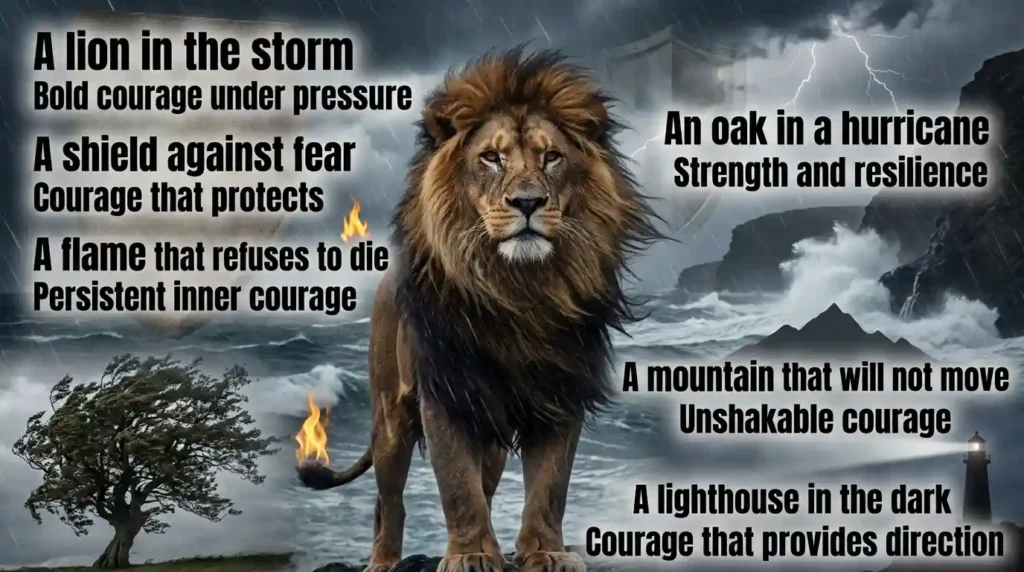
A metaphor for bravery describes courage by turning an abstract quality into a vivid image. Instead of simply saying someone is brave, you might describe that person as a lion, a shield, an oak tree in a storm, or a flame that refuses to go out. The best metaphor depends on the kind of bravery you want to express: bold action, inner strength, moral courage, resilience, or quiet determination.
Quick Answer
A strong metaphor for being brave is “a lion in the storm.” It suggests courage, strength, and the willingness to face danger without retreating. Other useful metaphors include “a shield against fear,” “an unquenchable flame,” “a mountain in the storm,” and “a compass in the dark.” Choose the image that matches the kind of bravery you want to describe.
Best Metaphors for Bravery
| Metaphor | Meaning | Tone | Best Use |
| A lion in the storm | Bold courage under pressure | Powerful | Fiction, speeches |
| A shield against fear | Courage that protects | Strong | Emotional writing |
| A flame that refuses to die | Persistent inner courage | Inspirational | Essays, poetry |
| An oak in a hurricane | Strength and resilience | Serious | Descriptive writing |
| A mountain that will not move | Unshakable courage | Grand | Speeches, fiction |
| A lighthouse in the dark | Courage that provides direction | Hopeful | Essays, reflective writing |
| An anchor in rough seas | Calm courage during uncertainty | Steady | Personal writing |
| A sword against fear | Courage used to confront danger | Bold | Action writing |
| A fortress of courage | Strong emotional defenses | Powerful | Fiction, speeches |
| A bridge over fear | Courage to move beyond uncertainty | Hopeful | Personal development |
| A torch in the darkness | Bravery that creates hope | Uplifting | Poetry, speeches |
| A backbone of steel | Firmness and resolve | Forceful | Character descriptions |
| A compass in a storm | Courage guided by purpose | Thoughtful | Essays, leadership writing |
| A warrior’s heart | Readiness to face hardship | Heroic | Fiction, motivational writing |
| A tree rooted in stone | Courage grounded in deep conviction | Poetic | Poetry, literary writing |
| A drumbeat in the darkness | Courage that keeps going despite fear | Dramatic | Stories, speeches |
| A spark in the cold | Small but persistent courage | Gentle | Emotional writing |
| A river cutting through rock | Courage that persists over time | Reflective | Essays, poetry |
| A door opened in the dark | Courage to enter uncertainty | Hopeful | Personal writing |
| A heartbeat beneath the armor | Courage that exists despite vulnerability | Emotional | Fiction, poetry |
1. A Lion in the Storm
This is one of the clearest images for bold bravery. The lion represents strength and confidence, while the storm represents danger, pressure, or uncertainty.
Example:
She stood like a lion in the storm, refusing to surrender to fear.
Best for: heroic characters, speeches, stories, and dramatic descriptions.
2. A Shield Against Fear
A shield represents protection. When bravery becomes a shield, the metaphor suggests that courage helps someone withstand fear rather than escape it.
Example:
His courage became a shield against fear when everything around him began to collapse.
Best for: emotional writing and descriptions of protective courage.
3. A Flame That Refuses to Die
Fire can represent inner energy, determination, and persistence. This metaphor works especially well when bravery continues despite repeated setbacks.
Example:
Her courage was a flame that refused to die, even after every setback.
Best for: essays, inspirational writing, and poetry.
4. An Oak in a Hurricane
An oak tree suggests stability, while a hurricane represents overwhelming pressure. Together, they create a strong image of someone who remains steady when circumstances become difficult.
Example:
He was an oak in a hurricane, bending under pressure but refusing to fall.
Best for: resilience and emotional bravery.
5. A Mountain That Will Not Move
A mountain suggests permanence and strength. This metaphor emphasizes courage that remains firm even when others try to shake a person’s confidence.
Example:
She stood as a mountain that would not move when everyone questioned her decision.
Best for: moral courage, determination, and strong character.
6. A Lighthouse in the Dark
A lighthouse does not remove the darkness; it provides direction through it. This makes it particularly useful for describing courage during uncertainty.
Example:
His courage was a lighthouse in the dark, helping the entire team move forward.
Best for: leadership, speeches, essays, and reflective writing.
7. An Anchor in Rough Seas
This metaphor focuses on calm rather than aggression. The anchor represents stability when circumstances become turbulent.
Example:
Her quiet courage was an anchor in rough seas.
Best for: quiet bravery, emotional strength, and supportive characters.
8. A Sword Against Fear
A sword represents confrontation and action. This metaphor works when bravery means actively facing something frightening.
Example:
His determination became a sword against fear.
Best for: dramatic fiction, speeches, and action-oriented writing.
9. A Fortress of Courage
A fortress suggests protection, strength, and resistance. Calling someone a fortress of courage presents bravery as something difficult to penetrate or destroy.
Example:
Even under intense pressure, she remained a fortress of courage.
Best for: character descriptions and powerful prose.
10. A Bridge Over Fear
A bridge connects two places. As a bravery metaphor, it represents the act of moving from fear toward action.
Example:
Courage became a bridge over fear, carrying him toward the decision he had avoided for months.
Best for: personal essays, reflective writing, and emotional narratives.
11. A Torch in the Darkness
A torch provides light where there is none. This metaphor presents bravery as something that helps people continue when circumstances feel uncertain.
Example:
Her courage was a torch in the darkness for everyone around her.
Best for: inspirational writing and speeches.
12. A Backbone of Steel
A backbone represents firmness and resolve. Steel intensifies the image by suggesting exceptional strength.
Example:
He had a backbone of steel when the pressure became unbearable.
Best for: determination, moral courage, and strong personalities.
13. A Compass in a Storm
This metaphor combines courage with direction. It works particularly well when someone remains guided by their values during a difficult situation.
Example:
Her principles were a compass in the storm, keeping her courageous when easier choices appeared.
Best for: moral courage and essays.
14. A Warrior’s Heart
The warrior traditionally represents someone prepared to face conflict and hardship. This metaphor emphasizes readiness and determination rather than literal combat.
Example:
She carried a warrior’s heart into every challenge.
Best for: fiction, motivational writing, and heroic descriptions.
15. A Tree Rooted in Stone
This original metaphor combines the endurance of a tree with the permanence of stone. It describes courage that has deep foundations.
Example:
His convictions were a tree rooted in stone; fear could shake the branches but never uproot him.
Best for: poetry, literary writing, and descriptions of moral courage.
16. A Drumbeat in the Darkness
A drumbeat continues even when visibility disappears. This metaphor represents courage that keeps moving forward without certainty.
Example:
Her courage was a drumbeat in the darkness, steady when everything else felt uncertain.
Best for: poetry, storytelling, and emotional writing.
17. A Spark in the Cold
Not every act of bravery looks enormous. A spark can represent a small but persistent source of courage.
Example:
Even after the rejection, a spark of bravery remained inside him.
Best for: quiet courage and personal reflection.
18. A River Cutting Through Rock
A river does not need to overpower rock instantly. Its strength comes from persistence.
Example:
His courage was a river cutting through rock, patient enough to overcome resistance.
Best for: perseverance, long-term challenges, and essays.
19. A Door Opened in the Dark
This metaphor focuses on the uncertainty that often accompanies brave decisions. Opening the door means choosing action without knowing exactly what lies ahead.
Example:
Taking that opportunity felt like opening a door in the dark.
Best for: personal essays, life transitions, and reflective writing.
20. A Heartbeat Beneath the Armor
Armor suggests protection, while a heartbeat suggests vulnerability. Together, they show that bravery does not require the absence of fear or vulnerability.
Example:
Beneath her confident smile was a heartbeat beneath the armor, still afraid but willing to continue.
Best for: emotional fiction and nuanced descriptions of courage.
Metaphors for Different Kinds of Bravery
Not all bravery looks the same. Choosing the image according to the kind of courage you mean can make your writing much more precise.
Bold or Fearless Bravery
Use images such as:
- A lion in the storm
- A sword against fear
- A warrior’s heart
- A mountain that will not move
These work when someone actively confronts danger or opposition.
Quiet Bravery
For courage that does not seek attention, softer metaphors work better:
- A spark in the cold
- An anchor in rough seas
- A heartbeat beneath the armor
- A lighthouse in the dark
These images show that courage can exist without dramatic action.
Moral Courage
Moral courage involves standing by a principle when doing so carries social or personal pressure.
Useful metaphors include:
- A compass in a storm
- A mountain that will not move
- A backbone of steel
- A tree rooted in stone
The focus here is not physical danger but conviction.
Resilient Courage
When bravery means continuing after setbacks, choose metaphors based on endurance:
- A flame that refuses to die
- A river cutting through rock
- An oak in a hurricane
- A drumbeat in the darkness
These images emphasize persistence rather than sudden boldness.
What Is a Metaphor for Being Brave?
A metaphor for being brave describes a person or their courage through another image without making a literal comparison.
For example:
“She was a lion in the storm.”
The person is not literally a lion. The lion represents qualities such as courage, strength, and boldness, while the storm represents the difficult circumstances she faces.
A useful bravery metaphor should do more than replace the word brave. It should tell the reader what kind of bravery the person demonstrates.
What Are 5 Metaphor Examples for Bravery?
Here are five simple examples:
- His courage was a shield against fear.
- She was a lion in the storm.
- Her bravery was a flame that refused to die.
- He stood like a mountain that would not move.
- Their courage was a lighthouse in the darkness.
Each creates a different image. The shield emphasizes protection, the lion emphasizes boldness, the flame emphasizes persistence, the mountain emphasizes stability, and the lighthouse emphasizes guidance.
What’s a Fancy Word for Bravery?
Several more formal words can describe bravery, but they carry slightly different meanings.
- Valor — great courage, especially in dangerous or heroic situations.
- Fortitude — courage and endurance during pain, difficulty, or prolonged hardship.
- Intrepidity — fearless courage, especially in the face of danger.
- Gallantry — brave or heroic behavior, often associated with daring action.
- Daring — willingness to take risks.
- Audacity — boldness that can suggest a willingness to challenge normal limits.
- Fearlessness — absence or apparent absence of fear.
- Grit — courage and determination to keep going through difficulty.
If you want one formal word that sounds especially literary, fortitude works well when the bravery involves enduring hardship over time. Valor is more strongly associated with great courage in dangerous situations.
What Is a Famous Quote About Bravery?
One of the best-known passages associated with courage comes from Theodore Roosevelt’s 1910 speech “Citizenship in a Republic,” delivered at the Sorbonne in Paris.
The passage describes a person who enters the arena, struggles, makes mistakes, and continues to act despite the possibility of failure. Its famous closing idea describes someone who “fails while daring greatly.”
That image works almost like an extended metaphor for bravery: courage means stepping into the arena rather than remaining safely outside it.
What Is an Idiom That Describes Bravery?
One especially useful idiom is “take the bull by the horns.”
It means to deal with a difficult situation directly and courageously. The image is powerful because the expression turns confrontation into a physical picture: instead of avoiding the problem, you face it head-on.
Example:
After months of avoiding the conversation, Maya decided to take the bull by the horns and address the problem.
Another useful expression is “have the courage of one’s convictions.” It describes acting according to your beliefs even when others disagree.
What Is a Metaphor for Strong?
A metaphor for being strong can overlap with a metaphor for bravery, but the two ideas are not identical.
For example:
“She is an oak tree in a storm.”
This can describe emotional strength, resilience, or bravery.
Other strength metaphors include:
- A mountain — stability and endurance
- Iron — toughness and determination
- A fortress — resistance and protection
- An anchor — reliability and stability
- A rock — dependability
- Steel — toughness and resolve
The key difference is that strength describes the ability to withstand or exert force, while bravery focuses on facing fear, danger, uncertainty, or difficulty.
Metaphor vs. Simile for Bravery
A metaphor directly identifies one thing with another:
She was a lion in the storm.
A simile makes the comparison explicit with like or as:
She was as brave as a lion.
Both can describe courage, but they create slightly different effects. The metaphor is more direct and often feels more vivid, while the simile openly signals the comparison.
If a teacher asks specifically for a metaphor, avoid turning the answer into a list of “like” or “as” comparisons.
Which Bravery Metaphor Should You Choose?
Use the metaphor that matches the feeling you want the reader to experience.
- For an essay: choose “a compass in a storm” or “a bridge over fear.”
- For poetry: try “a spark in the cold” or “a heartbeat beneath the armor.”
- For fiction: use “a lion in the storm,” “a warrior’s heart,” or “an oak in a hurricane.”
- For a speech: “a lighthouse in the dark” or “a mountain that will not move” can communicate courage clearly.
- For quiet emotional bravery: choose “an anchor in rough seas” or “a flame that refuses to die.”
The strongest metaphor is not necessarily the most dramatic one. It is the one that expresses the exact kind of courage your sentence needs.
Frequently Asked Questions
What is a good metaphor for bravery?
A strong metaphor for bravery is “a lion in the storm.” It presents courage as the strength to face danger or pressure without retreating. Other useful metaphors include “a shield against fear,” “a flame that refuses to die,” and “a mountain that will not move.”
What is a metaphor for being brave?
A metaphor for being brave can be “a lighthouse in the dark.” It suggests that a brave person continues to provide direction and hope even when circumstances are uncertain. For bold courage, “a lion in the storm” works especially well.
What is a fancy word for bravery?
Common formal words for bravery include valor, fortitude, courage, intrepidity, and fearlessness. Valor often suggests heroic courage, while fortitude emphasizes the ability to endure hardship with courage.
What is an idiom that describes bravery?
“Take the bull by the horns” is an idiom that describes facing a difficult situation directly and courageously. Another useful expression is “have the courage of one’s convictions,” which means acting according to your beliefs even when others disagree.
What is a metaphor for strong?
A common metaphor for strength is “an oak tree in a storm.” It suggests stability, resilience, and the ability to withstand pressure. Other examples include “a mountain,” “a fortress,” “an anchor,” and “a backbone of steel.”
What is the difference between a metaphor and a simile for bravery?
A metaphor makes a direct comparison, such as “She was a lion in the storm.” A simile uses “like” or “as,” such as “She was as brave as a lion.” Both can describe courage, but a metaphor presents the comparison more directly.
Final Thought
A good metaphor for bravery does more than make the word brave sound impressive. It gives courage a shape the reader can see.
A lion can represent boldness. A lighthouse can represent guidance. An anchor can represent steadiness. A flame can represent persistence. A mountain can represent unshakable conviction.
The most effective choice depends on the story behind the courage. Sometimes bravery charges into the storm. Sometimes it simply keeps burning in the dark.

Qaiser Abbas is an award-winning author, leadership coach, and motivational speaker known for his work on personal growth, leadership, and human potential. Through his writing and speaking, Qaiser focuses on turning challenges into opportunities and helping people build the mindset to achieve meaningful growth.