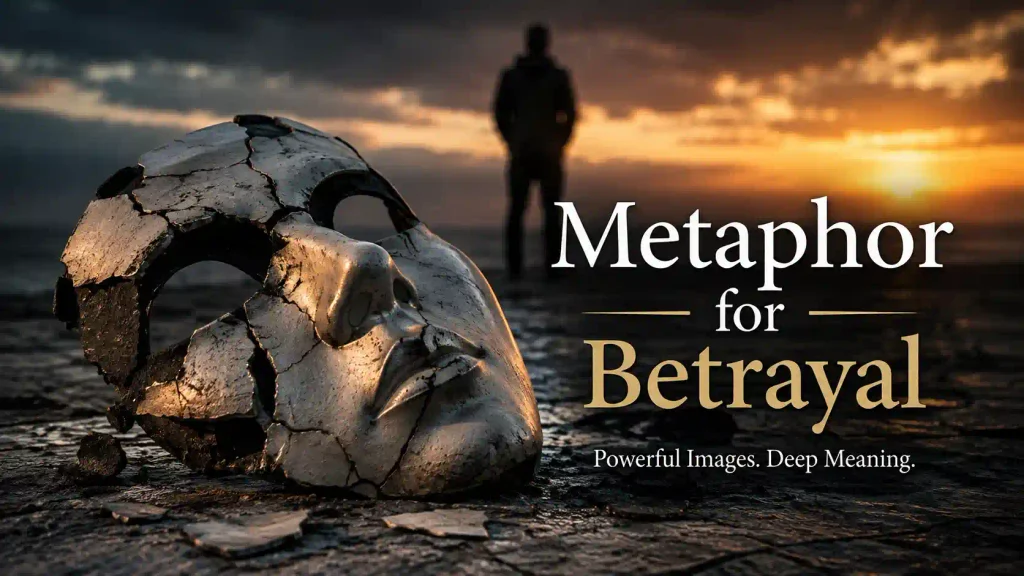
The best metaphor for betrayal depends on what you want to express. A knife in the back captures sudden disloyalty, a cracked foundation suggests damaged trust, and a poisoned gift points to harm hidden behind apparent kindness. For quieter emotional damage, images such as a shattered mirror or a wound beneath the skin can be more effective.
What are fancy words for betrayal?
A strong metaphor for betrayal turns an abstract experience—such as broken trust, deception, abandonment, or disloyalty—into a concrete image. Useful examples include a knife in the back, a cracked foundation, a poisoned gift, a shattered mirror, a burned bridge, and a false lighthouse. The right choice depends on whether you want to emphasize shock, deception, emotional damage, or the end of a relationship.
The Best Metaphors for Betrayal at a Glance
| Metaphor | What it expresses | Tone | Best use |
| A knife in the back | Sudden disloyalty | Sharp, painful | General writing |
| A cracked foundation | Damaged trust | Serious, reflective | Relationships, essays |
| A poisoned gift | Hidden harm | Deceptive, unsettling | Fiction, poetry |
| A shattered mirror | A changed view of someone | Sad, reflective | Poetry, personal writing |
| A burned bridge | A relationship damaged beyond easy return | Final, decisive | Breakups, conflict |
| A false lighthouse | Misleading guidance from someone trusted | Betrayed, reflective | Fiction, essays |
| A trapdoor beneath friendship | Sudden collapse of trust | Shocking | Creative writing |
| A wound beneath the skin | Hidden, lasting pain | Quiet, emotional | Poetry, memoir |
| A borrowed key used against you | Abuse of trust or access | Personal, violating | Stories, essays |
| A fault line beneath the floor | Hidden problems exposed by betrayal | Tense, serious | Fiction, analysis |
1. A Knife in the Back
Established expression
A knife in the back represents a sudden act of disloyalty from someone you trusted. The image works because the attack comes from a direction where you expected safety rather than danger.
Example:
Her decision to reveal his secret felt like a knife in the back after years of friendship.
Best when: the betrayal was unexpected and the shock matters most.
This is one of the most recognizable betrayal expressions, so it is effective when clarity matters more than originality.
2. A Cracked Foundation
Original metaphor
A cracked foundation represents trust that has been damaged at its base. The relationship may still appear intact, but its stability has changed.
Example:
That one lie put a crack in the foundation of their marriage.
Best when: you want to show that betrayal affects the stability of a relationship rather than simply causing one moment of pain.
This is particularly useful for essays and reflective writing because it suggests that rebuilding may require more than an apology.
3. A Poisoned Gift
Established-style figurative expression
A poisoned gift represents something that looks kind, helpful, or valuable but contains hidden harm.
Example:
His offer of help was a poisoned gift; accepting it gave him access to everything she wanted to protect.
Best when: betrayal involves manipulation, hidden motives, or false kindness.
This metaphor focuses on deception before discovery, rather than the emotional aftermath.
4. A Shattered Mirror
Common metaphorical image
A shattered mirror can represent the way betrayal changes how you see another person, a relationship, or even your own memories.
Example:
After the truth came out, their entire friendship looked like a shattered mirror—familiar pieces, but no longer one whole image.
Best when: you want to emphasize emotional reflection, changed perception, or the difficulty of seeing the past the same way again.
This is especially effective in poetry and literary writing.
5. A Burned Bridge
Established expression
A burned bridge represents a relationship or connection that has been damaged so severely that returning to the previous relationship may no longer be possible.
Example:
Sharing her private messages burned the bridge between them.
Best when: the betrayal has created distance, separation, or finality.
Unlike “a knife in the back,” this metaphor focuses less on the moment of betrayal and more on what the betrayal leaves behind.
6. A False Lighthouse
Original metaphor
A false lighthouse represents someone who appears to guide you toward safety but actually leads you toward danger.
Example:
I trusted his advice for years, never realizing he was a false lighthouse guiding me toward the rocks.
Best when: the betrayer was a mentor, partner, friend, leader, or anyone whose guidance you trusted.
This is a stronger choice than a generic betrayal metaphor when the betrayal involved misdirection.
7. A Trapdoor Beneath Friendship
Original metaphor
A trapdoor beneath friendship represents a relationship that suddenly collapses when you discover that the trust beneath it was never as secure as you believed.
Example:
Her confession felt like a trapdoor beneath a friendship I thought could hold my weight.
Best when: the betrayal is sudden and destabilizing.
The image gives the reader a physical sense of the emotional shock: one moment you are standing securely, and the next the ground disappears.
8. A Wound Beneath the Skin
Original metaphor
A wound beneath the skin represents emotional pain that remains largely invisible to other people.
Example:
Years later, his betrayal was still a wound beneath the skin of their friendship.
Best when: the betrayal continues to affect someone long after the event.
This works particularly well when you want a quieter alternative to violent images such as knives and daggers.
9. A Borrowed Key Used Against You
Original metaphor
A borrowed key represents access you willingly gave someone. When that person uses it to hurt you, the image becomes a metaphor for trust being turned against its owner.
Example:
I gave her the key to my confidence, and she used it to open every door I had tried to keep closed.
Best when: the betrayal involves secrets, vulnerability, privacy, or personal information.
This metaphor is especially useful because it describes how the betrayal happened rather than simply saying that it hurt.
10. A Fault Line Beneath the Floor
Original metaphor
A fault line beneath the floor represents hidden instability that may exist beneath an apparently healthy relationship.
Example:
The affair was the earthquake, but years of dishonesty had already created a fault line beneath their marriage.
Best when: betrayal exposes problems that existed before the final incident.
This makes it useful for fiction and analytical writing because it allows you to distinguish between the betrayal itself and the conditions that made the relationship vulnerable.
More Metaphors for Betrayal
If you need additional imagery, these options cover different shades of meaning without simply repeating the same knife-and-glass imagery.
A Mask Falling Away
Meaning: The betrayal reveals a person’s previously hidden intentions.
Example:
When the truth emerged, his kindness seemed like a mask falling away.
Best for: deception and discovering someone’s true character.
A Bridge Collapsing Behind You
Meaning: The relationship becomes difficult or impossible to return to.
Example:
Her betrayal felt like a bridge collapsing behind me; there was no easy way back.
Best for: irreversible separation.
Rust in the Bond
Meaning: Small acts of dishonesty gradually weaken a relationship.
Example:
Every half-truth added another layer of rust to their bond.
Best for: betrayal that develops over time rather than happening in one dramatic moment.
A Thread Cut in the Dark
Meaning: A relationship is quietly severed through an act of betrayal.
Example:
His silence felt like a thread cut in the dark.
Best for: subtle, understated emotional writing.
A Door Locked From the Other Side
Meaning: Someone has shut you out of a relationship or emotional connection.
Example:
After the betrayal, forgiveness felt like standing before a door locked from the other side.
Best for: abandonment, exclusion, and emotional distance.
A House With Rotten Beams
Meaning: A relationship looked strong but contained hidden weaknesses.
Example:
The betrayal revealed a house with rotten beams beneath its polished walls.
Best for: stories where the betrayal exposes deeper problems.
Which Metaphor for Betrayal Should You Use?
The best choice depends on the specific feeling you want your reader to experience.
For sudden betrayal
Choose “a knife in the back” if you want a familiar, immediately understandable image.
Choose “a trapdoor beneath friendship” if you want something more original and dramatic.
For broken trust
Choose “a cracked foundation.”
It suggests that the relationship still exists, but its basic stability has been compromised.
For deception
Choose “a poisoned gift.”
It works when something presented as kindness or help actually conceals harmful intentions.
For lasting emotional pain
Choose “a wound beneath the skin.”
It emphasizes the difference between visible recovery and internal damage.
For a relationship that may be over
Choose “a burned bridge.”
It emphasizes the loss of a path back rather than the pain of the betrayal itself.
For betrayal involving guidance or manipulation
Choose “a false lighthouse.”
It suggests that the person you trusted did not merely hurt you—they directed you toward harm.
For subtle or poetic writing
Choose “a thread cut in the dark.”
It is quieter and less familiar than the conventional knife metaphor.
Betrayal, Deception, and Broken Trust Are Not Exactly the Same
These ideas overlap, but they are not interchangeable.
Betrayal focuses on a violation of loyalty, trust, or an important relationship.
Deception focuses on hiding or misrepresenting the truth.
Disloyalty focuses on failing to remain faithful to someone or something.
Broken trust focuses on the consequence: you no longer feel safe relying on someone.
That distinction can help you choose a more precise metaphor.
For example:
- Deception: a poisoned gift
- Sudden disloyalty: a knife in the back
- Damaged trust: a cracked foundation
- Lasting emotional pain: a wound beneath the skin
- Permanent separation: a burned bridge
This is why there is no single “best” metaphor for betrayal. The strongest image depends on what part of betrayal you are actually describing.
Metaphor vs. Simile for Betrayal
A metaphor directly identifies one thing with another.
His betrayal was a knife in my back.
A simile makes the comparison explicitly with words such as “like” or “as.”
His betrayal felt like a knife in my back.
Both can work, but metaphors often feel more direct because the image becomes part of the statement rather than being introduced as a comparison.
Common Mistakes When Writing Betrayal Metaphors
Using too many violent images
Knives, daggers, wounds, and arrows are familiar betrayal imagery. They can work, but repeating them makes the writing predictable.
Try architecture, nature, navigation, light, objects, or physical connections when they better match the emotion.
Choosing a metaphor that does not match the situation
A burned bridge suggests finality.
A cracked foundation suggests damage that may still be repairable.
A poisoned gift suggests concealed danger.
Choose the image according to the meaning you want to communicate.
Mixing too many metaphors
Avoid writing:
Her betrayal stabbed my heart, cracked the foundation, burned the bridge, and shattered the mirror of our friendship.
Each metaphor can work independently, but together they compete for attention.
One precise image is usually stronger.
Explaining the metaphor too much
Once the image is clear, let the reader interpret part of it.
A metaphor becomes weaker when every detail is immediately explained.
FAQs About Metaphors for Betrayal
What is a good metaphor for betrayal?
A good metaphor depends on the type of betrayal. “A knife in the back” works for sudden disloyalty, “a cracked foundation” for damaged trust, and “a poisoned gift” for hidden deception.
What is a metaphor for broken trust?
“A cracked foundation” is a strong metaphor for broken trust because a foundation supports everything built above it. A crack suggests that the relationship may still stand but is no longer as secure as it was.
What is a metaphor for betrayal in a relationship?
For a relationship, “a cracked foundation,” “a shattered mirror,” and “a burned bridge” can work well. Choose based on whether you want to emphasize damaged stability, changed perception, or separation.
What is a metaphor for someone who betrayed you?
“A knife in the back” is a familiar expression for someone who betrays you unexpectedly. For a more original description, you could call that person “a false lighthouse” if they gained your trust by appearing to guide or protect you.
Can I use these metaphors in an essay?
Yes. For formal or academic writing, choose metaphors that clarify an idea rather than simply intensifying emotion. “A cracked foundation” can be more appropriate than highly dramatic imagery because it communicates the effect of damaged trust clearly.
What is a poetic metaphor for betrayal?
For poetry, quieter images can be effective. “A thread cut in the dark,” “a wound beneath the skin,” and “a shattered mirror” can communicate betrayal without relying on familiar violent imagery.
Final Takeaway
There is no single perfect metaphor for betrayal. The strongest choice depends on what you want to show: shock, deception, broken trust, emotional damage, abandonment, or final separation.
Use “a knife in the back” for sudden disloyalty, “a poisoned gift” for hidden deception, “a cracked foundation” for damaged trust, and “a burned bridge” when the relationship has been pushed toward an ending. If you want something more original, build your own metaphor around the specific quality of the betrayal rather than reaching automatically for familiar images.

Qaiser Abbas is an award-winning author, leadership coach, and motivational speaker known for his work on personal growth, leadership, and human potential. Through his writing and speaking, Qaiser focuses on turning challenges into opportunities and helping people build the mindset to achieve meaningful growth.