
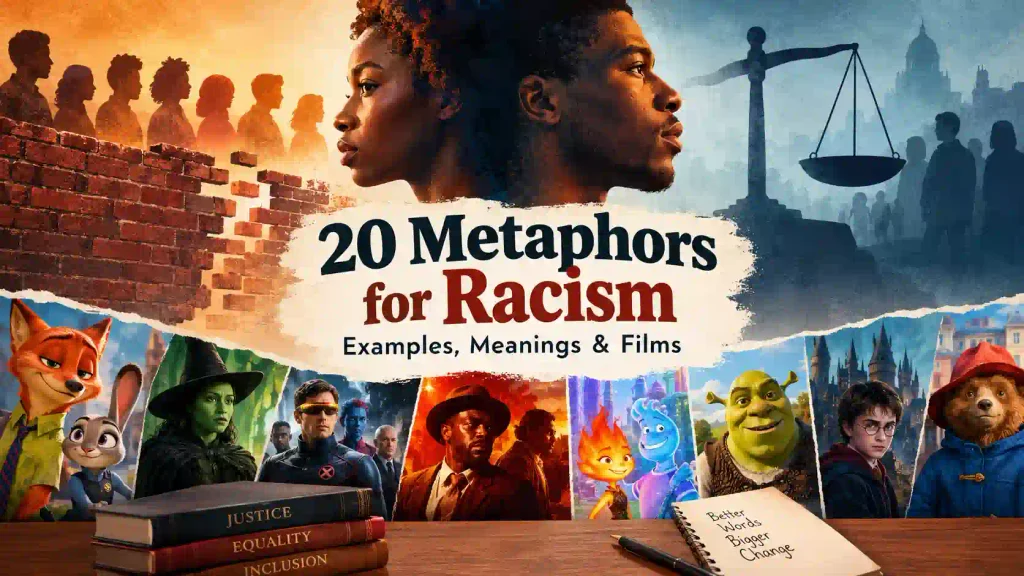
A metaphor for racism compares racial prejudice or discrimination to something people can picture, such as a locked door, an invisible cage, or a wall between communities. These comparisons help explain how racism creates barriers, reinforces stereotypes, and limits opportunities. They can also help readers understand how films, books, poems, and stories explore prejudice and social exclusion.
The best metaphor for racism depends on what you want to communicate. A wall can represent racial division, a tilted scale can symbolize unequal treatment, and an invisible cage can illustrate restrictions created by systemic barriers.
Quick Answer: What Is a Metaphor for Racism?
A metaphor for racism describes racial injustice through a figurative comparison. For example, “Racism is an invisible cage” suggests that prejudice and discriminatory systems can restrict people’s opportunities even when no physical barrier exists. Other useful examples include a wall of exclusion, a rigged playing field, and a poisoned foundation. Each metaphor highlights a different aspect of racism, from interpersonal prejudice to institutional inequality.
20 Powerful Metaphors for Racism
| Metaphor | Meaning | Best use |
| A wall between people | Racism separates communities and creates distrust. | Social division |
| An invisible cage | Discriminatory systems restrict freedom and opportunity. | Systemic racism |
| A poisoned foundation | Racist assumptions undermine institutions. | Institutional racism |
| A rigged playing field | People face unequal conditions and opportunities. | Education and employment |
| A locked door | Discrimination blocks access to opportunities. | Exclusion |
| A chain around progress | Racism restricts advancement. | Social inequality |
| A shadow over society | Racism continues to influence everyday life. | Persistent prejudice |
| A cracked mirror | Stereotypes distort how people see others. | Representation and identity |
| A fire fed by prejudice | Bias can grow into more harmful actions. | Escalating discrimination |
| A stain on justice | Racism compromises fairness. | Law and public institutions |
| A tree with diseased roots | Deep-seated assumptions damage connected systems. | Structural racism |
| A bridge with missing planks | Equality remains incomplete when support is absent. | Inclusion and access |
| A blindfold over truth | Denial prevents people from recognizing injustice. | Awareness and accountability |
| A tilted scale | Similar situations may receive unequal treatment. | Justice and fairness |
| A revolving door of exclusion | People encounter recurring barriers despite apparent progress. | Institutional reform |
| A burden passed down | The effects of past injustice can persist across generations. | Historical inequality |
| A maze with unequal maps | People have different access to information and support. | Unequal opportunity |
| A silenced microphone | Racism can suppress people’s voices. | Representation |
| A fog over the facts | Misinformation and stereotypes obscure understanding. | Media and public discourse |
| A locked gate guarded by prejudice | Bias prevents people from accessing resources or opportunities. | Discrimination |
Metaphors for Different Types of Racism
Racism can involve individual attitudes, discriminatory behavior, institutional practices, and broader social structures. Choosing a metaphor that matches the particular problem makes an argument more precise.
1. An Invisible Cage: A Metaphor for Systemic Racism
Racism is an invisible cage that restricts people’s opportunities.
An invisible cage represents barriers that limit people’s choices without appearing as physical restrictions. These barriers may result from interconnected policies, practices, and unequal access to resources.
Example: An invisible cage of systemic racism can restrict access to education, stable housing, and career opportunities.
This metaphor works well in essays about systemic racism because it emphasizes how multiple barriers can operate together.
2. A Wall Between People: A Metaphor for Racial Prejudice
Racism is a wall that divides people before they have a chance to understand one another.
A wall represents separation, distrust, and assumptions that prevent people from building relationships across racial differences.
Example: Racism built a wall between the communities, turning their differences into reasons for suspicion.
Use this metaphor when discussing segregation, social exclusion, or interpersonal prejudice.
3. A Poisoned Foundation: A Metaphor for Institutional Racism
Racism is a poisoned foundation beneath an otherwise impressive building.
A building may appear stable while its foundation undermines its structure. Similarly, an institution may present itself as fair while some of its policies or established practices produce unequal outcomes.
Example: The organization could not achieve genuine equality while racist assumptions remained embedded in its foundation.
This comparison is especially useful when analyzing workplaces, schools, government, and other institutions.
4. A Rigged Playing Field: A Metaphor for Unequal Opportunity
Racism is a rigged playing field where some people must overcome obstacles that others never face.
A fair competition requires meaningful access to opportunities and consistent rules. A rigged playing field suggests that the conditions themselves favor certain participants.
Example: Discriminatory hiring practices turned the job market into a rigged playing field for qualified applicants.
Use this metaphor when discussing employment, education, promotion, or unequal access to resources.
5. A Locked Door: A Metaphor for Discrimination
Racism is a locked door standing between qualified people and opportunity.
A locked door represents exclusion from something that should be accessible.
Example: Despite her qualifications, racial discrimination left a locked door between her and the career she wanted to pursue.
This image works well in discussions of hiring, housing, education, and access to services.
6. A Tree With Diseased Roots: A Metaphor for Structural Racism
Racism is a tree whose diseased roots weaken every branch.
The roots represent underlying assumptions and structures, while the branches represent the different areas of society they can affect.
Example: If discriminatory assumptions remain at the roots of a school system, changing a few classroom rules may not solve the deeper problem.
This metaphor helps readers distinguish surface-level changes from deeper structural reform.
7. A Tilted Scale: A Metaphor for Unequal Justice
Racism is a tilted scale that weighs the same actions differently depending on who performs them.
A scale symbolizes fairness and judgment. When it tilts, the outcome becomes unbalanced.
Example: A tilted scale of racial bias can undermine trust when similar conduct receives different treatment.
Use this comparison in essays about justice, disciplinary decisions, and unequal treatment. Support factual claims with evidence rather than relying on the metaphor alone.
8. A Burden Passed Down: A Metaphor for Historical Injustice
Racism is a burden passed from one generation to the next.
This metaphor describes how the consequences of past discrimination can persist through inherited disadvantages, unequal resources, and continuing institutional barriers.
Example: The community continued to carry a burden passed down through generations of discriminatory housing policies.
The image is useful for historical analysis and discussions of intergenerational inequality, but it should not imply that every individual has the same experience.
9. A Cracked Mirror: A Metaphor for Racist Stereotypes
Racism is a cracked mirror that distorts how society sees people.
A cracked mirror changes the reflection. Likewise, racial stereotypes can distort perceptions of individuals, reducing them to assumptions about their backgrounds.
Example: Racist stereotypes turned the public conversation into a cracked mirror, reflecting prejudice instead of people’s actual lives.
This metaphor works well for media analysis, identity, and representation.
10. A Fire Fed by Prejudice: A Metaphor for Escalating Racism
Racism is a fire that grows when prejudice supplies the fuel.
Fire represents the potential for harm to spread. The fuel represents biased assumptions, discriminatory actions, and the tolerance of injustice.
Example: Every unchallenged racist remark added fuel to the fire, allowing hostility to spread through the workplace.
Use this comparison to explain escalation without implying that the people targeted by racism are responsible for stopping it.
11. A Shadow Over Society: A Metaphor for Persistent Racism
Racism is a shadow that follows society even when people claim to have moved beyond it.
A shadow represents something that remains present in the background.
Example: Although the policy had changed, the shadow of racism remained in the institution’s everyday decisions.
This metaphor is useful for reflective essays and writing about the persistence of inequality.
12. A Chain Around Progress: A Metaphor for Restricted Advancement
Racism is a chain that holds back progress.
A chain limits movement. Here, it represents discriminatory practices that prevent individuals or communities from accessing opportunities on equal terms.
Example: Discriminatory barriers became a chain around progress, restricting students from reaching their potential.
Use it when discussing education, employment, and social mobility.
13. A Stain on Justice: A Metaphor for Corrupted Fairness
Racism is a stain on the promise of justice.
A stain marks something that should be clean. In this comparison, racism compromises the fairness that public and legal institutions are meant to uphold.
Example: When racial prejudice influences a decision, it leaves a stain on justice and weakens public trust.
This metaphor suits persuasive essays and speeches about fairness and accountability.
14. A Bridge With Missing Planks: A Metaphor for Incomplete Equality
Racism is a bridge with missing planks, making equal opportunity difficult to reach.
A bridge connects people to a destination, but missing planks make the journey harder.
Example: A school cannot promise equal opportunity while its bridge to advanced education has missing planks for some students.
This metaphor is useful for discussions of educational access, inclusion, and institutional support.
15. A Blindfold Over Truth: A Metaphor for Racial Denial
Racism is a blindfold that prevents society from seeing its own inequalities.
A blindfold represents an inability or unwillingness to acknowledge what is happening.
Example: Refusing to investigate repeated complaints placed a blindfold over the truth about discrimination in the workplace.
Use this metaphor to discuss denial or avoidance rather than assuming that everyone who disagrees is acting in bad faith.
16. A Revolving Door of Exclusion: A Metaphor for Repeated Barriers
Racism is a revolving door that returns people to the same barriers despite apparent progress.
This image describes situations in which reforms produce limited improvements but leave deeper obstacles intact.
Example: Without changes to its underlying practices, the organization became a revolving door of exclusion, repeating the same inequalities under new policies.
It is particularly useful for analyzing institutional reform.
17. A Maze With Unequal Maps: A Metaphor for Unequal Access
Racism is a maze in which some people receive clear maps while others must find their way through obstacles alone.
A maze represents complexity, while unequal maps represent differences in access to information, networks, resources, and institutional support.
Example: Students faced a maze of barriers when guidance and educational opportunities were not equally accessible.
This metaphor shows how individual effort and surrounding conditions can both influence outcomes.
18. A Silenced Microphone: A Metaphor for Suppressed Voices
Racism is a silenced microphone that keeps important experiences out of public conversation.
A microphone represents the ability to speak and be heard. Silencing it suggests exclusion from decision-making, representation, or public debate.
Example: When the committee repeatedly dismissed the experiences of racial minorities, it became a silenced microphone rather than a forum for meaningful discussion.
This image works well for journalism, public speaking, and discussions of representation.
19. A Fog Over the Facts: A Metaphor for Misinformation
Racism is a fog that obscures the facts and makes stereotypes appear convincing.
Fog reduces visibility. This metaphor describes how misinformation, selective reporting, and racial assumptions can make it harder to understand an issue accurately.
Example: Sensationalized reporting created a fog over the facts, allowing racial stereotypes to replace careful analysis.
Use it for media literacy and critical essays.
20. A Locked Gate Guarded by Prejudice: A Metaphor for Exclusion
Racism is a locked gate guarded by prejudice, preventing qualified people from reaching opportunities.
The gate represents access, while the guard represents biased attitudes or discriminatory practices that prevent entry.
Example: Prejudice stood at the gate of opportunity, excluding applicants whose qualifications deserved fair consideration.
This metaphor emphasizes that exclusion can be actively maintained by people or policies.
Is Zootopia a Metaphor for Racism?
Yes, Zootopia can be interpreted as a metaphor for racism, racial stereotypes, and implicit bias. The 2016 animated film depicts a society in which predators and prey live together, yet fear and assumptions about certain animals influence how they treat one another.
Its central metaphor is a city divided by prejudice. Although animals share public spaces, stereotypes affect trust, employment, safety, and social acceptance.
Example: In Zootopia, fear of predators illustrates how stereotypes can turn assumptions about an entire group into unfair judgments about individuals.
The allegory has limits. Fictional animal species do not perfectly correspond to human racial categories, and the film’s treatment of prejudice can be interpreted in different ways. A strong analysis should consider both the film’s anti-bias message and what its fictional divisions leave out.
Is Wicked a Metaphor for Racism?
Wicked can be interpreted as a metaphor for racism, scapegoating, and the persecution of marginalized people. Elphaba’s treatment illustrates how appearance and perceived difference can become reasons for exclusion. The story also raises questions about who controls public narratives and whose voices society believes.
The central metaphor is a green face turned into a social barrier. Elphaba’s visible difference becomes a reason for others to judge her before understanding her actions.
Example: Elphaba’s treatment illustrates how prejudice can transform a person’s difference into a supposed threat.
The story can also support discussions of political propaganda, ableism, and social conformity. These interpretations overlap but are not identical, and Elphaba’s experience should not be treated as a direct representation of every form of racial discrimination.
Is X-Men a Metaphor for Racism?
The X-Men stories are widely interpreted as allegories for prejudice, discrimination, and fear of marginalized groups. Mutants possess abilities that distinguish them from other people, and society often responds with suspicion, exclusion, and hostility.
The central metaphor is mutation as a mark of unwanted difference. Mutants are frequently judged by their group identity rather than their individual actions.
Example: The discrimination faced by mutants in X-Men acts as a metaphor for racism because society turns difference into a reason to deny people acceptance and equal treatment.
Is the X-Men Racism Metaphor Dated?
Some aspects of the X-Men allegory can feel incomplete when viewed through contemporary discussions of race. The mutant-versus-human conflict explores prejudice and exclusion, but fictional powers and mutant identity do not reproduce the history, institutions, or lived experiences associated with real-world racial discrimination.
The metaphor remains useful when readers examine who gets labeled dangerous, why some communities demand conformity, and how fear shapes public attitudes. It becomes less convincing when mutant discrimination is treated as an exact equivalent of racism.
Is Sinners a Metaphor for Racism?
Ryan Coogler’s 2025 film Sinners can be interpreted as an allegory of racial oppression, cultural appropriation, and the struggle to preserve Black cultural identity. Set in the Jim Crow-era American South, the film places Black community, music, and creative expression at the center of a supernatural horror story.
One interpretive metaphor is a vampire feeding on another community’s life. This image can suggest exploitation in which one party takes cultural value or power from another while ignoring the cost.
Example: The supernatural predation in Sinners can be interpreted as a metaphor for exploitation that consumes a community’s cultural gifts without respecting its history or autonomy.
The film supports several interpretations, so it is better to describe this as a reading of its symbolism than to claim that every vampire or plot event represents one specific historical phenomenon.
Is Elemental a Metaphor for Racism?
Pixar’s Elemental (2023) can be interpreted as a metaphor for racism, xenophobia, cultural difference, and the immigrant experience. Its characters belong to different elemental communities, and social expectations influence how they interact, where they feel welcome, and whom they are expected to accept.
The central metaphor is fire and water learning to share the same city. Their differences represent assumptions that separate communities, while their relationship challenges the idea that people from different backgrounds cannot understand one another.
Example: Elemental uses the relationship between fire and water as a metaphor for overcoming prejudice and building connections across cultural differences.
The film also explores family, identity, and love. Its elemental categories should not be treated as literal equivalents of human races.
Is Shrek a Metaphor for Racism?
Shrek can be interpreted as a story about prejudice, social exclusion, and the rejection of people who do not fit society’s standards. Shrek’s appearance causes others to fear him before they understand his character.
The central metaphor is an outsider trapped behind society’s walls. His experience challenges the assumption that someone who looks different must be dangerous or unworthy of acceptance.
Example: Shrek’s rejection illustrates how prejudice can turn physical difference into a social barrier.
The film is not exclusively about racism; it also explores appearance, belonging, and self-acceptance. Its relevance to racism depends on how viewers connect its themes of exclusion to real-world racial discrimination.
Is Disney’s Zombies a Metaphor for Racism?
Disney’s Zombies franchise can be interpreted as a metaphor for prejudice, segregation, and social integration. Its fictional communities are divided by differences between zombies and humans, and those divisions influence relationships, acceptance, and access.
The central metaphor is a divided school learning to share its space. The school setting makes exclusion visible through everyday rules, peer relationships, and social expectations.
Example: The conflict between zombies and humans can be read as a metaphor for how communities enforce social boundaries against groups they consider different.
The comparison is useful for discussing belonging, particularly with younger audiences. However, zombie identity is not equivalent to racial identity, and the franchise also explores individuality and conformity.
Is Paddington a Metaphor for Racism?
Paddington can be interpreted as a story about immigration, xenophobia, and the treatment of outsiders. Paddington arrives in Britain from Peru and must navigate an unfamiliar society. His experiences invite viewers to consider how newcomers are treated and how kindness can challenge suspicion.
The central metaphor is a stranger searching for a place to call home.
Example: Paddington’s journey can serve as a metaphor for the immigrant experience, showing how an unfamiliar newcomer may face suspicion before finding acceptance.
The comparison is strongest when discussing belonging, hospitality, and prejudice against outsiders. Immigration and racial discrimination are related topics, but they are not interchangeable, and Paddington’s story is not a complete account of either.
Squares as a Metaphor for Racism
A square can serve as an original metaphor for a rigid social system that expects everyone to fit the same boundaries. In writing about racism, squares might represent rules or expectations that exclude people who do not conform to a dominant group’s standards.
Example: The community had become a grid of rigid squares, leaving little room for people who challenged its racial expectations.
This is an interpretive metaphor, not a universally established symbol of racism. If “squares” refers to a specific film, artwork, poem, or online reference, its meaning should be evaluated in that context.
Harry Potter as a Metaphor for Racism
The Harry Potter series can be interpreted as a metaphor for racism through its depiction of blood-status prejudice. Some witches and wizards treat people with non-magical ancestry as inferior, using family background to determine who deserves respect and power.
The central metaphor is blood purity as a false measure of human worth. It exposes how people use ancestry and inherited identity to create social hierarchies.
Example: The blood-status hierarchy in Harry Potter acts as a metaphor for racism because it uses ancestry to justify discrimination.
The comparison also connects to inherited privilege, class prejudice, and ideological extremism. Magical ancestry is not identical to real-world race, but the series offers a framework for discussing how ideas of purity can justify exclusion and oppression.
What Does “Wool Pooh” Mean as a Metaphor for Racism?
The phrase “wool pooh” is unclear as written, and it should not be presented as an established metaphor without identifying its source. It may refer to a misspelled phrase, a character, a book, an artwork, or an online discussion.
If the intended reference is Winnie-the-Pooh, the character is not inherently a metaphor for racism. A particular adaptation or interpretation could explore prejudice, but that claim would require evidence from the specific work.
For accurate publication, identify the original source before assigning a racial meaning to this phrase.
Dated Metaphors for Racism in the 1960s
Writing about racism in the 1960s requires attention to the language and historical context of the civil rights movement. Images of walls, chains, barriers, and unequal scales can communicate segregation, restrictions on freedom, and unequal treatment.
However, these metaphors are not necessarily unique to the 1960s. It would be inaccurate to describe one as a standard expression of that decade without a historical source.
Example: In a historical essay, a wall of segregation can represent the legal and social barriers that restricted Black Americans’ rights and opportunities.
When analyzing a specific speech, poem, or political text from the 1960s, use the original wording and explain its historical context rather than assuming a modern metaphor was widely used at the time.
Racism as a Recipe: What Are Its Ingredients?
Racism is a recipe in which prejudice, stereotypes, unequal power, and discrimination can combine to produce injustice.
This original metaphor compares racism to a harmful recipe. Its ingredients represent factors that can reinforce one another, while the finished dish represents the resulting harm.
| Metaphorical ingredient | What it represents |
| Prejudice | Negative attitudes or assumptions about a racial group |
| Stereotypes | Oversimplified beliefs about people based on race |
| Discrimination | Unfair treatment based on racial identity |
| Unequal power | The ability to enforce or maintain unequal conditions |
| Institutional barriers | Policies or practices that disadvantage racial groups |
Example: When prejudice, unequal power, and discriminatory practices combine, they can become ingredients in a recipe for systemic racism.
This is a teaching device, not a scientific formula. Racism has multiple forms and causes, and these factors do not always appear in the same combination.
What Are the Four Elements of Racism?
There is no single universally accepted framework consisting of exactly four elements of racism. Different educational and academic frameworks organize the subject in different ways.
For a straightforward explanatory model, four connected dimensions are:
- Prejudice: Negative attitudes or assumptions about people based on race.
- Stereotyping: Generalizing characteristics or behavior to an entire racial group.
- Discrimination: Treating people unfairly because of their racial identity.
- Structural inequality: Policies, practices, or institutional arrangements that contribute to unequal outcomes.
These categories overlap, but they help distinguish individual attitudes from actions and broader systems. This is a practical explanatory framework rather than a definitive four-part scientific classification.
Example: A stereotype may encourage prejudice, prejudice may influence discriminatory behavior, and institutional practices may reinforce unequal outcomes. This sequence is one possible way these dimensions interact, not an automatic process.
What Is a Fancy Word for Racism?
The best alternative depends on the meaning you want to communicate.
| Term | Meaning and use |
| Racial prejudice | Biased attitudes or assumptions about a racial group |
| Racial discrimination | Unfair treatment based on race |
| Racial bigotry | Strong, intolerant prejudice based on race |
| Systemic racism | Racism operating through interconnected institutions, policies, and practices |
| Institutional racism | Racial disadvantage produced or maintained within an institution |
| Racial bias | A tendency to favor or judge people based on race |
| Racial hierarchy | A system that ranks racial groups unequally |
| Xenophobia | Fear or hostility toward people perceived as foreign; related to, but not synonymous with, racism |
For an academic essay, racial discrimination is often the most precise term when discussing unfair treatment. Use systemic racism when discussing interconnected social structures and racial prejudice when the focus is on attitudes.
What Are Five Metaphor Examples for Racism?
Here are five concise examples suitable for a school essay or classroom assignment.
- Racism is an invisible cage. It represents barriers that restrict people’s opportunities.
- Racism is a wall between people. It illustrates separation and social exclusion.
- Racism is a tilted scale. It symbolizes unequal treatment and unfair judgment.
- Racism is a poisoned foundation. It represents harmful assumptions embedded in institutions.
- Racism is a locked door. It illustrates exclusion from opportunities and resources.
Each example highlights a different aspect of racism. Choose the one that best fits your argument rather than using several images to repeat the same point.
What Is a Famous Quote About Racism?
A widely cited statement by Martin Luther King Jr. expresses the importance of judging people by their character rather than their skin color:
“not by the color of their skin but by the content of their character”
This excerpt comes from King’s 1963 “I Have a Dream” speech. It expresses a vision of a society in which racial identity does not determine how a person is valued or treated.
The statement is relevant to metaphors for racism. Because it provides an ethical principle against which images of exclusion, prejudice, and unequal treatment can be examined. For academic writing, consult the full speech to preserve the quotation’s context.
Racism Metaphor Poem: A Wall We Did Not Need
A wall rose high between our doors,
Built from old fears and silent laws.
Each brick was shaped by words untrue,
By judgments made before we knew.
A tilted scale, a locked-up gate,
A thousand ways to separate.
Yet every wall can lose its hold
When truth is heard and hearts grow bold.
No skin should set a person’s worth,
No prejudice define their birth.
Let fairness be the ground we share,
And build a world with room for care.
This original poem uses a wall, a tilted scale, and a locked gate to represent division, unequal treatment, and exclusion.
Metaphor vs. Simile: What’s the Difference?
A metaphor directly describes one thing as another to create a comparison. A simile makes the comparison explicit with words such as like or as.
| Metaphor | Simile |
| Racism is a wall between people. | Racism is like a wall between people. |
| Prejudice is a fire fed by fear. | Prejudice spreads like a fire fed by fear. |
| Racism is an invisible cage. | Racism is like an invisible cage. |
| Discrimination is a tilted scale. | Discrimination is like a tilted scale. |
Both forms can communicate the same general idea. A metaphor often sounds more direct, while a simile makes the comparison explicit. Choose the form that fits your writing.
How Metaphors Help Explain Racism
Metaphors make an abstract social problem easier to picture, but their value goes beyond vivid language.
- They clarify complex systems. An invisible cage or diseased-root metaphor can help readers understand how multiple barriers work together.
- They communicate emotional effects. Images such as shadows and chains convey the persistence or weight of discrimination.
- They support critical thinking. A rigged playing field invites readers to examine whether opportunities are genuinely equal.
- They make writing memorable. A precise metaphor can help readers remember an argument.
However, metaphors also influence how people interpret a problem. Writers should direct the comparison toward discriminatory behavior, unfair structures, or harmful assumptions—not toward the people affected by racism.
Frequently Asked Questions
What is a good metaphor for racism?
“Racism is an invisible cage” is a strong metaphor for systemic racism because it illustrates how unfair rules and structures can restrict people’s opportunities without creating visible physical barriers. For social division, “a wall between people” may be more appropriate.
What symbolizes racism?
There is no single universal symbol for racism. Walls can represent segregation, chains can represent restrictions on freedom, and tilted scales can represent unequal treatment. Their meanings depend on the context and how the images are used.
What is a metaphor for racial discrimination?
“Racial discrimination is a locked door” is a useful metaphor because it represents exclusion from opportunities based on racial bias. For example: “Discrimination became a locked door between qualified applicants and fair employment.”
What is a metaphor for systemic racism?
“Systemic racism is an invisible cage” conveys how interconnected policies, institutional practices, and social barriers can restrict opportunity. The metaphor works best when accompanied by specific examples of the systems or practices being discussed.
How do you describe racism metaphorically in an essay?
Identify the particular problem you want to explain, select a comparison that fits it, and follow the metaphor with a concrete example. For instance: “Racism is a rigged playing field; when hiring decisions favor one racial group, applicants do not compete under equal conditions.” This connects figurative language to a clear argument.
Conclusion
A strong metaphor for racism helps readers understand a particular dimension of racial injustice. A wall communicates division, a locked door conveys exclusion, a tilted scale highlights unequal treatment, and an invisible cage illustrates systemic restrictions.
Popular stories such as Zootopia, X-Men, Wicked, Elemental, and Harry Potter offer additional ways to examine prejudice, social exclusion, and the consequences of treating difference as a threat. These interpretations are most useful when writers explain both the connection and its limitations.
The goal is not simply to find a dramatic comparison. It is to choose language that clarifies the problem, supports a meaningful argument, and respects the difference between fictional allegory and real-world experiences of racism.

Qaiser Abbas is an award-winning author, leadership coach, and motivational speaker known for his work on personal growth, leadership, and human potential. Through his writing and speaking, Qaiser focuses on turning challenges into opportunities and helping people build the mindset to achieve meaningful growth.