
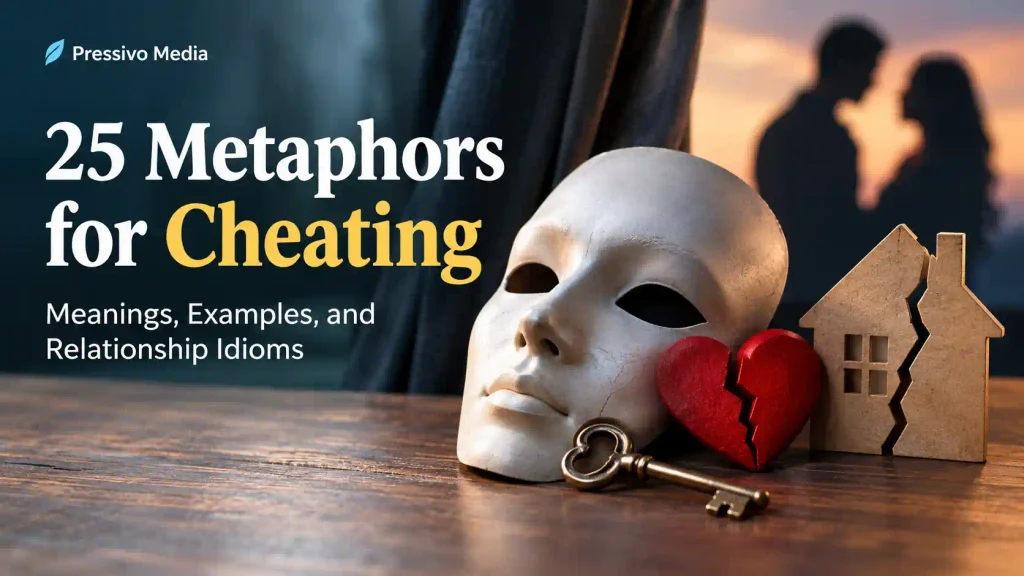
A metaphor for cheating describes dishonesty, infidelity, or betrayal through a vivid comparison. Cheating can be portrayed as a rigged game, a stolen key, or a crack in a foundation, depending on whether you want to emphasize unfairness, violated trust, or emotional damage. The best metaphor captures a specific aspect of deception rather than simply repeating that someone was unfaithful.
Powerful metaphor for cheating
A powerful metaphor for cheating is “a rigged game.” It suggests that someone secretly breaks the rules while allowing another person to believe the situation is fair. In a relationship, “a stolen key” can symbolize violated trust, while “a house built on lies” suggests that a relationship rests on deception. Each image communicates a different aspect of infidelity or dishonesty.
25 Metaphors for Cheating
The following metaphors describe different aspects of cheating, from secrecy and unfairness to broken trust and emotional pain. Each includes a meaning and an example sentence to help you use it naturally.
Metaphors for Deception and Secrecy
1. A Mask of Loyalty
A mask conceals a person’s real face. This metaphor describes someone who appears devoted while hiding behavior that contradicts their promises.
Example: “His promises of loyalty were a mask hiding the truth about his second relationship.”
2. A Stolen Key
A key represents access, privacy, and trust. A stolen key suggests crossing an intimate boundary without respecting the other person’s expectations.
Example: “Her secret affair felt like a stolen key that opened a door I thought was protected.”
3. A House Built on Lies
A house needs a stable foundation. When a relationship depends on deception, its apparent stability rests on something unreliable.
Example: “Their future looked promising, but the house was built on lies.”
4. A Double Game
A double game describes someone who maintains conflicting positions or deceives people about their intentions. In a relationship, it suggests pretending to be committed while secretly pursuing someone else.
Example: “She was playing a double game, making promises at home while hiding another relationship.”
5. A Curtain Over the Truth
A curtain conceals what lies behind it. This image emphasizes deliberate secrecy and the difference between what someone reveals and what they hide.
Example: “Every reassuring explanation became another curtain over the truth.”
Metaphors for Broken Trust and Betrayal
6. A Bridge Collapsing Midway
A bridge connects two separate places. Its collapse represents the sudden loss of connection and security between partners.
Example: “When I learned about the affair, it felt as though our bridge had collapsed halfway across the river.”
7. A Crack in the Foundation
A foundation supports an entire structure. A crack represents a serious weakness in the trust that supports a relationship.
Example: “The lies created a crack in the foundation of their marriage.”
8. A Contract Torn in Half
A contract represents an agreement and its obligations. Tearing it symbolizes breaking a commitment that both partners expected to honor.
Example: “The affair felt like a contract torn in half after years of shared promises.”
9. A Compass Spinning Without Direction
A compass provides direction. When it spins without settling, it represents the confusion that can follow betrayal, when a person no longer knows what to believe.
Example: “After the revelation, my sense of direction spun like a compass near a magnet.”
10. A Garden Full of Hidden Weeds
A garden may look healthy while weeds grow unnoticed. This metaphor represents problems concealed beneath an apparently happy relationship.
Example: “Their relationship looked peaceful, but resentment and dishonesty had become hidden weeds.”
Metaphors for Unfairness and Self-Interest
11. A Rigged Game
A rigged game is arranged to favor one side unfairly. It describes cheating that deprives others of an honest chance, whether in a competition or a relationship.
Example: “The relationship felt like a rigged game: I followed our agreements while he secretly ignored them.”
12. A Loaded Die
A loaded die is designed to produce an unfair advantage. It symbolizes someone who manipulates a situation while pretending to follow the same rules as everyone else.
Example: “She entered the competition with a loaded die, using dishonest methods to secure the prize.”
13. A Shortcut Through Someone Else’s Effort
This image describes gaining an advantage by bypassing the work, rules, or commitments that others respect. It suits cheating on exams, copying work, or dishonest competition.
Example: “Copying the answers was a shortcut through someone else’s effort.”
14. A Mirror With Two Reflections
A mirror with two reflections symbolizes conflicting versions of the same person: the trustworthy image presented publicly and the concealed behavior revealed later.
Example: “His behavior was a mirror with two reflections: the devoted partner everyone saw and the stranger I discovered.”
15. A Crown Made of Borrowed Gold
A crown suggests achievement or status, while borrowed gold suggests that the apparent success does not truly belong to the person wearing it.
Example: “The award was a crown made of borrowed gold; she had copied the work that earned it.”
Metaphors for the Emotional Consequences of Cheating
16. A Wound Beneath the Surface
An emotional wound may remain painful even when a person appears calm. This metaphor emphasizes the lingering effects of betrayal.
Example: “Months after the breakup, the betrayal remained a wound beneath the surface.”
17. A Shadow Over a Happy Memory
A shadow obscures something bright. It represents how discovering infidelity can change the way someone remembers earlier moments in a relationship.
Example: “The truth cast a shadow over every anniversary we had celebrated.”
18. A Poisoned Well
A well provides water, but poison makes it unsafe. This image suggests that dishonesty has contaminated a source of comfort or emotional security.
Example: “Once the lies came to light, even our simplest conversations felt like water from a poisoned well.”
19. A House With No Doors
A house without doors suggests confinement and a lack of easy escape. It can represent the emotional trap of remaining in a relationship where trust has disappeared.
Example: “After months of excuses and doubt, the relationship felt like a house with no doors.”
20. A Photograph With the Faces Scratched Out
A photograph preserves memories, but scratched-out faces make those memories painful or difficult to recognize. This image captures the feeling of looking back at a relationship that no longer means the same thing.
Example: “The old vacation pictures became photographs with the faces scratched out, preserving moments I no longer understood.”
Metaphors for Repeated Cheating and Escalating Deception
21. A Treadmill of Broken Promises
A treadmill keeps moving without carrying someone forward. This image describes a repeating cycle of apologies, promises, and renewed dishonesty without meaningful progress.
Example: “Their reconciliation became a treadmill of broken promises, with every apology leading back to the same behavior.”
22. A Leak Behind the Wall
A hidden leak causes damage before anyone sees it. This metaphor suggests that secretive behavior can gradually undermine a relationship before the full truth emerges.
Example: “The hidden affair was a leak behind the wall, quietly damaging the relationship long before anyone noticed.”
23. A House of Cards
A house of cards is fragile and can collapse when one part fails. It represents a situation that appears stable but depends on precarious assumptions or deception.
Example: “His elaborate excuses formed a house of cards that collapsed when the messages surfaced.”
24. A Fire Fed by Secrets
Fire grows when it receives fuel. This image suggests that continued deception can intensify conflict and deepen the consequences of cheating.
Example: “Every new lie became fuel for a fire fed by secrets.”
25. A Compass With a Broken Needle
A compass with a broken needle cannot reliably guide its user. Here, it represents a loss of moral direction or a refusal to honor agreed commitments.
Example: “His repeated dishonesty revealed a compass with a broken needle, pointing wherever his self-interest led.”
Cheating Metaphor at a Glance
| Metaphor | Meaning | Best use |
| A mask of loyalty | Hidden behavior behind apparent devotion | Secret infidelity |
| A stolen key | Violated privacy or trust | Relationship betrayal |
| A house built on lies | A relationship founded on deception | Essays and fiction |
| A crack in the foundation | Damaged trust | Relationship discussions |
| A rigged game | Unfairness and broken rules | General cheating |
| A wound beneath the surface | Lasting emotional pain | Emotional writing |
| A treadmill of broken promises | Repeated dishonesty without change | Recurring relationship problems |
| A house of cards | Fragile stability that can collapse | Exposing deception |
Idioms for Cheating in a Relationship
Idioms are established expressions whose meanings may differ from their literal wording. Some refer directly to infidelity, while others describe deception or betrayal more broadly.
| Idiom or expression | Meaning | Example |
| Two-time someone | Secretly maintain another romantic or sexual relationship | “He two-timed his partner for months.” |
| Play both sides | Try to benefit from opposing sides while concealing one’s position | “She tried to play both sides rather than be honest about her intentions.” |
| Stab someone in the back | Betray someone who trusts you | “The affair felt like a stab in the back.” |
| Lead someone on | Encourage romantic interest without being honest about your intentions | “He led her on while pursuing another relationship.” |
| Live a lie | Maintain a life or appearance built around deception | “She felt she had been living a lie.” |
| Pull the wool over someone’s eyes | Deceive someone so they fail to see the truth | “He thought he could pull the wool over her eyes.” |
| Get caught red-handed | Be discovered while doing something wrong | “He was caught red-handed sending romantic messages.” |
| Play dirty | Use dishonest or unfair tactics | “He played dirty rather than compete fairly.” |
| Cross the line | Go beyond an accepted boundary | “They disagreed about whether the messages crossed the line.” |
| Keep someone in the dark | Deliberately withhold important information | “She kept her partner in the dark about the affair.” |
Not every expression is a direct synonym for infidelity. For example, lead someone on describes misleading romantic expectations, while play dirty can refer to almost any unfair behavior. Choose an expression that matches the situation.
What Can I Say Instead of Cheating?
The best alternative depends on whether you want a neutral description, a direct accusation, or a figurative expression.
| Alternative | Best use |
| Infidelity | Formal or relationship-focused discussion |
| Unfaithfulness | Describing a breach of romantic commitment |
| Betrayal | Emphasizing broken trust |
| Deception | Emphasizing dishonesty |
| Dishonesty | A broad description of untruthful behavior |
| Two-timing | Informal description of secret romantic involvement with another person |
| Academic dishonesty | Exams, assignments, and schoolwork |
| Rule-breaking | Games, competitions, and regulations |
| Playing a double game | Conflicting actions and concealed intentions |
What’s a fancy word for cheating? Infidelity is a formal word for unfaithfulness in a romantic relationship. Duplicity describes deliberate double-dealing or deceit, while fraud refers to deception used to gain an unfair or unlawful advantage in relevant contexts. These words are related, but they are not interchangeable.
How to Describe Cheating Without Making an Unsupported Accusation
When you suspect a partner of cheating, vivid language can express your feelings, but it cannot establish what happened. A metaphor should describe your experience, not substitute for evidence.
For example:
- Instead of “You’re definitely living a double life,” say, “Some things you’ve told me don’t seem consistent, and I need an honest explanation.”
- Instead of “You’re a snake in the grass,” say, “I feel that my trust has been damaged, and I want to understand what happened.”
- Instead of “I know you’re cheating because you’re acting differently,” say, “I’ve noticed a change in our communication, and I’m worried about what it means.”
These alternatives leave room for an honest conversation without treating uncertainty as proof.
Frequently Asked Questions About Metaphors for Cheating
What is a metaphor for cheating?
A metaphor for cheating describes dishonesty or infidelity through an image that communicates its meaning. For example, “a rigged game” suggests unfairness, while “a crack in the foundation” represents damaged trust in a relationship.
What is a good metaphor for cheating on someone?
“A mask of loyalty” is a strong metaphor for cheating on someone because it suggests that a person appears faithful while concealing contradictory behavior. For a more emotional description, “a wound beneath the surface” expresses the lasting pain that betrayal can cause.
What can I say instead of cheating?
Depending on the context, you can use infidelity, unfaithfulness, betrayal, or deception. Infidelity specifically refers to unfaithfulness in a romantic relationship, while betrayal emphasizes the violation of trust. For academic dishonesty, terms such as plagiarism or academic misconduct may be more precise.
What is a fancy word for cheating in a relationship?
Infidelity is a formal term for unfaithfulness in a romantic relationship. Duplicity describes deliberate deception or double-dealing, making it useful when someone conceals their true intentions. The best choice depends on whether you want to emphasize unfaithfulness or dishonesty.
What is cheating paranoia?
Cheating paranoia is an informal expression for persistent fear or suspicion that a partner is being unfaithful, sometimes without clear evidence. Past betrayal, insecurity, or uncertainty about relationship boundaries can contribute to these feelings. Suspicion alone does not prove infidelity; separating observable facts from assumptions can help clarify the situation.
What is the best way to confront a partner you suspect of cheating?
Choose a private, calm setting if you feel safe, describe the specific behavior that concerns you, and ask direct questions. For example: “I’ve noticed some things that concern me, and I need an honest explanation.” Avoid treating suspicion as proof, and consider your emotional and physical safety before initiating the conversation.
Conclusion
The most effective metaphor for cheating reveals the particular kind of dishonesty or pain you want to describe. A rigged game communicates unfairness, a stolen key suggests violated trust, and a wound beneath the surface conveys lingering hurt. Familiar idioms work well in everyday conversation, while original metaphors can give essays, poems, and stories a more distinctive voice.
Choose language that expresses the situation accurately. Strong imagery can make betrayal easier to describe, but clear communication matters more than dramatic wording.

Qaiser Abbas is an award-winning author, leadership coach, and motivational speaker known for his work on personal growth, leadership, and human potential. Through his writing and speaking, Qaiser focuses on turning challenges into opportunities and helping people build the mindset to achieve meaningful growth.